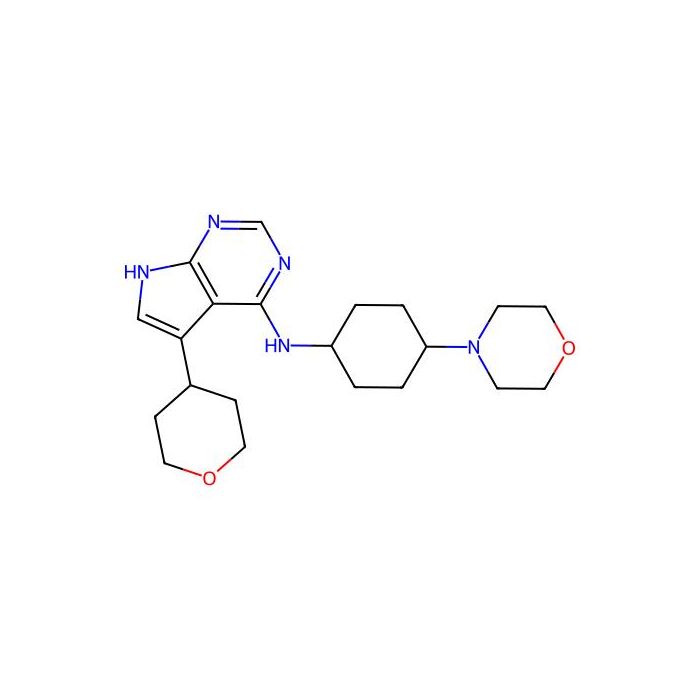
AZ1495 - 10mM in DMSO , CAS No.2196204-23-4

CAS: 2196204-23-4 Cat. No.: A654894 Formule: C21H31N5O2 Poids moléculaire: 385.50
DISPONIBLE À COMMANDE
QUALITÉ & PURETÉ 10mM in DMSO
Storage
Store at -80°C
Shipped In
Dry ice packs + Cold packs
★
Taille
USA
Allemagne (EU)*
Prix
Qté
1ml
A654894-1ml
Sur commande · 8–12 semaines
656,90$US
Enter a quantity for the sizes you want to add.

Vue d’ensemble

AZ1495, a weak base, is a potent orally active interleukin-1 receptor associated kinase 4 (IRAK4) inhibitor. AZ1495 has a favorable physicochemical and kinase selectivity for IRAK4 and IRAK1 with IC 50 values of 0.005 μM and 0.023 μM, respectively. AZ1495 has IRAK4 inhibition with a K d value of 0.0007 μM. AZ1495 can be used for the research of diffuse large B-cell lymphoma (DLBCL)

In Vitro

AZ1495 (compound 28) (10 μM,1 h) has kinase selectivity for IRAK4 with IC 50 values of 0.005 μM (enzyme assay) and 0.052 μM (cellular assay), respectively. AZ1495 (10 μM,1 h) has kinase inhibition for IRAK4 with an IC 50 value of 0.005 μM and K d value of 0.0007 μM. AZ1495 (0.001-100 μM, 72 h) inhibits NF-κB activation and growth of ABC-DLBCL cell lines in a dosedependent manner. AZ1495 (0-3.3 μM, 14 h) completely inhibits NF-κB signaling and induces cell death at lower concentration in combination with a BTK inhibitor in OCI-LY10 cells. MCE has not independently confirmed the accuracy of these methods. They are for reference only. Cell Viability AssayCell Line: OCI-LY10 and SUDHL2 cells Concentration: 0.001-100 μM Incubation Time: 72 h Result: Inhibited growth of OCI-LY10 cells in a dosedependent manner, whereas SUDHL2, a GCB-cell line was not sensitive and no increased cell killing to IRAK4 inhibitor. Increased the cell death in OCI-LY10 cells upon increasing concentrations of compound 28 and BTK ibrutinib. Western Blot AnalysisCell Line: OCI-LY10 cells Concentration: 0-3.3 μM Incubation Time: 14 h Result: Inhibited IκBα phosphorylation with dose-dependentence in OCI-LY10 cells. Showed induction of apoptosis combination with 10 nM ibrutinib by cleavage of caspase 3 in OCI-LY10 cells.

In Vivo

AZ1495 (compound 28) (oral, daily, 12.5 mg/kg) leds to tumor regression combination with ibrutinib in an ABC-DLBCL mouse model (OCI-LY10 cells) . AZ1495 (iv., 2 mg/kg and oral, 5mg/kg) is characterized by high clearance (Cl) in rat (75 mL/min/kg) and moderate predictions based on hepatocyte data (Clint 15 μl/min/106 cells, predicted clearance 42 mL/min/kg) with low bioavailability consistent with a high first pass effect . AZ1495 (iv., 1 mg/kg) has low the amount of active renal secretion occurring in the dog . MCE has not independently confirmed the accuracy of these methods. They are for reference only. Animal Model: CB.17 SCID mice Dosage: 12.5 mg/kg Administration: oral, daily, 12.5 mg/kg Result: Had modest anti-tumor activity as single agents but a combination ofibrutinib led to tumor regression and is well tolerated. Animal Model: rat Dosage: 2 mg/kg, 5mg/kg Administration: iv., 2 mg/kg and oral, 5mg/kg Result: Species Dose (mg/kg) Cl (mL/min/kg) Vss(L/kg) PO halflife (h) IV halflife (h) Fabs (%) F (%) Rat 2,5 75 2.1 2.0 0.8 100 28 Dog 1 29 3.0 - 3.3 - - Animal Model: dog Dosage: 1 mg/kg Administration: iv., 1 mg/kg Result: Species Dose (mg/kg) Cl (mL/min/kg) Vss(L/kg) PO halflife (h) IV halflife (h) Fabs (%) F (%) Rat 2,5 75 2.1 2.0 0.8 100 28 Dog 1 29 3.0 - 3.3 - -

IC50& Target:IRAK4 5 nM (IC 50 ) IRAK1 23 nM (IC 50 ) CLK1 50 nM (IC 50 ) CLK2 5 nM (IC 50 ) CLK4 8 nM (IC 50 ) haspin 4 nM (IC 50 )

Spécifications

Spécifications et pureté
10mM in DMSO
Mécanismes biochimiques et physiologiques
AZ1495, a weak base, is a potent orally active interleukin-1 receptor associated kinase 4 (IRAK4) inhibitor. AZ1495 has a favorable physicochemical and kinase selectivity for IRAK4 and IRAK1 with IC 50 values of 0.005 μM and 0.023 μM, respectively. AZ1495
Conditions de stockage de stockage
Store at -80°C
Expédié en
Dry ice packs + Cold packs
Ce produit nécessite l'expédition en chaîne froide. Les services terrestres et autres services économiques ne sont pas disponibles.
Type d'action
INHIBITOR
Noms et identifiants
Isomères SMILES
C1CC(CCC1NC2=NC=NC3=C2C(=CN3)C4CCOCC4)N5CCOCC5
Poids moléculaire
385.50

Données avancées

Certificats (CoA, COO, BSE/TSE et tableau d'analyse)
C of A & Other Certificates(BSE/TSE, COO):
Analytical Chart:
Calculateurs de solution
Avis

Avis des clients

Application Protocols

No tested applications or recommended dilutions are provided for this item. The following are general, non-item-specific suggestions for handling small-molecule screening compounds:

  • Stock preparation: Dissolve in anhydrous DMSO to 10–50 mM. Vortex, sonicate briefly, and warm gently if needed. Record exact concentration.
  • Aliquoting: Dispense into single-use, low-bind vials or 96/384-well source plates; seal to limit moisture ingress and evaporation.
  • Working solutions: Prepare serial dilutions in DMSO, then transfer into assay buffer to reach final test concentrations (e.g., 0.1–50 µM) at a constant solvent percentage (typically 0.1–1% DMSO v/v).
  • Controls: Include matched solvent controls and, where relevant, positive control ligands/enzymes for Z′-factor assessment.

For validated, item-specific protocols (WB, IHC, IF, FC, enzymatic assay conditions), refer to application notes in the CoA/Spec Sheet if available.

Biological Roles
  • Biological function/targets: Not specified for this item; no target annotation or mechanism data are provided in the Product Data.

General guidance (not item-specific):

  • If PubChem CID 131839619 contains bioassay annotations or target mappings, treat them as literature data and verify relevance to your lot using orthogonal assays (e.g., enzymatic IC50 with counterselectivity, cell-based phenotypes, cytotoxicity panels).
  • For exploratory biology, determine baseline properties experimentally: solubility in assay buffer (with defined DMSO%), chemical stability (time-course LC–MS in assay media), and non-specific binding (plastic/protein) which can impact apparent potency.
  • Assess off-target liabilities by broad counterscreening if the compound advances to lead-like studies. Record exact solvent percentages and incubation times to ensure reproducibility.

Note: No medical, diagnostic, or therapeutic use is intended or implied. This item is supplied strictly for research use only.

Buffer Applications

AZ1495 is not a buffer reagent, and no acid/base properties or buffering ranges are provided.

  • Buffer systems: Not applicable to this item.
  • Practical note: When dosing into biological buffers, pre-dilute in DMSO (or other miscible solvent), then add to buffer with vigorous mixing to avoid precipitation. Maintain a constant final solvent percentage across control and treated samples.
Green Alternatives

With no item-specific solvent or hazard data provided, greener practice focuses on dissolution media and handling steps common to small-molecule screening compounds.

  • Prefer lower-toxicity, biodegradable solvents when compatible with assay biology:
    • Ethanol (absolute) can substitute for part of DMSO in some cases; confirm assay tolerance and compound solubility.
    • For analytical work, replace acetonitrile where feasible with methanol–water gradients; evaluate resolution.
  • Minimize solvent use:
    • Employ high-concentration DMSO stocks (e.g., 50 mM) followed by acoustic dispensing to reduce total solvent consumption.
    • Use microvolumes and sealed plates to limit evaporation and emissions.
  • Waste reduction:
    • Consolidate organic waste streams; avoid halogenated solvents unless required by the method.
    • Rinse syringes and tips with minimal volumes; adopt reusable glassware where possible.

Trade-offs (general):

  • DMSO vs ethanol: DMSO offers broader solvency and lower volatility; ethanol is greener but may solubilize fewer hydrophobic scaffolds and can perturb biological systems at lower percentages.
  • DMF/ACN: Effective solvents yet less preferred environmentally; limit to method-critical uses and keep final assay percentages minimal.

Note: If the structure and properties (e.g., polarity, stability) are obtained from the CID/CoA, consider tailoring solvent selection accordingly—favor aqueous-compatible systems where compound solubility allows.

Pharmaceutical Uses

No pharmacopeial status, excipient role, or formulation guidance is provided for this item. It is supplied for research use only.

General R&D context (not item-specific):

  • Screening compounds may be used in preclinical discovery workflows for SAR exploration, in vitro ADME assays, and early developability assessments. Any movement toward regulated development would require comprehensive characterization (identity, potency, purity, polymorph, residual solvents, elemental impurities) not specified here.
  • If a salt form is prepared for solubility or stability, document counterion selection and stoichiometry; none are specified for this product.
Physical Properties

Item-specific physicochemical properties are not provided for this entry.

  • State/Appearance: Not specified for this item; refer to CoA/Spec Sheet.
  • Melting point: Not specified for this item; refer to CoA/Spec Sheet.
  • Boiling point: Not specified for this item; refer to CoA/Spec Sheet.
  • Density: Not specified for this item; refer to CoA/Spec Sheet.
  • Solubility: Not specified for this item; refer to CoA/Spec Sheet.
  • LogP/logD: Not specified for this item; refer to CoA/Spec Sheet.
  • pKa: Not specified for this item; refer to CoA/Spec Sheet.
  • Refractive index/UV cutoff: Not specified for this item; refer to CoA/Spec Sheet.

Practical guidance (general, not item-specific):

  • Library screening compounds are commonly prepared as 10–50 mM DMSO stocks. If the item is poorly soluble, co-solvents such as DMF, ethanol, or MeOH and mild warming/sonication may assist dissolution.
  • Avoid aqueous exposure until a co-solvent is present; many discovery compounds are moderately to highly lipophilic and may precipitate in purely aqueous buffers.
  • If you require exact properties for modeling or formulation, pull the structure using PubChem CID 131839619 and consult literature/computed properties, then verify experimentally with your lot.
Quality and Grades
  • Grade/Purity: Not specified for this item; refer to CoA/Spec Sheet.

Interpretation and guidance:

  • Screening compound/library quality: Discovery/library compounds are typically supplied with lot-specific analytical data (e.g., LC–MS purity area%, HRMS, occasionally 1H NMR). Since the grade is not declared here, rely on the CoA for definitive purity, identity confirmation, and any residual solvent or salt-form information.
  • UV-Visible characteristics/HPLC suitability: Not specified for this item. If chromatographic use is planned (e.g., as a reference standard), evaluate UV profile and purity by your method of choice (HPLC/UPLC) to ensure baseline separation and low background.
  • Stabilizers/Additives: Not specified for this item; refer to CoA/Spec Sheet. If none are listed, assume neat material or simple salt form only.
  • Lot-to-lot consistency: For screening applications, standardize concentration using assay-ready stock preparation (gravimetric or volumetric) and confirm concentration by UV or quantitative NMR when critical.
  • Documentation: Maintain chain-of-custody and archive the CoA/SDS corresponding to your received lot. If regulatory filings or GLP environments are anticipated, request extended characterization (water content, residual solvents, enantiomeric purity) before use.
Reaction and Applications

Manufacturer application notes are not provided. Given its listing within a small-molecule/compound library, AZ1495 is typically deployed as a research screening compound rather than a synthetic reagent.

Research use scenarios (general, not item-specific):

  • Primary/secondary screening: Preparation of concentration–response curves in biochemical or cell-based assays to identify potency ranges and assess selectivity against counterscreens.
  • Tool compound exploration: Phenotypic profiling, mechanism-of-action hypotheses, and preliminary structure–property assessments (solubility, stability, permeability) if the structure is known from CoA/CID.
  • Assay development: Validation of assay dynamic range, plate uniformity, and solvent tolerance using a representative small molecule from the library.

Practical tips:

  • Stock handling: Prepare 10–50 mM DMSO stocks, aliquot to single-use volumes (e.g., 10–50 µL), and avoid repeated freeze–thaw.
  • Plate operations: Use acoustic or pin-tool transfer to minimize DMSO volume and improve precision; equilibrate plates to room temperature to reduce edge effects and precipitation.
  • Controls: Include solvent controls that match the highest DMSO% in wells; implement positive/negative control compounds relevant to the assay biology.

Note: If the compound is to be used synthetically (e.g., as a building block), consult the CoA/Spec Sheet for functional group information; no synthetic reactivity is specified here.

Reaction Conditions

Reaction conditions are not applicable because no synthetic transformations for AZ1495 are specified. This catalog entry is intended for use as a small-molecule screening compound.

If you intend to use the compound in synthesis, first obtain the exact structure and any stability constraints from the CoA or PubChem, then consult literature for reaction precedents tailored to that scaffold. Without item-specific structure and functional group data, providing meaningful conditions would be speculative.

Safety and Handling

Hazard classification for this specific item has not been provided in the Product Data. Always consult the SDS for your received lot for authoritative safety and regulatory information.

  • GHS classification/Pictograms/Signal Word/H-statements: Not specified for this item; refer to SDS.
  • General laboratory precautions (good practice for small-molecule research solids/liquids):
    • Work in a chemical fume hood; avoid inhalation of dusts/aerosols and contact with skin/eyes.
    • Wear appropriate PPE: lab coat, safety glasses, and chemical-resistant gloves (nitrile recommended). Change gloves regularly, especially when handling DMSO solutions that can enhance dermal absorption.
    • Prevent environmental release; collect waste in suitable organic waste streams per institutional procedures.
  • Incompatibilities (general): Unknown for this item. As a precaution, segregate from strong oxidizers, strong acids/bases, and reactive reducing agents until specific information is available from SDS/CoA.
  • First aid (general overview; defer to SDS):
    • Skin/eye contact: Rinse with water for at least 15 minutes; remove contaminated clothing; seek medical attention as needed.
    • Inhalation: Move to fresh air; seek medical attention if symptoms persist.
    • Ingestion: Rinse mouth; do not induce vomiting; seek medical attention.
  • Thermal/chemical stability: Item-specific stability data are not provided. Store as directed (−80°C) and minimize freeze–thaw cycles. Protect from light and moisture unless otherwise specified in the CoA.
Solvent Selection

Item-specific solvent compatibility is not provided. The following is general, practical guidance for small-molecule screening compounds like AZ1495 when preparing assay stocks.

  • Primary solvent for stocks: DMSO (anhydrous) is the default for 10–50 mM solutions due to broad solvency and assay compatibility at ≤0.5–1% v/v in most biological assays.
  • Secondary solvents (if DMSO is inadequate): DMF > ethanol ≈ methanol > acetonitrile. Use the minimal amount necessary and evaluate assay tolerance for each co-solvent.
  • Aqueous buffers: Introduce compound to buffer only after pre-dilution in DMSO or miscible organic solvent to prevent precipitation. Typical working dilutions stepwise: 10–50 mM (DMSO) → 1–2 mM (DMSO) → 10–100 µM (buffer with 0.1–1% DMSO).
  • Practical tips:
    • Warm gently (≤40 °C) and sonicate to aid dissolution; avoid prolonged heating.
    • Filter through a PTFE/nylon 0.2 µm syringe filter if particulate persists and chemistry permits.
    • Record solvent lot, water content, and final v/v % in assay medium for reproducibility.

Comparison (general):

  • DMSO: highest solvency; biological tolerance generally good up to 0.5–1%.
  • Ethanol: greener option; limited solubility for very lipophilic chemotypes; volatility can alter assay concentration.
  • ACN: good miscibility; may perturb cells/enzymes at lower percentages than DMSO.
  • DMF: strong solvent but less favored for biological assays; limit final % to the lowest feasible.
Storage and Reconstitution

Item-specific storage and shipping:

  • Storage Conditions: Store at −80°C (item-specific, provided). Keep tightly closed in the original container. Protect from moisture and, if noted on CoA, from light.
  • Shipped In: Dry ice packs + Cold packs (item-specific, provided) to maintain subzero temperatures during transit.

Reconstitution and handling (general best practices for small molecules; verify compatibility with your lot):

  • Upon receipt: Inspect packaging integrity and allow to equilibrate to room temperature in a desiccator before opening to avoid condensation.
  • Solid material: Prepare a concentrated DMSO stock (e.g., 10–50 mM). Use anhydrous solvent and low-bind tubes. If necessary, apply brief sonication and gentle warming (<40 °C). Document exact concentration.
  • Aliquoting: Divide into single-use aliquots (e.g., 10–50 µL) to avoid repeated freeze–thaw. Seal tightly (cap + parafilm) and, for plate formats, use heat seals or high-quality adhesive seals.
  • Storage of solutions: Store aliquots at −80°C. Minimize exposure to air and light. Avoid more than one freeze–thaw; discard any turbid or discolored solutions.
  • Stability: Not specified for this item; refer to CoA/Spec Sheet. If stability is critical, perform periodic LC–MS checks after defined storage intervals.

Research use note: For research use only; not for human or animal therapeutic or diagnostic applications.

Structure and Identity

Overview: AZ1495 (SKU A654894) is a cataloged small-molecule screening compound supplied for research use. The structural identifiers typically used for unambiguous identification are only partially provided for this item.

  • CAS: 2196204-23-4 (item-specific, provided)
  • PubChem CID: 131839619 (item-specific, provided)
  • Molecular formula: Not specified for this item; refer to CoA/Spec Sheet.
  • Molecular weight: Not specified for this item; refer to CoA/Spec Sheet.
  • InChIKey: Not specified for this item; refer to CoA/Spec Sheet.
  • SMILES: Not specified for this item; refer to CoA/Spec Sheet.
  • Synonyms/Trade names: AZ1495 (catalog/legacy code; not an IUPAC name)

Structural features (general note):

  • The exact 2D structure, functional groups, ring systems, and stereochemistry are not provided in the Product Data. For authoritative structural information, consult the item’s CoA/Spec Sheet or the referenced PubChem CID.

Identification guidance (general):

  • When receiving the lot, verify identity against the CoA by comparing CAS, any listed spectral data (1H NMR, 13C NMR, LC–MS), and appearance. If structure is needed for in silico work, retrieve the record via the supplied CID and confirm it matches the lot documentation.
Synthetic Utility

No functional group information or reactivity data are provided for AZ1495; therefore, specific synthetic roles cannot be defined for this item.

General note:

  • If the structure is obtained from the CoA or PubChem CID 131839619 and contains recognizable handles (e.g., aryl halide, nitrile, amide, heteroaryl), standard transformations (cross-coupling, reductions, amidations) may be feasible. Such uses must be planned based on verified structure and lot documentation.

As listed, this item should be regarded primarily as a screening/reference compound rather than a building block or reagent.

Target Specificity

No target, enzyme, receptor, or pathway specificity information is provided for AZ1495 in the Product Data.

  • Antigen/epitope/clone/isotype fields are not applicable (this product is not an antibody).
  • For any biological target claims discovered in literature via PubChem CID 131839619, treat them as literature data and confirm experimentally with your lot (e.g., orthogonal binding/functional assays) before drawing conclusions.

Souhaitez-vous que nous vous envoyions un message lorsque des réductions seront disponibles?

Me rappeler plus tard

Merci ! Veuillez vérifier votre boîte de réception e-mail pour confirmer.

Oups ! Les notifications sont désactivées.