GRADE & PURITYMoligand™?Moligand™ — Aladdin's line of ligands and bioactive small molecules. Use for receptor, pathway, and binding studies needing defined small-molecule tools.10mM in DMSO
Moligand™, 10mM in DMSO Moligand™ for sensitive chromatographic and analytical workflows requiring minimal baseline interference.
🌡
Storage & shipping
Store at -80°C Ships Dry ice packs + Cold packs Check lot-specific COA for exact specifications.
📋
Quality documents
SDS, COA, datasheet, and spec sheet available for download. Lot-specific COA accessible via lot number lookup.
📚
Literature proof
Cited in 0 peer-reviewed publications across chromatography, organic synthesis, and cross-coupling reactions.
Vue d’ensemble
Information
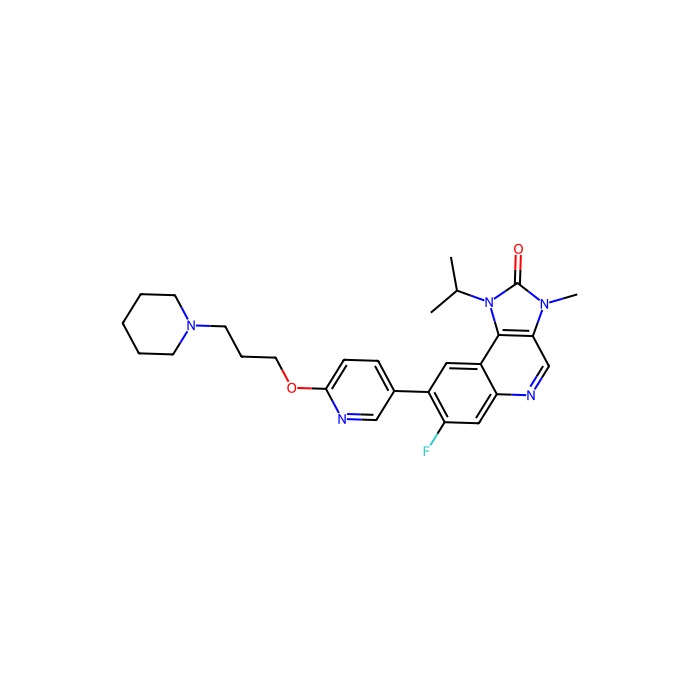
AZD1390 is a first-in-class orally available and CNS penetrantATMinhibitor with an IC50 of 0.78 nM in cells and >10,000-fold selectivity over closely related members of the PIKK family of enzymes and excellent selectivity across a broad panel of kinases. In vitro
AZD1390 blocks ATM-dependent DDR (DNA damage response) pathway activity and combines with radiation to induce G2 cell cycle phase accumulation, micronuclei, and apoptosis. AZD1390 radiosensitizes glioma and lung cancer cell lines, with p53 mutant glioma cells generally being more radiosensitized than wild type. AZD1390 results in increased genome instability.
In vivo
AZD1390 displays excellent oral bioavailability in preclinical species (66% in rat and 74% in dog). It can efficiently cross the BBB in non-human primate PET studies. Profound tumor regressions and increased animal survival (>50 days) have been observed in orthotopic xenograft models of brain cancer following just 2 or 4 days combination treatment of AZD1390 with radiotherapy, compared to radiotherapy treatment alone. In in vivo syngeneic and patient-derived glioma as well as orthotopic lung-brain metastatic models, AZD1390 dosed in combination with daily fractions of IR (whole-brain or stereotactic radiotherapy) significantly induces tumor regressions and increased animal survival compared to IR treatment alone. AZD1390 has favorable physical, chemical, PK, and PD properties suitable for clinical applications that require exposures within the central nervous system. Cell Data
AZD1390 is a first-in-class orally available and CNS penetrant ATM inhibitor with an IC50 of 0.78 nM in cells and >10,000-fold selectivity over closely related members of the PIKK family of enzymes and excellent selectivity across a broad panel of kina
Conditions de stockage de stockage
Store at -80°C
Expédié en
Dry ice packs + Cold packs
Ce produit nécessite l'expédition en chaîne froide. Les services terrestres et autres services économiques ne sont pas disponibles.
Certificats (CoA, COO, BSE/TSE et tableau d'analyse)
C of A & Other Certificates(BSE/TSE, COO):
Analytical Chart:
Propriétés chimiques et physiques
Solubilité
Solubility (25°C) In vitro
DMSO (mg/mL) Solubilité maximale
14
DMSO (mM) Solubilité maximale
29.3150742299558
Eau (mg/mL) Solubilité maximale
<1
Calculateurs de solution
Molarity Calculator
Determine the necessary mass, volume, or concentration for preparing a solution.
Dilution Calculator
Determine the dilution needed to prepare a stock solution.
Reconstitution Calculator
Avis
Avis des clients
Application Protocols
Only item-specific, tested protocols may be reported. For this listing:
Tested applications, recommended concentrations/dilutions, and positive control conditions: Not specified for this item; refer to CoA/Spec Sheet.
General research-use guidance (not item-specific)
Prepare sterile-filtered DMSO stocks (e.g., 10–50 mM). For cellular assays, titrate across a broad range (e.g., 0.1 nM to 10 μM) with appropriate vehicle controls. Limit final DMSO to ≤0.5% v/v unless your assay demonstrates tolerance.
Include time-course studies to differentiate immediate pathway modulation from downstream cytostatic/cytotoxic effects. Confirm reproducibility across independent lots and on different days.
Record lot numbers, storage history, and thaw cycles for data traceability.
Biological Roles
General literature context (no medical/clinical claims)
AZD1390 is widely cited in the literature as a potent, selective small-molecule probe of the DNA damage response pathway. Specifically, it is used to interrogate signaling nodes that govern replication stress and checkpoint activation in mammalian cells.
Research applications include: modulating checkpoint kinase signaling in response to genotoxic stressors; mapping synthetic interactions with DNA repair factors; and timing checkpoint engagement in synchronized cell systems.
Prepare high-quality, sterile-filtered DMSO stocks and validate working concentrations for each assay format (biochemical enzyme assays, cell viability/proliferation, reporter systems). Titrate carefully to distinguish on-target pathway effects from general cytotoxicity or solvent artifacts.
Pair with appropriate positive/negative controls (e.g., orthogonal pathway probes) and quantify responses by phospho-protein biomarkers, cell-cycle distribution (flow cytometry), or transcriptional readouts as appropriate.
Confirm compound stability and lack of aggregation or precipitation under assay conditions (consider DLS, UV absorbance scans, or detergent controls in biochemical assays).
Item-specific target, off-target profile, and potency metrics: Not specified for this item; refer to CoA/Spec Sheet and primary literature.
Buffer Applications
Not typically applicable. AZD1390 is not a buffering agent and is not used to control pH. When formulating working solutions for biological assays, select a buffer system compatible with your test system (e.g., PBS, HEPES, or assay-specific buffers) and verify compound solubility/stability after dilution from DMSO stocks.
Green Alternatives
Not typically applicable. AZD1390 is a discrete bioactive compound rather than a bulk solvent or reagent for which greener process substitutes are normally considered. Sustainability considerations for this item focus on:
Minimizing solvent volumes in stock preparation and assay setup (microscale handling, miniaturized plates).
Selecting lower-impact co-solvents where assay-compatible (e.g., aqueous buffers with minimal DMSO percentage).
Using closed, inert containers and cold-chain logistics to maximize shelf life and reduce waste.
Pharmaceutical Uses
Research/formulation context (no therapeutic claims)
Role: AZD1390 is supplied as a research-use small molecule. In preclinical discovery labs, similar compounds may be used in formulation screening (e.g., assessing solubility enhancers, co-solvent systems, or enabling excipients) to support in vitro or non-clinical studies.
Salt form and polymorphism can strongly influence solubility and stability. Confirm the supplied form and perform solid-state characterization (PXRD, DSC/TGA) if you plan pharmacokinetic or exposure studies.
Typical vehicles explored for small, lipophilic discovery compounds include: DMSO/PEG400/saline mixtures, Captisol or hydroxypropyl-β-cyclodextrin solutions, or microemulsions. Always verify compatibility and stability at intended concentrations.
Regulatory status and pharmacopeia monographs: None specified; this product is for research use only and is not manufactured to GMP specifications.
Item-specific excipient compatibility, salt form, and recommended formulation vehicles: Not specified for this item; refer to CoA/Spec Sheet.
Physical Properties
Item-specific physicochemical specifications are not provided in this listing.
Appearance: Not specified for this item; refer to CoA/Spec Sheet.
Melting point, boiling point, density, refractive index, UV cutoff, water/peroxide/metal limits: Not specified for this item; refer to CoA/Spec Sheet.
Solubility: Not specified for this item; refer to CoA/Spec Sheet.
LogP/logD, pKa: Not specified for this item; refer to CoA/Spec Sheet.
Practical guidance (general/literature-style, not item specifications)
Small-molecule screening ligands of this class are commonly supplied as solids and prepared as concentrated stocks in anhydrous DMSO (e.g., 10–50 mM) for biochemical or cellular assays; final assay DMSO concentrations are typically kept ≤0.1–0.5% v/v to limit solvent effects.
If aqueous use is intended, assess compound solubility and stability across the experimental pH range and ionic strength. Employ co-solvent strategies (DMSO → aqueous buffer titration) and inline filtration (0.2 μm) to remove particulates.
Always determine the exact extinction coefficient, solubility limits, and stability for your batch using appropriate analytical methods (HPLC/UPLC, LC–MS, NMR) prior to critical experiments.
Quality and Grades
Grade: Moligand™ (product data)
What Moligand™ typically signifies (general guidance)
Moligand™ denotes a research-grade, small-molecule ligand suitable for discovery workflows such as primary/secondary screening, target validation, and mechanism-of-action studies. Materials are intended for laboratory research use only and are not for human or veterinary use.
Emphasis is typically placed on identity confirmation and organic purity appropriate for biochemical/cellular assays, along with batch traceability. However, specific acceptance criteria (e.g., % purity by HPLC, residual solvents, salt form, water content) are batch- and item-dependent.
Item-specific details
Purity specification, counterion/salt form, polymorphic form, and stabilizers: Not specified for this item; refer to CoA/Spec Sheet.
Analytical verification (e.g., HPLC/UPLC chromatograms, LC–MS, NMR) supporting the supplied batch should be consulted in the CoA prior to use in quantitative assays.
Practical considerations
For screening cascades, consider performing an incoming quality check aligned with your use-case: orthogonal identity confirmation (HRMS/NMR), purity verification at assay detection wavelength(s), and a rapid solubility/stability assessment in the intended assay matrix. Document lot numbers to ensure reproducibility across campaigns.
Reaction and Applications
This product is primarily a research-grade small-molecule ligand used for biological studies and screening. It is not typically employed as a synthetic reagent, catalyst, or solvent.
If chemical transformations of AZD1390 are contemplated (e.g., prodrug elaboration, analytical derivatization):
Confirm full structural details (literature/CoA) before planning reactions.
Establish compatibility of the core scaffold with common conditions (acid/base sensitivity, oxidative/reductive stability) by micro-scale scouting.
Use orthogonal analytics (LC–MS, NMR) to detect subtle degradation or isomerization.
For its intended use-case, see the sections “Biological Roles,” “Pharmaceutical Uses,” and “Application Protocols” for guidance on handling in biochemical/cellular assays.
Reaction Conditions
Not applicable in the conventional sense. AZD1390 is not intended as a reagent or catalyst.
If conducting stability or forced-degradation studies (general guidance)
Chemical stability panels: acid/base (pH 2–10), oxidative (e.g., 0.1–3% H2O2), thermal (40–60°C), and photostability (ICH Q1B-like) in relevant solvents (aqueous buffer, DMSO/water). Analyze by LC–MS/UPLC for degradation pathways.
Stock solution handling: maintain under inert headspace where feasible, minimize light exposure, and avoid repeated freeze–thaw.
Item-specific reaction or processing conditions: Not specified for this item; refer to CoA/Spec Sheet.
Safety and Handling
GHS/SDS
GHS classification, signal word, pictograms, and H-statements: Not specified for this item; refer to the SDS for authoritative hazard information.
General laboratory precautions (professional guidance)
Handle in a fume hood with appropriate PPE: lab coat, safety glasses, and suitable chemical-resistant gloves (e.g., nitrile). Avoid inhalation of dust/aerosols and skin/eye contact.
Prevent ingestion and environmental release. Use secondary containment for transport inside the facility.
Avoid incompatible conditions typical for organic small molecules: strong oxidizers, strong acids/bases (hydrolysis risk), and prolonged exposure to light/heat or moisture until stability is confirmed.
Weigh solid quickly at ambient conditions if hygroscopicity is unknown; prefer pre-chilled spatulas and closed containers to minimize condensation when working from -80°C storage.
First aid (overview; defer to SDS)
Skin/eye contact: Rinse with water for ≥15 minutes; remove contaminated clothing; seek medical evaluation as needed.
Inhalation: Move to fresh air; support respiration; seek medical attention if symptoms persist.
Ingestion: Rinse mouth; do not induce vomiting unless directed by medical personnel; seek immediate medical attention.
Waste
Collect solid and liquid residues as halogenated or non-halogenated organic waste per local regulations; do not drain-dispose. Consult institutional EHS.
Solvent Selection
Applicability
AZD1390 is provided as a research small molecule; it is typically handled as concentrated stock solutions for biochemical or cellular assays rather than used as a reaction solvent.
General solvent guidance for small-molecule bioactives (literature/practice)
Primary stock solvent: Anhydrous DMSO is commonly used owing to broad solubilizing power and compatibility with most assays. Prepare sterile-filtered stocks (e.g., 10–50 mM) and store aliquots at ≤−20 to −80°C to minimize freeze–thaw.
Aqueous use: Dilute DMSO stocks into buffered media (e.g., PBS, HBSS, cell culture media) with vigorous mixing to avoid precipitation. Keep final DMSO ≤0.1–0.5% v/v when possible.
Alternative co-solvents (as needed): DMF or ethanol for initial dissolution, followed by dilution into aqueous buffers. Confirm assay tolerance to these solvents.
Solubility optimization: Employ gentle warming (≤37°C), sonication, or co-solvent gradients. Verify solution clarity and concentration by UV or LC methods.
Comparison (general)
DMSO vs ethanol: DMSO typically offers higher solubility and better stability for diverse chemotypes; ethanol may be preferable for certain biological systems sensitive to DMSO but often affords lower solubility.
Item-specific solubility, extinction coefficients, and stability parameters: Not specified for this item; refer to CoA/Spec Sheet.
Storage and Reconstitution
Item-specific conditions (product data)
Storage: Store at −80°C.
Shipping: Dry ice packs + Cold packs for maintenance of cold chain.
General best practices for small-molecule bioactives
Upon receipt: Keep sealed and cold. Allow the container to equilibrate in a desiccator to room temperature before opening to avoid condensation.
Aliquoting: Prepare small, single-use aliquots of concentrated DMSO stock (e.g., 10–50 mM) in inert, light-protective vials or plates. Flush headspace with inert gas if feasible. Label with lot, concentration, and date.
Freeze–thaw: Avoid repeated cycles. Thaw quickly at room temperature, mix gently to ensure homogeneity, and immediately return unused material to −80°C.
Light/moisture: Protect from light and humidity during handling and storage. Use desiccants in secondary containment.
Stability monitoring: Periodically verify integrity by HPLC/UPLC and/or LC–MS, especially after 6–12 months of storage or if any change in appearance is noted.
Item-specific solubility and reconstitution solvent recommendations: Not specified for this item; refer to CoA/Spec Sheet.
Structure and Identity
Product name: AZD1390 (SKU: A408361)
CAS: 2089288-03-7 (product data)
PubChem CID: 126689157 (product data)
Molecular formula: Not specified for this item; refer to CoA/Spec Sheet.
Molecular weight: Not specified for this item; refer to CoA/Spec Sheet.
SMILES: Not specified for this item; refer to CoA/Spec Sheet.
InChIKey: Not specified for this item; refer to CoA/Spec Sheet.
Structural description
Item-specific structural identifiers are not provided in this listing. AZD1390 is a discrete, single small-molecule entity; please consult the CoA/SDS or primary literature for exact structural representation and stereochemical details (if any).
General (literature) note: AZD1390 is widely referenced as a research-grade, brain-penetrant small molecule used to probe the DNA damage response pathway. Exact functional groups and ring systems should be confirmed from primary structural records before use in analytical or synthetic method development.
Synthetic Utility
Not typically applicable. AZD1390 is supplied as a final bioactive small molecule rather than a synthetic building block or reagent.
If derivatization is desired for probe development (general guidance)
Map functional handles amenable to modification (confirmed from structure): heteroaryl positions, amide/urea motifs, or pendant amines/ethers (exact features must be verified from structural records). Assess SAR impact with minimal perturbations.
For bioconjugation or imaging, consider linkers that preserve physicochemical properties (logD, TPSA) and avoid steric clash at binding interfaces.
Validate derivatives with orthogonal analytics and in the same bioassays used for the parent compound to confirm retained activity.
Item-specific reactive handles and derivatization routes: Not specified for this item; refer to CoA/Spec Sheet.
Target Specificity
Only item-specific data may be reported here. For this listing:
Target, selectivity panel, Kd/IC50, and off-target profile: Not specified for this item; refer to CoA/Spec Sheet.
Researchers should consult primary literature and the product CoA for validated target engagement metrics, assay formats, and selectivity data relevant to their biological system.
Need help choosing the grade?
Our grade selection guide covers purity, stabilizer status, and application suitability for all variants in our catalog.
We use cookies to ensure the website functions properly and, where permitted, to improve your experience. You can manage your preferences at any time in Settings. Learn more in our Cookie Policy.
Shall we send you a message when we have discounts available?
Remind me later
Thank you! Please check your email inbox to confirm.
Products are supplied to verified businesses, institutions, and qualified professionals for research and development use only. Not for use in humans, animals, diagnosis, or therapy.