GRADE & PURITYMoligand™?Moligand™ — Aladdin's line of ligands and bioactive small molecules. Use for receptor, pathway, and binding studies needing defined small-molecule tools.≥98%A solution in ethanol
Moligand™, ≥98%, A solution in ethanol Moligand™ for sensitive chromatographic and analytical workflows requiring minimal baseline interference.
🌡
Storage & shipping
Store at -20°C Ships Ice chest + Ice pads Check lot-specific COA for exact specifications.
📋
Quality documents
SDS, COA, datasheet, and spec sheet available for download. Lot-specific COA accessible via lot number lookup.
📚
Literature proof
Cited in 0 peer-reviewed publications across chromatography, organic synthesis, and cross-coupling reactions.
Vue d’ensemble
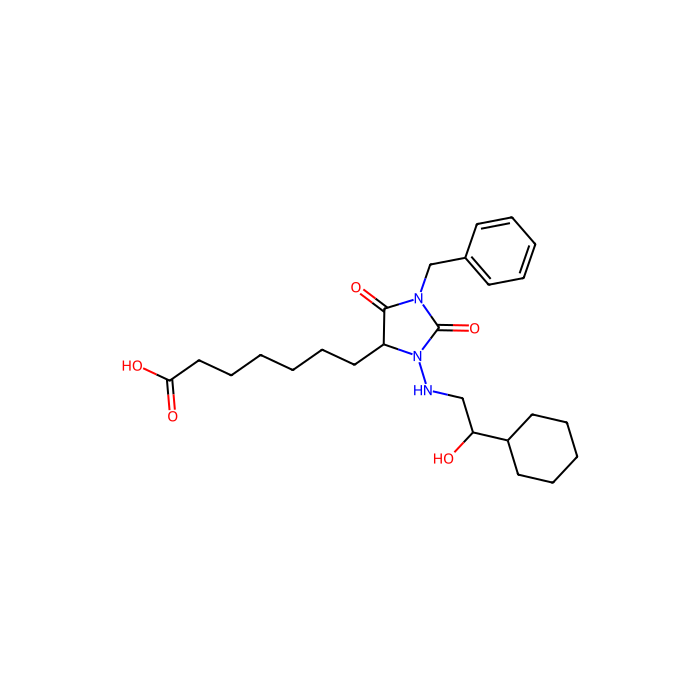
BW A868C is a hydantoin compound structurally related to the DP agonist BW245C. BW A868C antagonizes prosaglandin D2 and BW245C-induced activation of human platelet adenylate cyclase. Has been shown to antagonize accumulation of cAMP in rabbit non-pigmented ciliary epithelial cells. Shows virtually no effect on human TP, IP, EP1, EP2, and FP receptors. Ki is approximately 1.7 nM.
This compound belongs to the class of organic compounds known as hydantoins. These are heterocyclic compounds containing an imidazolidine substituted by ketone group at positions 2 and 4.
External Descriptors
Not available
1. Djoumbou Feunang Y, Eisner R, Knox C, Chepelev L, Hastings J, Owen G, Fahy E, Steinbeck C, Subramanian S, Bolton E, Greiner R, and Wishart DS. ClassyFire: Automated Chemical Classification With A Comprehensive, Computable Taxonomy. Journal of Cheminformatics, 2016, 8:61.
Certificats (CoA, COO, BSE/TSE et tableau d'analyse)
C of A & Other Certificates(BSE/TSE, COO):
Analytical Chart:
Propriétés chimiques et physiques
Solubilité
Soluble in water (0.25 mg/ml at 25° C), DMSO (~20 mg/ml), DMF (~20 mg/ml), PBS (pH 7.2) (~0.25 mg/ml), and ethanol.
Indice de réfraction
n20D1.59 (Predicted)
Point d'ébullition (°C)
78° C (Predicted)
Poids moléculaire
459.600 g/mol
XLogP3
1.700
Hydrogen Bond Donor Count
3
Hydrogen Bond Acceptor Count
6
Rotatable Bond Count
13
Exact Mass
459.273 Da
Monoisotopic Mass
459.273 Da
Topological Polar Surface Area
110.000 Ų
Heavy Atom Count
33
Formal Charge
0
Complexity
646.000
Isotope Atom Count
0
Defined Atom Stereocenter Count
0
Undefined Atom Stereocenter Count
2
Defined Bond Stereocenter Count
0
Undefined Bond Stereocenter Count
0
The total count of all stereochemical bonds
0
Covalently-Bonded Unit Count
1
Calculateurs de solution
Molarity Calculator
Determine the necessary mass, volume, or concentration for preparing a solution.
Dilution Calculator
Determine the dilution needed to prepare a stock solution.
Reconstitution Calculator
Avis
Avis des clients
Application Protocols
This listing does not include validated application protocols or recommended dilutions for BW A868C.
Tested applications (e.g., WB, IHC, IF, FC, enzymatic assays): Not specified for this item.
Recommended working concentrations: Not specified for this item.
General starting points for small-molecule screening (informational only):
Stock preparation: 10–50 mM in dry DMSO; pre-aliquot to avoid freeze–thaw.
Typical primary screen ranges: 1–30 µM final, subject to assay tolerance and solubility; confirm absence of precipitation and assay interference.
Include vehicle controls matched to the highest solvent content; run concentration–response (8–12 points, 3-fold dilutions) for actives to estimate potency.
Note: Only follow item-specific instructions when provided on the CoA/Spec Sheet or SDS. The above is general practice and not a validated protocol for this SKU.
Biological Roles
No target assignment or mode-of-action is provided in this product record for BW A868C. Therefore, no specific biological role can be claimed for this item.
General context for research ligands (informational, not item-specific):
Small-molecule ligands are used as chemical probes to perturb biological pathways transiently and reversibly, enabling hypothesis testing and pathway mapping.
Results should be interpreted alongside orthogonal evidence (e.g., genetic perturbation, structurally unrelated tool compounds) to confirm on-target effects.
Consider basic liability profiling (redox activity, PAINS/IMPs flags, aggregation propensity) to de-risk artifactual readouts before in-depth biological conclusions.
Important: This product is supplied strictly for research use only. It is not intended for use in humans or for clinical/diagnostic applications.
Buffer Applications
BW A868C is not a buffering agent, and no buffer system is specified for this item.
Practical notes for dosing compounds from DMSO stocks into buffers (general guidance):
Choose assay buffers that maintain target stability and minimize nonspecific binding (e.g., HEPES, PBS, Tris, with 0.01–0.05% nonionic surfactant if compatible).
Keep final DMSO ≤0.1–0.5% v/v to limit matrix effects in biochemical and cell-based assays.
Pre-equilibrate compound solutions at assay temperature; check for precipitation or turbidity after dilution.
Include vehicle controls that match the highest solvent concentration used across test conditions.
Item-specific buffer data (pH range, ionic strength, excipients): Not specified for this item; refer to CoA/Spec Sheet.
Green Alternatives
As BW A868C is a test ligand rather than a bulk solvent or reagent, green-chemistry considerations primarily concern dissolution media and handling.
Prefer aqueous buffers with minimal co-solvent when solubility permits; maintain assay integrity and compound stability.
Use ethanol or propylene glycol as co-solvents where compatible, to reduce reliance on dipolar aprotic solvents.
Minimize solvent volume via higher-concentration DMSO master stocks and precise low-volume dispensing to reduce waste.
Illustrative comparison (general; choose to fit your assay):
DMSO: high solvency; moderate EHS concerns; widely tolerated at ≤0.5% v/v.
Ethanol: renewable feedstocks available; often tolerated at ≤1–2% v/v; lower solvency for hydrophobes.
PEG 400 or cyclodextrins: can enhance solubility in aqueous systems; evaluate viscosity and assay interference.
Operational greening:
Use amber, reusable glass vials and PTFE-lined caps to extend solution lifespan and cut disposables.
Plan compound plating to minimize dead volumes and expired aliquots; consolidate freeze–thaw cycles by pre-aliquoting.
Note: No item-specific environmental metrics (biodegradability, E-factor, or solvent score) are provided; apply your institution’s green-chemistry framework to your workflow.
Pharmaceutical Uses
No pharmacopeial status, excipient role, or formulation use is provided for BW A868C.
Compendial listing (USP/EP/JP): Not specified for this item; refer to CoA/Spec Sheet.
Established role as an excipient or processing aid: Not specified for this item.
Context (general, non-clinical):
Compounds in discovery libraries are commonly formulated as DMSO stock solutions for screening. Any downstream preclinical formulation development (e.g., salt screening, enabling formulations) requires confirmed identity, purity, and solid-state form—none of which are specified here.
Regulatory note:
This product is supplied for research use only and is not intended for drug substance, drug product, or diagnostic use.
Physical Properties
Item-specific physicochemical data have not been provided in this record.
Appearance: Not specified for this item; refer to CoA/Spec Sheet.
Melting point (MP): Not specified for this item; refer to CoA/Spec Sheet.
Boiling point (BP): Not specified for this item; refer to CoA/Spec Sheet.
Density: Not specified for this item; refer to CoA/Spec Sheet.
Refractive index: Not applicable/unspecified for solids; Not specified for this item.
Solubility profile: Not specified for this item; refer to CoA/Spec Sheet.
pKa/logP/logD: Not specified for this item; refer to CoA/Spec Sheet.
General guidance (literature/practice-based, not item-specific):
For screening ligands with unknown solubility, begin with dry, anhydrous DMSO to prepare a 10–50 mM stock. If DMSO is insufficient, evaluate DMF, ethanol, or mixed cosolvents (e.g., DMSO:water, DMSO:buffer at ≤0.5% v/v final in assays).
If aqueous use is essential, consider pH adjustment (±1–2 pH units around predicted pKa) or solubilization aids compatible with your assay (e.g., 0.01–0.05% nonionic surfactant). Verify activity and background signal.
Confirm concentration by UV–Vis (if chromophore present) or quantitative NMR; filter stocks (0.2 µm PTFE) if particulate is observed. Perform a miniature solubility screen before large-scale experiments.
Quality and Grades
Grade: Moligand™ (from Product Data)
What Moligand™ generally implies (program-level context; not a specification for this SKU):
A research-grade small molecule suitable for discovery workflows (e.g., biochemical/cell-based screening, target ID studies).
Typically supported by identity confirmation (e.g., LC–MS and/or NMR) and a purity suitable for screening. Exact test methods, thresholds, and acceptance criteria are defined on the item’s CoA/Spec Sheet.
Not intended for clinical use, human consumption, or diagnostic procedures.
How to use grade information effectively:
For structure–activity relationship (SAR) or lead-optimization work, verify identity and purity of the received lot by in-house LC–MS or qNMR, especially before multi-parametric profiling.
If ultra-low background is needed (e.g., photoassays or fluorescence readouts), request UV-cutoff/fluorescence data for this specific lot, or perform a blank readout with the exact formulation.
If your application demands metal limits, residual solvent limits, or trace stabilizer disclosure, consult the CoA. Where a parameter is not listed here, it remains: Not specified for this item; refer to CoA/Spec Sheet.
Reaction and Applications
This product is offered as a research ligand/tool compound rather than a preparative reagent. No item-specific synthetic or catalytic application has been provided.
Research usage (general, non-target-specific):
Biochemical assays: evaluate modulation of enzyme or receptor readouts; incorporate appropriate positive/negative controls and counterscreens to flag aggregation or redox interference.
Cell-based assays: assess pathway-dependent phenotypes; confirm on-target effects via orthogonal assays (e.g., genetic knockdown/overexpression) and concentration–response curves.
Binding assays: SPR, MST, DSF, or radioligand displacement when a validated binding system is available; ensure compound stability in the assay buffer.
ADME pre-screens: assess solubility, metabolic stability, permeability, and protein binding to contextualize potency data.
Assay integrity tips:
Pre-clear compounds by centrifugation; use low-bind plasticware to minimize adsorption of lipophilic ligands.
Include detergent controls (e.g., 0.01% Tween-20) where appropriate to reduce colloidal aggregation artifacts.
Track the final solvent fraction (e.g., DMSO ≤0.1–0.5% v/v) across all wells/conditions; apply interleaved plate controls to mitigate edge effects.
If you intend to use BW A868C in a chemical reaction, verify reactivity and stability empirically; there are no manufacturer-provided reaction applications for this item.
Reaction Conditions
No manufacturer-supplied reaction or processing conditions are provided for BW A868C.
Catalysts, temperatures, stoichiometries, and yields: Not specified for this item; refer to CoA/Spec Sheet or primary literature once the structure is confirmed.
General handling for solution preparation (non-synthetic, assay-focused):
Prepare 10–50 mM DMSO stocks at room temperature with vortexing/sonication; avoid prolonged heating.
For aqueous use, dilute into buffer with vigorous mixing to minimize precipitation; confirm clarity visually and by 600 nm scattering.
Protect from moisture and air if stability screening suggests sensitivity; consider nitrogen backfill and amber vials for light/oxygen-prone chemotypes.
If you plan to employ BW A868C in chemical transformations (e.g., to make analogs), obtain the full structural and stability profile first; there are no reaction-condition recommendations specific to this item.
Safety and Handling
Authoritative safety information should be taken from the item-specific SDS. The following fields are not provided in this listing:
Signal word: Not specified for this item; refer to SDS.
H-statements: Not specified for this item; refer to SDS.
GHS classification/pictograms: Not specified for this item; refer to SDS.
General laboratory precautions (good practice; not item-specific):
Use in a chemical fume hood; avoid inhalation of dust/aerosols and contact with skin/eyes.
Wear appropriate PPE: lab coat, safety glasses, and chemically resistant gloves (e.g., nitrile). Replace gloves regularly when handling DMSO solutions due to enhanced dermal transport.
Avoid incompatible reactions/oxidants until structural compatibility is confirmed. Keep away from strong acids/bases and oxidizers unless supported by data.
In case of exposure: rinse eyes/skin with water for at least 15 minutes; remove contaminated clothing; seek medical attention. If inhaled, move to fresh air; if ingested, rinse mouth and do not induce vomiting; consult medical services.
Waste: Collect organic solutions and contaminated disposables as hazardous chemical waste per institutional and regulatory guidance.
Special handling notes for screening ligands:
Prepare small aliquots to avoid repeated freeze–thaw cycles.
Use amber vials when light sensitivity is suspected; purge headspace with inert gas for oxidation-prone compounds (if indicated by CoA or preliminary stability tests).
Solvent Selection
Given the absence of item-specific solubility data, begin with flexible, assay-compatible solvent strategies.
Primary approach (general practice for screening ligands):
DMSO (anhydrous): first-line solvent for 10–50 mM stocks; high solvency, broad assay compatibility at ≤0.1–0.5% v/v final.
DMF: alternative when DMSO insuffices; verify cell tolerance if used in cell assays.
Ethanol/MeOH: useful co-solvents for some targets; assess assay interference.
Aqueous buffers: use co-solvent strategies or pH adjustment; confirm absence of precipitation on dilution.
Practical tips:
Warm (25–37°C) and vortex/sonicate to accelerate dissolution. Avoid prolonged heating.
Filter stocks (0.2 µm PTFE) if particles persist. Pre-rinse filters with solvent to minimize analyte loss.
Dose–solubility check: prepare a dilution series in the intended matrix and inspect for turbidity (600 nm scattering) to pre-empt false negatives.
Comparison snapshot (general):
DMSO: highest solvency; potential to enhance dermal uptake; typically best for HTS.
DMF: strong solvency; higher cytotoxicity risk in cell assays.
Ethanol: good compatibility at ≤1–2% v/v; lower solvency for very lipophilic chemotypes.
PBS/assay buffer: green and benign; requires co-solvent or formulation aids for hydrophobes.
Always verify assay tolerance to the chosen solvent at the final working percentage.
Storage and Reconstitution
From Product Data:
Storage conditions: Store at −20°C.
Shipped in: Ice chest + Ice pads.
Item-specific solution stability, light sensitivity, and moisture sensitivity: Not specified for this item; refer to CoA/Spec Sheet.
General guidance for small-molecule ligands (informational, not item-specific):
Upon receipt, allow the sealed container to equilibrate to room temperature before opening to avoid moisture condensation.
If supplied as a solid, prepare concentrated DMSO stock (e.g., 10–50 mM), aliquot into amber vials or PCR tubes, and store at −20°C. Avoid repeated freeze–thaw cycles.
If supplied in solution, verify solvent and concentration; maintain at the recommended temperature and protect from light if the compound is chromophoric.
For aqueous dilutions, prepare fresh on the day of use; confirm clarity and absence of precipitate. Document lot number, concentration, and preparation date on each aliquot.
Reconstitution notes:
Solvent choice: start with anhydrous DMSO; if insoluble, evaluate DMF or alcohol co-solvents. Ensure final assay solvent content is compatible with your system.
Always defer to the item’s CoA and SDS for definitive storage and handling instructions.
Structure and Identity
Brief overview: BW A868C is listed as a small-molecule research ligand in Aladdin’s Moligand™ collection. Detailed structural identifiers are limited in the current product record.
Product name: BW A868C (SKU: B337961)
CAS: 118675-50-6 (from Product Data)
PubChem CID: 122021 (from Product Data)
InChIKey: 450939 (as provided; note that typical InChIKeys are 27-character hashes. Please refer to CoA/SDS or the supplier record for confirmation.)
SMILES: Not specified for this item; refer to CoA/Spec Sheet.
Molecular formula: Not specified for this item; refer to CoA/Spec Sheet.
Molecular weight: Not specified for this item; refer to CoA/Spec Sheet.
Structural features (general note):
Specific functional groups, ring systems, stereochemistry, and substitution pattern are not specified in this listing. For precise structural information (2D/3D structure, tautomers, and stereodescriptors), consult the product CoA/Spec Sheet or authoritative databases using the CAS/CID provided.
2D structure description:
Not available in the current record. If your workflow requires a standardized structure (SDF/MOL), request the SDF from technical support or retrieve from a curated database keyed by CAS 118675-50-6 (verify identity prior to use).
Synthetic Utility
BW A868C is supplied as a screening ligand/tool compound. No information is provided that would position it as a general synthetic reagent or building block.
General considerations (if derivatization is desired for probe development; not item-specific):
If structural information becomes available, common probe-development modifications include: installation of photoaffinity groups (diazirine/azide), reporter handles (alkyne/azide for click chemistry), or biotin for affinity capture.
Before derivatization, map SAR hotspots to avoid perturbing key pharmacophores; re-validate activity after tagging.
For target identification workflows, consider linker engineering to balance solubility, permeability, and binding maintenance.
Because the specific functional groups of BW A868C are not listed, no concrete synthetic transformations or named-reaction suitability can be recommended. For synthetic planning, obtain the complete structure and analytical data from the CoA/Spec Sheet or a curated database keyed to CAS 118675-50-6 (verify identity before use).
Target Specificity
No target annotations (enzyme/receptor/pathway), binding constants, or selectivity data are provided for BW A868C in this listing.
Primary target: Not specified for this item; refer to CoA/Spec Sheet or peer-reviewed literature.
Off-targets/panel data: Not specified for this item.
Species cross-reactivity: Not applicable.
If using BW A868C as a probe:
Establish specificity via orthogonal assays and, where possible, test against a selectivity panel relevant to your biological question.
We use cookies to ensure the website functions properly and, where permitted, to improve your experience. You can manage your preferences at any time in Settings. Learn more in our Cookie Policy.
Shall we send you a message when we have discounts available?
Remind me later
Thank you! Please check your email inbox to confirm.
Products are supplied to verified businesses, institutions, and qualified professionals for research and development use only. Not for use in humans, animals, diagnosis, or therapy.