QUALITÉ & PURETÉMoligand™?Moligand™ — Aladdin's line of ligands and bioactive small molecules. Use for receptor, pathway, and binding studies needing defined small-molecule tools.10 mM in DMSO
Moligand™, 10 mM in DMSO Moligand™ pour les flux de travail chromatographiques et analytiques sensibles nécessitant une interférence de ligne de base minimale.
🌡
Stockage & expédition
Store at -80°C Expédition Dry ice packs + Cold packs. Consultez le COA spécifique au lot pour les spécifications exactes.
📋
Documents qualité
SDS, COA, fiche technique et fiche de spécifications disponibles au téléchargement. COA spécifique au lot accessible via la recherche par numéro de lot.
📚
Preuve documentaire
Cité dans 0 publications à comité de lecture couvrant la chromatographie, la synthèse organique et les réactions de couplage croisé.
Vue d’ensemble
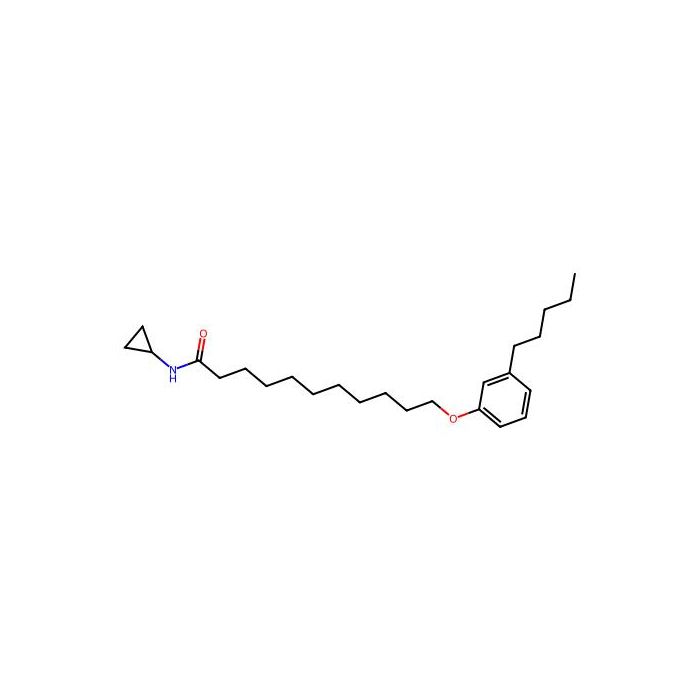
CB1/2 agonist 3 (compound 52), a potent non-selective cannabinoid ligand, is a CB1/CB2 ( cannabinoid receptor ) competitive agonist. CB1/2 agonist 3 acts on hCB1 and hCB2 with K i values of 5.9 nM and 3.5 nM, respectively.
Spécifications
Spécifications et pureté
Moligand™, 10 mM in DMSO
Conditions de stockage de stockage
Store at -80°C
Expédié en
Dry ice packs + Cold packs
Ce produit nécessite l'expédition en chaîne froide. Les services terrestres et autres services économiques ne sont pas disponibles.
Grade
Moligand™
Type d'action
AGONIST
Noms et identifiants
Poids moléculaire
387.60
Documentation
📋 Fiche de données de sécurité (FDS)
Document complet couvrant les dangers, la manipulation, le stockage et la conformité réglementaire.
Certificats (CoA, COO, BSE/TSE et tableau d'analyse)
C of A & Other Certificates(BSE/TSE, COO):
Analytical Chart:
Calculateurs de solution
Molarity Calculator
Determine the necessary mass, volume, or concentration for preparing a solution.
Dilution Calculator
Determine the dilution needed to prepare a stock solution.
Reconstitution Calculator
Avis
Avis des clients
Application Protocols
Only product-data-based details are permitted in this section.
Tested applications, assay formats, recommended concentrations/dilutions, and control compounds: Not specified for this item; refer to CoA/Spec Sheet.
Positive controls/standards and vehicle recommendations: Not specified for this item; refer to CoA/Spec Sheet.
Please consult the item’s CoA/Spec Sheet or SDS for any experimentally validated protocols.
Biological Roles
General/literature context for CB1/CB2 agonists (not item-specific):
Targets: Cannabinoid receptors CB1 (CNR1) and CB2 (CNR2) are class A GPCRs. CB1 is abundant in the central nervous system; CB2 is enriched in immune-related tissues and peripheral cells.
Endogenous ligands: Anandamide (AEA) and 2-arachidonoylglycerol (2-AG) are principal endocannabinoids, synthesized on demand and degraded primarily by FAAH (AEA) and MAGL (2-AG).
Signaling: CB1/CB2 typically couple to Gi/o proteins, reducing adenylyl cyclase activity (lower cAMP), modulating ion channels, and influencing MAPK pathways. β-Arrestin recruitment, receptor internalization, and biased signaling can occur depending on ligand chemotype.
Functional outcomes in models: Modulation of neurotransmitter release, synaptic plasticity, inflammatory signaling, and metabolic pathways have been documented in preclinical systems. These are general roles of the endocannabinoid system, not attributes of this specific item.
Research use cases: Dissecting receptor pharmacology, characterizing ligand bias, benchmarking assay performance, and serving as a tool compound for pathway interrogation.
Item-specific note:
No potency (EC50), efficacy (Emax), or selectivity data for CB1 vs CB2 are provided for this item. Verify any biological parameters in independent assays and refer to the CoA/Spec Sheet if available.
Compliance:
For research use only. Not for diagnostic or clinical applications.
Buffer Applications
This product is a bioactive small-molecule ligand rather than a buffering agent.
Not typically used to establish or maintain pH in biochemical systems.
When used in aqueous assays, it is typically dissolved in an organic vehicle (e.g., DMSO) and diluted into pre-selected assay buffers (HEPES, PBS, HBSS, etc.). Buffer selection should be driven by the biology of the assay (cell health, receptor activity) rather than the compound itself.
Item-specific details such as preferred buffer composition, pH range, and additives are not specified for this item; refer to the CoA/Spec Sheet and validate empirically for the intended assay.
Green Alternatives
Context:
As a bioactive ligand supplied for research assays, the main environmental footprint typically arises from solvent use during stock preparation and assay dilution rather than from synthetic transformations.
Greener handling strategies (general, not item-specific):
Prefer DMSO over chlorinated solvents for stock preparation when solubility permits.
Minimize solvent volumes by preparing higher-concentration stocks and aliquoting to reduce waste from repeated thawing.
Where compatible with biology, consider ethanol or water/cyclodextrin formulations as greener alternatives to high-DMSO conditions.
Use glass vials to reduce plastic adsorption and allow solvent reuse after rinsing where contamination control permits.
Comparison of common vehicles (general):
DMSO: High solubilizing power; relatively benign compared to chlorinated solvents; watch for biological effects above ~0.1–0.5% v/v.
Ethanol: Renewable sources available; volatile with lower persistence; solubilizing power may be limited for very lipophilic agonists.
Aqueous + excipient (e.g., HP-β-CD): Potentially greener in use-phase; requires validation for assay compatibility.
Waste and safety:
Collect organic solvent waste in designated containers; avoid drain disposal.
Opt for micro-scale assays (96–384 well) to reduce solvent usage.
Note: No item-specific solvent or formulation data are provided; refer to the CoA/Spec Sheet for any recommended handling guidance.
Pharmaceutical Uses
This product is supplied strictly for research use and is not indicated as an excipient or for any pharmaceutical manufacturing application.
No pharmacopeial status (USP/EP/JP), compendial monograph, or GMP suitability is provided for this item.
Do not use for human or veterinary applications, drug formulation, or clinical studies.
If formulation-type studies are being performed in vitro:
Treat this material as a research tool compound. Any vehicle, excipient, or stabilization strategy must be qualified for the specific experimental system and is outside the scope of this product’s intended use.
Item-specific note: No pharmaceutical or excipient uses are specified for this item; refer to the CoA/Spec Sheet.
Physical Properties
Item-specific facts (from Product Data):
Appearance: Not specified for this item; refer to CoA/Spec Sheet.
Physical state, color, odor: Not specified for this item; refer to CoA/Spec Sheet.
Molecular weight: Not specified for this item; refer to CoA/Spec Sheet.
Solubility profile (e.g., DMSO, ethanol, aqueous): Not specified for this item; refer to CoA/Spec Sheet.
Melting/boiling point, density, refractive index, logP, pKa: Not specified for this item; refer to CoA/Spec Sheet.
General/literature context (not item-specific):
CB receptor agonists are frequently hydrophobic, and are commonly handled as DMSO stock solutions at high concentration (e.g., 10–50 mM), then diluted into assay buffer with cosolvents or carrier proteins (BSA) to aid dispersion. These are general practices, not specifications for this item.
If the compound is a free base or zwitterion, salt forms (e.g., HCl, fumarate) may modify melting point and apparent solubility. Verify the exact form on the CoA before planning handling conditions.
Quality and Grades
Item-specific facts (from Product Data):
Grade/Purity: Moligand™
What Moligand™ implies (general description; not a specification):
Moligand™ indicates inclusion in a small-molecule ligand/agonist library intended for target engagement and screening in research settings. It typically emphasizes identity confirmation and suitability for in vitro studies. Exact purity, residual solvents, salt/form, and analytical thresholds are not specified here; refer to the item’s CoA/Spec Sheet for definitive values.
Quality considerations and documentation:
Identity/structure: Confirm via provided identifiers on the CoA (e.g., 1H/13C NMR, LC–MS, HRMS). For library compounds, LC–MS purity is often reported, but this is not stated for this item—consult the CoA.
Stabilizers/additives: Not specified for this item; refer to CoA/Spec Sheet. If none are listed, assume neat compound only after verification.
UV/LC suitability: If used in bioassays with UV readouts or LC–MS analytics, check UV cutoff and chromatographic behavior on the CoA to avoid interference.
Batch-to-batch: For screening campaigns, document lot numbers and retain raw QC data to ensure reproducibility.
Use scope:
Research use only. Not for human or veterinary use, diagnostic procedures, or clinical applications.
Reaction and Applications
Applicability to chemical reactions:
This product is a bioactive small molecule (CB1/CB2 receptor agonist) intended for research and screening. It is not typically used as a synthetic reagent or building block; therefore, conventional organic reaction applications (e.g., cross-couplings, condensations) are generally not applicable.
Research applications (general/literature context; not item-specific):
Target engagement: Evaluating CB1 and CB2 receptor activation in cell-based assays (e.g., cAMP inhibition, β-arrestin recruitment, calcium flux in engineered systems) or biochemical binding assays (radioligand displacement, SPR where feasible).
Pathway pharmacology: Probing endocannabinoid signaling, GPCR bias (G protein vs β-arrestin), receptor desensitization/internalization kinetics, and downstream ERK/AKT readouts.
Selectivity profiling: Counter-screening across GPCR panels or assessing off-target liabilities using binding/functional assays.
SAR anchoring: Using the compound as a reference agonist within a focused library to compare potency/efficacy trends in medicinal chemistry campaigns.
Practical considerations:
Prepare vehicle-matched controls and verify DMSO tolerance for the assay system.
Confirm receptor expression levels and assay window with known standards.
Record lot numbers and stock concentrations; use fresh dilutions to minimize adsorption and degradation.
Note: No item-specific potency, selectivity, or assay-validated data are provided here. Consult the CoA or internal qualification data as applicable.
Reaction Conditions
Conventional chemical reaction conditions are not applicable to this product, as it is intended as a bioactive ligand rather than a synthetic reagent.
General assay-handling conditions for small-molecule agonists (literature/practice; not item-specific):
Stock preparation: Dissolve in dry DMSO to a concentrated stock (e.g., 10–50 mM). Filter if needed through 0.22 µm PTFE after verifying solubility.
Working solutions: Dilute stocks into assay buffer with gentle mixing to avoid precipitation; maintain final DMSO typically ≤0.1–0.5% v/v depending on cell tolerance.
Temperature/light: Many ligands are light- and heat-sensitive; keep solutions cold and protected from light during setup.
Adsorption mitigation: Use low-binding plastics or glass; precondition surfaces with assay buffer containing protein or surfactant if compatible.
Item-specific conditions (solubility limits, stability half-life, pH sensitivity) are not specified for this item; refer to the CoA/Spec Sheet and validate empirically.
Safety and Handling
Item-specific facts (from Product Data):
GHS Classification: Not specified for this item; refer to SDS.
Signal Word: Not specified for this item; refer to SDS.
Hazard Statements (H-Statements): Not specified for this item; refer to SDS.
Pictograms: Not specified for this item; refer to SDS.
Storage Conditions: Store at -80°C.
Shipped in: Dry ice packs + Cold packs.
General safety guidance (not item-specific; always defer to SDS):
PPE: Use lab coat, safety glasses, and appropriate chemical-resistant gloves. Handle powders/solids in a fume hood to avoid inhalation of dust/aerosols. Avoid skin/eye contact.
Incompatibilities: Avoid strong oxidizers and strong acids/bases until compatibility is confirmed on the SDS/CoA. Many bioactive organics are light- and moisture-sensitive; minimize exposure.
First aid overview: In case of skin contact, wash with soap and water; for eye contact, rinse with water for several minutes and seek medical attention; if inhaled, move to fresh air; if ingested, rinse mouth and seek medical advice. Provide the SDS to responders.
Special risks: Bioactive receptor agonists may have potent pharmacology at low concentrations. Prevent accidental exposure, ingestion, or injection. Use dedicated, labeled containers and follow institutional controls for handling potent small molecules.
Cryogenic shipping/handling: Upon receipt on dry ice, verify container integrity and immediately place at -80°C. Avoid repeated freeze–thaw cycles by preparing single-use aliquots.
Solvent Selection
Item-specific facts (from Product Data):
Solubility: Not specified for this item; refer to CoA/Spec Sheet.
General guidance for CB agonist-like small molecules (literature/practice, not item-specific):
Primary stock solvent: DMSO is the default due to broad solubilizing power for lipophilic ligands. Prepare concentrated stocks (e.g., 10–50 mM) and store aliquots at -80°C to limit freeze–thaw.
Cosolvents and carriers: If precipitation occurs upon aqueous dilution, use up to 0.1–1% DMSO in the final assay, include 0.05–0.1% nonionic surfactant (e.g., Pluronic F-68) or 0.1% fatty-acid–free BSA, and pre-wet plasticware to minimize adsorption.
Alternative solvents: Ethanol or DMF can be used for initial dissolution if compatible with the assay. Confirm vehicle controls.
Aqueous systems: Direct dissolution in buffer is often poor for hydrophobic ligands. Consider forming cyclodextrin inclusion complexes or using acceptable co-solvent percentages as per assay tolerance.
Comparison (general, not item-specific):
DMSO: strongest solubilizer; may affect some cell assays above ~0.1–0.5% v/v.
Ethanol: volatile, biocompatible at ≤0.1–0.5% v/v; weaker solvent for very lipophilic scaffolds.
DMF: powerful but less preferred in live-cell assays; limit ≤0.1% v/v.
Always verify the exact solvent recommendations and solubility limits on the CoA/Spec Sheet for this item.
Storage and Reconstitution
Item-specific facts (from Product Data):
Storage Conditions: Store at -80°C.
Shipped In: Dry ice packs + Cold packs.
Reconstitution:
Reconstitution solvent, concentration, and stability in solution: Not specified for this item; refer to CoA/Spec Sheet.
General guidance (not item-specific; confirm against CoA before use):
Upon receipt, keep the container frozen at -80°C. Allow the vial to equilibrate to room temperature in a desiccated environment before opening to prevent moisture condensation.
If preparing solutions, use anhydrous solvent (commonly DMSO for small-molecule agonists) and make single-use aliquots to avoid repeated freeze–thaw. Store aliquots at -80°C in tightly sealed, inert-atmosphere vials when possible.
Label aliquots with concentration, solvent, lot, and date. Discard solutions that show precipitation, discoloration, or unexpected LC–MS profiles.
For definitive reconstitution instructions, stability, and shelf-life, consult the CoA/Spec Sheet for this item.
Structure and Identity
Item-specific facts (from Product Data):
Product Name: CB1/2 agonist 3 (SKU: C1497647)
CAS: 2772655-86-2
Grade: Moligand™
Molecular formula: Not specified for this item; refer to CoA/Spec Sheet.
Molecular weight: Not specified for this item; refer to CoA/Spec Sheet.
SMILES: Not specified for this item; refer to CoA/Spec Sheet.
InChIKey: Not specified for this item; refer to CoA/Spec Sheet.
Structural description:
Specific structural features (ring systems, heteroatoms, stereochemistry) are not provided for this item. Refer to the CoA/Spec Sheet for structural identifiers if available.
General/literature context (not item-specific):
“CB1/2 agonist” denotes a small molecule that engages and activates cannabinoid receptors CB1 (CNR1) and CB2 (CNR2), which are class A GPCRs. Many CB agonists are lipophilic scaffolds (e.g., classical cannabinoid cores, indole/indazole-based chemotypes, or mixed heteroaromatics), often bearing hydrophobic regions that interact with the transmembrane binding pocket.
Without an explicit structure, no stereochemical or functional group assignments can be made for this specific item.
Synthetic Utility
This product is a designated CB1/CB2 receptor agonist for biological research and is not typically employed as a synthetic intermediate or reagent.
Key takeaway: Not commonly used in standard synthetic transformations (e.g., coupling partners, electrophiles/nucleophiles) as a reagent.
If derivative synthesis or analog generation is intended, obtain or determine the full structure and functional group map from the CoA or internal analytics before planning synthetic routes. Protecting-group strategies, site-selective modifications, and stability considerations are structure-dependent and cannot be prescribed without structural data.
Item-specific structural/reactivity data are not provided; therefore, no guidance on named reactions, reactivity profiles, or derivatization pathways can be given for this specific item.
Target Specificity
Only product-data-based details are permitted in this section.
Target information (e.g., CB1 vs CB2 selectivity, Ki/EC50, bias profile): Not specified for this item; refer to CoA/Spec Sheet.
Agonist type (full/partial), off-target profile, and species selectivity: Not specified for this item; refer to CoA/Spec Sheet.
Note: While the product name implies CB1/2 agonist activity, no quantitative specificity data are provided here.
Foire aux questions
What is Moligand??
Moligand? is one of Aladdin Scientific's premium product lines, formulated for high-purity applications across multiple workflows. Compared to standard grades in the same workflow, Moligand? products typically offer tighter specifications, more rigorous QC, and stronger lot-to-lot consistency.
How should this product be stored?
Store at ?80 °C. Ultra-low temperature storage is required to maintain the specified shelf life.
How is this product shipped?
This product ships frozen with dry ice and cold packs. Unpack on arrival and transfer it to the storage condition stated above; handle dry ice with insulated gloves in a ventilated area.
What are the CAS number, molecular formula and molecular weight?
The CAS Number is 2772655-86-2, the molecular formula is C25H41NO2, and the molecular weight is 387.60 g/mol.
What documentation is provided?
Available product documentation, including Certificates of Analysis (COA), Safety Data Sheets (SDS), and specification sheets, is shown in the product document area. Document availability and access follow the current site policy.
Besoin d'aide pour choisir la qualité ?
Notre guide de sélection des qualités couvre la pureté, le statut du stabilisant et l'adéquation à l'application pour toutes les variantes de notre catalogue.
Nous utilisons des cookies pour garantir le bon fonctionnement du site et, lorsque cela est autorisé, pour améliorer votre expérience. Vous pouvez gérer vos préférences à tout moment dans les Paramètres. Pour en savoir plus, consultez notre Politique relative aux cookies.
Souhaitez-vous que nous vous envoyions un message lorsque des réductions seront disponibles?
Me rappeler plus tard
Merci ! Veuillez vérifier votre boîte de réception e-mail pour confirmer.
Products are supplied to verified businesses, institutions, and qualified professionals for research and development use only. Not for use in humans, animals, diagnosis, or therapy.