Determine the necessary mass, volume, or concentration for preparing a solution.
| Activity Type | Activity Value -log(M) | Mechanism of Action | Activity Reference | Publications (PubMed IDs) |
|---|

Moligand™, 10mM in DMSO Moligand™ for sensitive chromatographic and analytical workflows requiring minimal baseline interference.
Store at -80°C Ships Dry ice packs + Cold packs Check lot-specific COA for exact specifications.
SDS, COA, datasheet, and spec sheet available for download. Lot-specific COA accessible via lot number lookup.
Cited in 0 peer-reviewed publications across chromatography, organic synthesis, and cross-coupling reactions.
Information
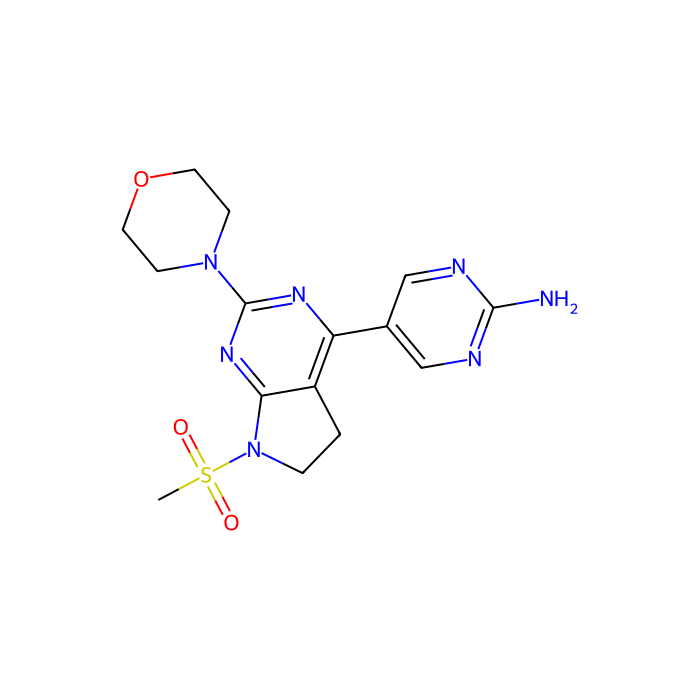
CH5132799 inhibits class I PI3Ks, particularlyPI3KαwithIC50of 14 nM; less potent to PI3Kβδγ, while sensitive in PIK3CA mutations cell lines. Phase 1.
In vitro
CH5132799 selectively inhibits class I PI3Ks, PI3Kα (IC50 = 0.014 μM ), PI3Kβ (IC50 = 0.12 μM ), PI3Kδ (IC50 = 0.50 μM ), PI3Kγ (IC50 = 0.036 μM ), but shows less inhibition of class II PI3Ks, class III PI3k and mTOR and also no inhibitory activity (IC50 > 10 μM) against 26 protein kinases. CH5132799 exhibits more inhibitory activities against PI3Kα with oncogenic mutations E542K (IC50 = 6.7 nM), E545K (IC50 = 6.7 nM) and H1047R (IC50 = 5.6 nM) than wild-type PI3Kα. CH5132799 treated breast cnacer KPL-4 cells, which harbor the PIK3CA mutation, phosphorylation of Akt and its direct substrates, PRAS40 and FoxO1/3a and phosphorylation of downstream factors, including S6K, S6 and 4E-BP1, are effectively suppressed. Cancer cell lines harboring PIK3CA mutations are significantly sensitive to CH5132799 In human tumor cell lines with PI3K pathway activation by mutation, CH5132799 shows potent antiproliferative activity [HCT116(CRC): IC50 = 0.20 lM, KPL-4(BC):13 IC50 = 0.032 lM, T-47D(BC): IC50 = 0.056 lM, SK-OV-3(Ovarian): IC50 = 0.12 lM]. CH5132799 effectively suppresses phosphorylation of AKT in KPL-4 cells.
In vivo
CH5132799 shows potent in vivo antitumor activity in several different xenograft models with PIK3CA mutations. CH5132799 overcomes mTORC1 inhibition-mediated Akt activation and regrowth of xenograft tumor by long-term everolimus administration. CH5132799 as a clinical candidate that shows excellent oral bioavailability (BA) (101% in mouse), human liver microsomal stability and in vivo antitumor activity in the PC-3 xenograft model (TGI: 101% at 25 mg/kg, po, q.d. × 11 days). CH5132799 exhibits good oral BA in mouse, rat, monkey and dog (F: 54.2-101%). In a human breast cancer (KPL-4: PI3Ka H1047R) xenograft model in mice, oral treatment with CH5132799 (12.5 mg/kg, q.d.) shows strong tumor regression. The strong regression is maintained during the 6 week administration, even in the intermittent dosing schedule (q.d., 2 weeks on/1 week off; q.d., 5 days on/2 days off), suggesting that a flexible administration schedule can be applicable in the clinic.
Cell Data
cell lines:
Concentrations:0 - 10μM
Incubation Time:4 days
Powder Purity:≥99%
Comprehensive hazard, handling, storage, and regulatory compliance document.
Download SDS →Lot-specific quality data. Enter your lot number to retrieve the exact COA.
Look up COA →Full quality attributes and acceptance criteria for this grade.
View spec sheet →| Activity Type | Activity Value -log(M) | Mechanism of Action | Activity Reference | Publications (PubMed IDs) |
|---|
| Activity Type | Activity Value -log(M) | Mechanism of Action | Activity Reference | Publications (PubMed IDs) |
|---|
| Activity Type | Activity Value -log(M) | Mechanism of Action | Activity Reference | Publications (PubMed IDs) |
|---|
| Activity Type | Activity Value -log(M) | Mechanism of Action | Activity Reference | Publications (PubMed IDs) |
|---|
| Activity Type | Activity Value -log(M) | Mechanism of Action | Activity Reference | Publications (PubMed IDs) |
|---|
| Solubilité | Solubility (25°C) In vitro DMSO: 92 mg/mL (199.34 mM); Water: Insoluble; Ethanol: Insoluble; |
|---|
Our grade selection guide covers purity, stabilizer status, and application suitability for all variants in our catalog.
View Moligand™ grade guide →