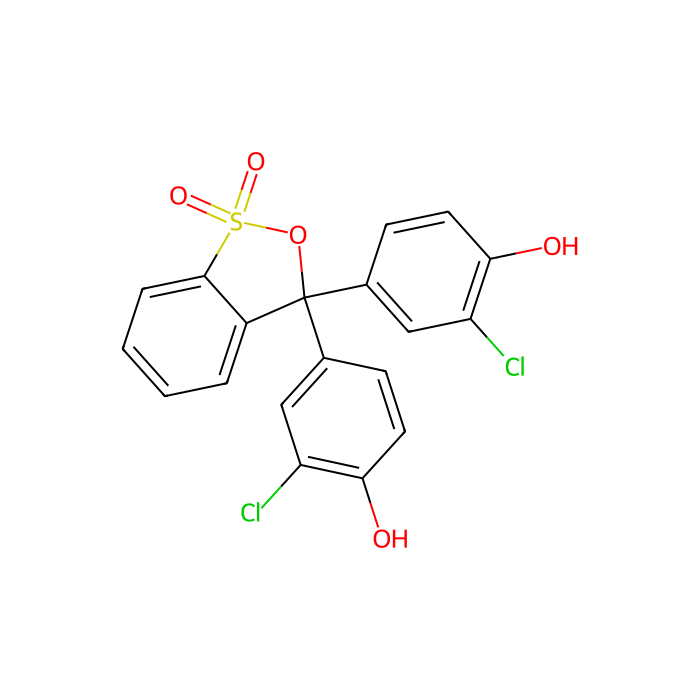
Rouge chlorophénol - indicateur , CAS No.4430-20-0

CAS: 4430-20-0 Cat. No.: C104980 Formule: C19H12Cl2O5S Poids moléculaire: 423.27 Beilstein Registry Number: 354053 Numéro CE: 224-619-2
DISPONIBLE À COMMANDE
QUALITÉ & PURETÉ Indicator ? Indicator grade — characterized dye giving a defined color change at a known transition. Use to signal pH or titration endpoints visually.
Synonyms
4,4'-(3H-2,1-Benzoxathiol-3-ylidene)bis[2-chlorophenol], 9CI|3',3'-Dichlorophenolsulfonaphthalein|Chlorphenol Red|Chlorphenolsulfonphthalein|3,3-Bis(3-chloro-4-hydroxyphenyl)-3H-benzo[c][1,2]oxathiole1,1-dioxide|3,3-bis(3-chloro-4-hydroxyphenyl)-3H-2,1lambda6-benzoxathiole-1,1-dione|3,3-bis(3-chloro-4-hydroxyphenyl)benzo[c]1,2-oxathiolene-1,1-dione|4,4'-(1,1-Dioxido-3H-2,1-benzoxathiol-3-ylidene)bis[2-chlorophenol]|4,4-(1,1-Dioxido-3H-2,1-benzoxathiol-3-ylidene)bis[2-chlorophenol]|3,3-Bis(3-chloro-4-hydroxyphenyl)3H-2,1-benzoxathiole S,S-dioxide|Dichlorophenolsulfonephthalein|ChlorophenolRed|Chlorophenol red indicator|2-Chloro-4-[3-(3-chloro-4-hydroxy-phenyl)-1,1-dioxo-benzo[c]oxathiol-3-yl]phenol|Chlorophenol Red, indicator grade|3,3-Bis(3-chloro-4-hydroxyphenyl)-3H-benzo[c][1,2]oxathiole 1,1-dioxide|Phenol,4'-(3H-2,1-benzoxathiol-3-ylidene)bis[2-chloro-, S,S-dioxide|Phenol, 4,4'-(1,1-dioxido-3H-2,1-benzoxathiol-3-ylidene)bis(2-chloro-|4,4'-(3H-2,1-Benzoxathiol-3-ylidene)bis(2-chlorophenol) S,S-dioxide|3,3-bis(3-chloro-4-hydroxyphenyl)-3H-2,1$l^{6}-benzoxathiole-1,1-dione|CHLOROPHENOL RED|Phenol, 4,4'-(3H-2,1-benzoxathiol-3-ylidene)bis[2-chloro-, S,S-dioxide|2-chloro-4-[3-(3-chloro-4-hydroxy-phenyl)-1,1-dioxo-2,1$l^{6}-benzoxathiol-3-yl]phenol|2-chloro-4-[3-(3-chloro-4-hydroxyphenyl)-1,1-dioxo-2,1$l^{6-benzoxathiol-3-yl]phenol|3,3'-Dichlorophenolsulfonephthalein|2-chloro-4-[3-(3-chloro-4-hydroxyphenyl)-1,1-dioxo-2,1lambda6-benzoxathiol-3-yl]phenol|3',3''-Dichlorophenolsulfonphthalein|Phenol, 4,4'-(3H-2,1-benzoxathiol-3-ylidene)bis(2-chloro-, S,S-dioxide
Storage
Room temperature
Shipped In
Normal
★
Taille
USA
Allemagne (EU)*
Prix
Qté
1g
C104980-1g
3 En stock
—
9,90$US
5g
C104980-5g
2 En stock
—
25,90$US
25g
C104980-25g
1 En stock
—
113,90$US
Enter a quantity for the sizes you want to add.

Spécifications

Synonymes
4,4'-(3H-2,1-Benzoxathiol-3-ylidene)bis[2-chlorophenol], 9CI | 3',3'-Dichlorophenolsulfonaphthalein | Chlorphenol Red | Chlorphenolsulfonphthalein | 3,3-Bis(3-chloro-4-hydroxyphenyl)-3H-benzo[c][1,2]oxathiole1,1-dioxide | 3,3-bis(3-chloro-4-hydroxyphenyl)-3H-2,1lambda6-benzoxathiole-1,1-dione | 3,3-bis(3-chloro-4-hydroxyphenyl)benzo[c]1,2 Afficher plus
Spécifications et pureté
indicateur
Mécanismes biochimiques et physiologiques
Le rouge de chlorophénol est un indicateur de pH. Il est utilisé comme transducteur optique de l'inhibition de l'acétylcholinestérase par les analytes. Le rouge de chlorophénol est également utilisé pour déterminer sélectivement le dioxyde de chlore dans
Conditions de stockage de stockage
Room temperature
Expédié en
Normal
Grade
Indicator
Noms et identifiants
Pubchem Sid
Pubchem Sid Url
https://pubchem.ncbi.nlm.nih.gov/substance/488182625
Sourires canoniques
C1=CC=C2C(=C1)C(OS2(=O)=O)(C3=CC(=C(C=C3)O)Cl)C4=CC(=C(C=C4)O)Cl
IUPAC Name
2-chloro-4-[3-(3-chloro-4-hydroxyphenyl)-1,1-dioxo-2,1λ6-benzoxathiol-3-yl]phenol
InChIKey
WWAABJGNHFGXSJ-UHFFFAOYSA-N
INCHI
1S/C19H12Cl2O5S/c20-14-9-11(5-7-16(14)22)19(12-6-8-17(23)15(21)10-12)13-3-1-2-4-18(13)27(24,25)26-19/h1-10,22-23H
Isomères SMILES
C1=CC=C2C(=C1)C(OS2(=O)=O)(C3=CC(=C(C=C3)O)Cl)C4=CC(=C(C=C4)O)Cl
WGK Allemagne
3
Poids moléculaire
423.27
Beilstein
354053
Reaxy-Rn
354053
Reaxys-RN_link_address
https://www.reaxys.com/reaxys/secured/hopinto.do?context=S&query=IDE.XRN=354053&ln=

Données avancées

Taxonomic Classification

Taxonomy Tree

KingdomOrganic compounds
SuperclassOrganoheterocyclic compounds
ClasseBenzofurans
SubclassBenzofuranones
Intermediate Tree Nodes Not available
Direct ParentBenzofuranones
Alternative Parents Phthalides  Benzoxathioles  O-chlorophenols  Chlorobenzenes  1-hydroxy-2-unsubstituted benzenoids  Organosulfonic acid esters  Aryl chlorides  Oxacyclic compounds  Organooxygen compounds  Organochlorides  Organic oxides  Hydrocarbon derivatives  
Molecular FrameworkAromatic heteropolycyclic compounds
Substituents Benzofuranone - Phthalide - Benzoxathiole - 2-halophenol - 2-chlorophenol - 1-hydroxy-2-unsubstituted benzenoid - Chlorobenzene - Halobenzene - Phenol - Aryl chloride - Aryl halide - Monocyclic benzene moiety - Benzenoid - Organosulfonic acid ester - Organosulfonic acid or derivatives - Organic sulfonic acid or derivatives - Oxacycle - Organic oxygen compound - Hydrocarbon derivative - Organic oxide - Organohalogen compound - Organochloride - Organooxygen compound - Aromatic heteropolycyclic compound
DescriptionThis compound belongs to the class of organic compounds known as benzofuranones. These are organic compounds containing a benzene ring fused to a furanone.
External Descriptors Not available
Structure 3D
Modèle de structure chimique interactif


Certificats (CoA, COO, BSE/TSE et tableau d'analyse)
C of A & Other Certificates(BSE/TSE, COO):
Analytical Chart:

Find and download the COA for your product by matching the lot number on the packaging.

14 results found

Lot NumberCertificate TypeDateArticle
F23141101F23141101Certificate of AnalysisMar 04, 2025 C104980
H2302458H2302458Certificate of AnalysisFeb 28, 2025 C104980
H2302462H2302462Certificate of AnalysisFeb 28, 2025 C104980
H2302463H2302463Certificate of AnalysisFeb 28, 2025 C104980
H2302466H2302466Certificate of AnalysisFeb 28, 2025 C104980
H2302469H2302469Certificate of AnalysisFeb 28, 2025 C104980
B2520318B2520318Certificate of AnalysisFeb 11, 2025 C104980
B2520325B2520325Certificate of AnalysisFeb 11, 2025 C104980
K2125666K2125666Certificate of AnalysisAug 15, 2023 C104980
H2302464H2302464Certificate of AnalysisJul 18, 2023 C104980
F2314976F2314976Certificate of AnalysisMay 27, 2023 C104980
F2314981F2314981Certificate of AnalysisMay 27, 2023 C104980
B2314436B2314436Certificate of AnalysisFeb 20, 2023 C104980
J1825139J1825139Certificate of AnalysisJun 21, 2022 C104980
Propriétés chimiques et physiques
SensibilitéMoisture sensitive.
Point de fusion (°C)261-262°C
Poids moléculaire423.300 g/mol
XLogP34.300
Hydrogen Bond Donor Count2
Hydrogen Bond Acceptor Count5
Rotatable Bond Count2
Exact Mass421.978 Da
Monoisotopic Mass421.978 Da
Topological Polar Surface Area92.200 Ų
Heavy Atom Count27
Formal Charge0
Complexity625.000
Isotope Atom Count0
Defined Atom Stereocenter Count0
Undefined Atom Stereocenter Count0
Defined Bond Stereocenter Count0
Undefined Bond Stereocenter Count0
The total count of all stereochemical bonds0
Covalently-Bonded Unit Count1
FAQ et articles
Citations of This Product
Calculateurs de solution
Avis

Avis des clients

Application Protocols

No vendor-validated protocols were provided for this item. The following are general literature-style procedures for Chlorophenol red; optimize for your laboratory conditions.

  • Preparation of 0.04% indicator solution (literature example):

    1. Dissolve 40 mg Chlorophenol red in ~2 mL ethanol or add drops of 0.1 M NaOH to wet and dissolve.
    2. Dilute to 100 mL with deionized water. Filter through 0.2 µm PTFE or PES. Store protected from light at room temperature.
    3. For use, add 1–2 drops per 50–100 mL of solution for visual titrations, or dose to 10–50 µM for spectrophotometry.
  • Spectrophotometric pH determination (ratiometric):

    1. Prepare buffer series spanning pH 4.5–6.8.
    2. Add indicator to each to a final concentration of ~20 µM.
    3. Record absorbance at two wavelengths corresponding to the acid and base forms (e.g., 433 nm and 573 nm; instrument-dependent).
    4. Plot ratio A573/A433 vs pH to generate a calibration curve; interpolate unknown sample pH.
  • Immobilized pH sensor preparation (outline):

    1. Mix indicator with a sol–gel precursor or hydrogel solution.
    2. Cast onto a support and cure.
    3. Calibrate the film in standard buffers.

These are illustrative only; confirm compatibility with your assay components.

Biological Roles

Chlorophenol red has no intrinsic biological role; it is a synthetic sulfonephthalein dye used as a pH indicator. The content below reflects research and analytical contexts (literature/general), not therapeutic use.

  • Assay reporter: Because its acid–base transition occurs around pH ~6, it can serve as a spectrophotometric reporter for proton-generating or -consuming enzymatic reactions operating in mildly acidic buffers. The absorbance ratio between its acidic and basic forms enables continuous monitoring.
  • Immobilized sensing: Incorporated into hydrogels or sol–gel matrices, Chlorophenol red has been used to construct optical pH sensors for bioprocess monitoring in the 5–6.5 range, where many enzymes and microbes exhibit activity.
  • Compatibility: Indicator dyes can bind nonspecifically to proteins or membranes; empirical testing is advised to rule out interference with enzyme kinetics or microbial growth studies. Keep concentrations minimal to avoid perturbing biological systems and buffering capacity.
  • Spectral readout: Dual-wavelength readouts (e.g., A433/A573, instrument-dependent) are convenient for ratiometric correction of pathlength or dye concentration variations.

Note: No medical, diagnostic, or therapeutic claims are made. For cell culture media pH monitoring near neutrality, alternative indicators (e.g., Phenol Red, Bromothymol Blue) may be better matched to typical pH 7–7.5 conditions.

Buffer Applications

Chlorophenol red is widely used as a visual/spectrophotometric indicator in buffer systems spanning pH ~4.8–6.4 (literature). It is not a buffering agent itself but aids in pH adjustment and monitoring.

Practical guidance:

  • Choosing buffers: Pair with buffers whose working ranges overlap its transition, e.g., acetate (pH 3.8–5.8), citrate (pH 3–6.2), MES (pH 5.5–6.7). The indicator provides a quick visual cue while you confirm pH with a pH meter.
  • Typical stock preparation (example, literature):
    • 0.1% (w/v) stock: Dissolve 100 mg dye in a small volume of ethanol or add a few drops of 0.1 M NaOH to aid dissolution, then bring to 100 mL with water. Filter (0.2 µm) and store protected from light.
    • Working concentration: 5–100 µM (approximately 2–40 mg/L), depending on pathlength and detection method.
  • Spectral monitoring: Measure absorbance at two wavelengths corresponding to acidic and basic forms (instrument-dependent; commonly near 430–450 nm and 570–580 nm). Use the ratio for improved robustness.
  • Temperature/ionic strength: Both can shift apparent pKa. Calibrate the indicator in your specific buffer matrix and temperature before quantitative use.
  • Interferences: Strongly colored or turbid samples will complicate visual endpoints; rely on spectrophotometry or alternative indicators in such cases.

Note: Values here are literature guidance only and not specifications for this product.

Green Alternatives

For pH indication near weakly acidic to neutral conditions, Chlorophenol red is one option among several sulfonephthalein dyes. Greenness considerations revolve around solvent usage, dye loading, and persistence.

  • Reduce solvent impact: Prefer water as the primary medium. If a cosolvent is needed to dissolve the dye, choose ethanol over more hazardous solvents (e.g., DMF, DMSO) where compatible with your assay.
  • Lower dye loadings: Use the minimum concentration that affords a clear signal to reduce environmental release of persistent colorants.
  • Alternative indicators (literature; choose by pH window and hazard profile):
    • Bromothymol Blue (pH 6.0–7.6): Slightly higher range; often effective in purely aqueous systems.
    • Methyl Red (pH 4.4–6.2): Similar lower range; smaller, potentially easier to extract/remove from waste.
    • Natural dyes (anthocyanins): For demonstrations and non-critical applications, plant-derived indicators can reduce synthetic dye load, albeit with poorer stability.

Comparison (general):

  • Chlorophenol red offers strong, distinct color change over 4.8–6.4 and robust photostability but may require base neutralization for water solubility (free acid form).
  • Bromothymol Blue provides a greener endpoint around neutrality but with a shifted range that may not suit pH ~5.5 endpoints.

Waste minimization: Collect dye-containing aqueous waste separately for appropriate treatment to prevent coloration of effluents.

Pharmaceutical Uses

Chlorophenol red is not an excipient for therapeutic effect; in pharmaceutical and compendial contexts it serves as an analytical indicator.

  • Analytical indicator: Employed in titrimetric or spectrophotometric assays to signal endpoints in the pH range ~4.8–6.4 (literature). It can assist in process control where pH drift is critical during manufacture of acid-labile substances.
  • Method development: Useful as a visual tracer for optimizing buffer capacity around pH 5–6, e.g., for stability-indicating studies of APIs sensitive to mild acidity.
  • Formulation R&D: Can be used in prototype formulations as a colorimetric probe for diffusion/release studies in model systems. Remove/replace with suitable colorants or none in final products.

Caveats:

  • Regulatory status: No pharmacopeial grade or monograph is stated for this specific item; refer to the CoA/Spec Sheet if compendial compliance is required.
  • Extractables/leachables: When used in contact with packaging or device materials during studies, consider potential sorption or staining of polymeric surfaces.

No medical or clinical claims are made; usage is limited to research and analytical development settings.

Physical Properties

Item-specific specs

  • Molecular formula: Not specified for this item; refer to CoA/Spec Sheet.
  • Molecular weight: Not specified for this item; refer to CoA/Spec Sheet.
  • Appearance: Not specified for this item; refer to CoA/Spec Sheet.

Typical properties (literature, for context only; not product specifications)

  • Indicator transition range: Approximately pH 4.8–6.4 (yellow → red) at 25 °C.
  • pKa (at 25 °C, aqueous): ~6.0 (indicator constant), sensitive to ionic strength and solvent composition.
  • UV–Vis absorption (aq.): Acidic form λmax typically near 430–450 nm; basic form λmax typically near 570–580 nm. Exact maxima depend on solvent, ionic strength, and concentration.
  • Solubility: The neutral (free-acid) dye is sparingly soluble in pure water but dissolves in polar organic solvents (e.g., ethanol) and becomes water-soluble upon neutralization to its salt (e.g., sodium salt) with dilute base.
  • Thermal behavior: Dye indicators can darken on prolonged heating; avoid high temperatures to preserve color fidelity.

Practical note: For analytical use, prepare fresh aqueous stocks by dissolving in a small volume of ethanol or by neutralizing with dilute NaOH, then diluting with water or buffer. Verify absorbance spectrum and apparent pKa under your exact conditions.

Quality and Grades

Item-specific grade

  • Grade/Purity: Indicator (as provided)

What “Indicator grade” implies (general guidance)

  • Indicator grade emphasizes correct and reproducible color transition behavior within the stated pH range, low levels of impurities that would shift the apparent pKa or introduce background absorbance, and batch-to-batch consistency in the absorbance spectrum.
  • Chromatic purity: Dye content is controlled to deliver expected λmax positions and color intensity at specified concentration, enabling reliable titration/colorimetry.
  • Performance checks often include: conformity of pH transition range, absorbance ratio of acidic/basic forms at benchmark pH values, and minimal UV–Vis baseline impurities in the analytical window.

What is not specified for this item

  • Specific numeric purity, metal content, residual solvents, water content, and stabilizers are not specified for this item; refer to the CoA/Spec Sheet and SDS for detailed quality attributes.

Practical guidance

  • For quantitative spectrophotometry, verify the spectrum and apparent pKa in your matrix (buffer composition and ionic strength can shift values slightly).
  • If trace absorbance is critical (e.g., enzyme kinetic assays), consider filtering stock solutions (0.2 µm) and using freshly prepared solutions to minimize degradation and particulate scatter.
Reaction and Applications

Primary role: Chlorophenol red is an acid–base indicator used for monitoring pH visually or spectrophotometrically in the mildly acidic to near-neutral region (literature transition range ~4.8–6.4, yellow → red).

Representative applications (literature/general):

  • Visual titrations: End-point detection for weak acid/weak base titrations centered near pH ~6.
  • Spectrophotometric pH monitoring: Ratiometric absorbance near λ ~ 430–450 nm (acid form) and ~570–580 nm (base form) for kinetic assays and buffer capacity studies.
  • Enzyme assays: Tracking proton release/consumption in reactions operating close to pH 6 (e.g., phosphatases or glycosidases) by coupling activity to indicator absorbance changes; verify no enzyme–dye interactions.
  • Immobilized sensors: Entrapment in sol–gel or polymer matrices to construct colorimetric pH sensors for aqueous systems in the target range.

Practical tips:

  • Prepare stocks at known ionic strength; apparent pKa is ionic-strength dependent. Calibrate with standard buffers.
  • Maintain low indicator concentration (typically 5–100 µM) to minimize indicator-induced buffering and inner-filter effects.
  • Avoid prolonged exposure to strong bases/acids or oxidants that degrade the chromophore, shifting λmax and color fidelity.

Note: No manufacturer application text was provided for this item; applications above are general literature use cases for this indicator class.

Reaction Conditions

Because Chlorophenol red functions as an indicator, not a reactant, “reaction conditions” pertain to its analytical performance (literature/general):

  • Concentration: 5–100 µM in aqueous buffers is typical for spectrophotometry. Lower concentrations (<20 µM) minimize inner-filter effects at λ ~570–580 nm.
  • Solvent: Water or aqueous buffer is preferred. If needed, pre-dissolve in minimal ethanol or add a small amount of dilute NaOH to aid dissolution, then dilute to final volume with buffer.
  • Temperature: Calibrate at the working temperature; apparent pKa shifts by several tenths of a pH unit with temperature and ionic strength.
  • pH range of utility: Approximately 4.8–6.4. Outside this range, color change is weak or saturated.
  • Spectral settings: Monitor Aacid near 430–450 nm and Abase near 570–580 nm; use ratiometric analysis for robust quantitation.
  • Light/oxygen: Protect solutions from strong light; avoid oxidizing environments that may bleach the dye.

Expected performance (general):

  • Rapid, reversible response to pH changes within milliseconds to seconds in well-mixed solutions.
  • Stability: Fresh solutions generally maintain spectral fidelity over days at room temperature when protected from light; verify baseline regularly.

Note: No batch-specific performance data are provided for this item; consult the CoA for any available QC photometric criteria.

Safety and Handling

GHS status provided for this item

  • Signal Word: Not specified for this item; refer to SDS.
  • H-Statements: Not specified for this item; refer to SDS.
  • GHS Classification/Pictograms: Not specified for this item; refer to SDS.

General laboratory safety (literature/good practice; defer to SDS for authority)

  • Handle as a laboratory chemical/indicator. Avoid inhalation of dusts and contact with skin/eyes. Use appropriate PPE: lab coat, safety glasses, and gloves (e.g., nitrile).
  • Work in a fume hood when weighing powders or preparing concentrated solutions to minimize dust and inhalation exposure.
  • Hygiene: Wash hands thoroughly after handling; avoid contamination of common surfaces due to the intense coloration.
  • Incompatibilities: Strong oxidizers and strong reducing agents may degrade the chromophore. Very strong acids/bases can irreversibly alter the dye; prolonged exposure to high pH may bleach the color.
  • Light sensitivity: Store solutions protected from light to preserve molar absorptivity and transition behavior.
  • First aid (overview): If on skin/eyes, rinse with water for several minutes; remove contaminated clothing. If inhaled, move to fresh air. If ingested, rinse mouth. Seek medical attention as appropriate.
  • Spills/waste: Absorb small spills with inert material; dispose in accordance with institutional and local regulations for organic dyes.

Always consult the product SDS for definitive hazard and handling information.

Solvent Selection

As a solid pH indicator dye, Chlorophenol red is not used as a reaction solvent. Solubility and vehicle choice matter for preparing indicator solutions.

  • Aqueous use: The salt form (e.g., sodium salt formed in situ with dilute NaOH) is water-soluble and suitable for buffers and aqueous titrations in the pH transition range ~4.8–6.4 (literature).
  • Co-solvents: Ethanol or methanol are commonly used to first wet/dissolve the dye before dilution with water or buffer; keep organic content low (<5–10%) to avoid perturbing pKa or assay systems.
  • Non-aqueous systems: For specialized non-aqueous acid–base titrations, more strongly polar aprotic solvents (DMF, DMSO) can dissolve the neutral dye, but the indicator behavior and color endpoints differ from aqueous values (literature). Validate before use.
  • Comparison to alternatives: Phenol Red (higher pH range) and Bromocresol Purple (similar but slightly lower range) may be preferable depending on target pH. Choose the indicator whose transition bracket straddles your endpoint.

Tip: Filter freshly prepared indicator solutions to remove undissolved particulates that can seed background turbidity and scattering in spectrophotometric measurements.

Storage and Reconstitution

Item-specific storage

  • Storage Conditions: Room temperature (as provided)
  • Shipped In: Normal conditions (as provided)

General guidance (literature/general)

  • Solid stability: Store tightly capped in a dry place, protected from light. Avoid high humidity to prevent caking and color drift.
  • Reconstitution/preparation:
    • For aqueous use, either pre-dissolve in a small volume of ethanol or neutralize with dilute NaOH to form a water-soluble salt, then dilute with water or buffer to the desired concentration.
    • Typical working concentrations: 5–100 µM for spectrophotometry; a few drops of a 0.04–0.1% solution per 50–100 mL for visual titration.
  • Solution handling: Prepare fresh solutions periodically. Store working solutions in amber glass at room temperature, protected from light. If microbial growth is a concern, filter-sterilize (0.2 µm) and consider cold storage; re-verify spectra before critical measurements.
  • Freeze–thaw: Not generally necessary for dye solutions. If refrigerated, allow to equilibrate to room temperature and inspect for precipitation; warm gently and mix to re-dissolve if needed.

Note: Specific shelf-life, stabilizers, water content, and exact solubility are not specified for this item; consult the CoA/Spec Sheet and SDS for authoritative information.

Structure and Identity

Item-specific identifiers (from Product Data)

  • SKU: C104980
  • Product Name: Chlorophenol red
  • CAS: 4430-20-0
  • PubChem CID: 20486
  • InChIKey: 409538 (as provided; truncated/not the standard 27-character form)
  • Grade: Indicator
  • Storage: Room temperature; shipped under normal conditions

Structural description (literature/general chemistry)

  • Compound class: Sulfonephthalein pH indicator dye (phenolsulfonphthalein family), chlorinated derivative.
  • Core features: Xanthene/sulfonephthalein scaffold bearing two phenolic hydroxyls and a sulfonate/sulfonyl bridge to a benzenoid ring. Two chloro substituents on the phenyl moiety increase acidity and shift the color transition to lower pH relative to Phenol Red.
  • Functional groups: Phenolic OH groups (acid–base active), sulfonyl bridge (–SO2– linking the phenolic/xanthene system to an aryl ring), multiple aromatic rings, halogen substituents (Cl).
  • Acid–base forms: Exhibits ring-opening and quinoid delocalization upon deprotonation; color change is governed by phenolate formation across the conjugated system.
  • 2D structure in words: A triarylmethane-like framework where two phenolic rings are fused (xanthene-type), connected via a sulfonyl bridge to a chlorinated phenyl ring; two phenolic OH groups enable reversible protonation/deprotonation that tunes the extended conjugation and visible absorbance.

Note: SMILES and full InChIKey were not provided for this item; refer to the CoA/Spec Sheet for definitive structural strings.

Synthetic Utility

Chlorophenol red is primarily a signaling molecule (pH indicator) rather than a synthetic building block. That said, several practical utilities in chemical workflows exist (literature/general):

  • Endpoint visualization: As an internal indicator in acid–base titrations near pH ~6, enabling precise quench/addition control in process chemistry.
  • Monitoring reactions that generate/consume protons: For example, hydrolysis or acylation reactions conducted in buffered media near the indicator’s transition range; visual or spectrophotometric tracking can aid kinetic studies.
  • Immobilization for sensors: The phenolic groups allow physical entrapment or covalent tethering (via linker chemistries to amine- or epoxy-functional supports) to fabricate solid-supported pH sensors used inline or in microreactors.
  • Teaching labs and method qualification: Provides a robust, easily observed transition suitable for validating pH meters, buffer preparations, and spectrophotometer wavelength accuracy via its acid/base spectra.

Limitations:

  • The dye is not typically used as a reagent or intermediate in bond-forming reactions, and the sulfonephthalein core is chemically inert under many conditions but can be degraded by strong oxidants or nucleophiles at elevated pH.
  • In non-aqueous titrations, behavior deviates from aqueous pKa; validate before use.
Target Specificity

Not applicable. Chlorophenol red is a small-molecule pH indicator and does not have biological targets, antigen specificity, clone, or isotype. For functional information, see the Reaction & Applications and Buffer Applications sections.

Foire aux questions

What does indicator mean?
indicator is a defined analytical purity tier suitable for quantitative analytical methods. It specifies a minimum assay percentage, controlled limits on common impurities (water, heavy metals, residue on ignition), and lot-to-lot consistency. indicator is one of several purity tiers — choose based on the sensitivity and regulatory requirements of your method.
How should this product be stored?
Store at room temperature.
How is this product shipped?
This product ships under standard ambient conditions. No temperature-controlled packaging is required.
What are the CAS number, molecular formula and molecular weight?
The CAS Number is 4430-20-0, the molecular formula is C19H12Cl2O5S, and the molecular weight is 423.27 g/mol. InChIKey WWAABJGNHFGXSJ-UHFFFAOYSA-N.
What documentation is provided?
Available product documentation, including Certificates of Analysis (COA), Safety Data Sheets (SDS), and specification sheets, is shown in the product document area. Document availability and access follow the current site policy.

Souhaitez-vous que nous vous envoyions un message lorsque des réductions seront disponibles?

Me rappeler plus tard

Merci ! Veuillez vérifier votre boîte de réception e-mail pour confirmer.

Oups ! Les notifications sont désactivées.