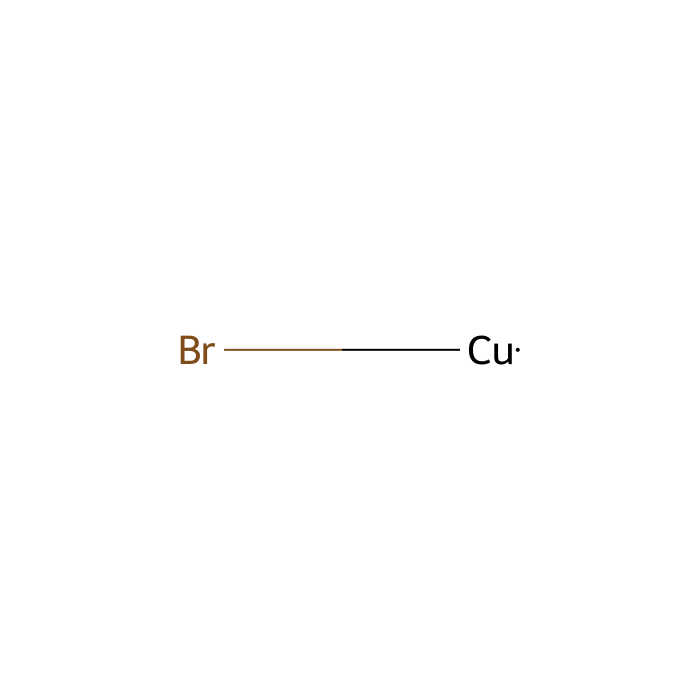
Cuprous bromide - PrimorTrace™, ≥99.99% metals basis , CAS No.7787-70-4

CAS: 7787-70-4 Cat. No.: C104701 Formule: CuBr Poids moléculaire: 143.45 Numéro CE: 232-131-6
DISPONIBLE À COMMANDE
QUALITÉ & PURETÉ PrimorTrace™ ? PrimorTrace™ — Aladdin's trace-metal-analysis line with ultra-low metal background. Use for ICP/AAS trace-metal work where contamination must be minimal. ≥99.99% metals basis
Synonyms
Copper(I) Bromide, Trace metals grade|Copper bromide (CuBr)|Copper( centn) bromide|copper(1)bromide|copper(1) bromide|copper-(1) bromide|CUPROUS BROMIDE|copper (1) bromide|copper- (I) bromide|Copper I Bromide|Copper(I) bromide|copper-(I) bromide|copper (I)bromide|Bromocopper|Copper(1+) bromide|copper-(I)bromide
Storage
Protected from light,Room temperature
Shipped In
Normal
★
Taille
USA
Allemagne (EU)*
Prix
Qté
10g
C104701-10g
3 En stock
—
122,90$US
50g
C104701-50g
1 En stock
—
355,90$US
Enter a quantity for the sizes you want to add.

Spécifications

Synonymes
Copper(I) Bromide, Trace metals grade | Copper bromide (CuBr) | Copper( centn) bromide | copper(1)bromide | copper(1) bromide | copper-(1) bromide | CUPROUS BROMIDE | copper (1) bromide | copper- (I) bromide | Copper I Bromide | Copper(I) bromide | copper-(I) bromide | copper (I)bromide | Bromocopper | Copper(1+) bromide | copper-(I)bromi Afficher plus
Spécifications et pureté
PrimorTrace™, ≥99.99% metals basis
Conditions de stockage de stockage
Protected from light,Room temperature
Expédié en
Normal
Grade
PrimorTrace™
Pureté
≥99.99% metals basis
Noms et identifiants
Pubchem Sid
SMILES
[Cu]Br
IUPAC Name
bromocopper
InChIKey
NKNDPYCGAZPOFS-UHFFFAOYSA-M
InChI
1S/BrH.Cu/h1H;/q;+1/p-1
Isomères SMILES
[Cu]Br
WGK Allemagne
3
Poids moléculaire
143.45
Reaxys
3902854
Reaxys-RN_link_address
https://www.reaxys.com/reaxys/secured/hopinto.do?context=S&query=IDE.XRN=3902854&ln=

Données avancées

Taxonomic Classification

Taxonomy Tree

KingdomInorganic compounds
SuperclassMixed metal/non-metal compounds
ClasseTransition metal salts
SubclassTransition metal bromides
Intermediate Tree Nodes Not available
Direct ParentTransition metal bromides
Alternative Parents Inorganic salts  
Molecular FrameworkNot available
Substituents Transition metal bromide - Inorganic salt
DescriptionThis compound belongs to the class of inorganic compounds known as transition metal bromides. These are inorganic compounds in which the largest halogen atom is Bromine, and the heaviest metal atom a transition metal.
External Descriptors Not available
Structure 3D
Modèle de structure chimique interactif


Certificats (CoA, COO, BSE/TSE et tableau d'analyse)
C of A & Other Certificates(BSE/TSE, COO):
Analytical Chart:

Find and download the COA for your product by matching the lot number on the packaging.

10 results found

Lot NumberCertificate TypeDateArticle
H2104115H2104115Certificate of AnalysisOct 09, 2026 C104701
H2402132H2402132Certificate of AnalysisMay 09, 2026 C104701
H2402134H2402134Certificate of AnalysisMay 09, 2026 C104701
C2613506C2613506Certificate of AnalysisMar 06, 2026 C104701
C2613507C2613507Certificate of AnalysisMar 06, 2026 C104701
H2402133H2402133Certificate of AnalysisJul 11, 2024 C104701
H2308260H2308260Certificate of AnalysisSep 05, 2022 C104701
I2209424I2209424Certificate of AnalysisSep 05, 2022 C104701
I2209425I2209425Certificate of AnalysisSep 05, 2022 C104701
H2224254H2224254Certificate of AnalysisJul 28, 2021 C104701
Propriétés chimiques et physiques
SensibilitéSensitive to light and air, argon filling operation and stor
Indice de réfraction2.116
Point d'ébullition (°C)1345°C
Point de fusion (°C)504°C
Poids moléculaire143.45
XLogP3
Hydrogen Bond Donor Count0
Hydrogen Bond Acceptor Count0
Rotatable Bond Count0
Exact Mass141.848 Da
Monoisotopic Mass141.848 Da
Topological Polar Surface Area0.000 Ų
Heavy Atom Count2
Formal Charge0
Complexity2.000
Isotope Atom Count0
Defined Atom Stereocenter Count0
Undefined Atom Stereocenter Count0
Defined Bond Stereocenter Count0
Undefined Bond Stereocenter Count0
The total count of all stereochemical bonds0
Covalently-Bonded Unit Count1
Sécurité et dangers (GHS)
Pictogramme(s)
GHS05,   GHS07,   GHS09
Signal
Danger
Mentions de danger

H302:Harmful if swallowed

H312:Harmful in contact with skin

H315:Causes skin irritation

H318:Causes serious eye damage

H319:Causes serious eye irritation

H335:May cause respiratory irritation

H400:Very toxic to aquatic life

H410:Very toxic to aquatic life with long lasting effects

Conseils de prudence

P261:Avoid breathing dust/fume/gas/mist/vapors/spray.

P264:Wash hands [and …] thoroughly after handling.

P270:Do not eat, drink or smoke when using this product.

P271:Use only outdoors or in a well-ventilated area.

P273:Avoid release to the environment.

P280:Wear protective gloves/protective clothing/eye protection/face protection.

P321:Specific treatment (see ... on this label).

P330:Rinse mouth.

P391:Collect spillage.

P302+P352:IF ON SKIN: wash with plenty of water.

P304+P340:IF INHALED: Remove person to fresh air and keep comfortable for breathing.

P305+P351+P338:IF IN EYES: Rinse cautiously with water for several minutes. Remove contact lenses if present and easy to do - continue rinsing.

P362+P364:Take off contaminated clothing and wash it before reuse.

P405:Store locked up.

P403+P233:Store in a well-ventilated place. Keep container tightly closed.

P501:Dispose of contents/container to an approved waste disposal plant.

P264+P265:Wash hands [and …] thoroughly after handling. Do not touch eyes.

P301+P317:IF SWALLOWED: Get medical help.

P305+P354+P338:IF IN EYES: Immediately rinse with water for several minutes. Remove contact lenses if present and easy to do. Continue rinsing.

P317:Get emergency medical help.

P337+P317:If eye irritation persists: Get medical help.

P332+P317:If skin irritation occurs: Get medical help.

P319:Get medical help if you feel unwell.

WGK Allemagne
3
Reaxys
3902854
Reaxys-RN_link_address
https://www.reaxys.com/reaxys/secured/hopinto.do?context=S&query=IDE.XRN=3902854&ln=
Index Merck
1684
FAQ et articles
TEMPO-Catalyzed Oxidation Quick Reference (Alcohol Oxidation Focus): Three Regeneration Routes (NaOCl / Cu–O₂ / PIDA) + Selection & Troubleshooting
Strategies and Progress in the Asymmetric Catalytic Synthesis of Chiral 1,2-Bis(boronic) Esters: Route Types, Selectivity Challenges, and Sequential Site Utilization (with Product Selection Navigator and Tables 1–4)
A Practical Guide to Small-Molecule Chemical Probes: Concept Clarification, Causal Validation, and Experimental Selection (with Product Navigation and Tables A–D)
Transition-Metal Salts/Precursor Selection Guide: How “Different Salts of the Same Metal” Start from Different Chemical Realities—and How to Reproduce Results (including a Selection Navigator and Product Tables 1–5)
Structural Features, Property Modulation, and Typical Applications of Triazole Compounds
Synthetic Application Logic of Triazoles and Related Compounds: Structural Introduction, Reactive Sites, and Target Molecule Construction
Reactions and Applications of 3,3-Difluoroallyl Sulfonium Salts (DFASs): Small-Molecule gem-Difluoroallylation, Selective Peptide Modification, and Subsequent Functionalization
Citations of This Product
Calculateurs de solution
Avis

Avis des clients

Souhaitez-vous que nous vous envoyions un message lorsque des réductions seront disponibles?

Me rappeler plus tard

Merci ! Veuillez vérifier votre boîte de réception e-mail pour confirmer.

Oups ! Les notifications sont désactivées.