Determine the necessary mass, volume, or concentration for preparing a solution.
| Activity Type | Relation | Activity value | Units | Action Type | Journal | PubMed Id | doi | Assay Aladdin ID |
|---|

10mM in DMSO for sensitive chromatographic and analytical workflows requiring minimal baseline interference.
Store at -80°C Ships Dry ice packs + Cold packs Check lot-specific COA for exact specifications.
SDS, COA, datasheet, and spec sheet available for download. Lot-specific COA accessible via lot number lookup.
Cited in 156 peer-reviewed publications across chromatography, organic synthesis, and cross-coupling reactions.
Product Application:
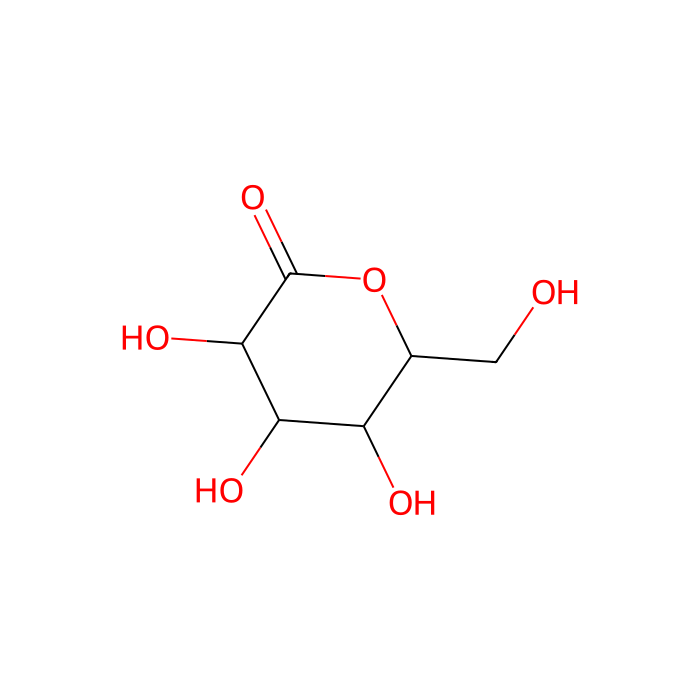
Glucono delta-lactone (GDL) is a kind of excellent multifunctional food additive. It is mainly used as protein coagulant, acidifier, pickling, or leavening agent. expander, preservative, seasonings, sequestrant, chelating agent, color-preserver, etc. it is widely applied to food, daily chemical industry, pharmaceuticals, cosmetics. Plastic and resinous modification, electrode position and polish, metal-surface cleaning and organic synthesis.
Comprehensive hazard, handling, storage, and regulatory compliance document.
Download SDS →Lot-specific quality data. Enter your lot number to retrieve the exact COA.
Look up COA →Full quality attributes and acceptance criteria for this grade.
View spec sheet →Taxonomy Tree
| Kingdom | Organic compounds |
|---|---|
| Superclass | Organic oxygen compounds |
| Classe | Organooxygen compounds |
| Subclass | Carbohydrates and carbohydrate conjugates |
| Intermediate Tree Nodes | Monosaccharides - Hexoses |
| Direct Parent | Gluconolactones |
| Alternative Parents | Delta valerolactones Oxanes Secondary alcohols Carboxylic acid esters Polyols Oxacyclic compounds Monocarboxylic acids and derivatives Primary alcohols Organic oxides Hydrocarbon derivatives Carbonyl compounds |
| Molecular Framework | Aliphatic heteromonocyclic compounds |
| Substituents | Gluconolactone - Delta valerolactone - Delta_valerolactone - Oxane - Carboxylic acid ester - Lactone - Secondary alcohol - Organoheterocyclic compound - Monocarboxylic acid or derivatives - Oxacycle - Carboxylic acid derivative - Polyol - Hydrocarbon derivative - Organic oxide - Alcohol - Primary alcohol - Carbonyl group - Aliphatic heteromonocyclic compound |
| Description | This compound belongs to the class of organic compounds known as gluconolactones. These are polyhydroxy acids containing a gluconolactone molecule, which is characterized by a tetrahydropyran substituted by three hydroxyl groups, one ketone group, and one hydroxymethyl group. |
| External Descriptors | aldono-1,5-lactone - gluconolactone |
| Activity Type | Relation | Activity value | Units | Action Type | Journal | PubMed Id | doi | Assay Aladdin ID |
|---|
| Activity Type | Relation | Activity value | Units | Action Type | Journal | PubMed Id | doi | Assay Aladdin ID |
|---|
| Activity Type | Relation | Activity value | Units | Action Type | Journal | PubMed Id | doi | Assay Aladdin ID |
|---|
| Activity Type | Relation | Activity value | Units | Action Type | Journal | PubMed Id | doi | Assay Aladdin ID |
|---|
| Sensibilité | Moisture sensitive; light sensitive |
|---|---|
| Rotation spécifique [α] | 63.5 ° (C=10, H2O) |
| Point de fusion (°C) | 160°C |
| Poids moléculaire | 178.140 g/mol |
| XLogP3 | -2.000 |
| Hydrogen Bond Donor Count | 4 |
| Hydrogen Bond Acceptor Count | 6 |
| Rotatable Bond Count | 1 |
| Exact Mass | 178.048 Da |
| Monoisotopic Mass | 178.048 Da |
| Topological Polar Surface Area | 107.000 Ų |
| Heavy Atom Count | 12 |
| Formal Charge | 0 |
| Complexity | 181.000 |
| Isotope Atom Count | 0 |
| Defined Atom Stereocenter Count | 4 |
| Undefined Atom Stereocenter Count | 0 |
| Defined Bond Stereocenter Count | 0 |
| Undefined Bond Stereocenter Count | 0 |
| The total count of all stereochemical bonds | 0 |
| Covalently-Bonded Unit Count | 1 |