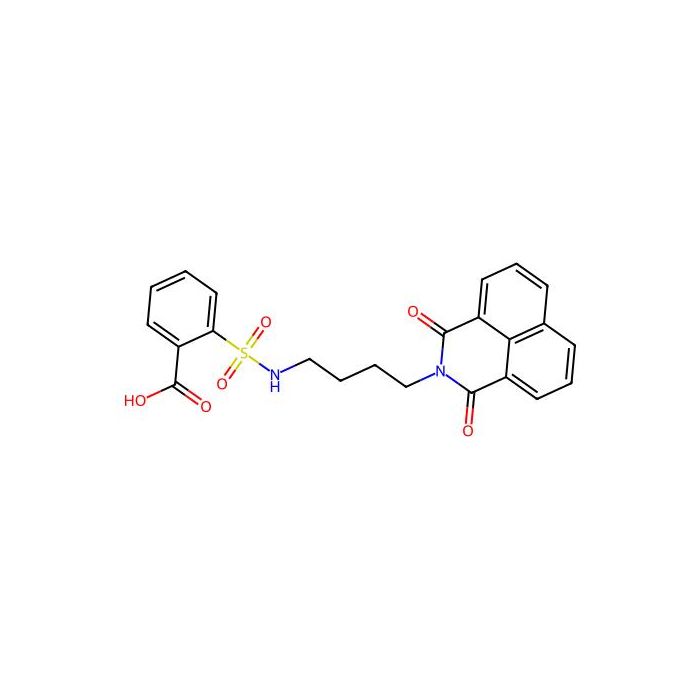
This compound belongs to the class of organic compounds known as isoquinolones and derivatives. These are aromatic polycyclic compounds containing a ketone bearing isoquinoline moiety.
External Descriptors
Not available
1. Djoumbou Feunang Y, Eisner R, Knox C, Chepelev L, Hastings J, Owen G, Fahy E, Steinbeck C, Subramanian S, Bolton E, Greiner R, and Wishart DS. ClassyFire: Automated Chemical Classification With A Comprehensive, Computable Taxonomy. Journal of Cheminformatics, 2016, 8:61.
Certificats (CoA, COO, BSE/TSE et tableau d'analyse)
C of A & Other Certificates(BSE/TSE, COO):
Analytical Chart:
Propriétés chimiques et physiques
Poids moléculaire
452.500 g/mol
XLogP3
3.100
Hydrogen Bond Donor Count
2
Hydrogen Bond Acceptor Count
7
Rotatable Bond Count
8
Exact Mass
452.104 Da
Monoisotopic Mass
452.104 Da
Topological Polar Surface Area
129.000 Ų
Heavy Atom Count
32
Formal Charge
0
Complexity
808.000
Isotope Atom Count
0
Defined Atom Stereocenter Count
0
Undefined Atom Stereocenter Count
0
Defined Bond Stereocenter Count
0
Undefined Bond Stereocenter Count
0
The total count of all stereochemical bonds
0
Covalently-Bonded Unit Count
1
Calculateurs de solution
Molarity Calculator
Determine the necessary mass, volume, or concentration for preparing a solution.
Dilution Calculator
Determine the dilution needed to prepare a stock solution.
Reconstitution Calculator
Avis
Avis des clients
Application Protocols
No tested application protocols are provided for Dbibb. There are no validated methods, dilutions, or positive controls listed for this item.
General best practices for method development with small molecules:
Establish analytical methods first (HPLC/UPLC-UV, LC–MS) for purity, identity, and stability-indicating capability.
If used in biochemical/cellular assays, prepare DMSO stocks (e.g., 10–50 mM), filter (0.22 μm), and validate final solvent percentages to avoid assay interference.
For synthetic use, document stoichiometry, solvent, temperature, time, and workup rigorously; archive spectra for every intermediate.
Please consult the CoA/SDS and contact Technical Support for any lot-specific handling or application details.
Biological Roles
Item-specific biological/biochemical roles are not provided for Dbibb, and the structure is undisclosed here. Without a defined molecular identity, no assertions can be made regarding metabolic pathways, targets, or cellular functions.
General notes for research chemicals:
If Dbibb is intended for biochemical assays, first establish purity and stability in the assay matrix (buffer, serum, cell culture media) and assess solubility and aggregation (e.g., DLS, detergent controls).
Evaluate nonspecific binding to plastics and proteins and determine logD (pH 7.4) experimentally if permeability is relevant.
Run counter-screens for PAINS/interference (redox cycling, fluorescence quench/emit, metal chelation) before interpreting bioassay hits.
Compliance statement:
This product is supplied for research use only. It is not intended for diagnostic, therapeutic, or clinical use. No biological performance claims are made for this item.
Buffer Applications
Not typically applicable. Dbibb is listed as a small-molecule research chemical with no disclosed acid/base properties or pKa. Without structural information, it cannot be recommended as a buffering agent.
If Dbibb is to be used in aqueous systems for assay work:
Determine aqueous solubility and potential ionization behavior experimentally.
Prepare stock solutions in a miscible organic co-solvent (e.g., DMSO, MeOH) and dilute into the target buffer while monitoring for precipitation.
Use standard biological buffers (e.g., PBS, HEPES, Tris) appropriate to your application rather than relying on Dbibb for buffering capacity.
Green Alternatives
Because the identity and solvent context for Dbibb are not provided, specific substitutions cannot be recommended. However, you can improve sustainability around its use by prioritizing greener solvents and conditions during synthesis, workup, and purification.
General greener-solvent guidance (CHEM21/ACS GCI principles):
Prefer 2-MeTHF, CPME, ethyl acetate, IPA, MeOH, MeCN (when justified) over chlorinated solvents where feasible.
Replace DMF/DMAc/NMP with dimethyl carbonate, Propylene carbonate, Cyrene, sulfolane when compatible.
Employ water or water/EtOH systems for extractions and crystallizations when solubility allows.
Trade-offs (general):
2-MeTHF/CPME are more hydrophobic than THF/Et2O, facilitating phase separations but may show different reactivity profiles.
MeCN offers low viscosity and good chromatographic behavior but has toxicity considerations; IPA/EtOAc are often safer.
Operational levers:
Use microscale optimization, flow chemistry, or biocatalysis where applicable to reduce solvent and energy use.
Minimize silica-gel chromatography by crystallization or precipitation methods.
Summary: Apply solvent selection tools (e.g., GSK/ACS solvent guides) once Dbibb’s solubility/reactivity are known to identify the lowest-hazard solvent that maintains performance.
Pharmaceutical Uses
No pharmacopeial status, excipient role, or formulation guidance is provided for this item. Dbibb is sold for research use only and is not intended for human or veterinary use.
General formulation considerations when handling unknown small molecules in preclinical research:
Establish a safe and stable vehicle (e.g., PEG400/saline, Captisol, mixed cosolvents) only after confirming solubility and chemical stability. Document pH and osmolality if used in in vivo research settings at your institution (subject to institutional approvals).
Screen solid-state forms (amorphous vs crystalline) and consider salt/cocrystal formation strategies if ionizable functional groups are present.
Evaluate photostability and oxidative stability to set protection requirements (amber vials, inert gas).
Important: Aladdin Scientific makes no claims regarding suitability for clinical applications. For any GLP/GMP or clinical pathway, request comprehensive documentation and qualify the material per your quality system.
Physical Properties
Item-specific properties from Product Data/CoA:
Appearance: Not specified for this item; refer to CoA/Spec Sheet.
Melting/Boiling Point, Density, Refractive Index, pKa, logP, UV cut-off, Water/Peroxide content, Residual solvents: Not specified for this item; refer to CoA/Spec Sheet.
Literature/computed values:
No public structural data were provided here; literature values cannot be cited without a defined structure. Consult PubChem CID 73296092 for any available third-party data and reconcile with the CoA for the exact lot.
General characterization guidance (for unknown small-molecule solids/liquids):
If a crystalline solid, determine mp by DSC/capillary; if an oil, report viscosity qualitatively and density by pycnometry.
Record UV–Vis spectrum (200–400 nm) in a suitable solvent for impurity screening; if intended for chromatography, note UV response at 210/254 nm.
For acid/base behavior, run a micro pH-solubility profile or titration (Sirius T3/AutoTitrator) to estimate pKa if relevant to your workflow.
For air/moisture/peroxide-prone classes (e.g., ethers, aldehydes), run peroxide or carbonyl assays before scale-up. Absent structure, treat as potentially sensitive.
Quality and Grades
Item-specific quality information:
Grade/Purity: Not specified for this item; refer to CoA/Spec Sheet.
Stabilizers/Inhibitors: Not specified for this item; refer to CoA/Spec Sheet.
Interpreting grades (general guidance):
Analytical/AR grade: Tight impurity control suitable for general analytical work.
HPLC/LC–MS grade: Optimized for low UV background and low volatile/nonvolatile residue; ideal for trace analytics.
Synthesis grade: Purity appropriate for routine reactions; may not meet UV/trace-metal thresholds required for analytics or catalysis.
Anhydrous/dry solvents/reagents: Supplied with water specification and packaging that maintains dryness; requires careful handling to preserve specification.
What to check on the CoA for this item:
Assay/purity method (HPLC/GC/NMR) and any related substances profile.
Water content (Karl Fischer) and, where applicable, residual solvents.
Trace metals (ICP) if the compound is intended for metal-catalyzed coupling.
Any stabilizer (e.g., BHT, acid) that could interfere with your application and may require pre-use treatment (e.g., inhibitor removal, base-wash, distillation, or column cleanup).
Recommendation: Validate fitness-for-use via a small pilot run and analytical check (LC–MS/HPLC) with your exact method before committing to scale.
Reaction and Applications
Manufacturer-supplied application notes are not provided for this item, and the compound’s functional groups are not disclosed. As such, no specific reaction roles can be asserted for this material.
General guidance when introducing an unfamiliar small molecule into synthesis:
Perform quick compatibility assays with common bases (e.g., DIPEA, K2CO3), acids (TFA, AcOH), and catalysts (Pd/C, Pd(PPh3)4) on micro-scale to detect instability.
Run stability studies in typical workup media (water, brine, bicarbonate, dilute acid) to avoid decomposition or emulsions.
If coupling chemistry is suspected (e.g., potential aryl halide, carboxylic acid, amine), verify with test reactions (Suzuki/amide formation/reductive amination) under mild conditions first.
If redox-active, check behavior under hydrogenation (H2, Pd/C) and oxidation (m-CPBA, oxone) on mg-scale.
Track transformations by LC–MS to profile byproducts and adjust conditions.
Note: Absent structure, treat Dbibb as a generic organic intermediate. Document findings and, once the CoA/SDS reveal functional groups, refine conditions (solvent, base, temperature) consistent with that class.
Reaction Conditions
No reaction conditions are specified for Dbibb, and without known functionality, only general guidance can be provided. After confirming the structure, consult literature precedents for the identified functional groups.
General condition heuristics by class (illustrative, literature-based, not item-specific):
Aryl halide couplings (Suzuki): Pd(PPh3)4 or Pd(dppf)Cl2, base (K2CO3, K3PO4), THF/2-MeTHF/DMF with water cosolvent, 50–90 °C, 1–12 h.
Amide coupling: EDC·HCl/HOBt or HATU/DIPEA in DMF/MeCN, 0–25 °C to rt, 1–16 h.
Reductive amination: NaBH3CN or BH3·THF, MeOH/THF, pH 5–6 (AcOH), 0–25 °C, 1–6 h.
Hydrogenation: H2, Pd/C (5–10 wt%), EtOH/EtOAc, rt–40 °C, 1–24 h.
Practical tips:
Begin with mg-scale scouting and a design-of-experiments mindset (solvent/base/catalyst/temperature).
Track conversions with LC–MS/UPLC; check mass balance for instability.
For moisture/air-sensitive substrates, employ glovebox or rigorous Schlenk technique.
Note: These are general literature conditions. Do not apply directly to Dbibb without establishing compatibility based on its confirmed structure.
Safety and Handling
Authoritative safety source: always defer to the product-specific SDS.
Item-specific safety data (from Product Data):
GHS Classification / Signal Word / H-Statements / Pictograms: Not specified for this item; refer to SDS.
Storage: Store at −20 °C (Product Data).
Shipping:Ice chest + ice pads (Product Data).
General laboratory precautions for an unclassified small-molecule research chemical:
PPE: Lab coat, safety glasses or splash goggles, and appropriate chemically resistant gloves (e.g., nitrile). Work in a fume hood.
Incompatibilities (conservative): Until identity is confirmed, avoid contact with strong oxidizers, strong acids/bases, and reducing agents. Segregate from ignition sources and reactive metals.
Atmosphere: If hygroscopic, air/moisture sensitive, or oxidizable, handle under dry nitrogen/argon; use desiccation.
Spill/Exposure (overview):
Skin/eye contact: rinse with water for ≥15 min; remove contaminated clothing; seek medical advice.
Inhalation: move to fresh air; obtain medical attention if symptoms persist.
Ingestion: rinse mouth; do not induce vomiting; seek medical attention.
Waste: Dispose according to local regulations; classify based on actual hazard profile once known.
Note: Because no GHS elements are provided, do not assume non-hazardous status. Review the lot-specific SDS before use.
Solvent Selection
Item-specific solubility data are not provided. Without a defined structure, solvent behavior must be established empirically.
Practical screening strategy:
Start with a tiered solvent set across polarity/hydrogen-bonding space: hexanes, toluene, DCM, EtOAc, MeCN, acetone, MeOH, IPA, DMF, DMSO, water (if applicable).
Assess room-temperature solubility (qualitative: insoluble/slightly/moderately/freely) and thermal solubility (40–60 °C).
For analytical prep, prioritize solvents compatible with your analytical platform (e.g., MeCN/H2O for LC, hexanes/DCM/EtOAc for GC-amenable workup).
General considerations:
If the compound is nonpolar, aromatic solvents or EtOAc/DCM often provide good solubility; for polar/ionic species, DMSO/DMF/MeOH may be necessary.
For moisture-sensitive substrates, use anhydrous solvents and handle under inert atmosphere.
For crystallization, identify antisolvent pairs (e.g., dissolve in hot EtOAc, precipitate with hexanes).
Protic polar (MeOH, IPA): enable acid/base manipulations; may promote side reactions.
Strongly polar aprotic (DMSO, DMF): broad solvation power; harder to remove; consider toxicity and workup.
Note: Record solvent choice, concentration, and temperature for reproducibility.
Storage and Reconstitution
Item-specific storage and shipping (from Product Data):
Storage: Store at −20 °C.
Shipping:Ice chest + ice pads to maintain low temperature during transit.
General guidance (absent item-specific formulation data):
Keep container tightly closed in a dry, well-ventilated place. If the compound is moisture- or air-sensitive, consider argon/nitrogen blanketing.
Upon first opening, work quickly to minimize temperature cycling and condensation; if feasible, aliquot into small vials to avoid repeated freeze–thaw.
If supplied as a solid: reconstitute in a suitable solvent after a brief equilibration to room temperature under dry conditions. Start with DMSO, DMF, MeCN, MeOH, EtOAc, DCM for screening.
If supplied as an oil/solution: verify concentration by qNMR or weight-by-difference; consider drying over molecular sieves if water-sensitive.
Light/oxidation: If chromophoric or oxidizable, store in amber vials with BHT/antioxidant only if validated for your application (not specified for this item; refer to CoA/Spec Sheet).
For research use only. Consult the lot-specific CoA/SDS for definitive instructions.
Structure and Identity
Brief overview: This listing is for a research-grade small molecule sold under the catalog name “Dbibb.” Item-specific structural data have not been disclosed in the Product Data.
Item-specific (from Product Data):
SKU: D980629
Product Name: Dbibb
CAS: 1569309-92-7
PubChem CID: 73296092
InChIKey: 282862 (as provided; appears truncated/non-standard; verify against CoA/SDS)
SMILES: Not specified for this item; refer to CoA/Spec Sheet.
Molecular Formula: Not specified for this item; refer to CoA/Spec Sheet.
Molecular Weight: Not specified for this item; refer to CoA/Spec Sheet.
Structural features and 2D description:
Not available for this item. Without a SMILES/InChI or structure drawing, functional-group and ring-system annotations cannot be provided.
Guidance for identity confirmation (general best practice):
Verify identity upon receipt via LC–MS (m/z vs expected), 1H/13C NMR (solvent selection based on trial solubility), and HPLC/UPLC purity profiling.
If the InChIKey in the paperwork differs from the Product Data, default to the CoA and contact Technical Support for reconciliation.
For regulatory documentation (custom specs, metal screening, residual solvent profile), request the lot-specific CoA/SDS.
Synthetic Utility
Specific functional groups for Dbibb are not disclosed, so targeted synthetic roles cannot be claimed. The following outlines a general framework to assess and exploit synthetic utility once the structure is confirmed from the CoA/SDS.
Functional-group mapping: Use NMR/IR/HRMS to annotate handles (e.g., aryl halide, boronate, acid, amine, alcohol, nitrile). This dictates entry into couplings, condensations, reductions/oxidations, or protect–deprotect sequences.
Protecting groups: If polyfunctional, plan orthogonal protection (Boc/Fmoc/CBz; TBDMS/TBS for alcohols) before multistep sequences.
Divergent synthesis: Identify branch points enabling access to analog libraries by late-stage diversification (e.g., Suzuki, Buchwald–Hartwig, Chan–Lam, amide couplings).
Purification: Choose trituration/crystallization over silica chromatography when possible; for basic/acidic compounds, leverage acid–base extraction.
Analytical control: Monitor with LC–MS and quantitative 1H NMR (with internal standard) to manage mass balance and byproducts.
Outcome: Once Dbibb’s reactive motifs are known, embed it into an efficient route with green solvent choices and robust workups to maximize yield and reproducibility.
Target Specificity
Not applicable. Dbibb is not supplied as a biological macromolecule or antibody in this listing, and no target, epitope, clone, or species-reactivity information is provided.
Item-specific fields (antibody/biologic metadata such as antigen, isotype, conjugate, tested applications) are not specified for this item.
For biochemical use, determine any putative target engagement empirically using orthogonal assays and proper controls.
We use cookies to ensure the website functions properly and, where permitted, to improve your experience. You can manage your preferences at any time in Settings. Learn more in our Cookie Policy.
Shall we send you a message when we have discounts available?
Remind me later
Thank you! Please check your email inbox to confirm.
Products are supplied to verified businesses, institutions, and qualified professionals for research and development use only. Not for use in humans, animals, diagnosis, or therapy.