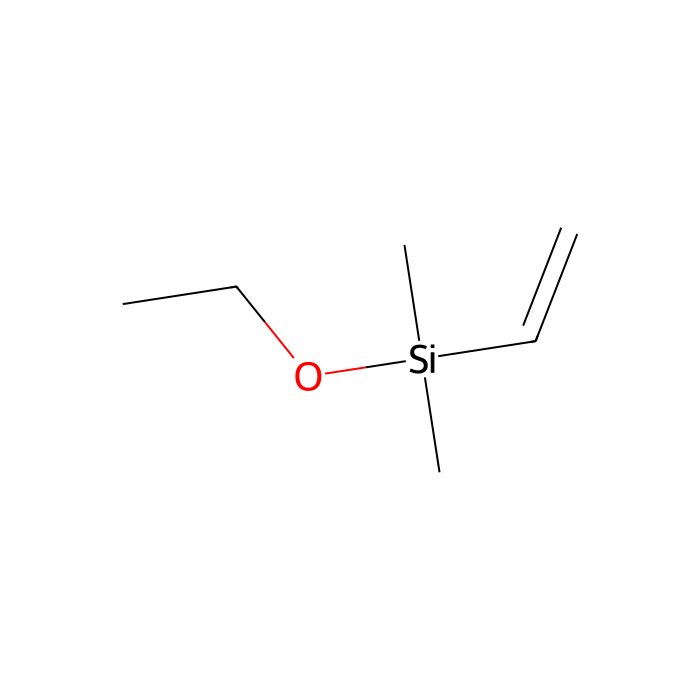
Determine the necessary mass, volume, or concentration for preparing a solution.
Taxonomy Tree
| Kingdom | Organic compounds |
|---|---|
| Superclass | Organometallic compounds |
| Classe | Organometalloid compounds |
| Subclass | Organosilicon compounds |
| Intermediate Tree Nodes | Not available |
| Direct Parent | Silyl ethers |
| Alternative Parents | Organoheterosilanes Organic metalloid salts Organooxygen compounds Hydrocarbon derivatives |
| Molecular Framework | Aliphatic acyclic compounds |
| Substituents | Silyl ether - Organoheterosilane - Organic metalloid salt - Organic oxygen compound - Hydrocarbon derivative - Organic salt - Organooxygen compound - Aliphatic acyclic compound |
| Description | This compound belongs to the class of organic compounds known as silyl ethers. These are organic compounds containing a silicon atom covalently bonded to an alkoxy group. They have the general formula R1R2R3Si-O-R4 (R4 = aryl, alkyl). |
| External Descriptors | Not available |
Find and download the COA for your product by matching the lot number on the packaging.
| Lot Number | Certificate Type | Date | Article |
|---|---|---|---|
| Certificate of Analysis | Sep 02, 2026 | D155112 | |
| Certificate of Analysis | Sep 02, 2026 | D155112 | |
| Certificate of Analysis | Sep 02, 2026 | D155112 | |
| Certificate of Analysis | Sep 02, 2026 | D155112 | |
| Certificate of Analysis | Nov 03, 2022 | D155112 | |
| Certificate of Analysis | Nov 03, 2022 | D155112 | |
| Certificate of Analysis | Nov 03, 2022 | D155112 | |
| Certificate of Analysis | Jun 24, 2022 | D155112 | |
| Certificate of Analysis | Jun 23, 2022 | D155112 |
| Sensibilité | Moisture sensitive. |
|---|---|
| Indice de réfraction | 1.398 |
| Point d'éclair (°C) | 3°C |
| Point d'ébullition (°C) | 100°C |
| Poids moléculaire | 130.26 |
| XLogP3 | |
| Hydrogen Bond Donor Count | 0 |
| Hydrogen Bond Acceptor Count | 1 |
| Rotatable Bond Count | 3 |
| Exact Mass | 130.081 Da |
| Monoisotopic Mass | 130.081 Da |
| Topological Polar Surface Area | 9.200 Ų |
| Heavy Atom Count | 8 |
| Formal Charge | 0 |
| Complexity | 78.600 |
| Isotope Atom Count | 0 |
| Defined Atom Stereocenter Count | 0 |
| Undefined Atom Stereocenter Count | 0 |
| Defined Bond Stereocenter Count | 0 |
| Undefined Bond Stereocenter Count | 0 |
| The total count of all stereochemical bonds | 0 |
| Covalently-Bonded Unit Count | 1 |
H225:Highly Flammable liquid and vapor
H315:Causes skin irritation
H319:Causes serious eye irritation
H335:May cause respiratory irritation
P210:Keep away from heat, hot surface, sparks, open flames and other ignition sources. - No smoking.
P233:Keep container tightly closed.
P240:Ground/bond container and receiving equipment.
P241:Use explosion-proof [electrical/ventilating/lighting/.../] equipment.
P242:Use only non-sparking tools.
P243:Take precautionary measures against static discharge.
P261:Avoid breathing dust/fume/gas/mist/vapors/spray.
P264:Wash hands [and …] thoroughly after handling.
P271:Use only outdoors or in a well-ventilated area.
P280:Wear protective gloves/protective clothing/eye protection/face protection.
P321:Specific treatment (see ... on this label).
P302+P352:IF ON SKIN: wash with plenty of water.
P303+P361+P353:IF ON SKIN (or hair): Take off Immediately all contaminated clothing. Rinse SKIN with water [or shower].
P304+P340:IF INHALED: Remove person to fresh air and keep comfortable for breathing.
P305+P351+P338:IF IN EYES: Rinse cautiously with water for several minutes. Remove contact lenses if present and easy to do - continue rinsing.
P362+P364:Take off contaminated clothing and wash it before reuse.
P370+P378:In case of fire: Use ... to extinguish.
P405:Store locked up.
P403+P233:Store in a well-ventilated place. Keep container tightly closed.
P403+P235:Store in a well-ventilated place. Keep cool.
P501:Dispose of contents/container to an approved waste disposal plant.
P264+P265:Wash hands [and …] thoroughly after handling. Do not touch eyes.
P337+P317:If eye irritation persists: Get medical help.
P332+P317:If skin irritation occurs: Get medical help.
P319:Get medical help if you feel unwell.
No assay or immunoassay protocols apply to this small-molecule organosilane. For practical use, see the Reaction Conditions and Synthetic Utility sections for literature-style procedures and optimization pointers relevant to cross-coupling, metathesis, and electrophilic additions.
This product is a small-molecule organosilane building block intended for chemical synthesis. It does not have a known intrinsic biological role or endogenous metabolic function.
Item-specific biological information: Not specified for this item; refer to CoA/Spec Sheet if any biological testing data are provided.
Not typically applicable. Dimethylethoxyvinylsilane is a hydrophobic, moisture-sensitive organosilane used in organic synthesis. It is not used to prepare aqueous buffers or as a buffering agent. For laboratory work involving this reagent, see Reaction & Applications, Synthetic Utility, and Reaction Conditions for relevant, non-aqueous handling guidance.
Consider greener choices along two axes: (1) the coupling partner type, and (2) the solvent/catalyst systems used with dimethylethoxyvinylsilane.
Alternative vinyl donors (literature/general):
Greener solvent choices in typical transformations:
Comparison snapshot (literature/general):
Process tips:
This product is supplied for research use only and is not intended for human or veterinary use.
Formulation/excipient context (literature/general):
Regulatory status and pharmacopeial monographs: None known for this specific compound. No compendial (USP/Ph.Eur./JP) excipient status is indicated.
Item-specific pharmaceutical/excipient specifications: Not specified for this item; refer to CoA/Spec Sheet.
General/literature notes relevant to handling and use:
Important: For process and safety calculations (e.g., vapor management, heat loads), do not use generalized literature trends; obtain lot-specific data from the CoA/SDS or measure under your conditions.
Guidance on grades (general):
Practical tip: For air/moisture-sensitive or catalytic processes, perform a quick check by 1H NMR for vinyl integrals and absence of silanol signals (broad ~2–5 ppm in protic solvents) before scale-up.
Dimethylethoxyvinylsilane is a versatile vinylsilane building block. The vinyl group enables alkene chemistry, while the silane enables post-functionalization or activation.
Key application families (literature/general):
Use cases:
The following are literature/general guidance examples; optimize for your substrate and catalyst system. Item-specific conditions are not specified for this product.
Cross-metathesis (CM) of vinylsilane with terminal alkene:
Hiyama coupling after hydrolysis to silanol:
Electrophilic addition (e.g., HCl, Br2) leveraging β-silyl effect:
Always assess catalyst poisons (water, acids/bases, peroxides) and pre-dry the reagent/solvents. Monitor by GC or NMR to track vinylsilane consumption and byproduct siloxane formation.
General safety guidance (literature/general for vinyl/alkoxy organosilanes):
Always consult the product-specific SDS for authoritative hazard and emergency information.
This product is a reactive organosilane building block rather than a working laboratory solvent.
General guidance (literature/general):
When to choose alternatives: If water compatibility or direct aqueous-phase handling is required, consider more robust vinyl donors (e.g., vinylboronates) that tolerate water better.
Handling and stability (literature/general):
Reconstitution: Not applicable (neat liquid reagent). If dilution is required for dosing or storage aliquots, prepare under dry inert atmosphere using anhydrous solvents (e.g., toluene, hexanes, dry ether). Label aliquots with solvent, concentration, and date; store under argon and use promptly.
Research Use Note: For research use only.
Dimethylethoxyvinylsilane is a vinyl-functional trialkoxyorganosilane analogue bearing two methyl groups and one ethoxy substituent on silicon.
Product identifiers (from Product Data)
Structure (literature/general)
Structural features & implications (literature/general)
Functional group synopsis (literature/general):
Strategic applications:
Practical tips:
Not applicable. This product is a small-molecule organosilane, not a biological macromolecule or affinity reagent. No target specificity, antigen, clone, or species reactivity data apply.