Disperse red 1 | Dispersive Ruby Zh | Acetamine Scarlet B | Celliton Scarlet B | Dispersol Scarlet B | Neosetile Scarlet B | Fenacet Scarlet B | Acetate Fast Scarlet B | Disperse Red Zh | Amacel Scarlet GB | Celliton Red B | Disperse Scarlet B | Disperse
Dye content 95 % pour les flux de travail chromatographiques et analytiques sensibles nécessitant une interférence de ligne de base minimale.
🌡
Stockage & expédition
Store at 2-8°C Expédition Wet ice. Consultez le COA spécifique au lot pour les spécifications exactes.
📋
Documents qualité
SDS, COA, fiche technique et fiche de spécifications disponibles au téléchargement. COA spécifique au lot accessible via la recherche par numéro de lot.
📚
Preuve documentaire
Cité dans 0 publications à comité de lecture couvrant la chromatographie, la synthèse organique et les réactions de couplage croisé.
Vue d’ensemble
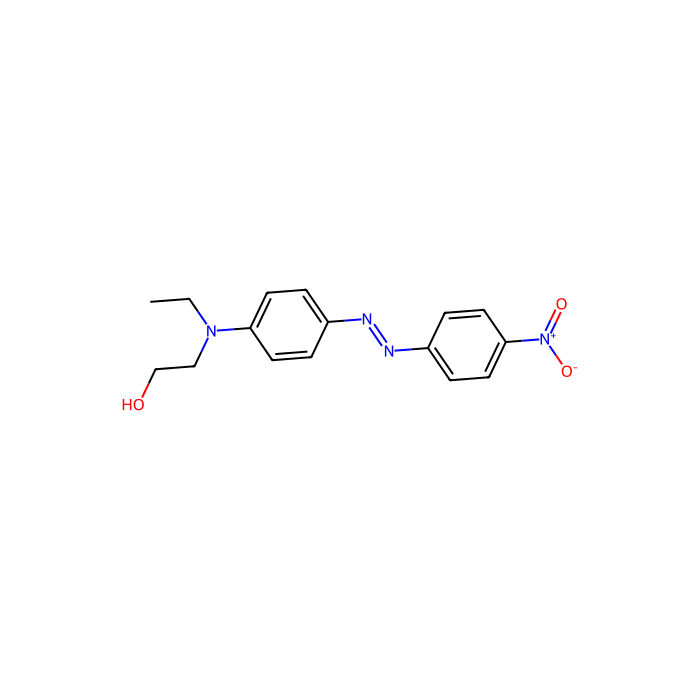
Disperse Red 1 (DR1) is a non-linear optical (NLO) material which is a chromophore used as an azobenzene dye. It can form a dipole network that can enhance the electro-optic effect of the non-linear components and can also improve the photorefractive effect.This benchmark dipolar chromophore was incorporated into aromatic polymers to obtain model electrooptic polymer films.
Purpose
DR1 dye can be incorporated into hydroxypropyl cellulose (HPC) matrix which can be used as a coating that finds potential application in light storage and photonics. It can also be used to evaluate the third order non-linear susceptibility (X(3)) for 1,3-indandione based glasses for use in optical frequency conversion. Polytetrafluoroethylene (PTFE) membranes modified using DR1 maintain the mass transport and diffusion properties under direct light irradiation and can be used for water desalination applications.
Spécifications
Synonymes
Disperse red 1 | Dispersive Ruby Zh | Acetamine Scarlet B | Celliton Scarlet B | Dispersol Scarlet B | Neosetile Scarlet B | Fenacet Scarlet B | Acetate Fast Scarlet B | Disperse Red Zh | Amacel Scarlet GB | Celliton Red B | Disperse Scarlet B | Disperse
Spécifications et pureté
Dye content 95 %
Conditions de stockage de stockage
Store at 2-8°C
Expédié en
Wet ice
Ce produit nécessite l'expédition en chaîne froide. Les services terrestres et autres services économiques ne sont pas disponibles.
This compound belongs to the class of organic compounds known as azobenzenes. These are organonitrogen aromatic compounds that contain a central azo group, where each nitrogen atom is conjugated to a benzene ring.
External Descriptors
Not available
1. Djoumbou Feunang Y, Eisner R, Knox C, Chepelev L, Hastings J, Owen G, Fahy E, Steinbeck C, Subramanian S, Bolton E, Greiner R, and Wishart DS. ClassyFire: Automated Chemical Classification With A Comprehensive, Computable Taxonomy. Journal of Cheminformatics, 2016, 8:61.
Nous utilisons des cookies pour garantir le bon fonctionnement du site et, lorsque cela est autorisé, pour améliorer votre expérience. Vous pouvez gérer vos préférences à tout moment dans les Paramètres. Pour en savoir plus, consultez notre Politique relative aux cookies.
Souhaitez-vous que nous vous envoyions un message lorsque des réductions seront disponibles?
Me rappeler plus tard
Merci ! Veuillez vérifier votre boîte de réception e-mail pour confirmer.
Products are supplied to verified businesses, institutions, and qualified professionals for research and development use only. Not for use in humans, animals, diagnosis, or therapy.

 H2631421