Determine the necessary mass, volume, or concentration for preparing a solution.
≥98% pour les flux de travail chromatographiques et analytiques sensibles nécessitant une interférence de ligne de base minimale.
Store at -20°C,Argon charged Expédition Ice chest + Ice pads. Consultez le COA spécifique au lot pour les spécifications exactes.
SDS, COA, fiche technique et fiche de spécifications disponibles au téléchargement. COA spécifique au lot accessible via la recherche par numéro de lot.
Cité dans 19 publications à comité de lecture couvrant la chromatographie, la synthèse organique et les réactions de couplage croisé.
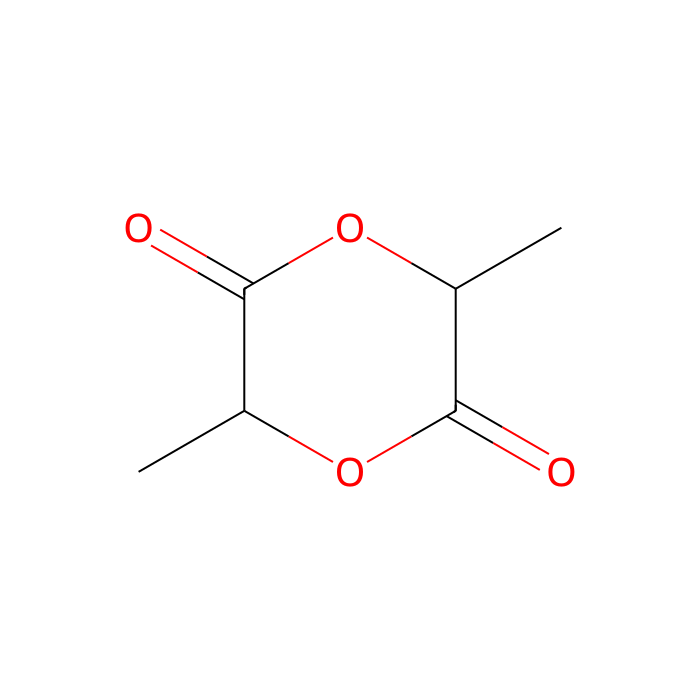
3,6-Dimethyl-1,4-dioxane-2,5-dione (or rac-lactide), is the 50:50 racemic mixture of D- and L-Lactide. Rac-lactide is a lactone derived from lactic acid that has attracted great interest in academia and commercial applications, as it is derived from abundant renewable resources. Rac-lactide can be ready polymerized via ring-opening polymerization, using a variety of metal or organocatalysts, yielding poly(D,L-lactide). While the resulting polymer is generally amorphous, the use of stereospecific catalysts can lead to heterotactic PLA, which exhibits some degree of crystallinity.
Application
DL-Lactide is used to produce 2-hydroxy-propionic acid 1-(1-phenyl-ethoxycarbonyl)-ethyl ester. It acts as an important raw material and an intermediate used in organic synthesis, pharmaceuticals, agrochemicals and dyes. It is involved in enzymatic alcoholysis to produce both alkyl (R)-lactates and alkyl (S,S)-lactyllactates.
Document complet couvrant les dangers, la manipulation, le stockage et la conformité réglementaire.
<<<<<<< HEAD Télécharger la SDS → ======= Télécharger la SDS → >>>>>>> release248-p3Données qualité spécifiques au lot. Saisissez votre numéro de lot pour récupérer le COA exact.
Rechercher le COA →Résumé de référence rapide des spécifications et applications du produit.
Voir la fiche technique →Attributs de qualité complets et critères d'acceptation pour cette qualité.
Voir la fiche de spécifications →Taxonomy Tree
| Kingdom | Organic compounds |
|---|---|
| Superclass | Organoheterocyclic compounds |
| Classe | Dioxanes |
| Subclass | 1,4-dioxanes |
| Intermediate Tree Nodes | Not available |
| Direct Parent | 1,4-dioxanes |
| Alternative Parents | Dicarboxylic acids and derivatives Lactones Carboxylic acid esters Oxacyclic compounds Organic oxides Hydrocarbon derivatives Carbonyl compounds |
| Molecular Framework | Aliphatic heteromonocyclic compounds |
| Substituents | Dicarboxylic acid or derivatives - Para-dioxane - Lactone - Carboxylic acid ester - Oxacycle - Carboxylic acid derivative - Organic oxygen compound - Organic oxide - Hydrocarbon derivative - Organooxygen compound - Carbonyl group - Aliphatic heteromonocyclic compound |
| Description | This compound belongs to the class of organic compounds known as 1,4-dioxanes. These are organic compounds containing 1,4-dioxane, an aliphatic six-member ring with two oxygen atoms in ring positions 1 and 4. |
| External Descriptors | a small molecule |
Find and download the COA for your product by matching the lot number on the packaging.
| Lot Number | Certificate Type | Date | Article |
|---|---|---|---|
| Certificate of Analysis | Mar 11, 2026 | S161100 | |
| Certificate of Analysis | Mar 11, 2026 | S161100 | |
| Certificate of Analysis | Mar 11, 2026 | S161100 | |
| Certificate of Analysis | Mar 11, 2026 | S161100 | |
| Certificate of Analysis | Mar 11, 2026 | S161100 | |
| Certificate of Analysis | Sep 09, 2025 | S161100 | |
| Certificate of Analysis | Aug 27, 2025 | S161100 | |
| Certificate of Analysis | Aug 27, 2025 | S161100 | |
| Certificate of Analysis | Aug 27, 2025 | S161100 | |
| Certificate of Analysis | Aug 27, 2025 | S161100 | |
| Certificate of Analysis | Jun 09, 2025 | S161100 | |
| Certificate of Analysis | May 19, 2025 | S161100 | |
| Certificate of Analysis | May 19, 2025 | S161100 | |
| Certificate of Analysis | May 19, 2025 | S161100 | |
| Certificate of Analysis | Mar 31, 2025 | S161100 | |
| Certificate of Analysis | Mar 31, 2025 | S161100 | |
| Certificate of Analysis | Jan 13, 2025 | S161100 | |
| Certificate of Analysis | Jan 13, 2025 | S161100 | |
| Certificate of Analysis | Jan 13, 2025 | S161100 | |
| Certificate of Analysis | Nov 30, 2022 | S161100 | |
| Certificate of Analysis | Nov 30, 2022 | S161100 | |
| Certificate of Analysis | Nov 30, 2022 | S161100 | |
| Certificate of Analysis | Nov 30, 2022 | S161100 | |
| Certificate of Analysis | Nov 30, 2022 | S161100 | |
| Certificate of Analysis | Nov 30, 2022 | S161100 | |
| Certificate of Analysis | Nov 30, 2022 | S161100 | |
| Certificate of Analysis | Nov 30, 2022 | S161100 | |
| Certificate of Analysis | Nov 30, 2022 | S161100 | |
| Certificate of Analysis | Oct 20, 2022 | S161100 |
| Solubilité | Slightly soluble in water, decomposes upon contact with water; Soluble in methanol and acetone |
|---|---|
| Sensibilité | Moisture sensitive |
| Point d'ébullition (°C) | 142 °C/8 mmHg |
| Point de fusion (°C) | 123.0-127.0℃ |
| Poids moléculaire | 144.120 g/mol |
| XLogP3 | 0.600 |
| Hydrogen Bond Donor Count | 0 |
| Hydrogen Bond Acceptor Count | 4 |
| Rotatable Bond Count | 0 |
| Exact Mass | 144.042 Da |
| Monoisotopic Mass | 144.042 Da |
| Topological Polar Surface Area | 52.600 Ų |
| Heavy Atom Count | 10 |
| Formal Charge | 0 |
| Complexity | 155.000 |
| Isotope Atom Count | 0 |
| Defined Atom Stereocenter Count | 0 |
| Undefined Atom Stereocenter Count | 2 |
| Defined Bond Stereocenter Count | 0 |
| Undefined Bond Stereocenter Count | 0 |
| The total count of all stereochemical bonds | 0 |
| Covalently-Bonded Unit Count | 1 |