This compound belongs to the class of organic compounds known as nitriles. These are compounds having the structure RC#N; thus C-substituted derivatives of hydrocyanic acid, HC#N.
External Descriptors
Not available
1. Djoumbou Feunang Y, Eisner R, Knox C, Chepelev L, Hastings J, Owen G, Fahy E, Steinbeck C, Subramanian S, Bolton E, Greiner R, and Wishart DS. ClassyFire: Automated Chemical Classification With A Comprehensive, Computable Taxonomy. Journal of Cheminformatics, 2016, 8:61.
Determine the necessary mass, volume, or concentration for preparing a solution.
Dilution Calculator
Determine the dilution needed to prepare a stock solution.
Reconstitution Calculator
Avis
Avis des clients
Application Protocols
Not applicable. No immunoassay or bioassay application protocols (e.g., WB, IHC, IF, FC) are associated with this small-molecule reagent. For synthetic or biocatalytic procedures, refer to the Reaction Conditions, Synthetic Utility, and Reaction & Applications sections for practical guidance.
Biological Roles
Item-specific biological data are not provided for this product; the following is general biochemical context for aliphatic nitriles (literature/general):
Occurrence and metabolism:
Long-chain aliphatic nitriles are not common endogenous metabolites in higher organisms but can arise from industrial or biosynthetic transformations of fatty derivatives.
Certain microbes express nitrile hydratases and nitrilases that convert nitriles like dodecanenitrile to the corresponding amide (lauramide) or acid (lauric acid) under mild conditions.
Biophysical properties:
The long hydrophobic tail promotes partitioning into lipid phases and micelles; derivatives (amides/amines) are typical surfactant building blocks.
Enzymatic relevance:
Dodecanenitrile can serve as a substrate or probe in studies of nitrile-converting enzymes (nitrile hydratase, amidase, nitrilase), enabling assessment of chain-length effects on activity, substrate specificity, and mass transfer in biphasic systems.
No claims are made regarding physiological effects, therapeutic activity, or clinical applications. This product is intended strictly for research and laboratory use.
Buffer Applications
Dodecanenitrile is a hydrophobic organic reagent and does not function as a buffering agent. It has no established role in preparing aqueous buffer systems. For work involving this compound in aqueous environments (e.g., biocatalysis), select an appropriate buffer independently (e.g., phosphate, Tris) and employ emulsification or organic co-solvents to accommodate the substrate’s low water solubility.
Green Alternatives
Considering green chemistry principles for processes involving dodecanenitrile (general guidance):
Feedstock considerations:
Biobased routes: Dodecanenitrile can, in principle, be derived from renewable lauryl alcohol/lauric acid (e.g., from coconut/palm kernel) via dehydration/ammoxidation. Selecting biobased starting materials can reduce carbon footprint (literature context).
Solvent and process choices:
Prefer greener solvents: replace DCM/toluene with 2-MeTHF, CPME, EtOAc, or alcohols where compatible.
Hydrogenation: Use catalytic H2 over Raney Ni/Pd with green solvents (EtOH, 2-MeTHF) instead of stoichiometric hydrides (LiAlH4) to minimize waste.
Hydrolysis: Enzymatic nitrile hydration (nitrile hydratase/amidase cascades) under aqueous conditions can avoid strong acids/bases, offering milder, safer processing.
Comparison (literature-based, indicative):
LiAlH4 reduction vs catalytic H2:
Waste: High (inorganic salts) vs low (water/amine).
Safety: Pyrophoric reagent vs pressurized gas handling.
Selectivity: Both effective; catalytic routes often more scalable/greener.
Solvent swap example:
DCM (excellent solubility; halogenated waste) → EtOAc/2-MeTHF (biobased options, safer, still dissolve long-chain nitriles with mild warming).
Trade-offs:
Greener solvents may modestly reduce solubility; mild heating/agitation can compensate.
Biocatalysis may require aqueous-organic biphasic systems and enzyme sourcing, but offers superior E-factor and safety.
Pharmaceutical Uses
Item-specific pharmacopeial status or excipient role: Not specified for this item; refer to CoA/Spec Sheet.
General context (non-clinical, manufacturing focus):
Role in synthesis: Dodecanenitrile can serve as an intermediate in the manufacture of hydrophobic amines, amides, and acids used as auxiliaries (e.g., phase-transfer catalysts, surfactants) or as intermediates toward API side chains. Any use in GMP processes requires appropriate vendor qualification and impurity controls.
Excipient status: Long-chain nitriles are not typical pharmaceutical excipients. Downstream derivatives (e.g., laurylamine, lauroyl derivatives) are more common in formulations as surfactants or emulsifiers.
Control considerations:
Residual solvents and homologous nitriles (C11/C13) may be process-related impurities; establish suitable analytical methods (GC) and limits.
Conversion steps (reduction/hydrolysis) should ensure removal of unreacted nitrile to meet toxicological specifications.
No therapeutic or clinical claims are made; this product is for research and laboratory synthesis only.
Physical Properties
All values below are literature/general references unless explicitly noted; they are not specifications for this catalog item.
Aggregate state at ambient: Waxy solid or low-melting liquid near room temperature (literature)
Melting point: ~27–30 °C (literature)
Boiling point: ~268–272 °C at 1 atm (literature)
Density: ~0.83–0.84 g/mL at 25 °C (literature)
Refractive index (n20 D, liquid phase): ~1.438–1.442 (literature)
Vapor pressure: Very low at ambient temperature (literature; consistent with long-chain nitriles)
Solubility: Practically insoluble in water; miscible with nonpolar and moderately polar organic solvents (e.g., hexanes, toluene, diethyl ether, THF, dichloromethane) (literature)
LogP (octanol/water): High; typical for C12 nitriles (estimated literature logP ~4.5–5.0)
pKa: Conjugate acid of nitrile (RC≡NH+): very weak base; pKa << 0 (literature). Alpha-C–H acidity of the adjacent methylene is weak (pKa ~25 in DMSO, literature, approximate for aliphatic nitriles).
Item-specific specifications (water, peroxide, metal content, UV cutoff, etc.): Not specified for this item; refer to CoA/Spec Sheet.
Quality and Grades
Item-specific grade/purity: Not specified for this item; refer to CoA/Spec Sheet for assay, GC profile, and impurity limits.
Interpretive guidance (general):
For synthetic applications, purity requirements vary:
Catalytic hydrogenations/reductions: Typically tolerant of trace nonpolar impurities; water should be minimal for hydride reductions (e.g., LiAlH4), so verify Karl Fischer if moisture-sensitive steps are planned.
Grignard/organolithium additions to nitriles: Moisture and protic impurities can quench reagents; consider pre-drying or distilling if applicable (mind the high bp and possible solid state near RT).
Stabilizers: None are typically added to saturated aliphatic nitriles; if any stabilizer/antioxidant is present, it will be listed on the CoA. Not specified for this item; refer to CoA/Spec Sheet.
UV cut-off/LC suitability: Not specified for this item; refer to CoA/Spec Sheet. Long-chain nitriles usually exhibit low UV absorbance above ~220–230 nm (literature), but chromatography needs are method-dependent.
Batch documentation: For regulated or scale-up use, request CoA/Spec Sheet for impurity profile (e.g., homologues C11/C13, residual alcohol/amide) and water content if relevant to process robustness.
Reaction and Applications
Dodecanenitrile is a versatile, hydrophobic nitrile building block useful for introducing a C12 linear chain via transformations of the –C≡N group (literature/general use).
Key transformations:
Reduction to primary amine (laurylamine): LiAlH4 or catalytic hydrogenation (Raney Ni, Pd/C) converts R–C≡N → R–CH2–NH2. Useful for surfactant, amide, and quaternary ammonium salt synthesis.
Hydrolysis to acid or amide: Acidic (H2SO4/H2O, heat) or basic (KOH/EtOH, reflux) conditions yield the corresponding amide (partial) or lauric acid after full hydrolysis.
Pinner reaction: Strong acid/alcohol converts nitrile to imidate ester; subsequent reactions furnish amidines or amides.
Organometallic addition: Grignard/organolithium reagents add to nitriles to give ketimines, which hydrolyze to ketones bearing the C12 chain (e.g., R′–CO–(CH2)11–CH3).
Oxidative or radical functionalization alpha to the nitrile is limited; deprotonation alpha to nitrile is possible with strong bases (LDA) enabling alkylation in more activated systems (less common for long chains).
Applications and contexts:
Precursor to cationic surfactants (via laurylamine → quats) and amide-based thickeners (lauroylamides).
Intermediate toward specialty lubricants, antistatic agents, and hydrophobic coatings.
Substrate for biocatalytic nitrile hydration to lauramide using nitrile hydratase enzymes.
Practical notes:
Low water solubility necessitates efficient mixing or biphasic catalysis; phase-transfer or emulsifiers may help.
When solid at ambient, preheat to maintain homogeneity; for hydrogenations, ensure sufficient temperature to keep substrate dissolved.
Monitor by GC or HPLC-ELSD/UV (low UV chromophore); derivatization may enhance detectability.
Reaction Conditions
Representative literature conditions (general guidance; not item-specific specifications):
Catalytic hydrogenation to laurylamine:
Catalyst: Raney Ni or Pd/C (5–10 wt% of substrate).
Solvent: EtOH, iPrOH, or 2-MeTHF; alternatively neat, if manageable.
Conditions: 20–60 bar H2, 50–120 °C, 2–16 h. Add acid (e.g., HCl) post-reaction to form amine salt for easy isolation. Typical isolated yields: high (70–95%), catalyst- and mass-transfer-dependent.
LiAlH4 reduction (anhydrous amine formation):
Solvent: Dry THF or diethyl ether.
Conditions: 0–25 °C addition, then reflux 2–6 h; rigorous exclusion of moisture. Quench cautiously (sequential water/NaOH/water). Yields: often >80% for simple aliphatic nitriles.
Hydrolysis to lauric acid/lauramide:
Acidic: Conc. H2SO4/H2O (or HCl), 80–120 °C for amide; prolonged reflux for full acid. Basic: KOH in EtOH/H2O, reflux to acid upon acidic work-up. Enzymatic hydration (nitrile hydratase): aqueous buffer (pH 6–8), 20–40 °C, organic cosolvent or biphasic system, hours to a day.
Organometallic addition to form ketone:
Reagent: RMgX or RLi (≥2 eq overall; 1 eq adds, 1 eq to neutralize acid by-products).
Solvent: Dry THF or ether; –20 to 25 °C for addition, then warm to rt; hydrolytic work-up (NH4Cl) gives ketone. Yields: moderate to high (50–85%), sensitive to sterics and reagent quality.
Pinner reaction (imidate formation):
Conditions: Dry HCl(g) in anhydrous ROH at 0–25 °C, hours; subsequent transformations to amidines/amides proceed upon neutralization.
Always optimize at small scale; control mass transfer due to hydrophobicity. Use inert atmosphere for moisture/air-sensitive reagents.
Safety and Handling
GHS/SDS status for this specific item: Not specified for this item; refer to SDS for authoritative classification, pictograms, and H/P statements.
General safety considerations for long-chain aliphatic nitriles (literature/general guidance):
Hazards: Typically classified as harmful/irritant for skin/eyes upon contact and may be harmful if swallowed. Low volatility reduces inhalation risk compared to short-chain nitriles, but avoid aerosol generation.
Incompatibilities: Strong oxidizers; strong acids/bases under forcing conditions (may promote hydrolysis/condensation). Avoid nitrating agents. Thermal decomposition may form nitrogen oxides and other irritants.
Stability: Generally stable at room temperature; does not form peroxides. Resistant to mild hydrolysis; requires strong acidic/basic conditions for conversion.
PPE: Wear lab coat, safety glasses, and suitable chemical-resistant gloves (e.g., nitrile). Use in a fume hood when heating, transferring bulk, or performing reactions.
Handling: Minimize skin contact; wipe spills with inert absorbent. Because the melting point is near room temperature, handle as a warm liquid or softened solid with care to avoid spills.
First aid (overview; defer to SDS):
Inhalation: Move to fresh air; seek medical attention if symptoms occur.
Skin/eye contact: Rinse thoroughly with water for at least 15 minutes; remove contaminated clothing; seek medical attention if irritation persists.
Ingestion: Rinse mouth; do not induce vomiting; seek medical advice.
Firefighting: Use dry chemical, CO2, foam. Combustion can produce CO/CO2 and nitrogen oxides. Cool containers with water spray.
Waste: Collect organic waste in halogen-free container unless mixed; dispose per local regulations.
Solvent Selection
This product is a hydrophobic reagent, not typically used as a solvent. Selection guidance here addresses dissolving and processing dodecanenitrile.
Limited solubility in highly polar protic solvents (e.g., water, methanol); better in alcohols with heating.
Processing tips:
If solid at room temperature, gently warm (30–40 °C) to liquefy prior to transfer or weighing. Use a warm-water bath; avoid overheating to limit volatilization or decomposition.
For reactions requiring polar aprotic media (e.g., nitrile reductions with borohydrides/catalysis), THF, EtOAc, or toluene/EtOH biphasic systems are commonly effective (literature).
When to choose alternative matrices:
For biocatalytic hydration by nitrile hydratase, aqueous-organic biphasic systems or emulsions (e.g., buffer/toluene with surfactant) improve mass transfer.
For organometallic additions, use dry ethers (THF, diethyl ether) or hydrocarbons under inert atmosphere.
Small comparison (literature):
Toluene: good solubility, high bp (110 °C) for moderate-temperature processing.
Hexanes/heptane: minimal polarity, good for extraction and crystallization of downstream products.
Storage and Reconstitution
Item-specific storage/shipping (Product Data):
Storage Conditions: Room temperature
Shipped In: Normal
General storage guidance (literature/practice):
Keep container tightly closed in a cool, well-ventilated place. Because the melting point is near ambient, store in a secondary container to contain leaks when liquefied on warm days.
Protect from strong oxidizers and strong acids/bases. No special light sensitivity is expected.
If solidifies, gently warm (30–40 °C) to liquefy before dispensing; avoid repeated high-temperature cycling.
Moisture sensitivity: Low; however, keep dry to prevent adventitious hydrolysis under strongly basic/acidic contamination.
Reconstitution: Not applicable; supplied neat. If a stock solution is desired for processing, prepare in a compatible solvent (e.g., toluene, THF, hexanes) under clean, dry conditions and label with concentration and date.
Shelf life: Not specified for this item; refer to CoA/Spec Sheet. Inspect periodically for phase changes or discoloration indicative of contamination.
Structure and Identity
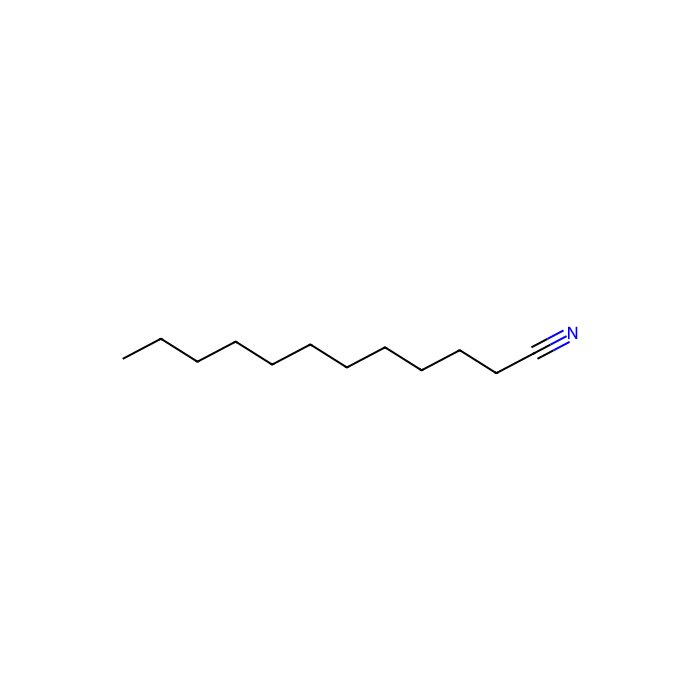
Brief overview: Dodecanenitrile (also known as lauronitrile) is a linear, saturated aliphatic nitrile featuring a terminal cyano group on a C12 chain.
Item-specific (Product Data):
CAS: 2437-25-4
CID: 17092
InChIKey (as provided): 390754
Storage Conditions: Room temperature; Shipped: Normal
Research Use: For research use only
Literature/Computed identifiers and features (not item-specific):
Structure description: A straight-chain hydrocarbon (no rings, no heteroatoms aside from nitrile nitrogen) with a terminal sp-hybridized carbon triple-bonded to nitrogen; no stereocenters; conformationally flexible alkyl segment.
Functional groups and features (general chemistry):
Terminal nitrile (–C≡N): polarizable, weakly basic nitrogen; carbon is electrophilic and can be reduced or hydrolyzed.
Long aliphatic tail: confers high hydrophobicity and low water solubility; enhances surfactant/lamellar phase behavior in derivatives.
Synthetic Utility
Functional handle: terminal nitrile (–C≡N) on a C12 chain.
Strategic transformations (literature):
To amines: Catalytic hydrogenation (H2, Raney Ni/Pd/C, 20–60 bar, 25–120 °C) affords laurylamine; subsequent quaternization yields ammonium surfactants.
To acids/amides: Hydrolysis under acidic (H2SO4, HCl) or basic (KOH/NaOH) conditions furnishes lauramide/lauroyl derivatives; selective hydration via nitrile hydratase affords amide under mild aqueous conditions.
To ketones: Addition of RMgX or RLi to the nitrile, followed by aqueous work-up, yields ketones (R–CO–(CH2)11–CH3), enabling installation of hydrophobic tails.
Pinner/imidate chemistry: Access to amidines and related functionalities for polymer and surfactant design.
Retrosynthetic value:
The nitrile serves as a masked carboxyl or primary amine equivalent, enabling late-stage interconversion with minimal over-oxidation/reduction risk in hydrocarbon-rich frameworks.
Process considerations:
The C12 chain imparts phase behavior (limited miscibility with polar phases); emulsions/biphasic catalysis may be beneficial.
Thermal robustness (bp ~270 °C) allows solvent removal without significant co-distillation loss in many media, but elevated temperatures may be required for homogeneous reactions.
Analytical:
Monitoring by GC-FID is convenient due to volatility at elevated injector temperatures; HPLC may require ELSD/CAD or UV at low wavelengths.
Target Specificity
Not applicable. This product is a small-molecule chemical reagent and does not possess biological target specificity (no antigen/epitope/clone/isotype). No item-specific data are provided.
Nous utilisons des cookies pour garantir le bon fonctionnement du site et, lorsque cela est autorisé, pour améliorer votre expérience. Vous pouvez gérer vos préférences à tout moment dans les Paramètres. Pour en savoir plus, consultez notre Politique relative aux cookies.
Souhaitez-vous que nous vous envoyions un message lorsque des réductions seront disponibles?
Me rappeler plus tard
Merci ! Veuillez vérifier votre boîte de réception e-mail pour confirmer.
Products are supplied to verified businesses, institutions, and qualified professionals for research and development use only. Not for use in humans, animals, diagnosis, or therapy.

 G2608089