Compound 21 is a potent designer drug with full agonist activity toward human hM3Dq (EC50 = 1.7 nM by cell-based Ca2+ mobilization assay), a human M3 muscarinic receptor (M3R)-based Gq (M3Dq) DREADD (Designer Receptors Exclusively Activated by Designer Dr
Conditions de stockage de stockage
Protected from light,Store at -20°C,Desiccated
Expédié en
Ice chest + Ice pads
Ce produit nécessite l'expédition en chaîne froide. Les services terrestres et autres services économiques ne sont pas disponibles.
Note
Wherever possible, you should prepare and use solutions on the same day. However, if you need to make up stock solutions in advance, we recommend that you store the solution as aliquots in tightly sealed vials at -20°C. Generally, these will be useable for up to one month. Before use, and prior to opening the vial we recommend that you allow your product to equilibrate to room temperature for at least 1 hour. Need more advice on solubility, usage and handling? Please visit our frequently asked questions (FAQ) page for more details.
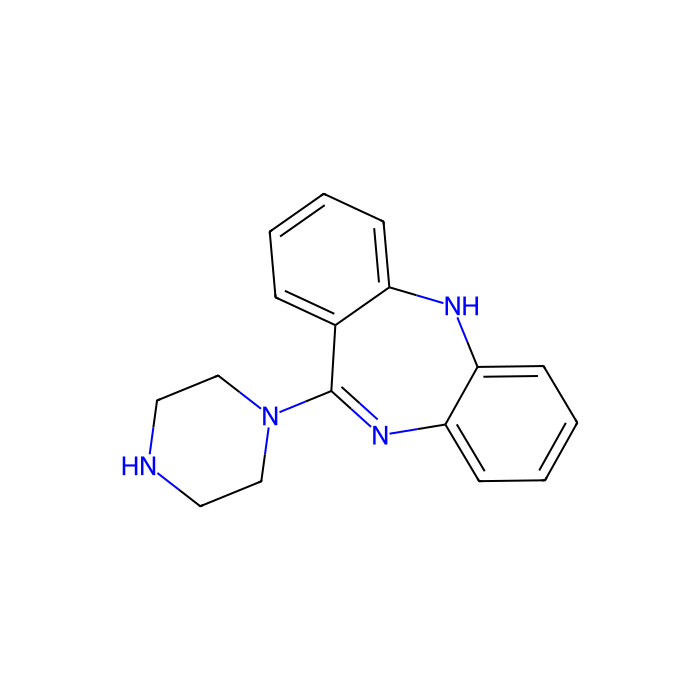
This compound belongs to the class of organic compounds known as dibenzodiazepines. These are compounds containing a dibenzodiazepine moiety, which consists of two benzene connected by diazepine ring.
External Descriptors
Not available
1. Djoumbou Feunang Y, Eisner R, Knox C, Chepelev L, Hastings J, Owen G, Fahy E, Steinbeck C, Subramanian S, Bolton E, Greiner R, and Wishart DS. ClassyFire: Automated Chemical Classification With A Comprehensive, Computable Taxonomy. Journal of Cheminformatics, 2016, 8:61.
≤5mg/ml in ethanol;10mg/ml in DMSO;10mg/ml in dimethyl formamide
Sensibilité
light sensitive
Poids moléculaire
278.350 g/mol
XLogP3
2.000
Hydrogen Bond Donor Count
2
Hydrogen Bond Acceptor Count
3
Rotatable Bond Count
1
Exact Mass
278.153 Da
Monoisotopic Mass
278.153 Da
Topological Polar Surface Area
39.700 Ų
Heavy Atom Count
21
Formal Charge
0
Complexity
388.000
Isotope Atom Count
0
Defined Atom Stereocenter Count
0
Undefined Atom Stereocenter Count
0
Defined Bond Stereocenter Count
0
Undefined Bond Stereocenter Count
0
The total count of all stereochemical bonds
0
Covalently-Bonded Unit Count
1
Calculateurs de solution
Molarity Calculator
Determine the necessary mass, volume, or concentration for preparing a solution.
Dilution Calculator
Determine the dilution needed to prepare a stock solution.
Reconstitution Calculator
Avis
Avis des clients
Application Protocols
Only item-specific, tested protocols may be listed here.
Tested applications, recommended concentrations/dilutions, and positive controls: Not specified for this item; refer to CoA/Spec Sheet. Users should develop assay-specific protocols based on receptor expression, cell type, and desired readout, incorporating appropriate vehicle and non-expressing controls.
Biological Roles
Context (literature/general): DREADD Agonist 21 is used in chemogenetics to selectively engage engineered GPCRs (Designer Receptors Exclusively Activated by Designer Drugs), enabling remote control of cell signaling.
Primary role: Orthogonal ligand for modified muscarinic receptors (e.g., hM3Dq, hM4Di). Upon binding:
hM3Dq (Gq-coupled): triggers PLCβ activation, IP3 production, and intracellular Ca2+ release; often used to acutely excite neurons or stimulate secretion/contractility in engineered systems.
hM4Di (Gi-coupled): inhibits adenylyl cyclase, reduces cAMP, can open GIRK channels; often used to silence neuronal activity or suppress secretion.
Selectivity considerations: Compared to earlier tools (e.g., clozapine-N-oxide), certain C21-class ligands have been reported to show improved in vivo efficacy; however, off-target binding and metabolism are chemotype- and model-dependent. Empirical validation in your system is essential.
Assay readouts: Ca2+ imaging, cAMP ELISAs, GIRK current clamp, ERK phosphorylation, and transcriptional reporters are common downstream measurements.
Kinetics: Onset and duration depend on ligand potency, receptor expression level, temperature, and compartmentalization; reversible effects are typical upon washout or metabolism.
Note: The above are general biological roles derived from chemogenetics literature and are not item-specific claims. This product is designated “For research use only.”
Buffer Applications
This compound is not a buffering agent and is not used to control solution pH.
Practical guidance (when working in buffers)
Prepare concentrated stocks in DMSO or other suitable solvent, then dilute into physiological buffers (e.g., HBSS, PBS, HEPES-buffered saline, or culture media) immediately before use.
Maintain final cosolvent at assay-compatible levels and include matching vehicle controls.
If precipitation occurs upon dilution, consider gentle warming, sonication, or inclusion of small amounts of surfactant (e.g., 0.01–0.05% Tween 80) after confirming compatibility with your assay.
No specific buffer recipes apply to this product.
Green Alternatives
As a specialized chemogenetic ligand, this product is not used as a process solvent or bulk reagent, so conventional “green solvent replacement” analysis is of limited relevance. Nevertheless, greener practices can be applied to its use and preparation.
Greener practice suggestions (general)
Prefer aqueous vehicles augmented with minimal cosolvent or cyclodextrin inclusion complexes for dosing solutions when feasible, reducing organic solvent waste.
Use the minimum effective concentration and miniaturize assays (e.g., 384/1536-well formats) to lower chemical consumption.
Select DMSO over higher-toxicity aprotic solvents when compatible, and keep final assay DMSO ≤0.1–0.5% v/v.
Implement closed, amber vials and cold-chain handling to extend shelf life and reduce material losses.
Comparison (contextual, not prescriptive)
CNO and clozapine-related ligands have varied metabolic and off-target profiles. Some newer DREADD ligands (e.g., deschloroclozapine, DCZ) achieve high potency at lower dosing, potentially lowering total mass used. Tradeoffs include cost, selectivity, and background effects—selection should be data-driven for your system.
Waste and disposal
Collect unused stock solutions and rinse solvents as halogen-free organic waste unless analytical testing indicates otherwise; follow institutional EHS guidance.
Pharmaceutical Uses
This product is offered strictly for research use only. It is not intended for human or veterinary use, clinical diagnostics, or as an API.
No pharmacopeial monograph or excipient role is provided for this item in the Product Data.
Formulation considerations for research dosing (general, not a claim of suitability)
Common research vehicles include aqueous buffers with minimal DMSO or ethanol, sometimes supplemented with hydroxypropyl-β-cyclodextrin to increase apparent solubility for in vivo chemogenetic studies.
Filter sterilize aqueous working solutions through 0.22 µm membranes where sterility is required. Verify stability under intended conditions (light, temperature, pH) before study.
Any translation of this material to regulated pharmaceutical use would require comprehensive qualification not covered here.
Physical Properties
Item-specific physicochemical specifications have not been provided for this listing.
Item-specific (from Product Data)
Appearance: Not specified for this item; refer to CoA/Spec Sheet.
Grade/Purity: Not specified for this item; refer to CoA/Spec Sheet.
Molecular Weight: Not specified for this item; refer to CoA/Spec Sheet.
Literature/general expectations for C21-type DREADD agonists (non-specification; for context only)
State at RT: typically solid, weakly to moderately lipophilic, and readily soluble in polar aprotic solvents (e.g., DMSO) when preparing concentrated stocks for bioassays.
pKa (basic center): basic amine often exhibits pKa in the 7–10 range (literature, scaffold-dependent), enabling partial protonation at physiological pH.
LogP/LogD: moderate lipophilicity is common in clozapine-like scaffolds; exact values depend on substitution pattern and salt form.
Solubility and preparation (practical guidance; not item-specific)
Prefer initial dissolution in anhydrous DMSO to make a 10–50 mM master stock, then dilute into assay buffer; adjust final DMSO to ≤0.1–0.5% v/v for cell-based readouts. Exact solubility for this item is not specified—verify experimentally.
Always treat literature values as guidance only; do not construe them as specifications for this item.
Quality and Grades
Grade/Purity: Not specified for this item; refer to CoA/Spec Sheet.
Guidance on research-chemical quality (general)
For bioactive ligands such as DREADD agonists, researchers typically require high chemical purity and low residual solvents/metals to minimize assay artifacts. Where relevant, additional tests (e.g., HPLC area %, NMR identity, water content by KF) ensure batch-to-batch reproducibility.
If offered in multiple grades, typical distinctions include:
Screening/Library Grade: suitable for primary HTS/chemogenetic screening; purity specifications often ≥95% by HPLC unless otherwise noted.
Analytical/Reference Grade: tighter identification criteria (1H NMR matches, HRMS, tighter HPLC thresholds) for pharmacology and reference controls.
Formulation Grade (laboratory): screened for counterion content and residual moisture to support aqueous dosing solution preparation.
Stabilizers and form
Stabilizers: None indicated in the Product Data. If present in a specific lot (e.g., acid salts to improve stability/handling), this will be declared on the CoA.
Salt form: Not specified; activity and solubility can vary between free base vs. salt. Verify the exact form on the label/CoA before calculating molarity.
Recommendation
Request and retain the CoA/SDS for your lot; verify identity, purity, and form before critical experiments (e.g., in vivo chemogenetics or precise EC50 benchmarking).
Reaction and Applications
This compound is primarily a bioactive ligand for chemogenetic studies and is not typically employed as a synthetic reagent or solvent.
Applications in research (literature/general)
Chemogenetic activation: Used to activate muscarinic-based DREADD receptors (e.g., hM3Dq for Gq signaling; hM4Di for Gi signaling) in engineered cells or organisms to modulate neuronal or cellular activity in a controlled, ligand-dependent manner.
In vitro pharmacology: Supports concentration–response profiling (EC50 determination), pathway readouts (Ca2+ flux for Gq, cAMP inhibition for Gi, GIRK currents), and off-target screening.
In vivo studies (research use only): Enables temporal control of DREADD-expressing circuits; dosing regimens, routes, and vehicles vary by model and should be optimized empirically. No medical or clinical use is implied.
Practical tips
Prepare DMSO master stocks, aliquot, and avoid repeated freeze–thaw to maintain potency.
Include vehicle controls and exposure-matched negative controls (non-DREADD-expressing cells/animals) to assess background effects.
When comparing to other ligands (e.g., clozapine-N-oxide, deschloroclozapine), standardize assay timing, solvent, and temperature.
Note: This section summarizes general research uses of DREADD agonists; it is not item-specific and not a specification.
Reaction Conditions
Not applicable in the synthetic chemistry sense: this product is not used as a reagent or catalyst. The following provides general conditions for biological assays using DREADD agonists (literature guidance; not item-specific):
In vitro assay conditions (examples)
Cell lines: HEK293 or CHO stably expressing hM3Dq/hM4Di; primary neurons with viral DREADD expression.
Readouts:
hM3Dq: intracellular Ca2+ (Fluo-4 AM) or IP1 accumulation.
hM4Di: cAMP inhibition (FRET/HTRF) or GIRK-mediated currents (patch clamp).
Ligand exposure: 5–30 min preincubation at 37°C (cells) prior to stimulus/readout; perform concentration–response spanning sub-nM to low-µM as appropriate for the system.
Vehicles: DMSO ≤0.1–0.5% v/v. Include vehicle-only controls.
In vivo (research-only) handling
Dosing vehicles: buffered saline with minimal DMSO/ethanol, optionally with hydroxypropyl-β-cyclodextrin; dose and route are model-dependent and must be optimized empirically.
Timing: Behavioral/physiological readouts often occur within 10–60 min post-dose depending on ligand, route, and expression.
These are generic literature practices for DREADD ligands and are not specifications for this product.
Safety and Handling
Safety data for this specific item have not been provided; handle as a potentially hazardous research chemical.
Item-specific hazard information (from Product Data)
GHS Classification: Not specified for this item; refer to SDS.
Signal Word / H-Statements / Pictograms: Not specified for this item; refer to SDS.
General laboratory precautions (best practice)
PPE: lab coat, safety glasses, and appropriate chemically resistant gloves (e.g., nitrile). Avoid inhalation, ingestion, and skin/eye contact. Handle powders in a fume hood or ventilated enclosure.
Light sensitivity: Store and handle under low light; the product is specified as “Protected from light.”
Incompatibilities: Avoid strong oxidizers and strong acids/bases when preparing stocks unless stability is known. Do not heat to dryness with oxidants.
Hygroscopicity: Store desiccated per item instructions; minimize exposure to ambient humidity.
Spill response: For small spills, cover with inert absorbent, collect, and dispose as hazardous waste. Decontaminate surfaces with suitable organic solvent followed by detergent/water, observing compatibility.
First aid (overview): If inhaled—move to fresh air. Skin/eye contact—rinse with water for ≥15 min; remove contaminated clothing. If ingested—rinse mouth. Seek medical attention for exposure or if symptoms persist.
Authoritative safety information resides in the product’s SDS; consult it prior to use.
Solvent Selection
This product is a bioactive small molecule typically used to prepare concentrated stock solutions for biological assays rather than as a reaction solvent.
Practical solvent guidance (general, not item-specific)
Primary choice: Anhydrous DMSO for master stocks (e.g., 10–50 mM) due to broad solubilizing power and biological compatibility at ≤0.1–0.5% v/v in assays.
Alternatives: Ethanol or DMF for initial dissolution if DMSO is unsuitable; subsequently dilute into aqueous buffers containing surfactant (e.g., 0.01–0.1% Tween 80) or serum proteins to reduce precipitation.
Aqueous media: Direct dissolution into water/PBS is often limited for amine-containing, moderately lipophilic scaffolds unless a salt form is supplied. Consider adjusting pH (slightly acidic) to protonate basic nitrogens for improved solubility—confirm compound stability beforehand.
Cyclodextrins: Hydroxypropyl-β-cyclodextrin can enhance apparent solubility for in vivo dosing vehicles; optimize inclusion complex ratios empirically.
Selection considerations
Assay compatibility: Maintain final cosolvent content low to avoid receptor modulation or cytotoxicity. Include vehicle controls matched to cosolvent concentration.
Adsorption: Polymeric labware can adsorb lipophilic ligands; glass vials or low-binding plastics reduce losses at low nanomolar concentrations.
Note: Exact solubility data for this item are not specified; verify empirically for your batch.
Reconstitution guidance (general best practice; not item-specific)
Allow container to equilibrate to room temperature in the dark before opening to prevent moisture condensation.
Prepare a concentrated stock in anhydrous DMSO (common for bioactive ligands). If an aqueous stock is required, confirm salt form and stability; consider gentle acidification for amine protonation if compatible.
Aliquot into amber vials or low-bind tubes to avoid adsorption and minimize freeze–thaw cycles. Typical aliquots support single-use or limited-use sessions.
For working solutions, dilute immediately before use into pre-warmed assay buffer or media, maintaining low final cosolvent content and including vehicle controls.
Stability notes
Avoid prolonged exposure to light and repeated temperature cycling. Discard solutions that show precipitation, discoloration, or performance drift.
Exact shelf life and solution stability are not specified for this item; consult the CoA/SDS and verify empirically for your application.
Structure and Identity
Short description: DREADD Agonist 21 (often abbreviated C21 in the chemogenetics literature) is a small-molecule research tool used to activate engineered muscarinic-based DREADD receptors. Item-specific identifiers are limited for this catalog entry.
Product Name: DREADD Agonist 21
SKU: D276441
CAS: 56296-18-5 (as provided)
PubChem CID: 11818276 (as provided)
InChIKey: 156416 (as provided; full-format InChIKey not specified for this item)
SMILES: Not specified for this item; refer to CoA/Spec Sheet.
Molecular Formula: Not specified for this item; refer to CoA/Spec Sheet.
Molecular Weight: Not specified for this item; refer to CoA/Spec Sheet.
Structural features (general chemogenetics context; literature):
DREADD agonists in the “C21” class are typically tricyclic, clozapine-related chemotypes bearing a basic nitrogen (e.g., piperazine or diazepine) that confers protonation near physiological pH and enhances GPCR binding.
2D description (generic for this scaffold class): a fused polycyclic aromatic core (dibenzodiazepine-like) appended to a dialkylated, tertiary-amine-containing sidechain or heterocycle that engages the muscarinic-DREADD orthosteric site.
Notes
This tab distinguishes between item-specific identifiers (above) and general chemotype features (literature). For exact stereochemistry, tautomerism, or salt form, consult the item’s CoA/Spec Sheet.
Synthetic Utility
This product is a finished bioactive small molecule used as a ligand in chemogenetics and is not commonly employed as a synthetic building block or reagent.
General notes (context only)
Tricyclic, basic-nitrogen GPCR ligands like C21 can, in principle, participate in salt formation and N-alkylation chemistry, but such transformations are outside the typical scope of use for this item.
If derivatization or conjugation is desired (e.g., for probe development), users typically obtain appropriately functionalized analogs rather than modifying the final agonist directly.
For preparative organic synthesis needs, consult reagents specifically designed for coupling, activation, or protection workflows.
Target Specificity
Only item-specific information may be listed here.
Target, epitope, species reactivity, or other specificity data: Not specified for this item; refer to CoA/Spec Sheet and primary literature for the DREADD construct used in your system (e.g., hM3Dq, hM4Di).
We use cookies to ensure the website functions properly and, where permitted, to improve your experience. You can manage your preferences at any time in Settings. Learn more in our Cookie Policy.
Shall we send you a message when we have discounts available?
Remind me later
Thank you! Please check your email inbox to confirm.
Products are supplied to verified businesses, institutions, and qualified professionals for research and development use only. Not for use in humans, animals, diagnosis, or therapy.

 C2330648