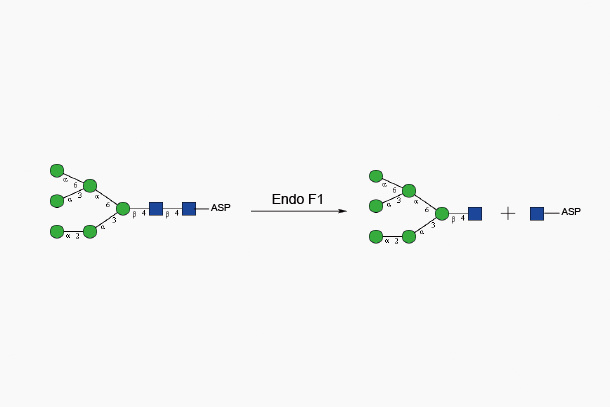
Endo F1 is a highly specific recombinant endoglycosidase expressed in Escherichia coli. Its gene originates from Elizabethkingia miricola. It specifically cleaves core-fucose-free high-mannose and hybrid-type N-glycans from glycoproteins. This product boasts high enzymatic activity and excellent stability, and is applicable to the modification and analysis of antibody glycosylation.
| E755053 | Component | 300U | 1KU | Storage | | E755053A | Endo-β-N-acetylglucosaminidase F1 | 300U | 1KU | -20℃. Avoid freeze/thaw cycle. | | E755053B | 10×Glycoprotein Denaturing Buffer (0.5% SDS, 40mM DTT) | 1000μl | 1000μl | -20℃. Avoid freeze/thaw cycle. | | E755053C | 10×GlycoBuffer 2 (500 mM Sodium Phosphate, pH7.5) | 1000μl | 1000μl | -20℃. Avoid freeze/thaw cycle. | | E755053D | 10% NP-40 | 1000μl | 1000μl | -20℃. Avoid freeze/thaw cycle. |
|
Pre-experiment Preparation
Before use, take out the Endo F1 reagent, thaw it at 4°C or on ice, then centrifuge at 10,000 rpm for 10 seconds to ensure all liquid collects at the bottom of the tube.
Reaction Reagents: Take out Endo-β-N-acetylglucosaminidase F1, 10× Glycoprotein Denaturing Buffer, 10× GlycoBuffer 2 and 10% NP-40 solution stored at -20°C for later use.
Note: Prepare reagents according to experimental requirements. If deglycosylation is carried out under non-denaturing conditions, 10× Denaturing Buffer and 10% NP-40 solution are not required.
Operating Procedures
Glycoprotein Deglycosylation under Denaturing Conditions
1. Dissolve 1–20 µg glycoprotein in deionized water, add 1 µL of 10× Glycoprotein Denaturing Buffer, and adjust the volume to 10 µL with deionized water.
2. Incubate at 75°C for 10 min.
3. Add 2 µL of 500 mM Sodium Acetate (pH 5.5) and 2 µL of 10% NP-40, then mix gently by pipetting.
4. Add 1–4 µL Endo F1, top up to 20 µL with deionized water and mix gently by pipetting.
5. Incubate at 37°C for 1–4 hr.
6. The reaction product can be analyzed by SDS-PAGE or HPLC.
Glycoprotein Deglycosylation under Non-denaturing Conditions
1. Transfer glycoprotein solution containing 10–100 µg target protein, add 2 µL of 500 mM Sodium Acetate (pH 5.5) and 2–5 µL Endo F1. Add purified water to a total reaction volume of 20 µL and mix gently.
2. Incubate the mixture at 37°C for 4–24 hr.
Note: For deglycosylation of native glycoproteins, it is recommended to digest an equal amount of denatured sample in parallel as a positive control to assess the extent of deglycosylation under non-denaturing conditions.Remark: When scaling up the reaction system, adjust incubation time or enzyme dosage accordingly. Gentle low-speed shaking can improve digestion efficiency.
Precautions
Wear a lab coat and disposable gloves during operation to protect personal safety and health. This product is for research use only.

