≥98%(HPLC) for sensitive chromatographic and analytical workflows requiring minimal baseline interference.
🌡
Storage & shipping
Store at 2-8°C Ships Wet ice Check lot-specific COA for exact specifications.
📋
Quality documents
SDS, COA, datasheet, and spec sheet available for download. Lot-specific COA accessible via lot number lookup.
📚
Literature proof
Cited in 0 peer-reviewed publications across chromatography, organic synthesis, and cross-coupling reactions.
Vue d’ensemble
Eplivanserin (SR-46349) hemifumarate is a potent, selective and orally active 5-HT2A receptor antagonist, with an IC50 of 5.8 nM in rat cortical membrane, and a Kd of 1.14 nM. Eplivanserin hemifumarate displays >20-fold selectivity more selective for 5-HT2A than 5-HT2B and 5-HT2C.
Potent and selective 5-HT2Aantagonist (IC50values are 5.8 and 120 and >100 nM for 5-HT2A, 5-HT2Band 5-HT2C, respectively). Attenuates cocaine-induced hyperactivity. Increases dopamine (DA) release in rat medial prefrontal cortex (mPFC); potentiates halope
Conditions de stockage de stockage
Store at 2-8°C
Expédié en
Wet ice
Ce produit nécessite l'expédition en chaîne froide. Les services terrestres et autres services économiques ne sont pas disponibles.
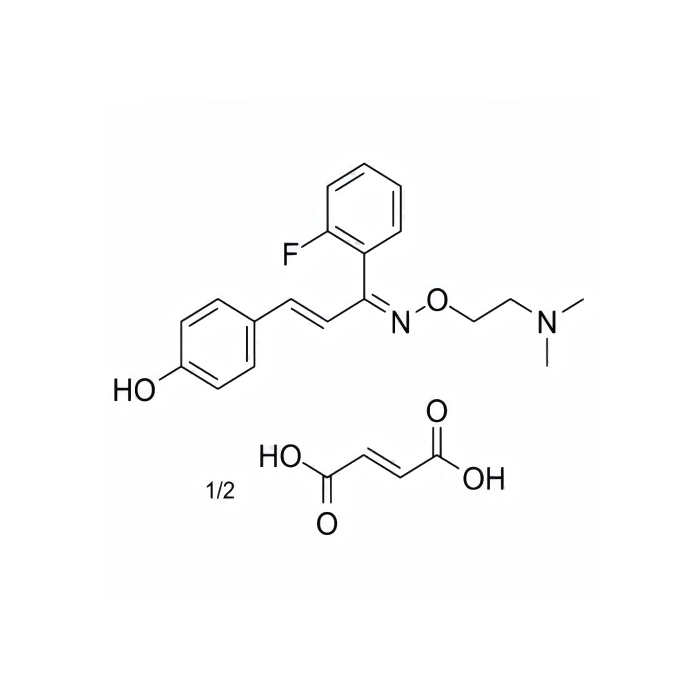
This compound belongs to the class of organic compounds known as cinnamylphenols. These are organic compounds containing the 1,3-diphenylpropene moiety with one benzene ring bearing one or more hydroxyl groups.
External Descriptors
Not available
1. Djoumbou Feunang Y, Eisner R, Knox C, Chepelev L, Hastings J, Owen G, Fahy E, Steinbeck C, Subramanian S, Bolton E, Greiner R, and Wishart DS. ClassyFire: Automated Chemical Classification With A Comprehensive, Computable Taxonomy. Journal of Cheminformatics, 2016, 8:61.
Certificats (CoA, COO, BSE/TSE et tableau d'analyse)
C of A & Other Certificates(BSE/TSE, COO):
Analytical Chart:
Propriétés chimiques et physiques
Solubilité
Solvent:DMSO, Max Conc. mg/mL: 19.32, Max Conc. mM: 50
Sensibilité
Moisture sensitive
Poids moléculaire
772.800 g/mol
XLogP3
Hydrogen Bond Donor Count
4
Hydrogen Bond Acceptor Count
14
Rotatable Bond Count
16
Exact Mass
772.328 Da
Monoisotopic Mass
772.328 Da
Topological Polar Surface Area
165.000 Ų
Heavy Atom Count
56
Formal Charge
0
Complexity
537.000
Isotope Atom Count
0
Defined Atom Stereocenter Count
0
Undefined Atom Stereocenter Count
0
Defined Bond Stereocenter Count
5
Undefined Bond Stereocenter Count
0
The total count of all stereochemical bonds
5
Covalently-Bonded Unit Count
3
Calculateurs de solution
Molarity Calculator
Determine the necessary mass, volume, or concentration for preparing a solution.
Dilution Calculator
Determine the dilution needed to prepare a stock solution.
Reconstitution Calculator
Avis
Avis des clients
Application Protocols
No tested application protocols are provided for this item.
General guidance for small-molecule reference compounds in screening workflows:
Stock preparation: Weigh accurately in a low-humidity environment; dissolve in high-purity DMSO to prepare a primary stock (e.g., 10–50 mM). Record exact concentration by gravimetry and adjust for purity/base-equivalent if CoA provides correction factors.
Aliquoting: Dispense single-use aliquots (e.g., 10–50 µL) into inert vials or plates to avoid repeated freeze–thaw. Store at 2–8°C or colder as permitted; protect from light if indicated by stability data.
Serial dilution: Prepare intermediate DMSO dilutions before final dilution into assay buffer/media to achieve target top concentration and keep final DMSO ≤0.5–1% v/v.
QC: Verify identity and concentration periodically by LC–UV/LC–MS; monitor for degradation products after storage.
These are general practices; adapt to your assay platform. Item-specific protocols are not specified for this product.
Biological Roles
No item-specific biological data are provided in the Product Data. The following are general, literature-based context for eplivanserin as a small-molecule research ligand; do not construe as medical or clinical claims.
Pharmacological class (literature): Eplivanserin is described in the literature as a serotonin (5-HT) receptor ligand, frequently associated with 5-HT2-family receptor studies. The hemifumarate is a salt form used to improve handling and solubility in research.
Research utility: Serves as a reference compound in receptor binding and functional assays to characterize GPCR signaling pathways, aiding in determination of potency, efficacy, and bias of test molecules.
Mechanistic studies: Enables interrogation of downstream signaling (e.g., Gq/PLC–IP3–Ca2+ pathways for 5-HT2A/2C in model systems) by providing a well-characterized comparator under uniform assay conditions.
ADME profiling (general): Compounds of this class are often used in in vitro metabolic stability assays (microsomes, hepatocytes), permeability (Caco-2/MDCK), and protein-binding panels as controls or benchmarks. No such data are specified for this item.
Note: Target specificity and any quantitative potency/affinity values are not provided for this product; consult primary literature if needed for study design. Use strictly for research use only.
Buffer Applications
This product is not a buffering agent and is not typically used to prepare defined pH buffer systems.
Practical notes (for solution preparation in buffered systems):
To maintain the hemifumarate salt in solution, slightly acidic buffers (e.g., 10–50 mM acetate pH 4.5–5.5 or citrate pH 3–6) can reduce free-base precipitation for basic amine salts (general guidance). Verify compatibility with your assay/analytics.
When diluting DMSO stocks into buffer, target a final DMSO content ≤0.5–1% v/v for cell-based assays to minimize solvent effects. Mix thoroughly and add stock last to reduce local supersaturation.
No item-specific pKa or solubility data are provided; optimize buffer composition empirically and confirm by clarity check and LC assay.
Green Alternatives
As a solid research compound (not a process solvent or reagent), "green alternatives" primarily concern the choice of dissolution and processing media rather than replacement of the active substance itself.
Greener solvent choices for handling (general):
Prefer water/buffer at suitable pH when feasible; maintain protonation of the amine via mildly acidic buffers (e.g., citrate or acetate) to enhance solubility.
If an organic co-solvent is required, consider ethanol or isopropanol over more hazardous solvents when compatible with your assay or analytics.
For LC methods, consider water–ethanol or water–acetonitrile systems; minimize use of halogenated solvents.
Comparison (general guidance)
Water/buffer: lowest environmental impact; may need pH adjustment and gentle warming to dissolve.
Ethanol: bio-based availability; good solvency; higher UV cut-off than acetonitrile.
DMSO: excellent solvency and low volatility; disposal considerations and potential biological effects at higher % v/v.
Operational practices:
Use concentrated stocks and micro-aliquots to reduce solvent volumes.
Employ closed-vial dissolution with vortex/sonication to limit emissions.
Validate lower-organic-content assay conditions to reduce DMSO levels without compromising performance.
Pharmaceutical Uses
No pharmacopeial status, excipient role, or formulation specifications are provided for this item.
Research/formulation context (general):
Salt-form studies: Hemifumarate salts are commonly explored in preformulation to assess effects of counterions on solubility, hygroscopicity, and solid-state stability of basic drug candidates.
Reference standard: May serve as a reference compound in analytical method development and validation (e.g., LC–UV/LC–MS) within pharmaceutical R&D labs.
Compatibility screening: Useful in small-scale evaluations of solvent/co-solvent systems, pH–solubility profiles, and forced-degradation studies to establish stability-indicating methods.
Important: This product is supplied strictly for research use only and is not intended for human or veterinary use, nor for use in diagnostic procedures.
Physical Properties
Item-specific physicochemical specifications are not provided in the Product Data for this SKU. Do not treat literature values as specifications.
Appearance: Not specified for this item; refer to CoA/Spec Sheet.
Melting point: Not specified for this item; refer to CoA/Spec Sheet.
Boiling point: Not applicable for an ionic organic salt; decomposition is expected before boiling (general).
Density: Not specified for this item; refer to CoA/Spec Sheet.
Solubility: Not specified for this item; refer to CoA/Spec Sheet. (General: hemifumarate salts of basic amines often show improved aqueous solubility relative to the free base; DMSO is commonly used for stock solutions in screening workflows.)
LogP/logD: Not specified for this item; refer to CoA/Spec Sheet.
pKa: Not specified for this item; refer to CoA/Spec Sheet. (General: protonated amine salts have acidic counterions and exhibit pH-dependent solubility.)
Refractive index: Not applicable (solid) unless dissolved; not specified for this item.
Practical notes (general, not specifications):
For analytical preparations, dissolution in anhydrous DMSO to make a concentrated primary stock, followed by dilution into assay buffer or aqueous media with co-solvent, is common practice for small-molecule salts.
Verify polymorph/hydrate state and water content by CoA prior to quantitative work.
Quality and Grades
Grade/Purity: Not specified for this item; refer to CoA/Spec Sheet for exact assay, related-substance limits, water content, and residual solvent profile.
Guidance on typical quality attributes for small-molecule reference compounds (general):
Identity: verified by NMR and/or HPLC–MS; salt form confirmed by titration or elemental analysis.
Purity: frequently reported by HPLC (area %) with defined method; residual solvents by GC; water content by Karl Fischer. None of these values are specified for this item.
Form: hemifumarate salt; the counterion can impact solubility, crystallinity, and stability relative to the free base. Confirm the salt stoichiometry (0.5 fumarate per base) and any hydrate state on the CoA.
UV behavior: Not specified for this item; refer to CoA/Spec Sheet. For LC-UV work, ensure method conditions minimize non-specific absorbance from the counterion.
Implications for use:
For quantitative bioassays and analytical standards, use the exact lot-specific potency/correction factor from the CoA if provided (e.g., assay % on anhydrous basis) to prepare accurate stock solutions.
If stabilizers are present, they will be disclosed on the CoA/SDS; none are specified in the Product Data here.
Reaction and Applications
This compound is primarily used as a research reference ligand/compound in screening collections and receptor pharmacology assays rather than as a synthetic reagent. No manufacturer application notes are provided for this SKU.
Research applications (general/literature):
Reference standard in bioassays: Employed as a characterized small molecule for binding and functional assays (e.g., GPCR-focused panels). Suitable for generating concentration–response curves and benchmarking assay performance.
Analytical method development: Used as a system-suitability or calibration analyte in LC–UV/LC–MS methods for small molecules when included in compound libraries. Optimize mobile phase to ensure adequate retention and peak symmetry; counterion (fumarate) may influence early elution.
Salt-interconversion studies: The hemifumarate provides a defined salt state useful for evaluating salt effects on solubility, stability, and solid-state behavior relative to free base (general pharmaceutics research).
Practical tips:
Prepare a high-concentration DMSO stock, verify concentration by UV or quantitative NMR if required, and minimize freeze–thaw cycles by aliquoting.
Document the salt mass fraction for potency correction (base-equivalent calculations) if performing dose-normalized studies. Use the CoA to determine assay % and hydration where applicable.
For long assays, assess solution stability (time, temperature, light) by LC to confirm no significant degradation in the chosen medium.
Reaction Conditions
Not typically applicable. This product is not provided as a reagent for conducting named organic reactions, and no reaction-condition guidance is specified for this item.
Related operational conditions (general for handling and analytics):
Solution preparation: Dissolve in anhydrous DMSO to prepare concentrated stocks (e.g., 10–50 mM), then dilute into assay media or mobile phases as required. Confirm clarity and absence of precipitate.
LC–MS analysis: Volatile mobile phases (e.g., water/acetonitrile with 0.1% formic acid or ammonium formate) are generally suitable. Optimize source conditions to balance desolvation for salts.
Stability checks: Conduct short-term stability assessments at intended temperatures (bench, autosampler at 4–10°C) and light exposure; re-inject over time to verify peak purity.
Any specific reaction temperatures, catalysts, or yields are not applicable for this catalog item.
Safety and Handling
Always consult the SDS for authoritative and complete safety information. Product Data for this item does not include GHS details.
GHS classification: Not specified for this item; refer to SDS.
Signal word / pictograms / H-statements: Not specified for this item; refer to SDS.
General laboratory precautions (for small-molecule organic salts):
PPE: lab coat, safety glasses, and appropriate chemical-resistant gloves (e.g., nitrile). Handle powders in a fume hood to avoid inhalation of dust/aerosols.
Avoid contact with skin and eyes; prevent ingestion and inhalation. Use local exhaust ventilation when weighing and preparing solutions.
Incompatibilities: strong oxidizers and strong bases/acids may cause degradation or salt exchange (general). Avoid prolonged exposure to moisture if hygroscopic behavior is indicated on CoA.
First aid (overview; consult SDS): move exposed person to fresh air for inhalation; rinse skin/eyes with copious water; seek medical attention if symptoms persist. If ingested, rinse mouth; do not induce vomiting unless directed by medical personnel.
Spill response: avoid dust generation; collect with inert absorbent; dispose of according to institutional and local regulations.
Storage and transport (item-specific):
Storage: Store at 2–8°C (per Product Data).
Shipping: Shipped on wet ice (per Product Data).
Waste disposal: Follow institutional chemical waste procedures; do not discharge to drains.
Solvent Selection
This product is a solid small-molecule hemifumarate salt. No item-specific solubility data are provided.
General solvent guidance (literature/practice for organic amine salts):
Primary stock preparation: DMSO is commonly used to prepare 10–50 mM stocks for screening libraries due to broad solvating power and compatibility with high-throughput assays.
Aqueous media: Hemifumarate salts often show better aqueous compatibility than the corresponding free base; however, pH can strongly influence solubility. Slightly acidic buffers (e.g., citrate, acetate) may maintain the salt state and enhance dissolution.
Alcohols: Methanol or ethanol may dissolve the salt for analytical sample prep (HPLC, LC–MS). Ensure compatibility with detectors and columns.
Mixed vehicles: For biological assays, co-solvent systems such as DMSO→buffer serial dilutions, or ethanol/PEG 400/saline mixtures, are commonly employed to achieve final organic content ≤1–2% v/v in the assay well.
Comparison (general):
DMSO: maximal solubilization; hygroscopic and can affect cells at >0.5–1% v/v.
Water/buffer: greener and assay-friendly; may require pH control to keep the salt protonated.
Acetonitrile/methanol: useful for LC; volatile and MS-compatible.
Always validate solubility and stability experimentally for your batch and intended matrix.
Storage and Reconstitution
Storage temperature (item-specific): Store at 2–8°C (per Product Data). Protect from excessive heat. If the CoA/SDS notes light sensitivity or hygroscopicity, store in amber, tightly closed containers with desiccant.
Shipping condition (item-specific): Shipped on wet ice (per Product Data).
Reconstitution: Not specified for this item; refer to CoA/Spec Sheet. General practice is to dissolve the solid in anhydrous DMSO to prepare a concentrated stock, then dilute into assay media immediately before use.
Aliquoting: Prepare single-use aliquots to minimize freeze–thaw and headspace moisture ingress. Clearly label with concentration, solvent, lot, and date.
Stability: Not specified for this item; verify by LC if storing solutions for more than 24–48 h. For long-term storage of solutions, consider −20°C to −80°C if compatible, and avoid repeated thawing.
Insoluble residue: Warm gently (≤40°C) and vortex/sonicate briefly; avoid strong base/acids that could induce salt exchange or degradation.
Note: For any precise reconstitution factors (e.g., to yield mmol base equivalent per mL), use the lot-specific assay and salt/hydrate information from the CoA.
Structure and Identity
Eplivanserin hemifumarate is the fumaric acid salt form (0.5 equiv fumarate per eplivanserin base) of the small-molecule research ligand eplivanserin.
SKU: E288211
Product name: Eplivanserin hemifumarate
CAS: 130580-02-8 (literature for the hemifumarate salt)
PubChem CID: 135456189 (literature)
InChIKey: Not specified for this item; refer to CoA/Spec Sheet. (Note: product data lists "320983", which is not a standard InChIKey.)
SMILES: Not specified for this item; refer to CoA/Spec Sheet.
Molecular formula: Not specified for this item; refer to CoA/Spec Sheet.
Molecular weight: Not specified for this item; refer to CoA/Spec Sheet.
Structural features (general/literature):
The substance is a crystalline organic salt composed of the eplivanserin cation paired with half an equivalent of fumarate (trans-butenedioate) as the counterion.
Fumarate contributes a dicarboxylate anion capable of strong hydrogen bonding, commonly improving crystallinity and handling of amine-containing drug-like bases (general salt-formation chemistry).
2D description: a protonated, heteroatom-containing aromatic small molecule (eplivanserin base) associated ionically with half-equivalent fumarate; no stereochemical information is specified here for this item.
Notes:
Identity parameters not listed above are not specified for this item; refer to CoA/Spec Sheet and SDS for definitive identifiers.
Synthetic Utility
This item is a finalized small-molecule hemifumarate salt and is not typically employed as a synthetic building block.
If used in chemistry workflows (general considerations):
Salt exchange: Conversion between salt forms (e.g., hemifumarate → free base → alternate salt) can be performed to tailor solubility or crystallinity for studies; ensure full counterion removal and characterization (NMR, HRMS, elemental analysis).
Derivatization: Any structural modification would proceed on the free base under standard functional-group transformations applicable to drug-like heteroaromatics and amines; however, such use is atypical for a catalog reference compound.
Analytical characterization: HPLC method development should consider the ionic nature of the salt; ion-pairing is usually unnecessary—adjust pH to suppress ionization for retention on reversed phase, or use appropriate gradient with volatile acids (e.g., formic acid) for LC–MS.
Conclusion: Treat primarily as a reference/assay compound rather than a synthetic intermediate.
Target Specificity
Target/assay specificity details (e.g., receptor subtype selectivity, potency values, or cellular targets) are not provided for this product. No antibody or biologic attributes (antigen, clone, isotype, species reactivity) apply to this small-molecule compound.
Item-specific target data: Not specified for this item; consult primary literature if needed for study design.
This section is generally not applicable to small molecules without supplied bioactivity data.
Nous utilisons des cookies pour garantir le bon fonctionnement du site et, lorsque cela est autorisé, pour améliorer votre expérience. Vous pouvez gérer vos préférences à tout moment dans les Paramètres. Pour en savoir plus, consultez notre Politique relative aux cookies.
Souhaitez-vous que nous vous envoyions un message lorsque des réductions seront disponibles?
Me rappeler plus tard
Merci ! Veuillez vérifier votre boîte de réception e-mail pour confirmer.
Products are supplied to verified businesses, institutions, and qualified professionals for research and development use only. Not for use in humans, animals, diagnosis, or therapy.