This compound belongs to the class of organic compounds known as benzoic acid esters. These are ester derivatives of benzoic acid.
External Descriptors
Not available
1. Djoumbou Feunang Y, Eisner R, Knox C, Chepelev L, Hastings J, Owen G, Fahy E, Steinbeck C, Subramanian S, Bolton E, Greiner R, and Wishart DS. ClassyFire: Automated Chemical Classification With A Comprehensive, Computable Taxonomy. Journal of Cheminformatics, 2016, 8:61.
Determine the necessary mass, volume, or concentration for preparing a solution.
Dilution Calculator
Determine the dilution needed to prepare a stock solution.
Reconstitution Calculator
Avis
Avis des clients
Application Protocols
Not applicable.
No validated biological assay protocols (e.g., WB, IHC, IF, FC) or recommended dilutions are provided for this small-molecule building block. For chemical use, refer to the Reaction Conditions and Synthetic Utility sections for representative procedures and adaptation guidance.
Biological Roles
Applicability
This product is a synthetic aromatic ester/aryl ether used as a chemical building block. It is not a biological buffer, nutrient, or biomolecule.
General biochemical context (literature/general)
Aryl esters and ethers of this type have no known native metabolic role. In biological systems, esterases can hydrolyze simple aliphatic esters; however, sterically hindered aromatic esters and aryl ethyl ethers are more resistant and generally persist under physiological conditions unless specifically metabolized.
Electron-rich salicylate derivatives (after deprotection to phenols) can coordinate metal ions and may serve as ligating motifs in bioinorganic model studies, but such uses are research-only and system-dependent.
Caveats
No biological function, pathway involvement, or receptor interactions are assigned to this specific compound in the Product Data. Any exploration of bioactivity must be conducted under appropriate approvals and is outside the scope of this research-use-only product.
Buffer Applications
Not typically applicable.
Ethyl 2,6-diethoxybenzoate is a hydrophobic organic building block, not a buffering agent. It does not provide acid/base pairs in the physiological pH range and has very low water solubility (literature expectation).
For aqueous work, focus on the Synthetic Utility and Reaction Conditions sections for transformations that generate more polar derivatives if needed.
Green Alternatives
Context
This item is a specialty aromatic building block rather than a common solvent or reagent. Greener choices relate to protection strategies, solvents, and process conditions rather than a direct one-to-one substitution of the molecule itself.
2,6-Dimethoxy analogs can be deprotected under milder conditions (BBr3) than diethoxy; methoxy groups are also more atom-economical but may raise worker exposure to MeBr byproducts during demethylation.
Carbonate or silyl protections (e.g., MOM, SEM, TBS) for phenolic positions may allow milder deprotection and reduced halogenated waste, but introduce additional steps and reagents.
Solvent selection:
Prefer ethyl acetate, 2-MeTHF, CPME, or toluene over chlorinated solvents where feasible.
Use water or water-miscible solvent systems for hydrolyses and couplings when compatible.
Reaction intensification:
Employ catalytic transesterifications (organocatalysts or enzymatic methods) at lower temperatures.
Flow chemistry and in-line workups can reduce solvent volumes and exposures.
Illustrative comparison (general)
Option: 2,6-dimethoxybenzoate vs 2,6-diethoxybenzoate
Pros (dimethoxy): Easier ether cleavage; typically lower boiling points; potential for reduced energy use in distillation.
Cons: Increased susceptibility to acid-catalyzed side reactions; different solubility/volatility profiles may complicate isolation.
Note
Selection of greener alternatives depends on target synthesis and deprotection route; assess life-cycle impacts, solvent recovery, and waste treatment before process changes.
Pharmaceutical Uses
Scope
No pharmacopeial status, excipient designation, or formulation role is provided in the Product Data for this item.
General context (literature/general)
Aromatic benzoate esters and aryl ethers are commonly explored as synthetic intermediates en route to candidate APIs or functional excipients after further transformation (e.g., hydrolysis to acids, conversion to amides, deprotection to phenols). The present compound may serve as a protected dihydroxybenzoate precursor in medicinal chemistry routes.
Compliance note
This product is supplied for research use only. It is not intended for human or veterinary use, clinical diagnostics, or as an active pharmaceutical ingredient without further qualification and regulatory review.
Physical Properties
Item-specific specifications
Not specified for this item; refer to CoA/Spec Sheet.
Literature/general expectations for this structure (for planning only; not product specifications)
Appearance: Aromatic esters of comparable substitution are typically colorless to pale yellow liquids or low-melting solids; actual physical state for this item is not specified.
Molecular formula: C13H20O4 (from structure)
Molecular weight: ~240.30 g/mol
Volatility: Significantly less volatile than ethyl benzoate due to two additional ethoxy substituents; expected to have a higher boiling point and lower vapor pressure (literature analogy).
Solubility profile: Expected to be
Miscible or highly soluble in nonpolar to moderately polar organic solvents (e.g., toluene, dichloromethane, chloroform, ethyl acetate, THF, acetone; literature expectation).
Very low solubility in water (aryl esters and aryl ethers are hydrophobic; literature expectation).
LogP: Likely high (hydrophobic) due to three ethoxy-related fragments and the aromatic core (qualitative, literature expectation).
Acid/base behavior: Neutral organic compound; the ester is not appreciably basic; phenoxy oxygens are tied up as ethers (no phenolic acidity).
Refractive index, melting/boiling points, density, UV cutoff, peroxide or trace-metal content, and water content: Not specified for this item; refer to CoA/Spec Sheet.
Quality and Grades
Item-specific quality information
Grade/purity: Not specified for this item; refer to CoA/Spec Sheet for assay, impurity profile, and any stabilizers.
General guidance for interpreting grades (context)
Research grade organics: Typically suitable for synthetic chemistry, method development, and materials research. Impurity levels (e.g., residual solvents, peroxides, metals, water) vary by lot and supplier; consult the CoA when reactions are sensitive.
Chromatography-suitable materials: If designated as HPLC/GC grade (not specified here), such labeling indicates low UV background and minimal volatile/nonvolatile residues; absence of such designation here means users should verify suitability for trace/analytical applications.
Recommendations for this compound type
Verify identity: 1H/13C NMR in CDCl3 or DMSO-d6, IR (ester C=O ~1735 cm−1, aryl C–O stretch 1200–1300 cm−1; literature), MS (M+ at m/z ~240). Consider GC–MS/LC–MS for purity profiling depending on volatility.
Moisture/acid/base sensitivity: Esters can slowly hydrolyze; aryl ethyl ethers are generally robust but can cleave under strong Lewis/Brønsted acids. Maintain dry storage and minimize prolonged exposure to strong acids/bases during handling.
Stabilizers: None specified for this item; if present, they will be listed on the CoA/Spec Sheet.
Reaction and Applications
Overview
Ethyl 2,6-diethoxybenzoate is an electron-rich, ortho,ortho-disubstituted aromatic ester useful as a protected salicylic-acid-type building block. The two ethoxy groups mask phenolic positions and modulate directing effects in electrophilic substitution.
Representative applications (literature/general)
Protecting-group strategy: The 2,6-diethoxy pattern can serve as removable protection for catechol-like positions; aryl ethyl ethers can be dealkylated to phenols under strong Lewis/Brønsted acids (e.g., BBr3, AlCl3/thiol, HBr) giving the corresponding 2,6-dihydroxybenzoate.
Ester transformations: Hydrolysis (acidic or basic) to the carboxylic acid; transesterification to other alkyl esters; amidation via activation to the acid chloride or via coupling reagents (EDC/HOBt, HATU) after saponification to the acid.
Reductions: Ester reduction to the corresponding benzyl alcohol derivative (e.g., LiAlH4 or DIBAL-H); hydrogenolysis conditions typically leave aryl ethoxy groups intact.
Electrophilic aromatic substitution (EAS): Two ethoxy groups are strong ortho/para directors; with 2,6-disubstitution, electrophiles favor the para position (C4) and potentially the meta-like 3,5 positions considering steric hindrance. Nitration, Friedel–Crafts acylation/alkylation, and halogenation can be tuned accordingly.
Cross-coupling after halogenation: Introduce a halogen at a remaining position, then utilize Suzuki–Miyaura, Buchwald–Hartwig, or Kumada couplings to elaborate the aromatic core while retaining/transforming the ester.
Materials/ligand precursors: Electron-rich salicylate frameworks are common motifs in UV-absorbing materials, coordination ligands (after deprotection to phenols), and fragrance intermediates; use is research-only and application-specific.
Practical tips
Maintain anhydrous conditions when ester integrity is critical. Avoid strong acids if aryl ether deprotection is not desired. During EAS, consider sterics: 2,6-disubstitution can impede ortho access and favor para outcomes.
Reaction Conditions
General literature guidance (representative; adjust to your system; not product specifications)
Hydrolysis to acid (saponification):
Basic: KOH or NaOH (1–2 M) in EtOH/H2O or MeOH/H2O, rt–70 C, 2–16 h; then acidify to isolate 2,6-diethoxybenzoic acid.
Acidic: Aqueous HCl (2–6 M) with refluxing EtOH or dioxane/H2O, 2–12 h; slower than base-catalyzed routes.
Transesterification:
Acid-catalyzed (e.g., p-TsOH, H2SO4) in the target alcohol (ROH) with Dean–Stark or molecular sieves, 60–120 C, 4–24 h.
Base-catalyzed (e.g., NaOEt/EtOH) at 25–80 C; monitor to avoid hydrolysis.
Reduction of ester:
LiAlH4 in anhydrous THF or Et2O, 0 C to reflux, 1–6 h, to afford the benzyl alcohol derivative. Quench cautiously.
DIBAL-H (1–2 equiv) in toluene or THF at −78 to 0 C for partial reduction to aldehyde; workup at low temperature to control over-reduction.
Ether deprotection (aryl ethyl ethers → phenols):
BBr3 (1–3 equiv per ether) in DCM, −78 to 0 C to rt, 1–18 h; ethyl ethers may require elevated temperature or longer times vs methoxy analogs. Work up with MeOH/water carefully.
Concentrated HBr/AcOH, 60–100 C, hours to overnight; may affect the ester—consider protecting the acid as amide or using milder Lewis acids.
Electrophilic aromatic substitution:
Halogenation: NBS/NCS with acid catalyst or FeCl3/Br2, 0–25 C, monitor regioselectivity (para often favored).
Friedel–Crafts acylation: Acyl chloride/AlCl3 in DCM or nitrobenzene, −20 to 0 C to rt; sterics at 2,6 positions limit ortho attack.
Analysis and workup
Monitor by TLC (hexanes/EtOAc) or HPLC. Neutralize/chelate residual Lewis acids (e.g., with MeOH, water, or aqueous NaHCO3), and consider silica deactivation (1–2% Et3N) to minimize decomposition during chromatography.
Safety and Handling
Item-specific hazard information
Signal word: Not specified for this item; refer to SDS.
H-statements: Not specified for this item; refer to SDS.
GHS classification/pictograms: Not specified for this item; refer to SDS.
General safety considerations for aryl esters/aryl ethers (literature/general guidance)
Likely hazards: Combustible liquid/solid; may cause skin/eye irritation; harmful if swallowed or inhaled. Always consult the SDS for definitive classification and response measures.
Personal protective equipment (PPE): Lab coat, safety glasses or splash goggles, and suitable chemical-resistant gloves (e.g., nitrile). Handle in a fume hood to avoid inhalation of vapors or aerosols.
Handling: Avoid heat, sparks, and open flame. Prevent contact with strong acids and bases that can catalyze hydrolysis or ether cleavage; avoid strong oxidizers.
First aid (overview; defer to SDS):
Skin/eye contact: Rinse with water for at least 15 minutes; remove contaminated clothing; seek medical attention if irritation persists.
Inhalation: Move to fresh air; monitor for respiratory irritation; seek medical attention if symptoms develop.
Ingestion: Rinse mouth; do not induce vomiting unless directed by medical personnel; seek medical attention.
Spill response: Absorb with inert material (vermiculite, sand), collect for disposal. Ventilate area, avoid ignition sources.
Waste disposal: Dispose of as organic chemical waste in accordance with institutional and local regulations.
Storage (from Product Data)
Store at room temperature. Keep container tightly closed in a dry, well-ventilated place. Protect from moisture and incompatible materials. Always refer to the SDS for authoritative guidance.
Solvent Selection
Applicability
This product is a hydrophobic aromatic ester/aryl ether building block rather than a solvent. The following guidance addresses solvents appropriate for dissolving and processing it in synthesis or analysis.
Solubility and polarity considerations (literature/general)
Polarity: Overall nonpolar to moderately polar; three ether/ester oxygens enhance dipolar interactions but the aromatic core and ethyl groups drive hydrophobic behavior.
Likely good solvents: Dichloromethane, chloroform, toluene, ethyl acetate, THF, acetone, acetonitrile (moderate), and DMF/DMSO for maximum solubility.
Poor solvents: Water; very polar protic solvents (methanol, ethanol) may solubilize partially but can also participate in transesterification in strongly acidic/basic media.
Selection tips by operation
Reaction medium: Choose toluene, DCM, or THF depending on transformation (e.g., acylations/transesterifications in toluene or toluene/EtOH; reductions in THF; hydrolyses in biphasic DCM/aqueous base).
Purification: Normal-phase silica gel chromatography with hexanes/EtOAc or toluene/EtOAc gradients typically offers good separation for aromatic esters; monitor for potential acid-catalyzed transesterification on acidic silica—pre-treat silica with 1–2% triethylamine if needed (literature practice).
Analytical: GC may be feasible if the compound is sufficiently volatile and thermally stable; otherwise use reverse-phase HPLC (C18) with acetonitrile/water or methanol/water (add 0.1% acid base as appropriate) for purity assessment.
Storage and Reconstitution
Item-specific storage (from Product Data)
Storage conditions: Room temperature.
Shipping: Normal.
General handling guidance (literature/general)
Keep container tightly closed in a dry, well-ventilated area. Protect from moisture and strong acids/bases to limit hydrolysis or ether cleavage.
If long-term storage is anticipated, consider storing under inert gas (nitrogen/argon) in amber glass to minimize oxidative discoloration; avoid prolonged exposure to elevated temperatures.
Reconstitution/solution preparation
Appearance and physical state are not specified for this item. To prepare stock solutions for synthetic or analytical use, dissolve in a suitable anhydrous organic solvent (e.g., DCM, toluene, THF, ethyl acetate, acetone, or acetonitrile) to the desired concentration. Filter if necessary through PTFE membranes.
No aqueous reconstitution is recommended due to expected low water solubility and potential for hydrolysis under acidic/basic conditions.
Stability notes
Not specified for this item; refer to CoA/Spec Sheet and SDS for any stated shelf life or additional storage precautions.
Structure and Identity
Item-specific (from Product Data)
SKU: E340709
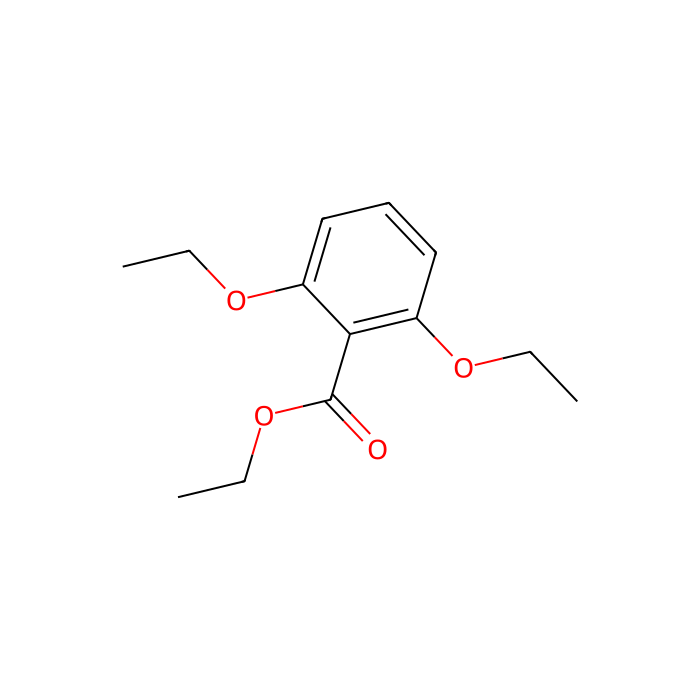
Product name: Ethyl 2,6-diethoxybenzoate
CAS: 92157-15-8
PubChem CID: 5069409
InChIKey: 301075 (as provided)
Storage condition: Room temperature
Shipped: Normal
Research use: For research use only
Literature/structural description (general chemistry; not item-specific specs)
IUPAC-style name: Ethyl 2,6-diethoxybenzoate
Core scaffold: Benzene ring bearing an ethyl benzoate ester (–C(=O)OCH2CH3) and two ethoxy substituents (–OCH2CH3) at the 2- and 6-positions (ortho,ortho to the carboxylate).
Stereochemistry: None (achiral; no stereogenic centers).
2D description: A benzene ring with an ester at C1 (carboxyl carbonyl bonded to ethoxy) and –OCH2CH3 groups at C2 and C6; remaining ring positions (3,4,5) are unsubstituted.
Empirical formula (computed from structure; literature): C13H20O4
Formula weight (literature/computed): ~240.30 g/mol
Example SMILES (literature): CCOC(=O)c1c(OCC)cccc1OCC
Notes
Any registry identifiers not explicitly provided above should be verified against the Certificate of Analysis (CoA) or specification sheet prior to regulated use.
Synthetic Utility
Key functional elements and reactivity (literature/general)
Ester handle (–CO2Et):
Hydrolysis (acidic/basic) to give 2,6-diethoxybenzoic acid; subsequent coupling to amides/esters.
Reduction (LiAlH4, DIBAL-H) to the corresponding benzyl alcohol derivative for further oxidation or etherification.
Transesterification (acid/base catalysis) to tune leaving group or volatility.
Aryl ethyl ethers (–OCH2CH3 at C2, C6):
Deprotection to phenols using strong Lewis/Brønsted acids (e.g., BBr3, BCl3, AlCl3 with nucleophiles, HBr/AcOH), enabling access to 2,6-dihydroxybenzoate motifs.
Relative robustness under many coupling and reduction conditions allows late-stage unveiling.
Aromatic substitution platform:
Ethoxy groups are strong activators and ortho/para directors. With 2,6-disubstitution, para (C4) is typically the most accessible site for EAS (nitration, halogenation, Friedel–Crafts), with potential substitution at C3/C5 under forcing conditions.
Cross-coupling after halogenation: Install Br/Cl at C4 (or C3/C5) and couple via Suzuki–Miyaura, Buchwald–Hartwig, or Negishi to elaborate the framework while preserving or transforming the ester/ether functions.
Retrosynthetic value
Serves as a protected equivalent of 2,6-dihydroxybenzoate esters, enabling orthogonal manipulations on the ring and side chain prior to global deprotection.
Target Specificity
Not applicable.
This product is a small-molecule organic building block, not a biological targeting reagent. No antigen, epitope, species reactivity, clone, or isotype information is associated with this item in the Product Data.
Foire aux questions
What is the purity of this product?
This product is supplied at ≥97% purity (chemical assay). Lot-specific values are stated on the Certificate of Analysis.
How should this product be stored?
Store at room temperature.
How is this product shipped?
This product ships under standard ambient conditions. No temperature-controlled packaging is required.
What are the CAS number, molecular formula and molecular weight?
The CAS Number is 92157-15-8, the molecular formula is C13H18O4, and the molecular weight is 238.28 g/mol. InChIKey QMVQTFWOHMQDQM-UHFFFAOYSA-N.
What documentation is provided?
Available product documentation, including Certificates of Analysis (COA), Safety Data Sheets (SDS), and specification sheets, is shown in the product document area. Document availability and access follow the current site policy.
Nous utilisons des cookies pour garantir le bon fonctionnement du site et, lorsque cela est autorisé, pour améliorer votre expérience. Vous pouvez gérer vos préférences à tout moment dans les Paramètres. Pour en savoir plus, consultez notre Politique relative aux cookies.
Souhaitez-vous que nous vous envoyions un message lorsque des réductions seront disponibles?
Me rappeler plus tard
Merci ! Veuillez vérifier votre boîte de réception e-mail pour confirmer.
Products are supplied to verified businesses, institutions, and qualified professionals for research and development use only. Not for use in humans, animals, diagnosis, or therapy.

 E2322043