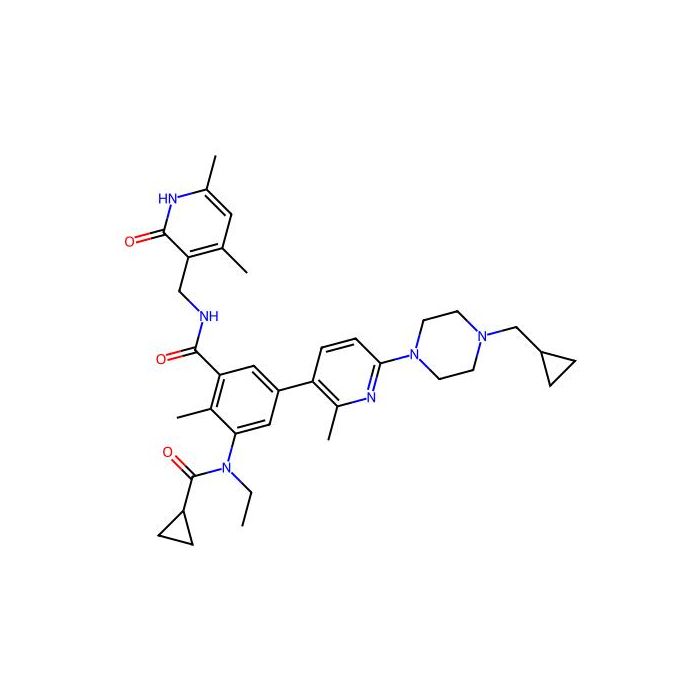
EZH2-IN-2 is a EZH2 inhibitor extracted from patent WO2018133795A1, Compound Example 69, with an IC 50 of 64 nM. EZH2-IN-2 can be used for the research of cancer or precancerous condition related to EZH2 activity
IC50& Target:EZH2 64 nM (IC 50 )
Spécifications
Spécifications et pureté
10mM in DMSO
Mécanismes biochimiques et physiologiques
EZH2-IN-2 is a EZH2 inhibitor extracted from patent WO2018133795A1, Compound Example 69, with an IC 50 of 64 nM. EZH2-IN-2 can be used for the research of cancer or precancerous condition related to EZH2 activity.
Conditions de stockage de stockage
Store at -80°C
Expédié en
Dry ice packs + Cold packs
Ce produit nécessite l'expédition en chaîne froide. Les services terrestres et autres services économiques ne sont pas disponibles.
Type d'action
INHIBITOR
Noms et identifiants
Poids moléculaire
610.79
Données avancées
Certificats (CoA, COO, BSE/TSE et tableau d'analyse)
C of A & Other Certificates(BSE/TSE, COO):
Analytical Chart:
Calculateurs de solution
Molarity Calculator
Determine the necessary mass, volume, or concentration for preparing a solution.
Dilution Calculator
Determine the dilution needed to prepare a stock solution.
Reconstitution Calculator
Avis
Avis des clients
Application Protocols
No item-specific, validated protocols are provided in this listing. The following general, non-binding guidance reflects common practices for small-molecule EZH2 inhibitors.
Stock preparation: Dissolve in anhydrous DMSO to a convenient concentration (e.g., 10 mM). Filter if necessary. Store as single-use aliquots at recommended storage temperature to avoid freeze–thaw.
Enzymatic assay setup: Prepare serial dilutions in DMSO, then into assay buffer to desired final concentrations, ensuring constant vehicle across wells. Include controls: vehicle-only, positive control inhibitor, and no-enzyme/background controls.
Cell-based dosing: Titrate across logarithmic range (e.g., 0.001–10 µM final) with matched vehicle controls. Replace media as required to maintain exposure; harvest at multiple time points for H3K27me3 assessment.
Readouts: Use western blot/ELISA for H3K27me3, or kit-based methyltransferase activity assays (e.g., HTRF/TR-FRET). Validate that the compound does not interfere with the detection chemistry (inner-filter effects, fluorescence quenching).
Data integrity: Confirm absence of precipitation by visual check and by monitoring assay signal baselines. Run at least three biological replicates with technical duplicates/triplicates.
For standardized, step-by-step SOPs with plate maps and calculation templates, contact technical support or consult vendor-neutral assay kit manuals.
Biological Roles
General context (not item-specific claims):
EZH2 is the catalytic lysine methyltransferase within the Polycomb Repressive Complex 2 (PRC2), responsible for mono-, di-, and tri-methylation of histone H3 at lysine 27 (H3K27me1/2/3). These marks are associated with transcriptional repression and maintenance of cellular identity.
Small-molecule EZH2 inhibitors are chemical probes that modulate the catalytic SET domain’s activity, often by competing with S-adenosyl-L-methionine (SAM) or engaging adjacent pockets, thereby reducing H3K27 methylation levels.
Chemical inhibition enables interrogation of epigenetic regulation, chromatin state transitions, and crosstalk with other histone modifiers (e.g., demethylases like KDM6A/B) and readers (e.g., CBX proteins from PRC1).
Use in research workflows:
Elucidation of gene silencing networks and feedback between PRC2 occupancy and DNA methylation.
Studies of cell fate and differentiation, where H3K27me3 redistribution impacts lineage specification.
Mapping chromatin accessibility and enhancer repression dynamics via ATAC-seq/ChIP-seq upon inhibitor treatment.
Notes:
Potency, selectivity versus EZH1 and other methyltransferases, and cellular activity vary among scaffolds. For this specific product (EZH2-IN-2), consult the CoA/Spec Sheet or primary references for quantitative parameters before drawing biological conclusions.
Buffer Applications
This product is not a buffering agent. It does not define pH ranges or classical buffer capacity.
Practical note for assay buffers:
In enzymology or cell-based studies using this inhibitor, select a buffer that preserves PRC2 activity and protein stability (commonly HEPES or Tris, pH 7.4–8.0, with appropriate salts, divalent ions if needed, mild detergents, and BSA to mitigate nonspecific adsorption). Maintain DMSO at the minimal effective level.
Ensure the buffer composition does not introduce assay interference with the chosen H3K27 methylation detection method (e.g., avoid components that quench fluorescence in TR-FRET/HTRF).
For actual buffer formulations and pH specifications, refer to your assay kit or published protocols; no item-specific buffer data are provided here.
Green Alternatives
This item is a specialized bioactive small molecule (EZH2 inhibitor) and not a solvent or commodity reagent. “Green alternative” selection is generally not applicable.
Sustainability considerations for handling and assays:
Minimize DMSO use by preparing the highest practical stock concentration and performing accurate serial dilutions to reduce waste.
Employ microplate formats and automated liquid handling to limit solvent consumption and plastic disposables.
Where feasible, choose aqueous assay buffers with minimal organic cosolvent and validate lower-DMSO tolerance.
Dispose of organic solutions via approved solvent-waste streams; avoid mixing halogenated and non-halogenated waste.
If synthetic route or sourcing sustainability is a priority, request available information on route efficiency, solvent selection, and any applicable green-chemistry metrics from our technical support; item-specific route data are not part of this listing.
Pharmaceutical Uses
No clinical or therapeutic claims are made for this product. It is supplied strictly for research use.
Role in pharmaceutical research (general, not item-specific):
Tool compound in target validation: Helps determine the tractability of EZH2 as a drug target in disease-relevant models by modulating H3K27 methylation.
Lead discovery workflows: Serves as a benchmark or comparator in SAR studies, aiding optimization of potency, selectivity, and ADME properties for novel EZH2-targeting chemotypes.
Assay control: Inclusion as a positive control in methyltransferase assays or chromatin-modification readouts during high-throughput screening and hit confirmation.
Formulation feasibility studies (preclinical): Solubility screening in biorelevant media, stability assessments, and vehicle selection for in vivo method development may be undertaken when supported by internal approvals; item-specific formulation data are not provided here.
Regulatory note:
This catalog entry provides no pharmacopeial designation, GMP status, or clinical-grade characterization. For any use beyond basic research, contact our team for availability of enhanced documentation or alternate grades if offered.
Physical Properties
Item-specific physicochemical data are not listed in this catalog entry.
Appearance: Not specified for this item; refer to CoA/Spec Sheet.
Molecular weight: Not specified for this item; refer to CoA/Spec Sheet.
Molecular formula: Not specified for this item; refer to CoA/Spec Sheet.
Melting point, boiling point, density, refractive index: Not specified for this item; refer to CoA/Spec Sheet.
Aqueous and organic solubility: Not specified for this item; refer to CoA/Spec Sheet.
logP/logD, pKa, PSA: Not specified for this item; refer to CoA/Spec Sheet.
General/literature guidance for EZH2 inhibitor chemotypes (not specific to this item):
Many EZH2 tool compounds are moderately lipophilic small molecules designed to access the SAM-binding pocket; they frequently display good DMSO solubility for screening stocks and low intrinsic aqueous solubility at neutral pH. Actual values vary by scaffold and substituents and must be confirmed per lot/item.
Practical notes:
For solid small-molecule inhibitors, labs commonly prepare concentrated DMSO stocks (e.g., 1–10 mM) before dilution into assay buffers; verify solubility and absence of precipitation at working concentrations for this particular item.
For accurate property values and handling parameters, consult the product CoA/Spec Sheet and SDS.
Quality and Grades
Grade/Purity: Not specified for this item; refer to CoA/Spec Sheet.
Research use note: For research use only (not for human or veterinary use, diagnostics, or clinical applications).
Context for small-molecule inhibitor library members:
Screening-grade or discovery-grade materials are typically provided with analytical identity confirmation (e.g., LC–MS, HPLC purity) suitable for biochemical/cell-based assays. Exact test methods and acceptance criteria are item-specific and should be verified on the CoA.
Low-residual solvent levels, controlled water content, and well-characterized polymorph/solvate forms may be important for reproducibility; consult the item CoA for these details when available.
UV/fluorescence background: Where inhibitors are used in optical assays, low UV-absorbing impurities are desirable; if “HPLC” or “assay” grade claims are critical for your method, verify them explicitly on the Spec Sheet for this SKU.
Stabilizers and additives:
This listing does not indicate any stabilizers, antioxidants, or salt forms. If the presence/absence of formic, trifluoroacetic, or counter-ions is important, confirm on the CoA/Spec Sheet before quantitative studies.
Documentation and traceability:
Request batch CoA, analytical chromatograms, and, if needed, impurity profiling to support regulated discovery workflows.
Reaction and Applications
This product is a bioactive small molecule intended as an EZH2 pathway tool; it is not typically used as a stoichiometric reagent or solvent.
Research applications (non-clinical):
Biochemical inhibition studies: Characterize inhibition of EZH2 (the catalytic subunit of PRC2) in methyltransferase assays monitoring H3K27 methylation state (e.g., radiometric SAM turnover, coupled SAH detection, or HTRF/TR-FRET formats).
Cell-based target engagement: Evaluate effects on H3K27me3 levels by western blot, ELISA, or targeted MS. Include time-course and washout to assess reversibility and durability.
Genetic/chemical biology synergy: Combine with EZH2 knockdown/knockout or EZH1/EZH2 dual targeting to parse pathway dependence (controls critical for specificity interpretation).
Chemoproteomics: When derivatized, related scaffolds may be used for pulldown/affinity profiling to assess off-target binding within the methyltransferase/reader space.
Assay design considerations:
Establish vehicle controls (matched DMSO), positive controls (a well-characterized EZH2 inhibitor standard), and orthogonal readouts (H3K27me3 vs global histone marks) to mitigate assay interference.
Confirm compound integrity in assay buffer over time (stability, adsorption to plastics). Use freshly thawed aliquots to avoid potency drift due to freeze–thaw.
Note: For potency/selectivity metrics (IC50, KD) and kinetic mechanism for this specific item, consult its CoA/Spec Sheet or primary literature if available.
Reaction Conditions
Not applicable as a chemical reagent: EZH2-IN-2 is supplied as a research probe, not for use as a stoichiometric reagent or catalyst.
Assay condition guidance (general, not item-specific):
Biochemical EZH2 assays often operate at 25–30°C in HEPES or Tris buffer (pH ~7.5–8.0) with cofactors (SAM), detergents (0.01–0.05% Tween-20), and BSA to reduce nonspecific adsorption. Time courses typically range from 15–120 min depending on detection sensitivity and enzyme concentration.
Cellular studies commonly dose compounds for 4–72 h depending on turnover of H3K27me3 and cell proliferation rate; confirm tolerance to vehicle.
For stability, prepare fresh dilutions from frozen DMSO stocks; minimize light and air exposure if the scaffold is photosensitive or oxidatively labile (item-specific stability not provided).
These parameters are general literature practices for EZH2 pathway studies and are not specifications for this item. Always optimize conditions empirically and consult primary protocols matched to your detection technology.
Safety and Handling
Hazard classification for this specific item is not provided in the listing.
GHS classification: Not specified for this item; refer to SDS.
Signal word / H-statements / Pictograms: Not specified for this item; refer to SDS.
General laboratory safety for research-use small molecules:
Handle in a chemical fume hood with appropriate PPE: lab coat, nitrile gloves (change regularly), and safety glasses or face shield as needed.
Avoid inhalation of dust/aerosols and contact with skin and eyes. Prevent ingestion. Wash hands thoroughly after handling.
Storage incompatibilities: Keep segregated from strong oxidizers and strong acids/bases unless compatibility is documented. Protect from moisture and repeated freeze–thaw.
Environmental considerations: Prevent release to the environment. Dispose according to institutional and local regulations for organic research chemicals.
First-aid overview (non-exhaustive; defer to SDS):
Inhalation: Move to fresh air; seek medical attention if symptoms persist.
Skin/eye contact: Rinse with water for several minutes; remove contaminated clothing; seek medical advice if irritation persists.
Ingestion: Rinse mouth; do not induce vomiting; seek medical attention.
Note: Always consult the item-specific Safety Data Sheet (SDS) for authoritative hazard, handling, spill response, and disposal guidance.
Solvent Selection
Item-specific solubility data are not provided; confirm empirically for your assay design.
General guidance for EZH2 inhibitor chemotypes (literature/experience-based, not item-specific):
Primary stock solvent: DMSO is commonly used to prepare 1–10 mM master stocks due to high solvating power for heteroaromatic inhibitors.
Aqueous work solutions: Dilute DMSO stocks into assay buffers (e.g., HEPES/Tris with 0.01–0.05% Tween-20, 0.1–1 mg/mL BSA as needed) while keeping final DMSO ≤0.1–1% v/v to minimize enzyme/cell effects. Verify tolerance for your system.
Alternative organic cosolvents (if needed): DMF or ethanol can assist in initial dissolution, but DMSO remains the most broadly compatible for screening plates.
Practical tips:
Warm gently (room temperature) and vortex/sonicate to aid dissolution; avoid prolonged heating.
Filter-sterilize working solutions through PTFE or PES if sterility is required; assess nonspecific binding to filters and plastics.
Precipitation check: After dilution into buffer/media, visually inspect and, if possible, confirm by light scattering or UV baseline stability.
Selection versus alternatives:
If DMSO sensitivity is a concern, test parallel conditions using lower DMSO or alternative vehicles with cyclodextrins or minimal amounts of ethanol; confirm no impact on EZH2/PRC2 activity or cell viability due to vehicle alone.
Storage and Reconstitution
Storage conditions (item-specific): Store at -80°C.
Shipping: Dry ice packs + Cold packs.
Reconstitution: Not specified for this item; refer to CoA/Spec Sheet.
General guidance for small-molecule inhibitors:
If supplied as a solid: Allow vial to equilibrate to room temperature in a desiccated environment before opening to prevent moisture condensation. Dissolve in anhydrous DMSO to prepare concentrated stocks (e.g., 1–10 mM), then aliquot into low-bind tubes.
If supplied as a DMSO solution: Keep tightly sealed; avoid moisture ingress. Aliquot to single-use volumes to prevent repeated freeze–thaw.
Freeze–thaw: Minimize cycles. Thaw rapidly at room temperature, mix gently, and keep on ice during assay preparation. Refreeze promptly after use if aliquoting is not possible.
Light/air sensitivity: Unknown for this item. As a precaution, protect from strong light and prolonged air exposure during handling.
Stability note:
Long-term and in-buffer stability are not specified here. For critical experiments, perform a quick stability check (LC–MS or HPLC) after storage and after typical assay incubation to confirm integrity.
Always consult the item’s CoA/Spec Sheet and SDS for definitive instructions.
Structure and Identity
Product name: EZH2-IN-2 (SKU: E655598)
CAS: 2238821-31-1
Category: Small molecules and compound libraries (小分子和化合物库)
Molecular formula: Not specified for this item; refer to CoA/Spec Sheet.
Molecular weight: Not specified for this item; refer to CoA/Spec Sheet.
SMILES: Not specified for this item; refer to CoA/Spec Sheet.
InChIKey: Not specified for this item; refer to CoA/Spec Sheet.
Structural features (general context):
“EZH2-IN-2” denotes a member of the EZH2 inhibitor class (tool compounds targeting the catalytic SET domain of the histone methyltransferase EZH2, a subunit of PRC2). Specific ring systems, heteroatoms, and stereochemistry for this catalog item are not disclosed here. Please consult the CoA/Spec Sheet for definitive structure.
2D description (general): Typical EZH2 inhibitors present polycyclic heteroaromatic scaffolds with hydrogen-bond acceptors/donors positioned to engage the SAM-binding pocket; however, the exact topology for this item is not provided in this listing and must be verified from the official structural data.
Identity confirmation recommendations:
Verify with the item-specific CoA (NMR, LC–MS/HRMS, HPLC purity traces where available).
Use orthogonal ID checks (accurate mass, retention time against reference).
Synthetic Utility
As a finished bioactive small molecule, EZH2-IN-2 is not typically employed as a synthetic reagent or building block in routine organic synthesis.
Contextual notes for chemists (general, not item-specific):
EZH2 inhibitor scaffolds have been adapted as warheads for bifunctional modalities (e.g., PROTAC design) by appending linkers at positions that tolerate substitution without abolishing binding. Whether EZH2-IN-2 contains such derivatizable vectors depends on its specific structure; consult structural data on the CoA/Spec Sheet.
For chemical biology, photoaffinity or biotin-tagged analogs of EZH2 inhibitors are often prepared to enable target engagement and proteomic profiling; the suitability of this particular scaffold for derivatization should be confirmed from the structure.
If analog synthesis is planned, typical transformations include amide couplings, heteroaryl cross-couplings (e.g., Suzuki–Miyaura, Buchwald–Hartwig), and heterocycle functionalizations common to SAM-competitive inhibitor classes. These are general strategies rather than protocols for this item.
Conclusion: Treat EZH2-IN-2 primarily as a research probe. For synthetic modification feasibility, obtain the exact structure and functional-group map from the item documentation.
Target Specificity
Item-specific potency, selectivity panel results, and mechanism details are not provided in this entry.
General information for EZH2 chemical probes:
Primary target: EZH2, the catalytic subunit of PRC2, mediating H3K27 methylation via its SET domain.
Selectivity considerations: Discrimination versus EZH1 and other methyltransferases (e.g., G9a/EHMT2, SETD family) is a common profiling need. Off-target assessment may include kinases, GPCRs, and transporters to rule out assay artifacts.
Mechanism: Many inhibitors are SAM-competitive or substrate-competitive; some exhibit noncompetitive or allosteric behavior depending on scaffold. Binding kinetics (k on/k off) can influence cellular durability beyond apparent IC50.
Recommendations:
Confirm target engagement by orthogonal means: biochemical IC50/Ki, thermal shift/DSF, CETSA, NanoBRET, or chemoproteomic pull-downs.
Assess on-target cellular effects by monitoring H3K27me3 levels and PRC2 occupancy (ChIP) alongside transcriptomic changes in canonical Polycomb target genes.
For EZH2-IN-2 specifically, please refer to the CoA/Spec Sheet or published references for definitive selectivity and mechanism data.
Nous utilisons des cookies pour garantir le bon fonctionnement du site et, lorsque cela est autorisé, pour améliorer votre expérience. Vous pouvez gérer vos préférences à tout moment dans les Paramètres. Pour en savoir plus, consultez notre Politique relative aux cookies.
Souhaitez-vous que nous vous envoyions un message lorsque des réductions seront disponibles?
Me rappeler plus tard
Merci ! Veuillez vérifier votre boîte de réception e-mail pour confirmer.
Products are supplied to verified businesses, institutions, and qualified professionals for research and development use only. Not for use in humans, animals, diagnosis, or therapy.