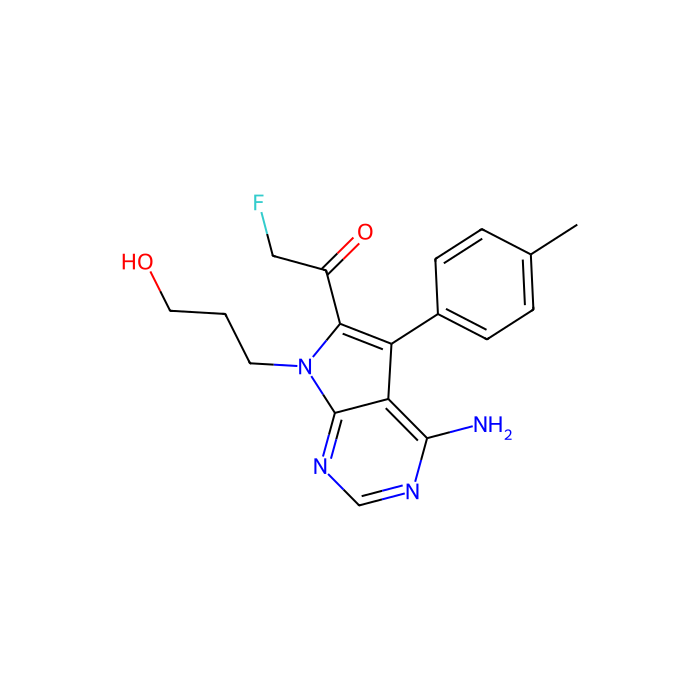
FMK - Moligand™, ≥98% , Inhibitor of ribosomal protein S6 kinase A3, CAS No.821794-92-7, Inhibitor of ribosomal protein S6 kinase A3

CAS: 821794-92-7 Cat. No.: F127391 Formule: C18H19FN4O2 Poids moléculaire: 342.37
DISPONIBLE À COMMANDE
QUALITÉ & PURETÉ Moligand™ ? Moligand™ — Aladdin's line of ligands and bioactive small molecules. Use for receptor, pathway, and binding studies needing defined small-molecule tools. ≥98%
Synonyms
1-[4-Amino-7-(3-hydroxypropyl)-5-(4-methylphenyl)-7H-pyrrolo[2,3-d]pyrimidin-6-yl]-2-fluoroethanone|fluoromethylketone-pyrrolopyrimidine scaffold|1-(4-amino-7-(3-hydroxypropyl)-5-p-tolyl-7H-pyrrolo[2,3-d]pyrimidin-6-yl)-2-fluoroethanone|1-[4-Amino-7-(3-hydroxypropyl)-5-(4-methylphenyl)-7H-pyrrolo[2,3-d]pyrimidin-6-yl]-2-fluoroethan-1-one|RSK2 kinase inhibitor|1-(4-amino-7-(3-hydroxypropyl)-5-(p-tolyl)-7H-pyrrolo[2,3-d]pyrimidin-6-yl)-2-fluoroethanone|RSK inhibitor Fmk|FMK (covalent)|FMK|FMK;RSK2 kinase inhibitor|Ethanone, 1-[4-amino-7-(3-hydroxypropyl)-5-(4-methylphenyl)-7H-pyrrolo[2,3-d]pyrimidin-6-yl]-2-fluoro- (9CI)|ethanone, 1-[4-amino-7-(3-hydroxypropyl)-5-(4-methylphenyl)-7H-pyrrolo[2,3-d]pyrimidin-6-yl]-2-fluoro-
Storage
Store at -20°C
Shipped In
Ice chest + Ice pads
★
Taille
USA
Allemagne (EU)*
Prix
Qté
1mg
F127391-1mg
3 En stock
—
91,90$US
5mg
F127391-5mg
2 En stock
—
370,90$US
10mg
F127391-10mg
2 En stock
—
555,90$US
25mg
F127391-25mg
Sur commande · 8–12 semaines
973,90$US
50mg
F127391-50mg
Sur commande · 8–12 semaines
1 368,90$US
100mg
F127391-100mg
Sur commande · 8–12 semaines
2 462,90$US
Enter a quantity for the sizes you want to add.

Spécifications

Synonymes
1-[4-Amino-7-(3-hydroxypropyl)-5-(4-methylphenyl)-7H-pyrrolo[2,3-d]pyrimidin-6-yl]-2-fluoroethanone | fluoromethylketone-pyrrolopyrimidine scaffold | 1-(4-amino-7-(3-hydroxypropyl)-5-p-tolyl-7H-pyrrolo[2,3-d]pyrimidin-6-yl)-2-fluoroethanone | 1-[4-Amino-7-(3-hydroxypropyl)-5-(4-methylphenyl)-7H-pyrrolo[2,3-d]pyrimidin-6-yl]-2-fluoroethan- Afficher plus
Spécifications et pureté
Moligand™, ≥98%
Mécanismes biochimiques et physiologiques
Fmk is an efficient, highly specific and irreversible inhibitor of ribonucleoprotein S6 kinase (RSK), with an IC50 value of 15 nm. Serine / threonine kinase RSK is ribonucleoprotein S6, which is part of the translation machine and is activated by MAPK / ERK pathway. RSK has two subfamilies p90rsk, MAPK activated protein kinase 1 (mapkap-k1); P70rsk, i.e. s6-h1 or S6 kinase. As the first substrate of ERK, 90 kDa ribonucleoprotein S6 kinase (p90rsk) is a universal multifunctional mediator in ERK signal transduction pathway. It regulates protein synthesis through the phosphorylation of polyribonucleoprotein and glycogen synthase kinase-3, phosphorylates Ras GTP / GDP conversion factor, and causes feedback inhibition of Ras ERK pathway. Fmk is an irreversible inhibitor that covalently modifies the C-terminal kinase domain of RSK. Therefore, it can inhibit the activation of the N-terminal kinase domain of RSK through the C-terminal kinase domain, but does not affect the activity of the N-terminal domain, which explains why the active forms of rSK1 and RSK2 are not inhibited by fmk in vitro [3]. In adult rat cardiomyocytes, fmk, a highly specific irreversible inhibitor of RSK, was used to determine the function of RSK in directly regulating NHE1 phosphorylation and myomembrane NHE activity in response to 1-adrenergic stimulation. Another propargylamine variant, fmk PA, can complete the selective and saturated modification of endogenous rSK1 and RSK2 in mammalian cells. In response to phorbol ester stimulation, saturated concentration of fmk PA inhibited ser386 phosphorylation and downstream signal pathway, but did not affect RSK activation induced by lipopolysaccharide. Cancer metastasis, as a way for cancer cells to migrate from the primary tumor through the body to the next site, is driven by changed signal pathways, which induce changes in cell-cell adhesion, cytoskeleton, integrin function, protease expression, epithelial cell transformation to mesenchymal cells and cell survival [6]. Ribonucleoprotein S6 kinase (RSK) family is a group of extracellular signal regulated kinase / mitogen activated protein kinase (ERK / MAPK) effector molecules that regulate these processes by phosphorylating targets in nucleus and cytoplasm. Therefore, it is urgent to develop RSK inhibitors as new antitumor drugs. Current studies have found that rsks can mediate a variety of cellular functions in the process of tumor. RSK may be an important driver in the process of PCA bone metastasis. It can regulate anchor independent growth by regulating transcription level factors mediating cell survival, including ing3, ckap2 and ptk6, making it a potential effective target for the treatment of PCA bone metastasis.
Conditions de stockage de stockage
Store at -20°C
Expédié en
Ice chest + Ice pads
Ce produit nécessite l'expédition en chaîne froide. Les services terrestres et autres services économiques ne sont pas disponibles.
Grade
Moligand™
Type d'action
INHIBITOR
Mécanisme d'action
Inhibitor of ribosomal protein S6 kinase A3
Pureté
≥98%
Noms et identifiants
Pubchem Sid
Pubchem Sid Url
https://pubchem.ncbi.nlm.nih.gov/substance/504759767
SMILES
CC1=CC=C(C=C1)C2=C(N(C3=NC=NC(=C23)N)CCCO)C(=O)CF
IUPAC Name
1-[4-amino-7-(3-hydroxypropyl)-5-(4-methylphenyl)pyrrolo[2,3-d]pyrimidin-6-yl]-2-fluoroethanone
InChIKey
IKLGYJACVCXYIL-UHFFFAOYSA-N
InChI
1S/C18H19FN4O2/c1-11-3-5-12(6-4-11)14-15-17(20)21-10-22-18(15)23(7-2-8-24)16(14)13(25)9-19/h3-6,10,24H,2,7-9H2,1H3,(H2,20,21,22)
Isomères SMILES
CC1=CC=C(C=C1)C2=C(N(C3=NC=NC(=C23)N)CCCO)C(=O)CF
Poids moléculaire
342.37
Reaxys
12877016
Reaxys-RN_link_address
https://www.reaxys.com/reaxys/secured/hopinto.do?context=S&query=IDE.XRN=12877016&ln=

Données avancées

Taxonomic Classification

Taxonomy Tree

KingdomOrganic compounds
SuperclassOrganoheterocyclic compounds
ClassePyrroles
SubclassSubstituted pyrroles
Intermediate Tree Nodes Not available
Direct ParentPhenylpyrroles
Alternative Parents Pyrrolo[2,3-d]pyrimidines  Aryl alkyl ketones  Toluenes  Aminopyrimidines and derivatives  Imidolactams  Heteroaromatic compounds  Alpha-haloketones  Alkanolamines  Azacyclic compounds  Organofluorides  Organic oxides  Hydrocarbon derivatives  Primary alcohols  Primary amines  Alkyl fluorides  Organopnictogen compounds  
Molecular FrameworkAromatic heteropolycyclic compounds
Substituents 3-phenylpyrrole - Pyrrolo[2,3-d]pyrimidine - Pyrrolopyrimidine - Aryl ketone - Aryl alkyl ketone - Aminopyrimidine - Toluene - Monocyclic benzene moiety - Pyrimidine - Benzenoid - Imidolactam - Alpha-haloketone - Heteroaromatic compound - Ketone - Azacycle - Alkanolamine - Hydrocarbon derivative - Primary amine - Primary alcohol - Organic oxygen compound - Organooxygen compound - Organonitrogen compound - Organofluoride - Organohalogen compound - Organopnictogen compound - Organic nitrogen compound - Alcohol - Amine - Alkyl halide - Alkyl fluoride - Organic oxide - Aromatic heteropolycyclic compound
DescriptionThis compound belongs to the class of organic compounds known as phenylpyrroles. These are polycyclic aromatic compounds containing a benzene ring linked to a pyrrole ring through a CC or CN bond.
External Descriptors Not available
Structure 3D
Modèle de structure chimique interactif


Cibles associées (humaines)
FYN Tclin Tyrosine-protein kinase Fyn (1 Activities)
Activity TypeActivity Value -log(M)Mechanism of ActionActivity ReferencePublications (PubMed IDs)
RPS6KA3 Tchem Ribosomal protein S6 kinase alpha-3 (6 Activities)
Activity TypeActivity Value -log(M)Mechanism of ActionActivity ReferencePublications (PubMed IDs)
MAPK11 Tchem MAP kinase p38 beta (2785 Activities)
Activity TypeRelationActivity valueUnitsAction TypeJournalPubMed IddoiAssay Aladdin ID
LCK Tclin Tyrosine-protein kinase LCK (9212 Activities)
Activity TypeRelationActivity valueUnitsAction TypeJournalPubMed IddoiAssay Aladdin ID
MAPK14 Tchem MAP kinase p38 alpha (12866 Activities)
Activity TypeRelationActivity valueUnitsAction TypeJournalPubMed IddoiAssay Aladdin ID
GSK3B Tclin Glycogen synthase kinase-3 beta (11785 Activities)
Activity TypeRelationActivity valueUnitsAction TypeJournalPubMed IddoiAssay Aladdin ID
PRKCZ Tchem Protein kinase C zeta (2414 Activities)
Activity TypeRelationActivity valueUnitsAction TypeJournalPubMed IddoiAssay Aladdin ID
MYLK Tchem Myosin light chain kinase, smooth muscle (1267 Activities)
Activity TypeRelationActivity valueUnitsAction TypeJournalPubMed IddoiAssay Aladdin ID
STK3 Tchem Serine/threonine-protein kinase MST2 (3069 Activities)
Activity TypeRelationActivity valueUnitsAction TypeJournalPubMed IddoiAssay Aladdin ID
CSNK1D Tchem Casein kinase I delta (4546 Activities)
Activity TypeRelationActivity valueUnitsAction TypeJournalPubMed IddoiAssay Aladdin ID
SRC Tclin Tyrosine-protein kinase SRC (10310 Activities)
Activity TypeRelationActivity valueUnitsAction TypeJournalPubMed IddoiAssay Aladdin ID
CHEK2 Tchem Serine/threonine-protein kinase Chk2 (4015 Activities)
Activity TypeRelationActivity valueUnitsAction TypeJournalPubMed IddoiAssay Aladdin ID
PDPK1 Tchem 3-phosphoinositide dependent protein kinase-1 (3758 Activities)
Activity TypeRelationActivity valueUnitsAction TypeJournalPubMed IddoiAssay Aladdin ID
AKT2 Tchem Serine/threonine-protein kinase AKT2 (4301 Activities)
Activity TypeRelationActivity valueUnitsAction TypeJournalPubMed IddoiAssay Aladdin ID
IKBKB Tchem Inhibitor of nuclear factor kappa B kinase beta subunit (5554 Activities)
Activity TypeRelationActivity valueUnitsAction TypeJournalPubMed IddoiAssay Aladdin ID
AURKB Tchem Serine/threonine-protein kinase Aurora-B (6805 Activities)
Activity TypeRelationActivity valueUnitsAction TypeJournalPubMed IddoiAssay Aladdin ID
PIM1 Tchem Serine/threonine-protein kinase PIM1 (9629 Activities)
Activity TypeRelationActivity valueUnitsAction TypeJournalPubMed IddoiAssay Aladdin ID
PKN2 Tchem Protein kinase N2 (1991 Activities)
Activity TypeRelationActivity valueUnitsAction TypeJournalPubMed IddoiAssay Aladdin ID
CSK Tchem Tyrosine-protein kinase CSK (2395 Activities)
Activity TypeRelationActivity valueUnitsAction TypeJournalPubMed IddoiAssay Aladdin ID
RPS6KA5 Tchem Ribosomal protein S6 kinase alpha 5 (3355 Activities)
Activity TypeRelationActivity valueUnitsAction TypeJournalPubMed IddoiAssay Aladdin ID
PRKD1 Tchem Protein kinase C mu (1904 Activities)
Activity TypeRelationActivity valueUnitsAction TypeJournalPubMed IddoiAssay Aladdin ID
PLK1 Tchem Serine/threonine-protein kinase PLK1 (28605 Activities)
Activity TypeRelationActivity valueUnitsAction TypeJournalPubMed IddoiAssay Aladdin ID
RPS6KA1 Tchem Ribosomal protein S6 kinase alpha 1 (2796 Activities)
Activity TypeRelationActivity valueUnitsAction TypeJournalPubMed IddoiAssay Aladdin ID
CAMK1 Tchem CaM kinase I alpha (1664 Activities)
Activity TypeRelationActivity valueUnitsAction TypeJournalPubMed IddoiAssay Aladdin ID
MAPK13 Tchem MAP kinase p38 delta (2605 Activities)
Activity TypeRelationActivity valueUnitsAction TypeJournalPubMed IddoiAssay Aladdin ID
MAPKAPK2 Tchem MAP kinase-activated protein kinase 2 (4814 Activities)
Activity TypeRelationActivity valueUnitsAction TypeJournalPubMed IddoiAssay Aladdin ID
MAPKAPK5 Tchem MAP kinase-activated protein kinase 5 (2831 Activities)
Activity TypeRelationActivity valueUnitsAction TypeJournalPubMed IddoiAssay Aladdin ID
ROCK2 Tclin Rho-associated protein kinase 2 (6206 Activities)
Activity TypeRelationActivity valueUnitsAction TypeJournalPubMed IddoiAssay Aladdin ID
MAPK9 Tchem c-Jun N-terminal kinase 2 (4655 Activities)
Activity TypeRelationActivity valueUnitsAction TypeJournalPubMed IddoiAssay Aladdin ID
MAPK10 Tchem c-Jun N-terminal kinase 3 (3396 Activities)
Activity TypeRelationActivity valueUnitsAction TypeJournalPubMed IddoiAssay Aladdin ID
MAP2K1 Tclin Dual specificity mitogen-activated protein kinase kinase 1 (4127 Activities)
Activity TypeRelationActivity valueUnitsAction TypeJournalPubMed IddoiAssay Aladdin ID
PRKCA Tchem Protein kinase C alpha (5923 Activities)
Activity TypeRelationActivity valueUnitsAction TypeJournalPubMed IddoiAssay Aladdin ID
MAPK3 Tchem MAP kinase ERK1 (4725 Activities)
Activity TypeRelationActivity valueUnitsAction TypeJournalPubMed IddoiAssay Aladdin ID
FYN Tclin Tyrosine-protein kinase FYN (5308 Activities)
Activity TypeRelationActivity valueUnitsAction TypeJournalPubMed IddoiAssay Aladdin ID
PRKACA Tchem cAMP-dependent protein kinase alpha-catalytic subunit (3475 Activities)
Activity TypeRelationActivity valueUnitsAction TypeJournalPubMed IddoiAssay Aladdin ID
DYRK1A Tchem Dual-specificity tyrosine-phosphorylation regulated kinase 1A (6484 Activities)
Activity TypeRelationActivity valueUnitsAction TypeJournalPubMed IddoiAssay Aladdin ID
MAPK8 Tchem c-Jun N-terminal kinase 1 (5038 Activities)
Activity TypeRelationActivity valueUnitsAction TypeJournalPubMed IddoiAssay Aladdin ID
AKT1 Tchem Serine/threonine-protein kinase AKT (9192 Activities)
Activity TypeRelationActivity valueUnitsAction TypeJournalPubMed IddoiAssay Aladdin ID
SGK1 Tchem Serine/threonine-protein kinase Sgk1 (2343 Activities)
Activity TypeRelationActivity valueUnitsAction TypeJournalPubMed IddoiAssay Aladdin ID
RPS6KA3 Tchem Ribosomal protein S6 kinase alpha 3 (4284 Activities)
Activity TypeRelationActivity valueUnitsAction TypeJournalPubMed IddoiAssay Aladdin ID
RPS6KB1 Tchem Ribosomal protein S6 kinase 1 (4456 Activities)
Activity TypeRelationActivity valueUnitsAction TypeJournalPubMed IddoiAssay Aladdin ID
CHEK1 Tchem Serine/threonine-protein kinase Chk1 (6846 Activities)
Activity TypeRelationActivity valueUnitsAction TypeJournalPubMed IddoiAssay Aladdin ID
MAPK12 Tchem MAP kinase p38 gamma (2776 Activities)
Activity TypeRelationActivity valueUnitsAction TypeJournalPubMed IddoiAssay Aladdin ID
YES1 Tclin Tyrosine-protein kinase YES (2781 Activities)
Activity TypeRelationActivity valueUnitsAction TypeJournalPubMed IddoiAssay Aladdin ID
EEF2K Tchem Serine/threonine-protein kinase EEF2K (1246 Activities)
Activity TypeRelationActivity valueUnitsAction TypeJournalPubMed IddoiAssay Aladdin ID
AURKC Tchem Serine/threonine-protein kinase Aurora-C (1780 Activities)
Activity TypeRelationActivity valueUnitsAction TypeJournalPubMed IddoiAssay Aladdin ID
EPHA2 Tclin Ephrin type-A receptor 2 (3499 Activities)
Activity TypeRelationActivity valueUnitsAction TypeJournalPubMed IddoiAssay Aladdin ID
NEK2 Tchem Serine/threonine-protein kinase NEK2 (3514 Activities)
Activity TypeRelationActivity valueUnitsAction TypeJournalPubMed IddoiAssay Aladdin ID
CAMKK1 Tchem CaM-kinase kinase alpha (487 Activities)
Activity TypeRelationActivity valueUnitsAction TypeJournalPubMed IddoiAssay Aladdin ID
CAMKK2 Tchem CaM-kinase kinase beta (1281 Activities)
Activity TypeRelationActivity valueUnitsAction TypeJournalPubMed IddoiAssay Aladdin ID
MKNK2 Tchem MAP kinase signal-integrating kinase 2 (3518 Activities)
Activity TypeRelationActivity valueUnitsAction TypeJournalPubMed IddoiAssay Aladdin ID
NEK6 Tchem Serine/threonine-protein kinase NEK6 (1986 Activities)
Activity TypeRelationActivity valueUnitsAction TypeJournalPubMed IddoiAssay Aladdin ID
Cibles associées (non humaines)
Mapk1 MAP kinase ERK2 (650 Activities)
Activity TypeRelationActivity valueUnitsAction TypeJournalPubMed IddoiAssay Aladdin ID
NIH3T3 (5395 Activities)
Activity TypeRelationActivity valueUnitsAction TypeJournalPubMed IddoiAssay Aladdin ID
rep Replicase polyprotein 1ab (378 Activities)
Activity TypeRelationActivity valueUnitsAction TypeJournalPubMed IddoiAssay Aladdin ID
Mécanismes d'action
Certificats (CoA, COO, BSE/TSE et tableau d'analyse)
C of A & Other Certificates(BSE/TSE, COO):
Analytical Chart:

Find and download the COA for your product by matching the lot number on the packaging.

8 results found

Lot NumberCertificate TypeDateArticle
A2205290A2205290Certificate of AnalysisJul 15, 2025 F127391
A2205294A2205294Certificate of AnalysisJul 15, 2025 F127391
A2205299A2205299Certificate of AnalysisJul 15, 2025 F127391
A2205302A2205302Certificate of AnalysisJul 15, 2025 F127391
A2205303A2205303Certificate of AnalysisJul 15, 2025 F127391
A2205304A2205304Certificate of AnalysisJul 15, 2025 F127391
E2527110E2527110Certificate of AnalysisJun 11, 2025 F127391
J2531085J2531085Certificate of AnalysisJun 11, 2025 F127391
Propriétés chimiques et physiques
SolubilitéSolvent:DMSO, Max Conc. mg/mL: 34.24, Max Conc. mM: 100
Poids moléculaire342.4
XLogP32.300
Hydrogen Bond Donor Count2
Hydrogen Bond Acceptor Count6
Rotatable Bond Count6
Exact Mass342.149 Da
Monoisotopic Mass342.149 Da
Topological Polar Surface Area94.000 Ų
Heavy Atom Count25
Formal Charge0
Complexity458.000
Isotope Atom Count0
Defined Atom Stereocenter Count0
Undefined Atom Stereocenter Count0
Defined Bond Stereocenter Count0
Undefined Bond Stereocenter Count0
The total count of all stereochemical bonds0
Covalently-Bonded Unit Count1
Sécurité et dangers (GHS)
Reaxys
12877016
Reaxys-RN_link_address
https://www.reaxys.com/reaxys/secured/hopinto.do?context=S&query=IDE.XRN=12877016&ln=
Calculateurs de solution
Avis

Avis des clients

Application Protocols

No tested application protocols (e.g., assay formats, concentrations, or biological panels) are provided for SKU F127391.

General guidance for FMK-bearing compounds in enzymology (literature/practice; not item-specific):

  • Stock preparation: Dissolve in anhydrous DMSO (e.g., 10–50 mM). Filter if necessary through PTFE (0.22 µm).
  • Enzyme inhibition assay: Preincubate enzyme with serial dilutions of compound (maintain ≤1% DMSO) for 15–60 minutes at the assay temperature, then initiate with substrate. Record time-dependent inhibition to estimate kinact/Ki where appropriate.
  • Controls: Include vehicle control, non-reactive analogs (lacking FMK), and thiol quenchers (e.g., N-ethylmaleimide) to probe covalency. For selectivity, counter-screen against off-target enzymes.
  • Sample handling for proteomics: For activity-based protein profiling probes, after labeling, quench unreacted electrophile, denature, and enrich tagged proteins (e.g., streptavidin for biotin tags) prior to LC–MS/MS.

These steps are provided as general best practices. For any item-specific validated protocols or recommended concentrations, consult the CoA/Spec Sheet or contact Aladdin support.

Biological Roles

No item-specific biological targets or roles are provided for SKU F127391. The following is general, literature-based background on fluoromethyl ketone (FMK) functionality used in chemical biology; it is not specific to this product batch.

  • Mechanistic role: FMK groups serve as covalent electrophiles designed to react with nucleophilic residues, most prominently cysteine thiolates in cysteine proteases. The reaction proceeds via nucleophilic attack at the carbonyl carbon accompanied by fluoride displacement, yielding a stable thioether or hemithioketal-like adduct depending on scaffold.
  • Enzyme classes commonly studied: Cysteine proteases (e.g., cathepsins, papain-like proteases), certain deubiquitinases (DUBs), and other thiol-dependent enzymes have been interrogated using FMK-bearing inhibitors or probes.
  • Selectivity determinants: Biological specificity is dictated primarily by the recognition elements (peptidic sequence or non-peptidic pharmacophore) that orient the FMK warhead within the active site, not by the FMK moiety alone.
  • Applications in research: FMK-containing molecules are used to study enzyme function, map active-site residues via activity-based protein profiling, and validate targets through covalent occupancy measurements (e.g., MS-based proteomics).
  • Reversibility: FMK adducts are generally considered irreversible on biochemical timescales, though the kinetic parameters (kinact, Ki) vary with scaffold and enzyme microenvironment.

Important: The above roles are general to the FMK functional group. For SKU F127391, consult the CoA or technical note for any declared targets or recommended assay contexts. For research use only.

Buffer Applications

This product is a small-molecule library member rather than a buffering reagent. No item-specific buffer recipes or pKa data are provided.

General guidance for using FMK-bearing small molecules in biochemical buffers (literature/practice, not item-specific):

  • Vehicle: Prepare concentrated stocks in anhydrous DMSO. Dilute into assay buffer immediately before use to the lowest feasible DMSO percentage (commonly 0.1–1% v/v).
  • Buffer choice: Neutral, non-nucleophilic buffers (e.g., HEPES, MOPS, phosphate) are commonly employed. Avoid strongly basic conditions that could decompose FMK moieties.
  • Additives: Include reducing agents (e.g., DTT or TCEP) cautiously; while necessary to maintain enzyme activity (thiol reduction), excess free thiol may compete with target cysteines and quench FMK electrophiles. Titrate reducing agent to balance enzyme stability and covalent labeling efficiency.
  • Salts and surfactants: Ionic strength (e.g., 150 mM NaCl) and low-level nonionic surfactants (e.g., 0.01% Tween-20) can improve assay robustness; confirm compatibility experimentally.

Because exact ionization and solubility depend on the full structure, always consult the specific CoA/Spec Sheet and run small-scale solubility and stability tests under intended buffer conditions.

Green Alternatives

This section discusses greener choices for handling and synthesis of FMK-bearing compounds in general (literature/practice), not item-specific specifications.

Greener handling solvents (for stocks/workups):

  • Prefer water-based buffers with minimal DMSO (≤1% v/v) when assay sensitivity permits. While DMSO remains standard for dissolving polar inhibitors, minimizing its fraction reduces environmental and safety burdens.
  • For synthetic steps and workups, consider ethyl acetate or 2-methyltetrahydrofuran (2-MeTHF) as replacements for dichloromethane/THF when feasible.

Comparison (general, qualitative):

  • DMSO vs DMF: DMSO is generally favored in biochemistry for lower volatility and better toxicological profile; still, reduce usage volume.
  • 2-MeTHF vs THF: 2-MeTHF is bio-based, lower peroxide risk accumulation rate, and offers easier phase separation; THF has broader literature precedence but higher peroxide formation concerns.
  • EtOAc vs DCM: EtOAc is less toxic and more biodegradable; DCM offers superior solvency for certain polar FMKs but with higher environmental/health impact.

Process considerations:

  • Temperature-efficient chemistry: Use microwave or flow techniques to shorten reaction times and reduce energy consumption during FMK installations.
  • Waste minimization: Plan telescoped sequences for FMK introduction to limit halogenated waste from fluorination steps.

Trade-offs:

  • Greener solvents may compromise solubility or selectivity in certain FMK transformations. Pilot small-scale trials are recommended.

Always validate any substitution experimentally to confirm yield, purity, and assay performance.

Pharmaceutical Uses

No item-specific pharmacopeial status or excipient role is provided for this Moligand library compound. This product is supplied strictly for research use only.

General context (literature; not item-specific):

  • FMK-bearing molecules are frequently explored in discovery research as covalent inhibitors or chemical probes. Such compounds are evaluated in pre-formulation studies for solubility, stability, and permeability, but these activities remain within R&D and are not equivalent to approved pharmaceutical uses.
  • Formulation screening in research often uses DMSO stock solutions for in vitro assays. For in vivo method development (outside the scope of this listing), solvent systems may include PEG-containing vehicles or cyclodextrin complexes; such applications require dedicated safety and regulatory evaluation and are not covered here.

Regulatory note:

  • This item has no declared pharmacopeial grade. No clinical/therapeutic claims are made or implied. For research use only.

If you require an excipient-grade material or a GMP-compliant intermediate, please contact Aladdin Scientific for alternative offerings or custom synthesis. Always rely on the batch CoA/Spec Sheet for any suitability assessments within your organization’s quality system.

Physical Properties

Item-specific properties (as supplied):

  • Molecular weight: Not specified for this item; refer to CoA/Spec Sheet.
  • Molecular formula: Not specified for this item; refer to CoA/Spec Sheet.
  • Appearance: Not specified for this item; refer to CoA/Spec Sheet.
  • Density: Not specified for this item; refer to CoA/Spec Sheet.
  • Melting point (MP): Not specified for this item; refer to CoA/Spec Sheet.
  • Boiling point (BP): Not specified for this item; refer to CoA/Spec Sheet.
  • Refractive index: Not specified for this item; refer to CoA/Spec Sheet.
  • UV/Vis cutoff or ε: Not specified for this item; refer to CoA/Spec Sheet.
  • Water content, residual solvents, metal limits, or stabilizers: Not specified for this item; refer to CoA/Spec Sheet.

General/literature guidance for FMK-bearing small molecules (not item-specific):

  • Solubility: Many FMK-functionalized inhibitors are polar to moderately polar and are commonly prepared as stock solutions in anhydrous DMSO (e.g., 10–50 mM). Aqueous solubility then depends on the full scaffold (peptidic vs non-peptidic) and counterions.
  • Stability: FMK moieties are typically stable under neutral conditions but can be susceptible to base-promoted elimination or hydrolysis under strongly basic/aqueous conditions. Storage at low temperature and protection from moisture are standard.
  • pKa/logP: Determined by the broader scaffold; FMK alone does not define ionization. Peptidyl FMKs often have multiple ionizable sites and logP values that vary widely (literature only).

Recommendation: Use the batch CoA/Spec Sheet for authoritative, measured physical properties specific to SKU F127391.

Quality and Grades

Item-specific grade:

  • Grade/Purity: Moligand™ (as provided in Product Data)

What Moligand™ typically signifies (general description, not item-specific specs):

  • Moligand™ indicates inclusion in a curated small-molecule/ligand library suitable for screening and chemical biology. Emphasis is placed on structural identity, library-ready handling, and research use compatibility (e.g., soluble in DMSO, microplate-friendly).
  • Purity is typically suited for discovery screening; exact assay purity, counterion content, and residual solvents vary by batch and should be verified on the CoA/Spec Sheet.

Analytical expectations and documentation:

  • Identity confirmation: CoA typically includes NMR and/or LC–MS identities; for peptidyl FMKs, HRMS and HPLC purity are commonly reported in library settings. For this SKU, consult the CoA for the definitive data.
  • Stabilizers/additives: Not specified for this item; refer to CoA/Spec Sheet.

Practical notes for users:

  • If using in biochemical screening, consider parallel identity/purity verification (LC–MS) upon receipt to align with internal QC criteria.
  • For SAR work, request and retain batch-specific spectral data and impurity profiles. Small differences in counterions or solvation can influence solubility and assay behavior.
  • Library handling: For high-throughput screening, pre-dissolve in anhydrous DMSO at a validated concentration from CoA potency/purity, and track freeze–thaw cycles to maintain integrity.
Reaction and Applications

Item-specific application notes were not supplied. Below are general, literature-based applications relevant to fluoromethyl ketone (FMK) functionality (not item-specific):

  • Covalent enzyme probes/inhibitors: FMK acts as an electrophilic warhead targeting nucleophilic active-site residues, especially cysteine thiolates in cysteine proteases (e.g., papain-family). The carbonyl activates the adjacent CH2–F, enabling formation of a stable covalent adduct after nucleophilic attack and fluoride displacement.
  • Activity-based profiling: FMK-bearing probes coupled with reporter tags (biotin/fluorophores) are used to label active enzymes in complex proteomes (activity-based protein profiling, ABPP). The selectivity arises primarily from the recognition elements (peptidic or non-peptidic scaffold), with FMK providing the irreversible capture step.
  • Chemical biology assays: Screening of FMK-containing libraries identifies covalent binders; time-dependent inhibition (kobs/[I]) and kinact/Ki analyses are common readouts.
  • Synthetic derivatization: FMKs can be introduced by converting appropriate precursors (e.g., aldehydes/Weinreb amides) to the fluoromethyl ketone via fluorination strategies (see Synthetic Utility/Reaction Conditions tabs for literature guidance).

Practical tips (general):

  • Handle solutions under dry, neutral conditions; avoid strong base. Store stock in DMSO at low temperature protected from moisture.
  • In enzymology, preincubation time and temperature control are critical to capture time-dependent covalent inhibition. Include appropriate controls (non-reactive analogs, cysteine-blocking agents) to assess specificity of the covalent step.

Note: For SKU F127391, consult the CoA/Spec Sheet for any item-specific application notes or recommended assay conditions.

Reaction Conditions

No reaction conditions are item-specific in the Product Data. The following are general, literature-based conditions relevant to preparing or using FMK-bearing compounds (not specific to this SKU):

  • Installing –CH2F next to a carbonyl:
    • From aldehydes: Nucleophilic addition of fluorinated reagents to form gem-difluorides followed by selective reduction can be used, but more commonly, aldehyde → chloromethyl ketone → halogen exchange to FMK is employed under mild conditions.
    • From Weinreb amides/acid chlorides: Acylation with chloromethyl metallic reagents followed by fluorination (e.g., DeoxoFluor/DAST variants) to afford FMKs; temperatures typically −78 to 0 °C to control side reactions.
  • Protecting groups: When FMK is appended to peptides, side-chain protection and N-terminal caps are retained during FMK installation to avoid undesired reactions; final deprotections are conducted under neutral to mildly acidic conditions.
  • Stability considerations: Avoid strong base and prolonged heating; room temperature to 40 °C operations are typical. Moisture control is recommended to prevent hydrolysis.
  • Analytical monitoring: LC–MS tracking for target mass with potential 19F signal confirmation. In enzymology, time-dependent inhibition requires preincubation (e.g., 15–60 min) and temperature control (on ice to 37 °C depending on enzyme).
  • Expected yields: Highly scaffold-dependent; FMK introduction often gives moderate yields due to competing eliminations or over-fluorination. Literature ranges span 30–70% for final FMK installation steps.

Always optimize conditions for the specific scaffold and verify with small-scale trials before scale-up.

Safety and Handling

Item-specific hazard information (from Product Data):

  • GHS classification: Not specified for this item; refer to SDS.
  • Signal word: Not specified for this item; refer to SDS.
  • Hazard (H) statements: Not specified for this item; refer to SDS.
  • Pictograms: Not specified for this item; refer to SDS.

General safety guidance (literature/practice; not item-specific):

  • Potential hazards: Fluoromethyl ketone electrophiles can react with nucleophiles (e.g., thiols, amines). Avoid skin/eye contact and inhalation of dust or aerosols. Handle as a potentially harmful alkylating/covalent modifier.
  • PPE: Use lab coat, safety glasses, and appropriate chemical-resistant gloves (e.g., nitrile). Employ a fume hood for weighing and solution preparation.
  • Incompatibilities: Strong bases may promote decomposition (e.g., HF elimination or aldol-type processes, depending on scaffold). Avoid prolonged exposure to moisture; some FMK derivatives can be moisture sensitive. Segregate from strong oxidizers and strong reducing agents.
  • First aid (overview; defer to SDS): If on skin/eyes, rinse with water for at least 15 minutes and seek medical attention. If inhaled, move to fresh air; if ingested, do not induce vomiting—seek medical attention.
  • Spill/cleanup: Use inert absorbent, avoid dust generation, and collect in a suitable waste container. Decontaminate with appropriate solvent and detergent, following institutional procedures.
  • Waste: Dispose of as organic hazardous waste following local regulations; label as halogenated organic waste when applicable.

Always consult the Aladdin SDS for this specific SKU for authoritative hazard classification and response procedures.

Solvent Selection

Item-specific solvent data are not provided. The following guidance is general for FMK-bearing small molecules and library compounds (literature/practice):

  • Primary solvent for stocks: Anhydrous DMSO is commonly used due to excellent solvating power for polar/peptidomimetic inhibitors. Typical screening stocks: 10–50 mM.
  • Co-solvents: For working solutions, DMF or acetonitrile may be used to aid dissolution prior to dilution into buffer. For biochemical assays, maintain final organic content ≤1–2% v/v to minimize assay interference.
  • Aqueous compatibility: Depends on the full scaffold; peptidyl FMKs may require buffered saline with small % DMSO. Avoid strong base to prevent potential FMK decomposition.
  • Polarity class: FMK moiety itself is polar and electrophilic; overall polarity is dictated by the scaffold (e.g., peptide side chains vs hydrophobic capping groups). Trial dissolution tests are recommended.

Comparison (general):

  • DMSO: Highest solvency; hygroscopic; can affect some assays at >1% v/v.
  • DMF: Good solvency; higher toxicity concerns; use sparingly and avoid in enzymology when possible.
  • Acetonitrile: Volatile, miscible with water; moderate solvency for peptidics; useful for HPLC sample prep.
  • 2-MeTHF/EtOAc/MeOH: More relevant to synthetic work-up; may not dissolve highly polar FMK derivatives effectively.

Recommendation: Begin with dry DMSO, then evaluate aqueous buffer tolerance. Confirm solvent choice and concentration with the CoA solubility notes when available.

Storage and Reconstitution

Item-specific storage and shipping (from Product Data):

  • Storage conditions: Store at −20 °C
  • Shipped in: Ice chest + ice pads

Item-specific appearance and stabilizers: Not specified for this item; refer to CoA/Spec Sheet.

General reconstitution guidance for small-molecule library members (not item-specific):

  • Upon receipt: Allow the sealed container to equilibrate to room temperature before opening to prevent condensation. If supplied as a solid, quickly weigh the desired amount and reseal under inert gas if possible.
  • Stock solution preparation: Dissolve in anhydrous DMSO to a convenient concentration (e.g., 10–50 mM), based on the exact molecular weight from the CoA. Vortex and, if needed, sonicate briefly to ensure complete dissolution.
  • Aliquoting: Divide into single-use aliquots (e.g., 10–50 µL) in inert, low-bind tubes. Minimize headspace and moisture exposure.
  • Storage of solutions: Keep aliquots at −20 °C (or as low as −80 °C for long-term). Protect from light and moisture. Avoid repeated freeze–thaw cycles; discard aliquots after a defined number of uses.
  • Aqueous working solutions: Prepare immediately before use. Maintain minimal organic cosolvent (≤1% v/v DMSO) where compatible with the assay.

Always consult the batch CoA/Spec Sheet for any item-specific solubility limits, stabilizers, and additional storage precautions.

Structure and Identity

Brief overview: This listing is for a Moligand small-molecule library member labeled “FMK.” Item-specific structural identifiers are largely not provided in the Product Data. The acronym FMK commonly denotes a fluoromethyl ketone warhead in medicinal chemistry; however, definitive structure for this SKU must be confirmed from the CoA/Spec Sheet.

Item-specific facts (from Product Data):

  • SKU: F127391
  • Product name: FMK
  • CAS: 821794-92-7
  • PubChem CID: 644243 (as provided)
  • InChIKey: 143344 (string provided; note: typical InChIKeys are 27 characters; verify on CoA)
  • Molecular formula: Not specified for this item; refer to CoA/Spec Sheet.
  • Molecular weight: Not specified for this item; refer to CoA/Spec Sheet.
  • SMILES: Not specified for this item; refer to CoA/Spec Sheet.

General chemistry context (literature, not item-specific):

  • “FMK” is widely used to denote a fluoromethyl ketone electrophile (–CO–CH2–F) that can form covalent adducts with nucleophiles (e.g., cysteine thiolates) in protease-inhibitor design.
  • Typical structural features in FMK-bearing inhibitors include: a ketone adjacent to a mono-fluorinated methylene (–CO–CH2F), often appended to peptidic or peptidomimetic backbones to provide recognition while the FMK unit serves as the covalent warhead.

2D structural description (generic FMK warhead, literature):

  • A carbonyl carbon (sp2) adjacent to a methylene bearing a fluorine substituent; the carbonyl most often connects to an acyl fragment (R–C(=O)–CH2–F). Stereochemistry is not inherent to the FMK moiety itself but may arise from the R substituent (e.g., chiral amino acid residues).

Important: For this catalog item, consult the CoA/Spec Sheet for the exact identity (formula, MW, canonical SMILES, full InChI/InChIKey).

Synthetic Utility

No item-specific synthetic role is specified. The following summarizes general synthetic utility of fluoromethyl ketone (FMK) functionality (literature-based; not specific to this SKU):

  • Warhead installation: FMK groups (R–C(=O)–CH2F) are valuable electrophiles in covalent inhibitor design. They can be appended to peptide or small-molecule scaffolds to create irreversible (or effectively irreversible) enzyme inhibitors.
  • Retrosynthetic disconnections: A common approach is to prepare an acyl precursor (aldehyde or activated amide) and then introduce the –CH2F unit via electrophilic fluorination or fluorinated building blocks. Alternatives include transformations from chloromethyl ketones (CMKs) to FMKs by halogen exchange under carefully controlled conditions.
  • Chemoselectivity: The FMK moiety balances reactivity and stability better than more reactive halo- or diazomethyl ketones, enabling improved handling while maintaining covalent capture capability.
  • Derivatization: N-terminal capping (e.g., carbamates or aryl/heteroaryl groups) and side chain modifications can modulate potency and selectivity without altering FMK reactivity. Solid-phase peptide synthesis (SPPS) strategies can be adapted by late-stage FMK installation to minimize side reactions.
  • Analytical considerations: FMK-bearing compounds are conveniently monitored by LC–MS; fluoride loss can be diagnostic in MS/MS. NMR (1H, 19F) provides additional confirmation; 19F signals near −200 to −220 ppm (literature range) may assist in characterization depending on scaffold.

For SKU F127391, consult the CoA/Spec Sheet for the exact structure to design appropriate synthetic analogs or derivatizations.

Target Specificity

No target specificity information is provided in the Product Data for SKU F127391.

Policy notes for this listing:

  • Only item-specific target, enzyme class, epitope, or binding data explicitly provided by the manufacturer can be reported here. None are available for this product entry.

General (literature) context, not item-specific:

  • FMK-functionalized molecules can display apparent specificity to certain cysteine-dependent enzymes when coupled to appropriate recognition elements (e.g., peptide sequences tailored to a protease’s S1–S3 pockets). However, the FMK warhead alone does not confer selectivity; scaffold design dictates target engagement.

For validated target specificity, please refer to the batch CoA/Spec Sheet, any associated technical bulletins, or contact Aladdin Scientific for additional documentation.

Foire aux questions

How should this product be stored?
Store at ?20 °C. Freezer storage is required to maintain the specified shelf life.
What is the purity of this product?
This product is supplied at ≥98% purity (chemical assay). Lot-specific values are stated on the Certificate of Analysis.
What is Moligand??
Moligand? is one of Aladdin Scientific's premium product lines, formulated for high-purity applications across multiple workflows. Compared to standard grades in the same workflow, Moligand? products typically offer tighter specifications, more rigorous QC, and stronger lot-to-lot consistency.
How is this product shipped?
This product ships in an insulated container with ice pads. Unpack on arrival and transfer it to the storage condition stated above.
What are the CAS number, molecular formula and molecular weight?
The CAS Number is 821794-92-7, the molecular formula is C18H19FN4O2, and the molecular weight is 342.37 g/mol. InChIKey IKLGYJACVCXYIL-UHFFFAOYSA-N.
What documentation is provided?
Available product documentation, including Certificates of Analysis (COA), Safety Data Sheets (SDS), and specification sheets, is shown in the product document area. Document availability and access follow the current site policy.

Besoin d'aide pour choisir la qualité ?

Notre guide de sélection des qualités couvre la pureté, le statut du stabilisant et l'adéquation à l'application pour toutes les variantes de notre catalogue.

Voir le guide des qualités Moligand™ →

Souhaitez-vous que nous vous envoyions un message lorsque des réductions seront disponibles?

Me rappeler plus tard

Merci ! Veuillez vérifier votre boîte de réception e-mail pour confirmer.

Oups ! Les notifications sont désactivées.