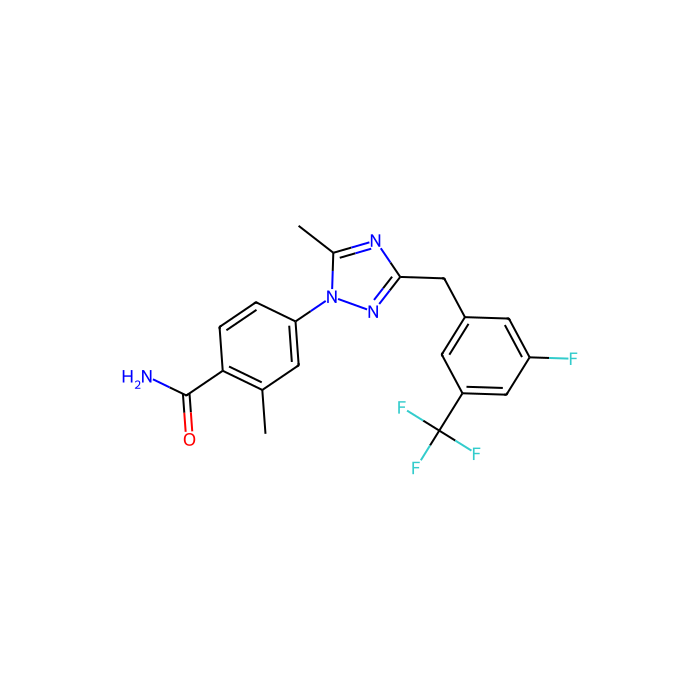
FTBMT - ≥98%(HPLC) , CAS No.1358575-02-6

CAS: 1358575-02-6 Cat. No.: F288397 Formule: C19H16F4N4O Poids moléculaire: 392.35
DISPONIBLE À COMMANDE
GRADE & PURITY ≥98%(HPLC)
Synonyms
4-[3-[[3-Fluoro-5-(trifluoromethyl)phenyl]methyl]-5-methyl-1H-1,2,4-triazol-1-yl]-2-methylbenzamide
Storage
Store at -20°C
Shipped In
Ice chest + Ice pads
★
Size
USA
Allemagne (EU)*
Price
Qty
5mg
F288397-5mg
Sur commande · 8–12 semaines

67,90$US

101,90$US
Enregistrer 34,00 $US (33.37%)
25mg
F288397-25mg
Sur commande · 8–12 semaines

291,90$US

437,90$US
Enregistrer 146,00 $US (33.34%)
Enter a quantity for the sizes you want to add.
🧪
Why this grade

≥98%(HPLC) for sensitive chromatographic and analytical workflows requiring minimal baseline interference.

🌡

Storage & shipping

Store at -20°C Ships Ice chest + Ice pads Check lot-specific COA for exact specifications.

📋

Quality documents

SDS, COA, datasheet, and spec sheet available for download. Lot-specific COA accessible via lot number lookup.

📚

Literature proof

Cited in 0 peer-reviewed publications across chromatography, organic synthesis, and cross-coupling reactions.

Specifications

Synonymes
4-[3-[[3-Fluoro-5-(trifluoromethyl)phenyl]methyl]-5-methyl-1H-1,2,4-triazol-1-yl]-2-methylbenzamide
Spécifications et pureté
≥98%(HPLC)
Mécanismes biochimiques et physiologiques
Potent and selective GPR52 agonist (EC50= 75 nM, Emax= 122%). Selective for GPR52 over a panel of 98 targets including D1, D2, AMPA and NMDA. Suppresses methamphetamine-induced hyperlocomotion in mice. InhibitsMK-801-induced hyperactivity (model for acute
Conditions de stockage de stockage
Store at -20°C
Expédié en
Ice chest + Ice pads
Ce produit nécessite l'expédition en chaîne froide. Les services terrestres et autres services économiques ne sont pas disponibles.
Pureté
≥98%(HPLC)
Noms et identifiants
Sourires canoniques
CC1=C(C=CC(=C1)N2C(=NC(=N2)CC3=CC(=CC(=C3)F)C(F)(F)F)C)C(=O)N
IUPAC Name
4-[3-[[3-fluoro-5-(trifluoromethyl)phenyl]methyl]-5-methyl-1,2,4-triazol-1-yl]-2-methylbenzamide
InChIKey
TYXSIXOYTBHZFA-UHFFFAOYSA-N
INCHI
1S/C19H16F4N4O/c1-10-5-15(3-4-16(10)18(24)28)27-11(2)25-17(26-27)8-12-6-13(19(21,22)23)9-14(20)7-12/h3-7,9H,8H2,1-2H3,(H2,24,28)
Isomères SMILES
CC1=C(C=CC(=C1)N2C(=NC(=N2)CC3=CC(=CC(=C3)F)C(F)(F)F)C)C(=O)N
Poids moléculaire
392.35
Reaxy-Rn
24902903
Reaxys-RN_link_address
https://www.reaxys.com/reaxys/secured/hopinto.do?context=S&query=IDE.XRN=24902903&ln=

Documentation

📋 Safety Data Sheet (SDS)

Comprehensive hazard, handling, storage, and regulatory compliance document.

Download SDS →

✅ Certificate of Analysis (COA)

Lot-specific quality data. Enter your lot number to retrieve the exact COA.

Look up COA →

📊 Datasheet

Quick-reference summary of product specifications and applications.

View datasheet →

🔬 Specification Sheet

Full quality attributes and acceptance criteria for this grade.

View spec sheet →

Advanced Data

Taxonomic Classification

Taxonomy Tree

KingdomOrganic compounds
SuperclassOrganoheterocyclic compounds
ClasseAzoles
SubclassTriazoles
Intermediate Tree Nodes Phenyltriazoles
Direct ParentPhenyl-1,2,4-triazoles
Alternative Parents Trifluoromethylbenzenes  o-Toluamides  Benzamides  Benzoyl derivatives  Fluorobenzenes  Aryl fluorides  Heteroaromatic compounds  Primary carboxylic acid amides  Azacyclic compounds  Organooxygen compounds  Organonitrogen compounds  Organofluorides  Organic oxides  Hydrocarbon derivatives  Alkyl fluorides  
Molecular FrameworkAromatic heteromonocyclic compounds
Substituents Phenyl-1,2,4-triazole - Trifluoromethylbenzene - Benzamide - O-toluamide - Toluamide - Benzoic acid or derivatives - Benzoyl - Toluene - Fluorobenzene - Halobenzene - Aryl fluoride - Aryl halide - Monocyclic benzene moiety - Benzenoid - Heteroaromatic compound - Primary carboxylic acid amide - Carboxamide group - Carboxylic acid derivative - Azacycle - Organofluoride - Organohalogen compound - Organooxygen compound - Alkyl fluoride - Hydrocarbon derivative - Organic oxide - Organic oxygen compound - Organic nitrogen compound - Alkyl halide - Organonitrogen compound - Aromatic heteromonocyclic compound
DescriptionThis compound belongs to the class of organic compounds known as phenyl-1,2,4-triazoles. These are organic compounds containing a 1,2,4-triazole substituted by a phenyl group.
External Descriptors Not available
Structure 3D
Modèle de structure chimique interactif


Cibles associées (humaines)
GPR52 Tchem G-protein coupled receptor 52 (1 Activities)
Activity TypeActivity Value -log(M)Mechanism of ActionActivity ReferencePublications (PubMed IDs)
ABL1 Tclin Tyrosine-protein kinase ABL (18331 Activities)
Activity TypeRelationActivity valueUnitsAction TypeJournalPubMed IddoiAssay Aladdin ID
EGFR Tclin Epidermal growth factor receptor erbB1 (33727 Activities)
Activity TypeRelationActivity valueUnitsAction TypeJournalPubMed IddoiAssay Aladdin ID
INSR Tclin Insulin receptor (5558 Activities)
Activity TypeRelationActivity valueUnitsAction TypeJournalPubMed IddoiAssay Aladdin ID
ADRB2 Tclin Beta-2 adrenergic receptor (11824 Activities)
Activity TypeRelationActivity valueUnitsAction TypeJournalPubMed IddoiAssay Aladdin ID
CHRM2 Tclin Muscarinic acetylcholine receptor M2 (10671 Activities)
Activity TypeRelationActivity valueUnitsAction TypeJournalPubMed IddoiAssay Aladdin ID
ADRB1 Tclin Beta-1 adrenergic receptor (6630 Activities)
Activity TypeRelationActivity valueUnitsAction TypeJournalPubMed IddoiAssay Aladdin ID
HTR1A Tclin Serotonin 1a (5-HT1a) receptor (14969 Activities)
Activity TypeRelationActivity valueUnitsAction TypeJournalPubMed IddoiAssay Aladdin ID
ADRA2A Tclin Alpha-2a adrenergic receptor (9450 Activities)
Activity TypeRelationActivity valueUnitsAction TypeJournalPubMed IddoiAssay Aladdin ID
CHRM1 Tclin Muscarinic acetylcholine receptor M1 (12690 Activities)
Activity TypeRelationActivity valueUnitsAction TypeJournalPubMed IddoiAssay Aladdin ID
DRD2 Tclin Dopamine D2 receptor (23596 Activities)
Activity TypeRelationActivity valueUnitsAction TypeJournalPubMed IddoiAssay Aladdin ID
DRD1 Tclin Dopamine D1 receptor (9720 Activities)
Activity TypeRelationActivity valueUnitsAction TypeJournalPubMed IddoiAssay Aladdin ID
DRD4 Tchem Dopamine D4 receptor (7907 Activities)
Activity TypeRelationActivity valueUnitsAction TypeJournalPubMed IddoiAssay Aladdin ID
SLC6A2 Tclin Norepinephrine transporter (10102 Activities)
Activity TypeRelationActivity valueUnitsAction TypeJournalPubMed IddoiAssay Aladdin ID
HRH2 Tclin Histamine H2 receptor (5428 Activities)
Activity TypeRelationActivity valueUnitsAction TypeJournalPubMed IddoiAssay Aladdin ID
ADRA1D Tclin Alpha-1d adrenergic receptor (4171 Activities)
Activity TypeRelationActivity valueUnitsAction TypeJournalPubMed IddoiAssay Aladdin ID
HTR1D Tclin Serotonin 1d (5-HT1d) receptor (2897 Activities)
Activity TypeRelationActivity valueUnitsAction TypeJournalPubMed IddoiAssay Aladdin ID
HTR1B Tclin Serotonin 1b (5-HT1b) receptor (2801 Activities)
Activity TypeRelationActivity valueUnitsAction TypeJournalPubMed IddoiAssay Aladdin ID
HTR2A Tclin Serotonin 2a (5-HT2a) receptor (14758 Activities)
Activity TypeRelationActivity valueUnitsAction TypeJournalPubMed IddoiAssay Aladdin ID
HTR2C Tclin Serotonin 2c (5-HT2c) receptor (11471 Activities)
Activity TypeRelationActivity valueUnitsAction TypeJournalPubMed IddoiAssay Aladdin ID
SLC6A4 Tclin Serotonin transporter (12625 Activities)
Activity TypeRelationActivity valueUnitsAction TypeJournalPubMed IddoiAssay Aladdin ID
ADRA1A Tclin Alpha-1a adrenergic receptor (8359 Activities)
Activity TypeRelationActivity valueUnitsAction TypeJournalPubMed IddoiAssay Aladdin ID
HRH1 Tclin Histamine H1 receptor (7573 Activities)
Activity TypeRelationActivity valueUnitsAction TypeJournalPubMed IddoiAssay Aladdin ID
ADRA1B Tclin Alpha-1b adrenergic receptor (2912 Activities)
Activity TypeRelationActivity valueUnitsAction TypeJournalPubMed IddoiAssay Aladdin ID
OPRM1 Tclin Mu opioid receptor (19785 Activities)
Activity TypeRelationActivity valueUnitsAction TypeJournalPubMed IddoiAssay Aladdin ID
DRD3 Tclin Dopamine D3 receptor (14368 Activities)
Activity TypeRelationActivity valueUnitsAction TypeJournalPubMed IddoiAssay Aladdin ID
OPRD1 Tclin Delta opioid receptor (15096 Activities)
Activity TypeRelationActivity valueUnitsAction TypeJournalPubMed IddoiAssay Aladdin ID
OPRK1 Tclin Kappa opioid receptor (16155 Activities)
Activity TypeRelationActivity valueUnitsAction TypeJournalPubMed IddoiAssay Aladdin ID
HTR3A Tclin Serotonin 3a (5-HT3a) receptor (3366 Activities)
Activity TypeRelationActivity valueUnitsAction TypeJournalPubMed IddoiAssay Aladdin ID
SLC6A3 Tclin Dopamine transporter (10535 Activities)
Activity TypeRelationActivity valueUnitsAction TypeJournalPubMed IddoiAssay Aladdin ID
ERBB2 Tclin Receptor protein-tyrosine kinase erbB-2 (7851 Activities)
Activity TypeRelationActivity valueUnitsAction TypeJournalPubMed IddoiAssay Aladdin ID
PDGFRB Tclin Platelet-derived growth factor receptor beta (5195 Activities)
Activity TypeRelationActivity valueUnitsAction TypeJournalPubMed IddoiAssay Aladdin ID
CHRM4 Tclin Muscarinic acetylcholine receptor M4 (6041 Activities)
Activity TypeRelationActivity valueUnitsAction TypeJournalPubMed IddoiAssay Aladdin ID
CHRM5 Tclin Muscarinic acetylcholine receptor M5 (4677 Activities)
Activity TypeRelationActivity valueUnitsAction TypeJournalPubMed IddoiAssay Aladdin ID
ADRA2B Tclin Alpha-2b adrenergic receptor (4412 Activities)
Activity TypeRelationActivity valueUnitsAction TypeJournalPubMed IddoiAssay Aladdin ID
ADRA2C Tclin Alpha-2c adrenergic receptor (4876 Activities)
Activity TypeRelationActivity valueUnitsAction TypeJournalPubMed IddoiAssay Aladdin ID
CHRM3 Tclin Muscarinic acetylcholine receptor M3 (7750 Activities)
Activity TypeRelationActivity valueUnitsAction TypeJournalPubMed IddoiAssay Aladdin ID
DRD5 Tchem Dopamine D5 receptor (1597 Activities)
Activity TypeRelationActivity valueUnitsAction TypeJournalPubMed IddoiAssay Aladdin ID
ADRB3 Tclin Beta-3 adrenergic receptor (5850 Activities)
Activity TypeRelationActivity valueUnitsAction TypeJournalPubMed IddoiAssay Aladdin ID
HTR2B Tclin Serotonin 2b (5-HT2b) receptor (10323 Activities)
Activity TypeRelationActivity valueUnitsAction TypeJournalPubMed IddoiAssay Aladdin ID
IGF1R Tclin Insulin-like growth factor I receptor (8605 Activities)
Activity TypeRelationActivity valueUnitsAction TypeJournalPubMed IddoiAssay Aladdin ID
KIT Tclin Stem cell growth factor receptor (10667 Activities)
Activity TypeRelationActivity valueUnitsAction TypeJournalPubMed IddoiAssay Aladdin ID
CSNK2A1 Tchem Casein kinase II alpha (3512 Activities)
Activity TypeRelationActivity valueUnitsAction TypeJournalPubMed IddoiAssay Aladdin ID
DAPK3 Tchem Death-associated protein kinase 3 (2108 Activities)
Activity TypeRelationActivity valueUnitsAction TypeJournalPubMed IddoiAssay Aladdin ID
MAPK11 Tchem MAP kinase p38 beta (2785 Activities)
Activity TypeRelationActivity valueUnitsAction TypeJournalPubMed IddoiAssay Aladdin ID
LCK Tclin Tyrosine-protein kinase LCK (9212 Activities)
Activity TypeRelationActivity valueUnitsAction TypeJournalPubMed IddoiAssay Aladdin ID
MAPK14 Tchem MAP kinase p38 alpha (12866 Activities)
Activity TypeRelationActivity valueUnitsAction TypeJournalPubMed IddoiAssay Aladdin ID
GSK3B Tclin Glycogen synthase kinase-3 beta (11785 Activities)
Activity TypeRelationActivity valueUnitsAction TypeJournalPubMed IddoiAssay Aladdin ID
PRKACB Tchem cAMP-dependent protein kinase beta-1 catalytic subunit (589 Activities)
Activity TypeRelationActivity valueUnitsAction TypeJournalPubMed IddoiAssay Aladdin ID
MAP2K6 Tchem Dual specificity mitogen-activated protein kinase kinase 6 (1284 Activities)
Activity TypeRelationActivity valueUnitsAction TypeJournalPubMed IddoiAssay Aladdin ID
MYLK Tchem Myosin light chain kinase, smooth muscle (1267 Activities)
Activity TypeRelationActivity valueUnitsAction TypeJournalPubMed IddoiAssay Aladdin ID
Cibles associées (non humaines)
Cdk4 Cyclin-dependent kinase 4 (3 Activities)
Activity TypeRelationActivity valueUnitsAction TypeJournalPubMed IddoiAssay Aladdin ID
Htr7 Serotonin 7 (5-HT7) receptor (19 Activities)
Activity TypeRelationActivity valueUnitsAction TypeJournalPubMed IddoiAssay Aladdin ID
Sigmar1 Sigma opioid receptor (160 Activities)
Activity TypeRelationActivity valueUnitsAction TypeJournalPubMed IddoiAssay Aladdin ID
Hrh4 Histamine H4 receptor (388 Activities)
Activity TypeRelationActivity valueUnitsAction TypeJournalPubMed IddoiAssay Aladdin ID
PIK3CA PI3-kinase p110-alpha subunit (51 Activities)
Activity TypeRelationActivity valueUnitsAction TypeJournalPubMed IddoiAssay Aladdin ID
Prkcd Protein kinase C delta (192 Activities)
Activity TypeRelationActivity valueUnitsAction TypeJournalPubMed IddoiAssay Aladdin ID
Mapk1 MAP kinase ERK2 (650 Activities)
Activity TypeRelationActivity valueUnitsAction TypeJournalPubMed IddoiAssay Aladdin ID
Fgfr4 Fibroblast growth factor receptor 4 (138 Activities)
Activity TypeRelationActivity valueUnitsAction TypeJournalPubMed IddoiAssay Aladdin ID
Fgfr3 Fibroblast growth factor receptor 3 (21 Activities)
Activity TypeRelationActivity valueUnitsAction TypeJournalPubMed IddoiAssay Aladdin ID
Camk2g CaM kinase II gamma (1 Activities)
Activity TypeRelationActivity valueUnitsAction TypeJournalPubMed IddoiAssay Aladdin ID
Tec Tyrosine-protein kinase TEC (25 Activities)
Activity TypeRelationActivity valueUnitsAction TypeJournalPubMed IddoiAssay Aladdin ID
Mus musculus (284745 Activities)
Activity TypeRelationActivity valueUnitsAction TypeJournalPubMed IddoiAssay Aladdin ID
Rattus norvegicus (775804 Activities)
Activity TypeRelationActivity valueUnitsAction TypeJournalPubMed IddoiAssay Aladdin ID
rep Replicase polyprotein 1ab (378 Activities)
Activity TypeRelationActivity valueUnitsAction TypeJournalPubMed IddoiAssay Aladdin ID
Brain (1 Activities)
Activity TypeRelationActivity valueUnitsAction TypeJournalPubMed IddoiAssay Aladdin ID
Plasma (328 Activities)
Activity TypeRelationActivity valueUnitsAction TypeJournalPubMed IddoiAssay Aladdin ID
Gabrp GABA-A receptor; anion channel (5731 Activities)
Activity TypeRelationActivity valueUnitsAction TypeJournalPubMed IddoiAssay Aladdin ID
pknB Serine/threonine-protein kinase pknB (356 Activities)
Activity TypeRelationActivity valueUnitsAction TypeJournalPubMed IddoiAssay Aladdin ID
CDPK1 Calcium-dependent protein kinase 1 (793 Activities)
Activity TypeRelationActivity valueUnitsAction TypeJournalPubMed IddoiAssay Aladdin ID
CRK2 Cell division control protein 2 homolog (194 Activities)
Activity TypeRelationActivity valueUnitsAction TypeJournalPubMed IddoiAssay Aladdin ID
ORF74 G protein-coupled receptor (3 Activities)
Activity TypeRelationActivity valueUnitsAction TypeJournalPubMed IddoiAssay Aladdin ID
Gpr52 G-protein coupled receptor 52 (24 Activities)
Activity TypeRelationActivity valueUnitsAction TypeJournalPubMed IddoiAssay Aladdin ID
Tmem97 Sigma intracellular receptor 2 (922 Activities)
Activity TypeRelationActivity valueUnitsAction TypeJournalPubMed IddoiAssay Aladdin ID
Mécanismes d'action
Certificats (CoA, COO, BSE/TSE et tableau d'analyse)
C of A & Other Certificates(BSE/TSE, COO):
Analytical Chart:
Propriétés chimiques et physiques
SolubilitéSolvent:DMSO, Max Conc. mg/mL: 39.23, Max Conc. mM: 100; Solvent:ethanol, Max Conc. mg/mL: 19.62, Max Conc. mM: 50
Poids moléculaire392.300 g/mol
XLogP34.200
Hydrogen Bond Donor Count1
Hydrogen Bond Acceptor Count7
Rotatable Bond Count4
Exact Mass392.126 Da
Monoisotopic Mass392.126 Da
Topological Polar Surface Area73.800 Ų
Heavy Atom Count28
Formal Charge0
Complexity561.000
Isotope Atom Count0
Defined Atom Stereocenter Count0
Undefined Atom Stereocenter Count0
Defined Bond Stereocenter Count0
Undefined Bond Stereocenter Count0
The total count of all stereochemical bonds0
Covalently-Bonded Unit Count1
Calculateurs de solution
Avis

Avis des clients

Application Protocols

Item-specific (from Product Data)

  • Tested applications and recommended dilutions: Not specified for this item; refer to CoA/Spec Sheet.

General handling protocols for small-molecule screening stocks

  • Prepare concentrated stocks (commonly 10–50 mM) in an appropriate solvent (DMSO is typical). Record exact concentration by weight-in or qNMR where precision is required.
  • Aliquot into inert vials or plates to minimize freeze–thaw; flush headspace with inert gas if oxidation-sensitive (to be determined from SDS/CoA).
  • For biological assays, verify final solvent tolerance and include vehicle controls.
  • Filter sterilize only if necessary and compatible (0.22 µm PTFE for organic stocks); avoid aqueous filtration if solubility is limited.
Biological Roles

Item-specific

  • Biological role/function: Not specified for this item; refer to literature and CoA/Spec Sheet if available.

Context and guidance

  • As a small-molecule library member, any putative biological targets or pathway interactions are unknown unless disclosed. Do not assume mechanism or selectivity without primary data.
  • Before use in biochemical or cellular assays:
    • Confirm purity and identity to avoid attributing activity to impurities.
    • Determine solubility and stability in the specific assay media.
    • Run counter-screens to detect assay interference (fluorescence quenching/auto-fluorescence, redox cycling, aggregation). Tools such as detergent sensitivity, dynamic light scattering, and orthogonal readouts are recommended.
  • If a target is proposed from external sources, validate with orthogonal biochemical and biophysical assays (e.g., enzyme kinetics, DSF/thermal shift, SPR/ITC) and basic selectivity panels.
  • No medical or clinical utility is implied; this material is designated For research use only.
Buffer Applications

Not typically applicable

  • FTBMT is supplied as a small-molecule library compound, not a buffering reagent. No defined pKa/pH range is available.

Practical note

  • If buffers are involved in your workflow, select standard buffering systems (e.g., phosphate, HEPES, Tris) appropriate to your assay pH and ionic strength, and verify compound stability in that buffer by LC.
Green Alternatives

Applicability note

  • Without structural identity and use-case (e.g., solvent vs reagent), specific greener substitutions cannot be given.

General green chemistry guidance

  • If the intended role is as a solvent or process medium, consider established greener replacements where feasible:
    • Replace chlorinated solvents (DCM, chloroform) with ethyl acetate, dimethyl carbonate, CPME, or 2-MeTHF when performance allows.
    • Replace DMF/NMP with safer dipolar aprotics such as propylene carbonate, sulfolane (with caution), or Cyrene for compatible transformations.
  • If the compound is used as a screening tool compound:
    • Evaluate hazard and persistence via SDS and available databases before scale-up.
    • Minimize waste by microscale assays, parallel screening formats, and solvent recycling.
  • Life-cycle considerations: confirm if the synthesis route or sourcing allows for lower E-factor or biobased feedstocks; engage with supplier for sustainability disclosures when critical to your program.
Pharmaceutical Uses

Not typically applicable

  • No pharmacopeial status, excipient role, or formulation function is provided for this item. It is offered for research use only.

General guidance

  • If using as a research tool in preformulation-style studies, establish: solubility profile (pH–solubility, cosolvents), stability (hydrolysis, oxidation, photolysis), and compatibility with common excipients. Do not use in human or veterinary applications.
Physical Properties

Item-specific (from Product Data)

  • Molecular weight: Not specified for this item; refer to CoA/Spec Sheet.
  • Molecular formula: Not specified for this item; refer to CoA/Spec Sheet.
  • Melting point: Not specified for this item; refer to CoA/Spec Sheet.
  • Boiling point: Not specified for this item; refer to CoA/Spec Sheet.
  • Density: Not specified for this item; refer to CoA/Spec Sheet.
  • Refractive index: Not specified for this item; refer to CoA/Spec Sheet.
  • Solubility: Not specified for this item; refer to CoA/Spec Sheet.
  • LogP/logD, pKa: Not specified for this item; refer to CoA/Spec Sheet.

General guidance (literature/practice)

  • For unknown small molecules, perform a rapid solvent panel to determine solubility: DMSO, DMF, MeOH, EtOH, acetonitrile, acetone, ethyl acetate, dichloromethane, toluene, water, and relevant buffers (pH 2–10).
  • If hygroscopicity is suspected, determine water uptake by Karl Fischer after ambient exposure.
  • Thermal behavior can be screened by DSC/TGA to guide storage and handling.
  • For UV detection methods, record a UV-Vis spectrum (200–400 nm) to select analytical wavelengths; avoid assigning UV cutoffs without data.
Quality and Grades

Item-specific (from Product Data)

  • Grade/purity: Not specified for this item; refer to CoA/Spec Sheet.

Interpretation and guidance

  • For small-molecule library members, typical supplier documentation includes: assay by HPLC/UPLC (% area), purity threshold (e.g., ≥95% by HPLC), residual solvent limits, and identity confirmation (NMR/HRMS). These specifics are not provided here and should be verified on the lot-specific CoA.
  • If UV-transparent applications (e.g., HPLC method development) are planned, request UV trace and impurity profile. For bioassay screening, confirm endotoxin/bioburden expectations if relevant (often not specified for chemical libraries).
  • Stabilizers/inhibitors: Not specified for this item; refer to CoA/Spec Sheet. If inhibitors are present (e.g., BHT), they can affect redox/assay readouts—plan appropriate controls.
  • Recommended incoming QC (best practice):
    • HPLC purity verification using orthogonal methods (different columns/gradients).
    • Identity check by HRMS and at least 1D NMR.
    • Water content by Karl Fischer for hygroscopic materials.
    • Residual metals/halides only if synthesis route suggests concern; otherwise not routinely required.
Reaction and Applications

Item-specific (from Product Data)

  • Manufacturer applications: Not provided.

General considerations

  • This product is listed under “small molecules and compound libraries.” In research workflows, such materials are commonly used as:
    • Screening compounds in phenotypic or target-based assays (in vitro), hit validation, and SAR exploration.
    • Analytical reference standards or internal controls after proper qualification.
  • Without a known structure or functional groups, no specific synthetic or reaction applications can be responsibly recommended.
  • Practical tips for handling unknowns in assay contexts:
    • Prepare fresh DMSO stocks, filter (0.22 µm PTFE) if particulate is present, and record exact concentration via qNMR or UV if chromophore is known.
    • Minimize freeze–thaw cycles by aliquoting.
    • Assess compound stability by time-course LC (bench, 4°C, and 37°C) in relevant media.
  • If this item is to be used as a reagent or building block, obtain full structural data and reactivity profile first; otherwise, unintended side reactions or assay artifacts (e.g., redox cycling, PAINS behaviors) may confound results.
Reaction Conditions

Not determinable for this item

  • Typical solvents, catalysts, and temperatures depend entirely on the compound’s functional groups, which are not specified.

General guidance

  • If the compound is to be subjected to synthesis or derivatization, first establish its stability domains (acid/base, redox, thermal, photochemical) by small-scale tests.
  • Use analytical monitoring (LC-MS, TLC, NMR) to detect degradation or incompatibilities during condition scouting.
  • For scale-up or sensitive chemistry, conduct reactions under inert atmosphere and anhydrous conditions until robustness is confirmed.
Safety and Handling

Item-specific (from Product Data)

  • GHS classification: Not specified for this item; refer to SDS.
  • Signal word / H-statements / Pictograms: Not specified for this item; refer to SDS.
  • Storage conditions: Store at -20°C.
  • Shipping: Ice chest + ice pads (cold chain maintained).

General safety (defer to SDS for authoritative guidance)

  • Handle in a chemical fume hood with standard PPE: lab coat, safety glasses, and appropriate chemically resistant gloves (nitrile as default unless SDS indicates otherwise).
  • Avoid inhalation of dusts/aerosols and contact with skin/eyes. Prevent environmental release.
  • Incompatibilities cannot be specified without structure; as a precaution, segregate from strong oxidizers, strong acids/bases, and sources of ignition until SDS is reviewed.
  • First aid (overview):
    • Skin/eye contact: Rinse with water for several minutes; remove contaminated clothing; seek medical attention if irritation persists.
    • Inhalation: Move to fresh air; monitor for respiratory symptoms; seek medical attention if needed.
    • Ingestion: Rinse mouth; do not induce vomiting unless directed by medical personnel.
  • Waste disposal: Collect as organic chemical waste; follow institutional and local regulations.
  • Note: If the compound contains peroxide-forming or air/moisture-sensitive motifs, additional precautions (inert atmosphere, peroxide testing) may be required—confirm via SDS/CoA before opening.
Solvent Selection

Item-specific (from Product Data)

  • Solubility/miscibility: Not specified for this item; refer to CoA/Spec Sheet.

General solvent strategy for unknown small molecules

  • Start with a tiered solubility screen (room temperature, then gentle warming):
    • Polar aprotic: DMSO, DMF, NMP, acetonitrile.
    • Protic: methanol, ethanol, isopropanol, water (with pH adjustments if ionizable groups suspected).
    • Moderately polar aprotic: ethyl acetate, acetone.
    • Nonpolar: dichloromethane, chloroform, toluene, hexane/MTBE mixtures.
  • For biological assays, DMSO stock solutions (e.g., 10–50 mM) are standard; dilute into assay buffer to ≤0.5% DMSO final, unless assay tolerates more.
  • If poor aqueous solubility is observed, consider:
    • Cosolvent systems (DMSO/MeOH/ACN with buffer), cyclodextrin inclusion, or pH adjustment for ionizable compounds.
    • Surfactants (Tween-20, Pluronic F-127) only if compatible with the assay.
  • Avoid unknown reactivity: test for solvent stability by LC over time at ambient/light exposure; check for hydrolysis/solvolysis in protic solvents.
Storage and Reconstitution

Item-specific (from Product Data)

  • Storage conditions: Store at -20°C.
  • Shipping: Ice chest + ice pads (maintain cold chain).

General best practices

  • Keep container tightly closed, desiccated, and protected from light until use. Allow vial to equilibrate to room temperature in a desiccator before opening to avoid moisture condensation.
  • If supplied as a solid: dissolve in a compatible, dry solvent (e.g., anhydrous DMSO, DMF, or alcohol) after confirming solubility; avoid prolonged exposure to air if moisture/oxidation sensitivity is suspected.
  • If supplied as a solution: verify concentration and solvent on the label/CoA; store as instructed and avoid repeated freeze–thaw by aliquoting.
  • Working solutions: prepare fresh or store short-term at 2–8°C as justified by stability data. Lacking stability data, do not store diluted aqueous solutions beyond 24–48 h.
  • Long-term stability: Not specified for this item; refer to CoA/Spec Sheet. Establish internal stability-indicating methods (LC/LC-MS) and retain samples for monitoring.
  • Research use note: For research use only.
Structure and Identity

Item-specific (from Product Data)

  • Product name: FTBMT (SKU: F288397)
  • CAS: 1358575-02-6
  • PubChem CID: 56649300
  • InChIKey: 353606 (note: appears incomplete; verify against CoA/SDS)
  • SMILES: Not specified for this item; refer to CoA/Spec Sheet.
  • Molecular formula: Not specified for this item; refer to CoA/Spec Sheet.
  • Molecular weight: Not specified for this item; refer to CoA/Spec Sheet.
  • Appearance: Not specified for this item; refer to CoA/Spec Sheet.

General notes

  • Without an authenticated structure (SMILES/InChI), precise functional group analysis, stereochemistry, and ring systems cannot be reported for this item.
  • For unambiguous identity, request and compare: full InChIKey (27-character), verified SMILES, and NMR/HRMS data on the current lot CoA.
  • Recommended identity confirmation upon receipt (typical QC workflow):
    • 1H/13C NMR in an appropriate deuterated solvent (selection depends on solubility screening).
    • HRMS (ESI or APCI as appropriate) for exact mass and isotopic pattern.
    • HPLC/UPLC retention time match with supplier reference method.
    • If chiral: polarimetry or chiral HPLC (not known for this item).
Synthetic Utility

Not determinable for this item

  • Without a verified chemical structure, we cannot discuss functional-group reactivity, named reactions, or retrosynthetic value specific to FTBMT.

General advice

  • Obtain full structural information (SMILES/InChI, NMR, HRMS) before considering this material as a reagent, intermediate, or building block.
  • If structure becomes available, map potential handles (halides, boronates, amines, acids, alkenes, etc.) to common transformations (cross-coupling, amide coupling, heterocycle formation) and evaluate protecting-group compatibility.
Target Specificity

Not applicable

  • This listing is not an antibody, protein, or targeted biological reagent. No antigen/epitope, clone, isotype, or species reactivity information applies.
  • Any molecular target associations for FTBMT are not provided and should be established experimentally if relevant to your work.

Souhaitez-vous que nous vous envoyions un message lorsque des réductions seront disponibles?

Me rappeler plus tard

Merci ! Veuillez vérifier votre boîte de réception e-mail pour confirmer.

Oups ! Les notifications sont désactivées.