GPCR Compound Library

Cat. No.: Lib412031
DISPONIBLE À COMMANDE
Storage
Store at -80°C
Shipped In
Dry ice packs + Cold packs
★
Taille
USA
Allemagne (EU)*
Prix
Qté
100μl/well
Lib412031-100μl-well
Sur commande · 8–12 semaines

32 616,90$US

38 053,90$US
Enregistrer 5 437,00 $US (14.29%)
2×100μl/well
Lib412031-2×100μl-well
Sur commande · 8–12 semaines

47 866,90$US

55 844,90$US
Enregistrer 7 978,00 $US (14.29%)
Enter a quantity for the sizes you want to add.
🧪
Pourquoi cette qualité

pour les flux de travail chromatographiques et analytiques sensibles nécessitant une interférence de ligne de base minimale.

🌡

Stockage & expédition

Store at -80°C Expédition Dry ice packs + Cold packs. Consultez le COA spécifique au lot pour les spécifications exactes.

📋

Documents qualité

SDS, COA, fiche technique et fiche de spécifications disponibles au téléchargement. COA spécifique au lot accessible via la recherche par numéro de lot.

📚

Preuve documentaire

Cité dans 0 publications à comité de lecture couvrant la chromatographie, la synthèse organique et les réactions de couplage croisé.

Vue d’ensemble

•A unique collection of 1325 small molecules targeting G protein coupled receptors for high throughput screening (HTS) and high content screening (HCS)

• All of the small molecules in the GPCR library are well characterized with biological and pharmaceutical activity

• A powerful tool for discovering GPCR-based drugs that are the richest signal receptor targets for drug discovery

• It is estimated about 200 so-called orphan GPCRs are functionally unknown, as a result, use of our GPCR Small Molecule Compound Library for screening the functionally unknown GPCRs may yield potentially new GPCR-based drug candidates

• The GPCR compound library contains small molecules associated with receptors including 5-HT Receptor, Dopamine Receptor, Opioid Receptor, Adrenergic Receptors, Cannabinoid Receptor, mGluR, and ETA-receptor etc.

• Structurally diverse, medicinally active, and cell permeable

• Rich documentation with structure and customer reviews

• NMR and HPLC validated to ensure the highest purity


Product Details

Formulation

1204 compounds pre-dissolved in 10mM DMSO, 80 compounds pre-dissolved in 10mM water, 36 compounds pre-dissolved in 2mM DMSO and 5 compounds pre-dissolved in 2mM water

Container

96 Well Format Sample Storage Tube With Screw Cap and Optional 2D Barcode

Stability

12 months -20°C in DMSO

24 months -80°C in DMSO


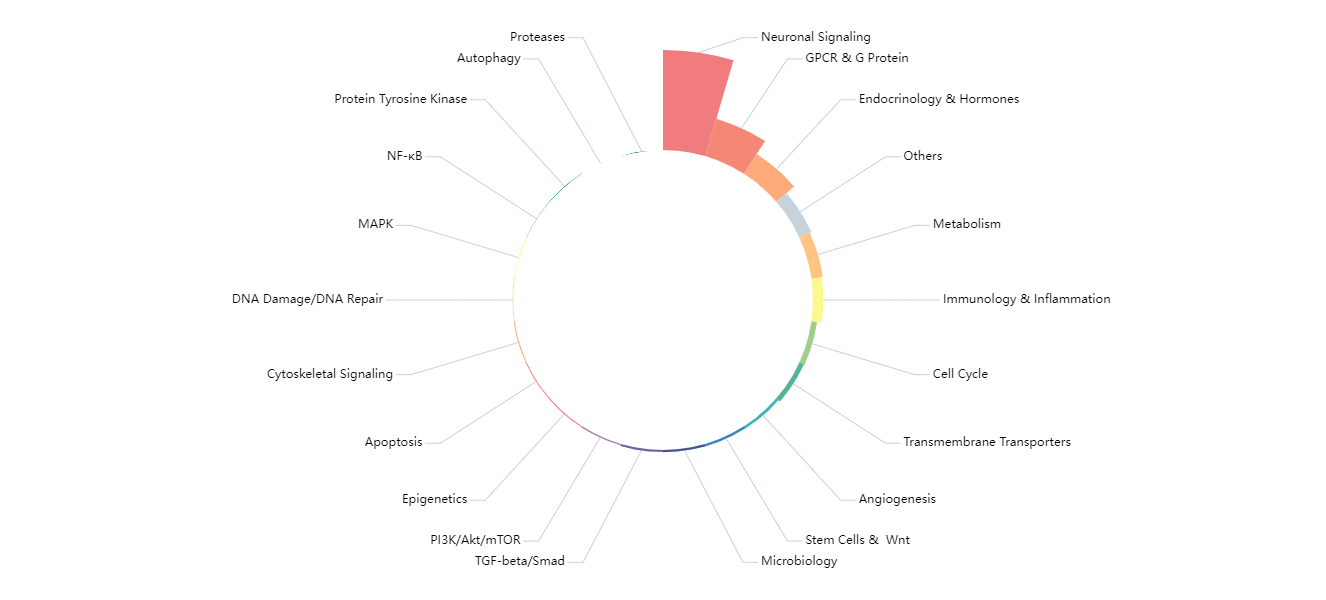
GPCR Compound Library Composition


Spécifications

Conditions de stockage de stockage
Store at -80°C
Expédié en
Dry ice packs + Cold packs
Ce produit nécessite l'expédition en chaîne froide. Les services terrestres et autres services économiques ne sont pas disponibles.

Documentation

📋 Fiche de données de sécurité (FDS)

Document complet couvrant les dangers, la manipulation, le stockage et la conformité réglementaire.

<<<<<<< HEAD Télécharger la SDS → ======= Télécharger la SDS → >>>>>>> release248-p3

✅ Certificat d'analyse (COA)

Données qualité spécifiques au lot. Saisissez votre numéro de lot pour récupérer le COA exact.

Rechercher le COA →

📊 Fiche technique

Résumé de référence rapide des spécifications et applications du produit.

Voir la fiche technique →

🔬 Fiche de spécifications

Attributs de qualité complets et critères d'acceptation pour cette qualité.

Voir la fiche de spécifications →

Données avancées

Certificats (CoA, COO, BSE/TSE et tableau d'analyse)
C of A & Other Certificates(BSE/TSE, COO):
Analytical Chart:
Calculateurs de solution
Avis

Avis des clients

Application Protocols

No vendor‑validated protocols are provided in the Product Data; below are general, field‑tested workflows for screening GPCR libraries.

  • Plate handling (general):
    1. Receipt: Keep frozen on dry ice; inventory and store immediately at −80°C.
    2. Thawing: Place plates in a desiccated environment; allow to equilibrate to RT before unsealing to prevent condensation. Record thaw event.
    3. Mixing: Briefly centrifuge and vortex if in DMSO; for dry films, add the indicated volume of anhydrous DMSO, seal, and shake (30–60 min) to fully dissolve.
  • Assay setup (example, cAMP):
    • Cells: GPCR‑expressing line plated at 5–20k cells/well (96/384‑well), 16–24 h before assay.
    • Buffer: HBSS + 20 mM HEPES + 0.1% BSA; IBMX 0.5 mM for accumulation assays.
    • Dosing: Transfer compounds to achieve 0.1–1% final DMSO; include vehicle, reference agonist, and antagonist controls.
    • Incubation: 10–30 min at 37°C (optimize per receptor/assay kit).
    • Readout: Homogeneous cAMP detection (e.g., HTRF/luminescence) per kit instructions.
  • Counter‑screens and artifacts:
    • Add 0.01–0.05% Tween‑20 to mitigate aggregation; evaluate Hill slope anomalies and test in presence/absence of detergent.
    • Run FLIPR/Calcium and β‑arrestin orthogonal assays for MOA.
  • Data quality:
    • Compute Z′‑factor per plate (target ≥0.5), include interleaved controls, and apply robust normalization.
  • Post‑screen:
    • Cherry‑pick hits, confirm by fresh dilutions, and procure neat compounds for IC50/EC50 confirmation and selectivity profiling.
Biological Roles

GPCRs are integral membrane receptors that transduce extracellular signals into intracellular responses through heterotrimeric G proteins and β‑arrestins (literature background). This library enables exploration of these pathways.

  • Signaling overview (literature):
    • GPCR activation modulates cAMP (Gs/Gi), phospholipase C/IP3‑DAG/Ca2+ (Gq/11), and Rho/ROCK (G12/13) cascades; β‑arrestins mediate receptor desensitization and alternative signaling.
    • Biased agonism and allosteric modulation are key properties of many modern GPCR probes, enabling pathway‑selective responses.
  • Ligand types expected in a GPCR library (general):
    • Orthosteric agonists/antagonists and inverse agonists.
    • Positive/negative allosteric modulators (PAMs/NAMs), silent allosteric modulators, and bitopic ligands.
  • Biological applications (general):
    • Target deconvolution and selectivity mapping across GPCR families.
    • Probe biology: Dissecting receptor reserve, desensitization kinetics, receptor internalization/trafficking, and receptor oligomerization.
    • Systems pharmacology: Pathway mapping in native cells/tissues that express multiple GPCRs.
  • Practical notes for biological assays (general):
    • Receptor expression: Verify receptor density (Bmax) and coupling efficiency in engineered lines; use appropriate agonist/antagonist controls.
    • Kinetics: Some GPCR ligands exhibit slow association/dissociation; allow sufficient pre‑incubation and consider kinetic readouts.
    • Safety: Certain ligands may have potent bioactivity; handle at small scales with appropriate containment.

Item-specific: No specific biological targets or ligand annotations are provided for this library; consult the plate manifest for receptor coverage and ligand annotations, if supplied.

Buffer Applications

While this product is not a buffer, appropriate buffers are essential for GPCR screening.

  • Item-specific: No buffer compositions are specified for this item.
  • Typical buffer systems for GPCR assays (literature/guidance):
    • Binding assays (membranes or intact cells): HEPES‑buffered saline (HBS; 20–50 mM HEPES, 100–150 mM NaCl, pH 7.4), supplemented with 0.1% BSA to reduce nonspecific binding.
    • Functional assays:
      • cAMP (Gs/Gi): HBSS or PBS with 20 mM HEPES, 0.5 mM IBMX (for phosphodiesterase inhibition), 0.1% BSA; pH 7.3–7.4.
      • Ca2+ flux (Gq): HBSS with 20 mM HEPES, 2.5 mM probenecid (to retain dyes), 0.1% BSA; pH 7.3–7.4.
      • IP1 accumulation: Manufacturer‑recommended assay buffer with LiCl (typically 50 mM) to inhibit inositol phosphate degradation.
    • Detergents/additives: 0.01–0.05% Tween‑20 or Pluronic F‑127 can mitigate compound aggregation; include 0.1–1 mM ascorbate/DTT only if target and readout are compatible.
  • DMSO considerations:
    • Maintain constant DMSO across wells, commonly 0.1–0.5% v/v; confirm tolerance of your cells/readout.
  • Practical handling:
    • Filter buffers (0.22 µm), degas if using SPR/label‑free. Equilibrate temperature to assay conditions to minimize drift.

Always validate buffer composition for your specific receptor, detection chemistry, and cell system.

Green Alternatives

Greener choices in screening workflows focus on solvent use, plastics reduction, and energy management rather than substitution of the library itself.

  • Item-specific (from Product Data): No solvent or format details are provided; recommendations below are general.
  • Solvent considerations (general):
    • DMSO remains the standard for compound stocks; while not "green," it is relatively low‑volatility and reusable. Minimize waste by aliquoting and reusing master plates prudently (track freeze‑thaw cycles).
    • For assay dilution, prefer aqueous buffers with minimal organic content (≤0.5–1% DMSO). Avoid DMF/NMP unless necessary.
  • Operational improvements:
    • Plate sealing: Use heat seals compatible with multiple punctures to reduce evaporation and re‑plating.
    • Right‑sizing: Choose 384‑ or 1536‑well formats to reduce reagent volumes and plastic consumption.
    • Energy: Store infrequently used plates at −80°C in high‑efficiency freezers; consolidate inventory to improve freezer load factor and reduce door‑open time.
  • Alternative solvents (comparison, literature):
    • Ethanol: Greener but less universal for solubility; higher volatility and assay effects.
    • 2‑MeTHF/CPME: Green for synthesis; generally incompatible with aqueous HTS workflows.
    • Cyclodextrin‑based carriers: Aqueous enabling technology that can reduce DMSO fractions for hydrophobic ligands.
  • Waste handling:
    • Segregate DMSO‑organic waste and aqueous waste; implement on‑site solvent recycling where feasible.

Overall: Prioritize aqueous assay conditions, minimize DMSO percentages, and adopt microvolume, sealed, and energy‑efficient practices to improve the environmental footprint of GPCR screening.

Pharmaceutical Uses

No clinical or therapeutic claims are made. This library is intended strictly for research use in drug discovery workflows.

  • Item-specific (from Product Data): Research Use Note: For research use only.
  • Role in pharmaceutical R&D (general):
    • Hit identification: Enable rapid screening against GPCR targets to discover starting points for medicinal chemistry.
    • Selectivity profiling: Early cross‑target assessment to reduce downstream attrition from off‑target GPCR activity.
    • Mechanistic pharmacology: Characterize efficacy (agonism/antagonism/inverse agonism), bias, and allosteric modulation to guide target product profiles.
    • ADME considerations: Early insight into ligand lipophilicity and potential liabilities through chemotype analysis, followed by hit triage and resynthesis.
  • Formulation/excipient context: Not applicable; this is not an excipient.
  • Compliance/documentation (general best practice):
    • Maintain traceability (plate barcodes, lot numbers) and data integrity compliant with internal QA systems.
    • Archive raw screening data and metadata (temperature, DMSO%, cell passage, buffer) to support reproducibility.

Item-specific details such as plate size, well count, and compound annotations are not specified here; consult the CoA/Spec Sheet for exact configuration.

Physical Properties

This product is a multi‑compound library; bulk physical constants are not meaningful at the item level.

  • Item-specific (from Product Data):
    • Appearance: Not specified for this item; refer to CoA/Spec Sheet.
    • Concentration/volume/format: Not specified for this item; refer to CoA/Spec Sheet.
  • Per‑compound properties (general/literature values):
    • Typical stock solvent: anhydrous DMSO due to broad solubility for drug‑like molecules.
    • Typical stock concentration (literature practice): 1–10 mM in DMSO; verify actual values on the plate map/label.
    • Solubility: Many GPCR ligands are moderately lipophilic (cLogP ~2–5, literature) and dissolve well in DMSO; aqueous solubility varies widely and may require co‑solvent or cyclodextrin.
    • pKa: Basic amines (pKa ~7–10, literature) are common; acidic motifs less frequent but present in certain subclasses.
    • Stability: Most small molecules are stable in dry DMSO at −20 to −80°C for months; hydrolysis‑prone chemotypes (esters, lactams, anilides) may degrade with moisture or heat (literature).
  • Practical screening parameters (general guidance):
    • Working assay DMSO tolerance: many biochemical/cell assays tolerate 0.1–1% v/v DMSO; confirm for your assay.
    • Light/air sensitivity: A subset of compounds may be photosensitive or oxidizable; minimize light/oxygen exposure during handling.

For definitive values for any constituent, consult the compound‑level CoA or structure file provided with the library.

Quality and Grades
  • Item-specific (from Product Data):
    • Grade/purity: Not specified for this item; refer to CoA/Spec Sheet.
  • What quality means for a screening library (general guidance):
    • Identity: Verified by supplier using NMR, LC‑MS/HRMS, and/or HPLC; acceptance criteria typically include correct mass and retention time vs. reference.
    • Purity: Screening libraries commonly target ≥90–95% purity by LC/UV at multiple wavelengths; exact thresholds vary by vendor and compound class. Impure wells may be flagged on the plate map.
    • Concentration accuracy: Stock concentration is usually confirmed by weight/volume and can be titered spectroscopically (e.g., UV for chromophoric compounds) or by quantitative NMR; actual values should be stated on the label/manifest.
    • Format/traceability: Barcoded plates/vials with unique well identifiers, plate maps (SMILES/SDF/SD files), and CoAs per lot ensure reproducibility.
    • Stability/QC on receipt: Many users perform incoming QA (random LC‑MS spot checks, re‑titering) and record freeze‑thaw cycles per plate to maintain integrity.
  • Stabilizers/additives: If present (e.g., antioxidants for easily oxidized chemotypes), they will be documented on the Spec Sheet—none are specified here.

Conclusion: Use the vendor’s CoA and plate documentation to confirm identity, purity, concentration, and any flags for specific wells before commencing screens.

Reaction and Applications

This GPCR Compound Library is intended for screening and profiling rather than chemical synthesis.

  • Item-specific (from Product Data):
    • Manufacturer Applications: Not specified in the listing; use and expand on standard screening uses as general guidance below.
  • Research applications (general/literature):
    • Primary screening (HTS/uHTS): Identify initial hits against GPCR targets using binding assays (radioligand/fluorescent tracer), functional second‑messenger assays (cAMP, IP1, Ca2+ flux), or label‑free readouts (impedance, dynamic mass redistribution).
    • Secondary pharmacology: Counter‑screening across off‑target GPCRs to assess selectivity panels and early safety signals.
    • Mode‑of‑action studies: Agonist/antagonist bias, allosteric modulation, and probe dependence via concentration–response analyses.
    • Phenotypic assays: Use in cellular systems expressing native GPCRs to capture pathway‑integrated effects.
    • Chemoinformatics: Scaffold enrichment, SAR by catalog, and substructure/descriptor analysis to prioritize follow‑ups.
  • Practical tips (general):
    • QC before use: Random LC‑MS checks of selected wells; verify concentrations and integrity after shipment.
    • Controls: Include reference ligands (known agonists/antagonists) and plate‑based DMSO controls; use interleaved control wells to correct edge effects.
    • Aggregation/artifacts: Use detergent (0.01–0.05% v/v) and counter‑screens for PAINS/aggregators; monitor Hill slopes and steep curves.
    • Data quality: Employ Z′‑factor evaluation per plate; normalize signals to positive/negative controls.

Note: For any specific target or assay format, tailor buffer composition, cell density, incubation times, and detection chemistry to established protocols.

Reaction Conditions

Not applicable to this product’s intended use. The GPCR Compound Library is for biological screening, not for conducting chemical reactions.

  • If you plan follow‑up chemistry on hits, reaction conditions will depend on the specific scaffold and functional groups of the selected compounds (consult primary literature and standard synthetic references).
Safety and Handling

Safety considerations apply to the library as a whole and to each constituent compound.

  • Item-specific (from Product Data):
    • GHS classification, signal word, pictograms, H‑statements: Not specified for this item; refer to SDS for this library and for individual compounds where available.
    • Storage: Store at −80°C.
    • Shipping: Dry ice packs + cold packs.
  • General laboratory safety (literature/best practice):
    • PPE: Lab coat, safety glasses, and appropriate chemically resistant gloves (e.g., nitrile). Handle within a fume hood or biosafety cabinet when preparing assay plates.
    • DMSO handling: DMSO can facilitate dermal absorption of solutes; avoid skin contact. Clean spills promptly with absorbent; decontaminate with soap/water.
    • Avoid inhalation/ingestion; do not pipette by mouth. Use sealed plate mats or caps to limit vapors and cross‑contamination.
    • Incompatibilities: Keep away from strong oxidizers and light/heat sources. Avoid moisture exposure if plates are supplied as dry films.
    • Cryogenic handling: When receiving on dry ice, wear insulated gloves and face protection; allow controlled thawing to prevent condensation and water ingress.
  • First‑aid overview (general):
    • Skin/eye contact: Rinse with water for ≥15 minutes; remove contaminated clothing. Seek medical attention if irritation persists.
    • Inhalation: Move to fresh air; seek medical advice if symptoms occur.
    • Ingestion: Rinse mouth; seek medical attention.

Always consult the SDS and plate manifest for lot‑specific hazards and recommended precautions.

Solvent Selection

For library dissolution and assay dilution, solvent choice impacts solubility, assay performance, and data quality.

  • Item-specific (from Product Data):
    • No solvent, concentration, or format is specified for this item; refer to CoA/Spec Sheet.
  • Primary stock solvent (general/literature practice):
    • DMSO is the standard due to high polarity/aprotic character (dielectric constant ~47, literature), broad solubilizing power for drug‑like molecules, and compatibility with most screening assays at ≤1% v/v.
  • Co‑solvents and alternatives (general):
    • For poorly soluble compounds: DMF or N‑methyl‑2‑pyrrolidone (NMP) are stronger solvents but have higher assay toxicity; use minimal final %.
    • Aqueous dilution: Use assay buffer containing 0.01–0.05% non‑ionic surfactant (e.g., Tween‑20/Pluronic F‑127) to reduce precipitation; filter if compatible.
    • Cyclodextrins (e.g., 2‑HP‑β‑CD, literature) can enhance aqueous solubility for hydrophobic ligands without high organic content.
  • Practical tips:
    • Pre‑warm plates to ambient in sealed conditions to avoid condensation; gently vortex/sonicate individual wells for complete dissolution.
    • Maintain consistent DMSO percentage across controls and test wells to avoid solvent‑bias.
    • Validate assay DMSO tolerance and adjust transfer volumes accordingly (acoustic vs. pin tools vs. tip‑based).
  • Comparison (general):
    • DMSO: highest solubility, good stability, low volatility; primary choice.
    • MeOH/EtOH: more volatile, greater assay interference risk; limited use for final dilutions.
    • 2‑MeTHF/CPME: greener but generally unsuitable for aqueous HTS dilutions; reserve for special cases.
Storage and Reconstitution
  • Item-specific (from Product Data):
    • Storage Conditions: Store at −80°C.
    • Shipped In: Dry ice packs + Cold packs.
  • General best practices for compound libraries:
    • Temperature management: Keep plates/vials at −80°C for long‑term storage; for working sets, −20°C is acceptable for short‑term (days–weeks) if freeze–thaw cycles are minimized.
    • Aliquoting: Prepare daughter plates/aliquots to limit freeze–thaw events; track the number of thaws per plate/well.
    • Moisture/light protection: Handle in low‑humidity conditions; unseal only after equilibrating to room temperature to prevent condensation. Protect from light where feasible.
    • Reconstitution (if supplied dry): Add anhydrous DMSO to the specified volume (Not specified for this item; refer to CoA/Spec Sheet), seal, and shake/sonicate until fully dissolved. Verify concentration by weight/volume and, if needed, spectroscopic titer.
    • Working solutions: Dilute into assay buffer to the desired final concentration, maintaining constant DMSO across wells. Typical final DMSO 0.1–1% (literature guidance; validate for your assay).
    • Stability: Many small molecules are stable in dry DMSO at −20 to −80°C for months; avoid repeated freeze–thaw and extended room‑temperature exposure.
    • Documentation: Maintain plate maps, thaw logs, and any re‑titer data linked to plate barcodes for full traceability.

For any lot‑specific instructions (e.g., initial stock concentration, plate format, reconstitution volumes), consult the CoA/Spec Sheet.

Structure and Identity

Brief overview: This is a curated small‑molecule screening library focused on G protein–coupled receptors (GPCRs), intended for discovery and profiling applications.

  • Item-specific (from Product Data):
    • Product: GPCR Compound Library (SKU: Lib412031)
    • CAS/SMILES/InChIKey/CID: Not specified for this item; refer to CoA/Spec Sheet.
    • Molecular formula/weight: Not specified for this item; refer to CoA/Spec Sheet.
    • Contents: Multiple distinct small molecules; individual compound identifiers and plate maps are typically provided in the accompanying documentation (not supplied here).
  • Library composition (general/literature context):
    • GPCRs comprise Class A (rhodopsin-like), Class B (secretin-like), Class C (metabotropic/glutamate), and other families. Screening libraries often include orthosteric ligands, allosteric modulators, and tool compounds across these classes.
    • Structural motifs commonly encountered include: biaryl/heteroaryl cores, basic amines (piperidine, morpholine), indoles/indazoles, quinazolines, benzimidazoles, sulfonamides, and amide/urea linkages.
    • Stereochemistry: Many GPCR ligands possess chiral centers; enantiopure or racemic forms may be present depending on the constituent.
  • Plate/format notes (general):
    • Libraries are typically supplied as DMSO solutions or dry films in 96‑/384‑well plates or vials with barcoding and plate maps. Concentrations and volumes vary by lot; verify on the plate manifest.

2D structural description (general): diverse drug-like fragments and leads with aromatic/heteroaromatic scaffolds, H‑bond donors/acceptors, and cationic centers positioned to engage conserved GPCR binding pockets.

Synthetic Utility

This product is a ready‑to‑screen library, not a synthetic building block or reagent set.

  • Applicability: Not typically used as a substrate or reagent in synthetic chemistry.
  • Guidance: If individual hits are identified, resynthesis or purchase of neat compounds for confirmation and SAR expansion is the standard next step. Synthetic routes are specific to each chemotype and are outside the scope of this library description.

For synthetic strategies, consult literature on the specific scaffolds identified during screening.

Target Specificity

Item-specific: Target coverage, receptor subfamilies, and per‑compound annotations are not specified for this item; refer to the library’s manifest or CoA for any available mapping.

General notes (literature):

  • GPCR libraries may include ligands for Class A (e.g., aminergic, chemokine, opsin‑like), Class B (secretin family), and Class C (metabotropic glutamate/GABA_B) receptors, as well as orphan GPCRs.
  • Specificity varies widely by ligand; many compounds exhibit polypharmacology across related receptors (e.g., 5‑HT, adrenergic, muscarinic families). Profiling against panels is recommended to determine selectivity.

Recommendation: Use orthogonal assays (binding plus functional), concentration–response curves, and reference comparators to establish target specificity and off‑target liabilities.

Foire aux questions

How should this product be stored?
Store at ?80 °C. Ultra-low temperature storage is required to maintain the specified shelf life.
How is this product shipped?
This product ships frozen with dry ice and cold packs. Unpack on arrival and transfer it to the storage condition stated above; handle dry ice with insulated gloves in a ventilated area.
What documentation is provided?
Available product documentation, including Certificates of Analysis (COA), Safety Data Sheets (SDS), and specification sheets, is shown in the product document area. Document availability and access follow the current site policy.

Souhaitez-vous que nous vous envoyions un message lorsque des réductions seront disponibles?

Me rappeler plus tard

Merci ! Veuillez vérifier votre boîte de réception e-mail pour confirmer.

Oups ! Les notifications sont désactivées.