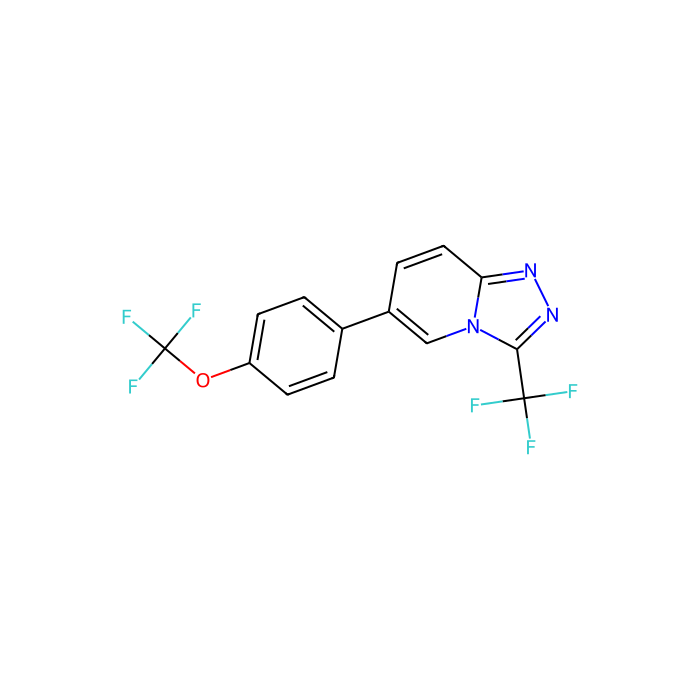
GS967 - Moligand™, ≥99% , Inhibitor of Na v1.5, CAS No.1262618-39-2, Inhibitor of Na v1.5

CAS: 1262618-39-2 Cat. No.: G413260 Formule: C14H7F6N3O Poids moléculaire: 347.22
DISPONIBLE À COMMANDE
QUALITÉ & PURETÉ Moligand™ ? Moligand™ — Aladdin's line of ligands and bioactive small molecules. Use for receptor, pathway, and binding studies needing defined small-molecule tools. ≥99%
Storage
Store at -20°C
Shipped In
Ice chest + Ice pads
★
Taille
USA
Allemagne (EU)*
Prix
Qté
5mg
G413260-5mg
3 En stock
—
73,90$US
25mg
G413260-25mg
3 En stock
—
270,90$US
100mg
G413260-100mg
2 En stock
—
741,90$US
Enter a quantity for the sizes you want to add.

Vue d’ensemble

Information

GS967 GS967 (GS458967) is a potent and selective inhibitor of late I Na with anti-arrhythmic actions.


Targets

late INa 0.13 μM


In vitro

GS967 (3 μM) has no significant effect on L- or T-type calcium channel currents or Na+-Ca2+ exchanger current (INCX), and 1 μM GS967 has minimal or no effect on the ATP-inhibited K+ current or on human cardiac ion channels expressed in human embryonic kidney 293 or Chinese hamster ovary cells. GS967 is a novel sodium channel modulatorspecifically developed to inhibit persistent sodium current, with a 42-fold preference for persistent as opposed to peakcurrent inhibition.


In vivo

GS967 protects against seizures and prematurelethality in vivo. Chronic GS967 does not cause overt behavioraltoxicity or sedation in wild-type mice at theeffective anticonvulsant dose. GS967 suppresses arrhythmogenicity evoked by ischemia, hypokalemia, and catecholamines in canine and porcine models.

Spécifications

Spécifications et pureté
Moligand™, ≥99%
Mécanismes biochimiques et physiologiques
GS967 (GS458967) is a potent and selective inhibitor of late INa with anti-arrhythmic actions.
Conditions de stockage de stockage
Store at -20°C
Expédié en
Ice chest + Ice pads
Ce produit nécessite l'expédition en chaîne froide. Les services terrestres et autres services économiques ne sont pas disponibles.
Grade
Moligand™
Type d'action
INHIBITOR
Mécanisme d'action
Inhibitor of Na v1.5
Pureté
≥99%
Propriétés du produit
ALogP
5.307
hba_count
3
Liaison rotative
4
Noms et identifiants
Pubchem Sid
Pubchem Sid Url
https://pubchem.ncbi.nlm.nih.gov/substance/504771656
SMILES
C1=CC(=CC=C1C2=CN3C(=NN=C3C(F)(F)F)C=C2)OC(F)(F)F
IUPAC Name
6-[4-(trifluoromethoxy)phenyl]-3-(trifluoromethyl)-[1,2,4]triazolo[4,3-a]pyridine
InChIKey
FEVBKJITJDHASC-UHFFFAOYSA-N
InChI
1S/C14H7F6N3O/c15-13(16,17)12-22-21-11-6-3-9(7-23(11)12)8-1-4-10(5-2-8)24-14(18,19)20/h1-7H
Isomères SMILES
C1=CC(=CC=C1C2=CN3C(=NN=C3C(F)(F)F)C=C2)OC(F)(F)F
Termes d'entrée MeSH
6-(4-(trifluoromethoxy)phenyl)-3-(trifluoromethyl)(1,2,4)triazolo(4,3-a)pyridine;GS-458967;GS-967;GS967
Poids moléculaire
347.22
Reaxys
21012437
Reaxys-RN_link_address
https://www.reaxys.com/reaxys/secured/hopinto.do?context=S&query=IDE.XRN=21012437&ln=

Données avancées

Taxonomic Classification

Taxonomy Tree

KingdomOrganic compounds
SuperclassOrganoheterocyclic compounds
ClassePyridines and derivatives
SubclassPhenylpyridines
Intermediate Tree Nodes Not available
Direct ParentPhenylpyridines
Alternative Parents Triazolopyridines  Phenoxy compounds  Phenol ethers  Triazoles  Heteroaromatic compounds  Trihalomethanes  Azacyclic compounds  Organooxygen compounds  Organonitrogen compounds  Organofluorides  Hydrocarbon derivatives  Alkyl fluorides  
Molecular FrameworkAromatic heteropolycyclic compounds
Substituents 3-phenylpyridine - Triazolopyridine - Phenoxy compound - Phenol ether - Monocyclic benzene moiety - Benzenoid - Azole - Triazole - 1,2,4-triazole - Heteroaromatic compound - Trihalomethane - Azacycle - Alkyl halide - Organic oxygen compound - Organooxygen compound - Organonitrogen compound - Organofluoride - Organohalogen compound - Organic nitrogen compound - Halomethane - Hydrocarbon derivative - Alkyl fluoride - Aromatic heteropolycyclic compound
DescriptionThis compound belongs to the class of organic compounds known as phenylpyridines. These are polycyclic aromatic compounds containing a benzene ring linked to a pyridine ring through a CC or CN bond.
External Descriptors Not available
Structure 3D
Modèle de structure chimique interactif


Cibles associées (humaines)
SCN2A Tclin Sodium channel protein type 2 subunit alpha (2 Activities)
Activity TypeActivity Value -log(M)Mechanism of ActionActivity ReferencePublications (PubMed IDs)
SCN5A Tclin Sodium channel protein type 5 subunit alpha (4 Activities)
Activity TypeActivity Value -log(M)Mechanism of ActionActivity ReferencePublications (PubMed IDs)
SCN1A Tclin Sodium channel protein type 1 subunit alpha (1 Activities)
Activity TypeActivity Value -log(M)Mechanism of ActionActivity ReferencePublications (PubMed IDs)
SCN1A Tclin Sodium channel protein type I alpha subunit (483 Activities)
Activity TypeRelationActivity valueUnitsAction TypeJournalPubMed IddoiAssay Aladdin ID
KCNH2 Tclin HERG (29587 Activities)
Activity TypeRelationActivity valueUnitsAction TypeJournalPubMed IddoiAssay Aladdin ID
SCN5A Tclin Sodium channel protein type V alpha subunit (3462 Activities)
Activity TypeRelationActivity valueUnitsAction TypeJournalPubMed IddoiAssay Aladdin ID
U2OS (164939 Activities)
Activity TypeRelationActivity valueUnitsAction TypeJournalPubMed IddoiAssay Aladdin ID
HEK-293T (167025 Activities)
Activity TypeRelationActivity valueUnitsAction TypeJournalPubMed IddoiAssay Aladdin ID
Cibles associées (non humaines)
Scn2a Sodium channel protein type II alpha subunit (191 Activities)
Activity TypeRelationActivity valueUnitsAction TypeJournalPubMed IddoiAssay Aladdin ID
Scn3a Sodium channel protein type III alpha subunit (24 Activities)
Activity TypeRelationActivity valueUnitsAction TypeJournalPubMed IddoiAssay Aladdin ID
Scn9a Sodium channel protein type IX alpha subunit (69 Activities)
Activity TypeRelationActivity valueUnitsAction TypeJournalPubMed IddoiAssay Aladdin ID
Scn8a Sodium channel protein type VIII alpha subunit (53 Activities)
Activity TypeRelationActivity valueUnitsAction TypeJournalPubMed IddoiAssay Aladdin ID
Scn10a Sodium channel protein type X alpha subunit (425 Activities)
Activity TypeRelationActivity valueUnitsAction TypeJournalPubMed IddoiAssay Aladdin ID
Scn4a Sodium channel protein type IV alpha subunit (55 Activities)
Activity TypeRelationActivity valueUnitsAction TypeJournalPubMed IddoiAssay Aladdin ID
Oryctolagus cuniculus (11301 Activities)
Activity TypeRelationActivity valueUnitsAction TypeJournalPubMed IddoiAssay Aladdin ID
Rattus norvegicus (775804 Activities)
Activity TypeRelationActivity valueUnitsAction TypeJournalPubMed IddoiAssay Aladdin ID
Cynomolgus monkey (4946 Activities)
Activity TypeRelationActivity valueUnitsAction TypeJournalPubMed IddoiAssay Aladdin ID
rep Replicase polyprotein 1ab (378 Activities)
Activity TypeRelationActivity valueUnitsAction TypeJournalPubMed IddoiAssay Aladdin ID
Liver microsome (341 Activities)
Activity TypeRelationActivity valueUnitsAction TypeJournalPubMed IddoiAssay Aladdin ID
Mécanismes d'action
Certificats (CoA, COO, BSE/TSE et tableau d'analyse)
C of A & Other Certificates(BSE/TSE, COO):
Analytical Chart:

Find and download the COA for your product by matching the lot number on the packaging.

3 results found

Lot NumberCertificate TypeDateArticle
F2229359F2229359Certificate of AnalysisApr 03, 2025 G413260
F2229360F2229360Certificate of AnalysisApr 03, 2025 G413260
F2229361F2229361Certificate of AnalysisApr 03, 2025 G413260
Propriétés chimiques et physiques
SolubilitéSolubility (25°C) In vitro Ethanol: 46 mg/mL (132.48 mM); DMSO: 45 mg/mL (129.6 mM); Water: Insoluble;
DMSO (mg/mL) Solubilité maximale45
DMSO (mM) Solubilité maximale129.600829445308
Eau (mg/mL) Solubilité maximale<1
Poids moléculaire347.21
XLogP34.900
Hydrogen Bond Donor Count0
Hydrogen Bond Acceptor Count9
Rotatable Bond Count2
Exact Mass347.049 Da
Monoisotopic Mass347.049 Da
Topological Polar Surface Area39.400 Ų
Heavy Atom Count24
Formal Charge0
Complexity435.000
Isotope Atom Count0
Defined Atom Stereocenter Count0
Undefined Atom Stereocenter Count0
Defined Bond Stereocenter Count0
Undefined Bond Stereocenter Count0
The total count of all stereochemical bonds0
Covalently-Bonded Unit Count1
Sécurité et dangers (GHS)
Pictogramme(s)
Signal
Warning
Mentions de danger

H302:Harmful if swallowed

H315:Causes skin irritation

H320:Causes eye irritation

H335:May cause respiratory irritation

Conseils de prudence

P264:Wash hands [and …] thoroughly after handling.

P270:Do not eat, drink or smoke when using this product.

P330:Rinse mouth.

P301+P312:IF SWALLOWED: call a POISON CENTER/doctor/... IF you feel unwell.

Reaxys
21012437
Reaxys-RN_link_address
https://www.reaxys.com/reaxys/secured/hopinto.do?context=S&query=IDE.XRN=21012437&ln=
Calculateurs de solution
Avis

Avis des clients

Application Protocols

No vendor-tested application protocols are provided in the Product Data for this item.

General usage framework for small-molecule screening (non-item-specific):

  • Stock solution: Prepare in dry DMSO at an appropriate concentration (e.g., 10–20 mM). Aliquot to avoid repeated freeze–thaw.
  • Plate handling: Equilibrate plates to room temperature before pinning/dispensing; standardize DMSO content across wells.
  • Assay validation: Include positive/negative controls, DMSO-only controls, and orthogonal readouts to confirm activity.
  • Interference checks: Evaluate absorbance/fluorescence overlap with assay detection wavelengths; include detergent controls to rule out colloidal aggregation.
  • Data integrity: Track lot number, stock age, and exact solvent composition in ELN.

Because no item-specific protocols are supplied, tailor these steps to your assay platform (biochemical, biophysical, or cellular) and confirm solubility and stability empirically.

Biological Roles

Item-specific biological mechanism, target class, or pathway engagement are not provided in the Product Data for GS967. Accordingly:

  • Biological function: Not specified for this item; refer to primary literature and the CoA/SDS for any target annotations supplied for your lot.

General guidance for small-molecule screening compounds (non-item-specific):

  • Treat as a research chemical for exploratory in vitro/in situ use. Establish baseline cytotoxicity and assay interference profiles before deriving mechanistic conclusions.
  • Implement orthogonal assays to distinguish true target engagement from artifacts (e.g., redox cycling, metal chelation, PAINS-like motifs). Use appropriate controls, including detergent rescue for aggregation and counterscreens for assay readout interference.
  • If using in cells, confirm permeability and stability in culture media; use LC–MS to quantify intracellular exposure where feasible.

Compliance note:

  • For research use only; not for human or animal therapeutic applications. Avoid clinical or diagnostic use.
Buffer Applications

This product is a discrete small molecule, not a classical buffering agent. It has no defined buffering capacity range specified in the Product Data.

  • Buffer use: Not typically applicable. Any incorporation into buffers should be for assay delivery of the small molecule (e.g., dilution of DMSO stocks into PBS, HEPES, or assay-specific media) rather than pH control.

Practical guidance (general):

  • When diluting DMSO stocks into aqueous buffers, maintain constant final DMSO across assay wells (e.g., 0.1–1% v/v) and verify that precipitation does not occur.
  • Use compatible, well-characterized buffers (HEPES, PBS, Tris) per your assay, and pre-warm solutions to reduce microprecipitation for marginally soluble compounds.

Item-specific buffer parameters (pKa, buffer range, recipes): Not applicable/not specified for this item.

Green Alternatives

For discrete screening compounds (such as this Moligand™ item), “green alternatives” typically concern solvent and process choices rather than substitution of the active entity.

Greener handling strategies (general guidance):

  • Prefer aqueous buffers with minimal DMSO (≤1% v/v) where assay-compatible; optimize assay sensitivity to allow lower stock concentrations.
  • Use bio-based or lower-toxicity co-solvents when feasible: 2-MeTHF or ethanol for preparative steps; avoid chlorinated solvents.
  • Minimize waste: prepare small, right-sized aliquots to reduce expired stock disposal.
  • Energy efficiency: store only as cold as necessary (here, −20°C is specified); avoid unnecessary ultralow freezers for compounds stable at −20°C per CoA/SDS.

Illustrative solvent comparison (general, not item-specific):

| Solvent | Greenness profile | Typical role | | --- | --- | --- | | Water (with ≤1% DMSO) | Preferred | Assay diluent | | Ethanol | Renewable option, higher volatility | Co-solvent/diluent | | 2-MeTHF | Bio-derived ether, lower peroxide risk than THF | Workup/prep steps | | DMSO | High boiling, good solvency; manage at low % | Stock solvent |

Note: No item-specific solubility/compatibility data are provided; confirm green substitutions do not compromise assay quality.

Pharmaceutical Uses

No pharmacopeial status, excipient role, or formulation use is provided in the Product Data for this item.

  • Status: Research use only; not intended for human or veterinary use.
  • Formulation/excipient use: Not specified for this item; refer to CoA/Spec Sheet if any guidance is provided for preclinical formulation research.

General lab context (non-clinical, non-therapeutic):

  • In early discovery, discrete small molecules are often evaluated in solubility/stability screens (pH, co-solvent, surfactant) and in vitro ADME panels. Any such work with this item should be confined to research environments and institutional approvals.
  • If conducting preformulation research, record polymorph/solid form and hydrate state where known; none are specified here for this product.

Regulatory disclaimer:

  • Not supplied under GMP; not suitable for clinical, diagnostic, or compendial applications. No medical or clinical claims are made or implied.
Physical Properties

Item-specific physicochemical properties are not provided in the Product Data. Where not specified, consult the CoA/SDS or verify internally by analytical methods.

  • Appearance: Not specified for this item; refer to CoA/Spec Sheet.
  • Molecular weight: Not specified for this item; refer to CoA/Spec Sheet.
  • Molecular formula: Not specified for this item; refer to CoA/Spec Sheet.
  • Melting point: Not specified for this item; refer to CoA/Spec Sheet.
  • Boiling point: Not specified for this item; refer to CoA/Spec Sheet.
  • Density: Not specified for this item; refer to CoA/Spec Sheet.
  • Refractive index: Not applicable/unknown for solids; Not specified for this item; refer to CoA/Spec Sheet.
  • LogP/logD: Not specified for this item; refer to CoA/Spec Sheet.
  • pKa values: Not specified for this item; refer to CoA/Spec Sheet.
  • Solubility profile: Not specified for this item; refer to CoA/Spec Sheet. As general practice for screening compounds, initial dissolution in dry DMSO (e.g., 10–50 mM) is commonly used, followed by dilution into aqueous buffers containing co-solvent (0.1–1% DMSO), pending compound-specific compatibility tests.

General lab guidance (not item-specific):

  • If the compound is non-volatile and crystalline, DSC and TGA can aid in assessing thermal behavior and hygroscopicity before long assays.
  • Determine actual solubility and stability in your specific assay media by small-scale titration and LC–MS monitoring (time-course) to detect precipitation or degradation.
Quality and Grades
  • Grade/Purity: Moligand™ (from Product Data)

What Moligand™ implies (general description):

  • Moligand™ designates small molecules curated for research screening, ligand discovery, and chemical biology workflows. While not a pharmacopeial grade, lots are intended for reproducible in vitro use with documented identity and purity metrics on the CoA (e.g., LC–MS, HPLC area%).

How to interpret typical documentation (general guidance):

  • CoA will usually report identity confirmation (MS/NMR), purity by HPLC/UPLC (area %), and residual solvent limits for the lot. If your application is light-sensitive (e.g., photobiology) or extremely purity-sensitive (biophysical assays), request full spectral data where available.

Item-specific notes:

  • Specific numeric purity, residual solvents, water content, and stabilizers are Not specified for this item; refer to CoA/Spec Sheet.
  • Appearance is Not specified for this item; refer to CoA/Spec Sheet.

Best practices for screening-grade small molecules:

  • Verify purity in-house before HTS or SAR-critical assays; short LC–MS runs can reveal co-eluting impurities.
  • Document the exact lot and solution-age in ELN records; many bioactives can undergo time-/light-/oxygen-dependent degradation in DMSO.
  • For orthogonal confirmation, replicate key readouts with a fresh vial or freshly prepared stock.

Regulatory note:

  • Research use only; not intended for diagnostic, therapeutic, or human/animal use.
Reaction and Applications

This product is supplied as a discrete small molecule for screening/ligand discovery and is not primarily intended as a synthetic reagent or catalyst.

  • Synthetic reaction use: Not typically applicable. No item-specific reactivity or reagent role is provided in the Product Data.
  • Analytical/biochemical applications (general for screening compounds):
    • Hit identification and SAR: evaluate in target-based or phenotypic assays; confirm activity via orthogonal methods.
    • Biophysical binding assessments: thermal shift (DSF), SPR, MST, ITC—contingent on compound solubility and optical properties.
    • Cellular assay deployment: validate permeability, off-target aggregation (use detergent controls), and redox/fluorescence interference profiling.

Practical tips (general guidance):

  • Prepare fresh DMSO stocks (e.g., 10–20 mM), store aliquots at −20°C, minimize freeze–thaw.
  • Verify absence of colloidal aggregation using detergent controls or DLS if activity is unusually steep or promiscuous.
  • Include counterscreens for assay interference (fluorescence/absorbance) when relevant.

Because no manufacturer-provided application text is available for this item, plan and validate use conditions empirically and document lot, stock age, and solvent composition in your ELN.

Reaction Conditions

Not applicable in the conventional synthetic sense: this product is not provided as a reagent or catalyst, and no reaction-condition guidance is specified in the Product Data.

If used in assay or analytical contexts (general, non-item-specific):

  • Stock preparation: Commonly 10–50 mM in anhydrous DMSO; vortex/sonicate briefly; filter if needed. Validate concentration by UV or quantitative NMR where practical.
  • Assay delivery: Dilute into assay buffer to 0.1–1% DMSO final; verify solubility (no visible precipitate; consistent activity upon serial dilution).
  • Stability checks: Incubate representative working solutions at assay temperature and sample at intervals for LC–MS assessment of degradation or adsorption losses.

Because the present listing supplies no mechanistic or reagent-use data, there are no recommended temperatures, catalysts, or yields associated with chemical reactions for this item.

Safety and Handling

Safety data specific to this item are not fully specified in the Product Data. Always consult the product SDS for authoritative information.

GHS/SDS fields from Product Data:

  • Signal word: Not specified for this item; refer to SDS.
  • H-statements: Not specified for this item; refer to SDS.
  • GHS classification: Not specified for this item; refer to SDS.
  • Pictograms: Not specified for this item; refer to SDS.

General laboratory precautions (non-item-specific):

  • Handle in a chemical fume hood. Avoid inhalation of dust or aerosols and prevent contact with skin and eyes.
  • Recommended PPE: lab coat, safety glasses or splash goggles, and appropriate chemically resistant gloves (e.g., nitrile). For weighed powders, consider antistatic measures and local exhaust.
  • Storage incompatibilities: Keep away from strong oxidizers and strong acids/bases unless stability has been verified for this compound. Protect from moisture and light as a precaution for small-molecule screening compounds.
  • First aid overview: If inhaled—move to fresh air; if on skin—wash with soap and water; if in eyes—rinse cautiously with water for several minutes; if ingested—rinse mouth and seek medical advice. Follow SDS guidance.
  • Spill response: For small spills, absorb with inert material (e.g., vermiculite), collect in labeled container for disposal. Prevent dust formation; avoid release to environment.
  • Waste disposal: Dispose of contents/container in accordance with institutional, local, and national regulations. Segregate halogenated vs non-halogenated organic waste streams as applicable.

Note: This product is for research use only.

Solvent Selection

Item-specific solubility data are not provided. The following are general, literature-based practices for handling discrete small molecules in discovery research.

Primary solvents for stock solutions (general guidance):

  • DMSO (anhydrous): first-line for screening stocks (e.g., 10–50 mM). Provides broad solubility and stability for many heteroaromatic and lipophilic scaffolds.
  • DMF or NMP (anhydrous): alternatives when DMSO solubility is limited; verify assay compatibility and cytotoxicity profiles.
  • Aqueous buffers: prepare by serial dilution from an organic stock; maintain low organic fractions (0.1–1% v/v DMSO) and include surfactant (e.g., 0.01% Tween-20) where appropriate to mitigate aggregation.

Miscibility and co-solvent strategies (general guidance):

  • To reach higher aqueous concentrations, consider co-solvent blends (DMSO/H2O, DMSO/ethanol/H2O) validated against your assay readout. Filter through 0.2 µm if precipitation is suspected.
  • For light- or oxidation-sensitive molecules, degas solvents and protect from light; prepare single-use aliquots.

Quick comparison (general guidance):

  • DMSO: maximal solubilizing power, high boiling point; may interfere in some enzyme assays above ~1–2%.
  • Ethanol: higher volatility; limited solubility envelope but often assay-friendly up to ~0.5–1%.
  • PEG400: useful for difficult solutes in in vivo formulation research, but not recommended unless required by protocol and safety review.

Note: Determine compound-specific solubility/compatibility empirically; the present listing provides no item-specific solvent specifications.

Storage and Reconstitution

From Product Data (item-specific):

  • Storage conditions: Store at −20°C.
  • Shipping conditions: Shipped in ice chest with ice pads.

General reconstitution guidance (not item-specific; verify with CoA/SDS for your lot):

  • Solvent for stock: Prepare fresh stocks in anhydrous DMSO (typical 10–50 mM). If an alternative solvent is required (DMF, ethanol), confirm compatibility with downstream assays.
  • Technique: Allow vial to equilibrate to room temperature in a desiccator before opening to minimize moisture condensation. Weigh quickly and cap promptly.
  • Aliquoting: Dispense into single-use micro-aliquots to avoid repeated freeze–thaw. Store aliquots at −20°C, protected from light and moisture.
  • Working solutions: Prepare immediately before use by diluting the DMSO stock into assay buffer. Keep final DMSO consistent across samples (commonly 0.1–1% v/v).
  • Stability monitoring: For extended experiments, verify concentration and integrity by LC–MS or HPLC at start and end of use; discard if precipitation or degradation is detected.

Additional notes:

  • Appearance: Not specified for this item; refer to CoA/Spec Sheet.
  • Stabilizers/antioxidants: Not specified for this item; refer to CoA/Spec Sheet.
  • For research use only; not for human or animal use.
Structure and Identity

Brief overview: GS967 (SKU G413260) is offered as a research-only small molecule in our Moligand™ collection. Item-specific structural identifiers are not provided in the product data below.

  • CAS: 1262618-39-2 (from Product Data)
  • PubChem CID: 58118983 (from Product Data)
  • InChIKey: Not specified for this item; refer to CoA/Spec Sheet. (Product Data lists a short code “80945,” which is not a standard InChIKey.)
  • SMILES: Not specified for this item; refer to CoA/Spec Sheet.
  • Molecular formula: Not specified for this item; refer to CoA/Spec Sheet.
  • Molecular weight: Not specified for this item; refer to CoA/Spec Sheet.

Structural features (general remarks):

  • This product is supplied as a single, discrete small molecule suitable for screening and ligand discovery workflows. Detailed functional groups, ring systems, or stereochemical elements are not specified in the current Product Data; consult the CoA/SDS or authoritative databases for the definitive 2D depiction.

2D structure (described in words):

  • Not specified for this item; refer to CoA/Spec Sheet. When planning analytical ID (NMR/LC–MS), ensure you have lot-specific reference spectra from the CoA where available.

Notes:

  • Always reconcile identifiers (CAS, CID) with the specific lot documentation, as screening compounds can have multiple reported salt forms or stereochemical annotations in literature. The present listing does not specify salt form; assume free base/neutral form only if confirmed on the CoA.
Synthetic Utility

This listing provides GS967 as a finished small molecule for screening, not as a synthetic building block or reagent.

  • Reagent/transformational roles: Not specified for this item; no functional group reactivity or coupling handles are documented in the Product Data.
  • Use in synthesis: Not typically applicable unless your program explores analog derivatization; in that case, refer to the literature for scaffold-level modifications. The present product is not advertised as a protected intermediate or handle-bearing synthon.

General advice (if derivatization is pursued):

  • Establish unambiguous structure via full spectroscopic characterization of your lot (1H/13C NMR, HRMS, and, if needed, 2D NMR). Without item-specific SMILES/InChI in the listing, rely on CoA and independent confirmation.
  • Map potential liabilities (e.g., hydrolysis, oxidation, photolysis) with stress testing before planning late-stage functionalization.

Conclusion: Treat GS967 primarily as a bioactive screening compound; synthetic utility is outside the intended scope and not specified in the current Product Data.

Target Specificity

Target binding, selectivity profile, and potency metrics are not provided in the Product Data for this item.

  • Target/Pathway: Not specified for this item; refer to CoA/Spec Sheet and primary literature for any target annotations associated with your lot.
  • Selectivity/counter-targets: Not specified for this item.
  • Species reactivity: Not specified for this item.

Note: For research screening compounds, confirm any reported target specificity independently under your assay conditions, including orthogonal counterscreens to exclude assay artifacts.

Foire aux questions

What are the CAS number, molecular formula and molecular weight?
The CAS Number is 1262618-39-2, the molecular formula is C14H7F6N3O, and the molecular weight is 347.22 g/mol. InChIKey FEVBKJITJDHASC-UHFFFAOYSA-N.
How should this product be stored?
Store at ?20 °C. Freezer storage is required to maintain the specified shelf life.
How is this product shipped?
This product ships in an insulated container with ice pads. Unpack on arrival and transfer it to the storage condition stated above.
What is the purity of this product?
This product is supplied at ≥99% purity (chemical assay). Lot-specific values are stated on the Certificate of Analysis.
What is Moligand??
Moligand? is one of Aladdin Scientific's premium product lines, formulated for high-purity applications across multiple workflows. Compared to standard grades in the same workflow, Moligand? products typically offer tighter specifications, more rigorous QC, and stronger lot-to-lot consistency.
What documentation is provided?
Available product documentation, including Certificates of Analysis (COA), Safety Data Sheets (SDS), and specification sheets, is shown in the product document area. Document availability and access follow the current site policy.

Besoin d'aide pour choisir la qualité ?

Notre guide de sélection des qualités couvre la pureté, le statut du stabilisant et l'adéquation à l'application pour toutes les variantes de notre catalogue.

Voir le guide des qualités Moligand™ →

Souhaitez-vous que nous vous envoyions un message lorsque des réductions seront disponibles?

Me rappeler plus tard

Merci ! Veuillez vérifier votre boîte de réception e-mail pour confirmer.

Oups ! Les notifications sont désactivées.