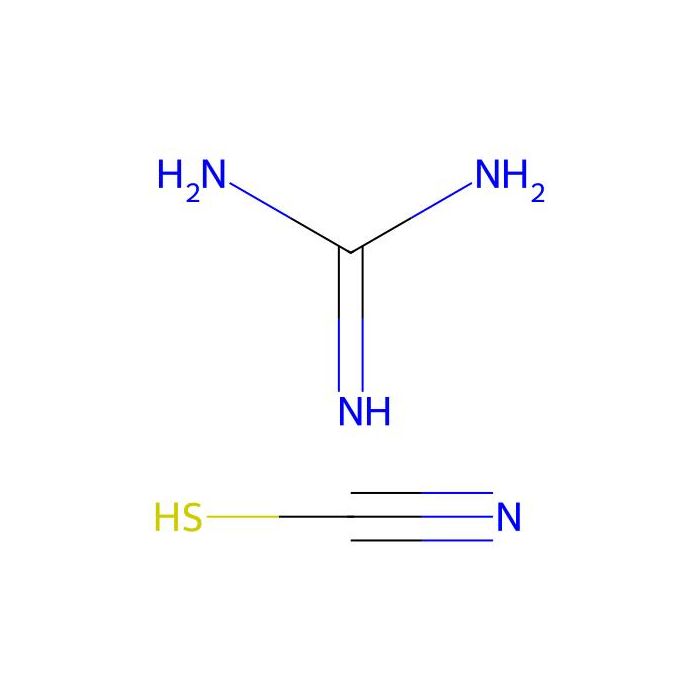
Guanidine thiocyanate solution - UltraBio™,Suitable for molecular biology,~6 M in H2O , CAS No.593-84-0

CAS: 593-84-0 Cat. No.: G755743 Formule: C2H6N4S Poids moléculaire: 118.16 Beilstein Registry Number: 3563461 Numéro CE: 209-812-1
DISPONIBLE À COMMANDE
GRADE & PURITY UltraBio™ ? UltraBio™ — Aladdin's line for molecular-biology applications. Use for nuclease-free, high-consistency reagents across molecular workflows. Suitable for molecular biology ? Molecular-biology grade — free of nucleases and contaminants that degrade DNA/RNA. Use in cloning, PCR, and nucleic-acid work needing clean reagents. ~6 M in H2O
Storage
Room temperature
Shipped In
Normal
★
Size
USA
Allemagne (EU)*
Price
Qty
50ml
G755743-50ml
Sur commande · 8–12 semaines
276,90$US
250ml
G755743-250ml
Sur commande · 8–12 semaines
885,90$US
Enter a quantity for the sizes you want to add.
🧪
Why this grade

UltraBio™,Suitable for molecular biology,~6 M in H2O Suitable for molecular biology,UltraBio™ for sensitive chromatographic and analytical workflows requiring minimal baseline interference.

🌡

Storage & shipping

Room temperature Ships Normal Check lot-specific COA for exact specifications.

📋

Quality documents

SDS, COA, datasheet, and spec sheet available for download. Lot-specific COA accessible via lot number lookup.

📚

Literature proof

Cited in 40 peer-reviewed publications across chromatography, organic synthesis, and cross-coupling reactions.

Vue d’ensemble

Guanidine thiocyanate is a chaotropic agent that functions as a strong protein denaturant. It is widely used in RNA isolation protocols. Guanidine thiocyanate can irreversibly inactivate RNase and DNase and breaks cellular membranes. It dissolves proteins by disturbing their secondary structures. Guanidine thiocyanate also separates nucleoproteins from nucleic acids and aids the digestion of the proteins with proteases. It improves the activity of proteinase K thus making it the protease of choice.

Application:

Guanidine thiocyanate solution has been used to extract:
  • plasma RNA from human immunodeficiency virus (HIV)-infected and control patients
  • total RNA from collected tissues (shoots, flowers, fruits, and seeds)
  • in reverse transcription-polymerase chain reaction (RT-PCR) analysis, RNA from teratocarcinoma cell line (Tera-1)

Specifications

Spécifications et pureté
UltraBio™,Suitable for molecular biology,~6 M in H2O
Conditions de stockage de stockage
Room temperature
Expédié en
Normal
Grade
Suitable for molecular biology, UltraBio™
Noms et identifiants
PH
4.5-7.0 (25 °C)
Sourires canoniques
C(#N)S.C(=N)(N)N
IUPAC Name
guanidine;thiocyanic acid
InChIKey
ZJYYHGLJYGJLLN-UHFFFAOYSA-N
INCHI
1S/CH5N3.CHNS/c2-1(3)4;2-1-3/h(H5,2,3,4);3H
Isomères SMILES
C(#N)S.C(=N)(N)N
WGK Allemagne
2
RTECS
XL1225000
Numéro ONU
1759
Groupe d'emballage
III
Poids moléculaire
118.16
Beilstein
3563461
Reaxy-Rn
3563461
Reaxys-RN_link_address
https://www.reaxys.com/reaxys/secured/hopinto.do?context=S&query=IDE.XRN=3563461&ln=

Documentation

📋 Safety Data Sheet (SDS)

Comprehensive hazard, handling, storage, and regulatory compliance document.

Download SDS →

✅ Certificate of Analysis (COA)

Lot-specific quality data. Enter your lot number to retrieve the exact COA.

Look up COA →

📊 Datasheet

Quick-reference summary of product specifications and applications.

View datasheet →

🔬 Specification Sheet

Full quality attributes and acceptance criteria for this grade.

View spec sheet →

Advanced Data

Taxonomic Classification

Taxonomy Tree

KingdomOrganic compounds
SuperclassOrganosulfur compounds
ClasseThiocyanates
SubclassNot available
Intermediate Tree Nodes Not available
Direct ParentThiocyanates
Alternative Parents Organopnictogen compounds  Organonitrogen compounds  Hydrocarbon derivatives  
Molecular FrameworkNot available
Substituents Thiocyanate - Organic nitrogen compound - Organopnictogen compound - Hydrocarbon derivative - Organonitrogen compound - Aliphatic acyclic compound
DescriptionThis compound belongs to the class of organic compounds known as thiocyanates. These are salts or esters of thiocyanic acid, with the general formula RSC#N (R=alkyl, aryl).
External Descriptors Not available
Structure 3D
Modèle de structure chimique interactif


Certificats (CoA, COO, BSE/TSE et tableau d'analyse)
C of A & Other Certificates(BSE/TSE, COO):
Analytical Chart:
Propriétés chimiques et physiques
Point de fusion (°C)118-122°C
Poids moléculaire118.160 g/mol
XLogP3
Hydrogen Bond Donor Count4
Hydrogen Bond Acceptor Count3
Rotatable Bond Count0
Exact Mass118.031 Da
Monoisotopic Mass118.031 Da
Topological Polar Surface Area101.000 Ų
Heavy Atom Count7
Formal Charge0
Complexity57.600
Isotope Atom Count0
Defined Atom Stereocenter Count0
Undefined Atom Stereocenter Count0
Defined Bond Stereocenter Count0
Undefined Bond Stereocenter Count0
The total count of all stereochemical bonds0
Covalently-Bonded Unit Count2
FAQ et articles
UltraBio™: Defining Excellence in Molecular Biology Applications
Molecular Biology Grade
How Biotinylated Molecules are Purified with Streptavidin Beads
A Review of Ten Commonly Used Techniques for Detection, Quantification, and Interaction Analysis in Nucleic Acid Research
Plant Omics Panorama: Workflow Frameworks and Multi-Omics Integration from Genomics to Transcriptomics, Proteomics, and Metabolomics
RNA Extraction Technologies: Method Systems, Operational Workflows, and Key Quality-Control Considerations
Interleukin-29 (IL-29/IFN-λ1): Molecular Features, Signaling Networks, and a Systematic Framework for Research Applications
dsDNase-Mediated Hydrolysis of Double-Stranded DNA: Enzymatic Characteristics, Methodological Strategies, and Bioanalytical Applications
GITC——Key Reagent for Nucleic Acid Extraction and Sample Protection
Phase-Partitioning Principles, System Differences, and Application Selection in Phenol-Based DNA and RNA Extraction
Citations of This Product
Calculateurs de solution
Avis

Avis des clients

Shall we send you a message when we have discounts available?

Remind me later

Thank you! Please check your email inbox to confirm.

Oops! Notifications are disabled.