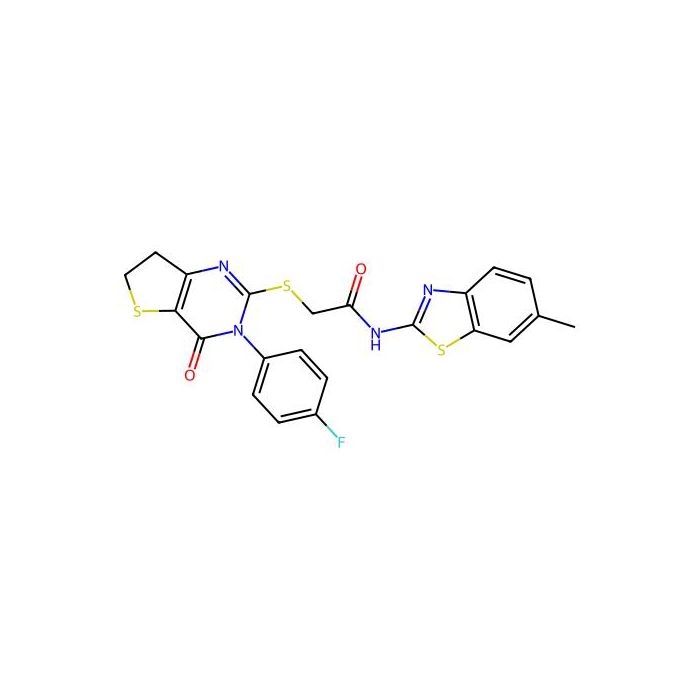
 I2608677
Determine the necessary mass, volume, or concentration for preparing a solution.
| Activity Type | Relation | Activity value | Units | Action Type | Journal | PubMed Id | doi | Assay Aladdin ID |
|---|

IWP-3 is an potent inhibitor of Wnt production with an IC 50 of 40 nM. IWP-3 inhibits Porcupine (Porcn) function thereby blocking palmitoylation of Wnt proteins. IWP-3 inhibits CK1γ3 and CK1ε only moderately and does not inhibit CK1α.
Form:Solid
Taxonomy Tree
| Kingdom | Organic compounds |
|---|---|
| Superclass | Organoheterocyclic compounds |
| Classe | Thienopyrimidines |
| Subclass | Not available |
| Intermediate Tree Nodes | Not available |
| Direct Parent | Thienopyrimidines |
| Alternative Parents | Benzothiazoles N-arylamides Pyrimidones Alkylarylthioethers Fluorobenzenes Aryl fluorides Thiazoles Heteroaromatic compounds Secondary carboxylic acid amides Lactams Sulfenyl compounds Azacyclic compounds Carbonyl compounds Hydrocarbon derivatives Organic oxides Organofluorides Organopnictogen compounds |
| Molecular Framework | Aromatic heteropolycyclic compounds |
| Substituents | 1,3-benzothiazole - Thienopyrimidine - Aryl thioether - N-arylamide - Fluorobenzene - Halobenzene - Pyrimidone - Alkylarylthioether - Aryl fluoride - Aryl halide - Monocyclic benzene moiety - Pyrimidine - Benzenoid - Thiazole - Heteroaromatic compound - Azole - Secondary carboxylic acid amide - Carboxamide group - Lactam - Azacycle - Sulfenyl compound - Thioether - Carboxylic acid derivative - Hydrocarbon derivative - Organohalogen compound - Organopnictogen compound - Organic oxygen compound - Organofluoride - Organonitrogen compound - Carbonyl group - Organic nitrogen compound - Organooxygen compound - Organosulfur compound - Organic oxide - Aromatic heteropolycyclic compound |
| Description | This compound belongs to the class of organic compounds known as thienopyrimidines. These are heterocyclic compounds containing a thiophene ring fused to a pyrimidine ring. Thiophene is 5-membered ring consisting of four carbon atoms and one sulfur atom. Pyrimidine is a 6-membered ring consisting of four carbon atoms and two nitrogen centers at the 1- and 3- ring positions. |
| External Descriptors | Not available |
| Activity Type | Relation | Activity value | Units | Action Type | Journal | PubMed Id | doi | Assay Aladdin ID |
|---|
| Activity Type | Relation | Activity value | Units | Action Type | Journal | PubMed Id | doi | Assay Aladdin ID |
|---|
| Activity Type | Relation | Activity value | Units | Action Type | Journal | PubMed Id | doi | Assay Aladdin ID |
|---|
| Activity Type | Relation | Activity value | Units | Action Type | Journal | PubMed Id | doi | Assay Aladdin ID |
|---|
| Activity Type | Relation | Activity value | Units | Action Type | Journal | PubMed Id | doi | Assay Aladdin ID |
|---|
| Activity Type | Relation | Activity value | Units | Action Type | Journal | PubMed Id | doi | Assay Aladdin ID |
|---|
| Activity Type | Relation | Activity value | Units | Action Type | Journal | PubMed Id | doi | Assay Aladdin ID |
|---|
| Activity Type | Relation | Activity value | Units | Action Type | Journal | PubMed Id | doi | Assay Aladdin ID |
|---|
| Activity Type | Relation | Activity value | Units | Action Type | Journal | PubMed Id | doi | Assay Aladdin ID |
|---|
| Activity Type | Relation | Activity value | Units | Action Type | Journal | PubMed Id | doi | Assay Aladdin ID |
|---|
| Activity Type | Relation | Activity value | Units | Action Type | Journal | PubMed Id | doi | Assay Aladdin ID |
|---|
| Activity Type | Relation | Activity value | Units | Action Type | Journal | PubMed Id | doi | Assay Aladdin ID |
|---|
| Solubilité | DMSO : 25 mg/mL (51.59 mM; ultrasonic and warming and heat to 60°C) |
|---|---|
| Poids moléculaire | 484.6 |
| XLogP3 | 4.900 |
| Hydrogen Bond Donor Count | 1 |
| Hydrogen Bond Acceptor Count | 8 |
| Rotatable Bond Count | 5 |
| Exact Mass | 484.05 Da |
| Monoisotopic Mass | 484.05 Da |
| Topological Polar Surface Area | 154.000 Ų |
| Heavy Atom Count | 32 |
| Formal Charge | 0 |
| Complexity | 830.000 |
| Isotope Atom Count | 0 |
| Defined Atom Stereocenter Count | 0 |
| Undefined Atom Stereocenter Count | 0 |
| Defined Bond Stereocenter Count | 0 |
| Undefined Bond Stereocenter Count | 0 |
| The total count of all stereochemical bonds | 0 |
| Covalently-Bonded Unit Count | 1 |
H302:Harmful if swallowed
P264:Wash hands [and …] thoroughly after handling.
P270:Do not eat, drink or smoke when using this product.
P330:Rinse mouth.
P501:Dispose of contents/container to an approved waste disposal plant.
P301+P317:IF SWALLOWED: Get medical help.
Tested/validated application details (e.g., WB, IHC, IF, FC), recommended dilutions, and positive controls are not applicable to this small-molecule product and are not specified for this item.
General use guidance (non-item-specific; for planning only):
For any item-specific protocols, refer to the CoA/Spec Sheet.
Research context (literature/general knowledge; non-clinical):
Experimental considerations (practice):
Caveats:
This product is not a buffering agent and is not used to prepare classical pH buffer systems. For laboratory use, it is typically dissolved in DMSO and then diluted into biological buffers (e.g., PBS, HBSS, or culture media) immediately before use. If precipitation occurs upon dilution, consider using low percentages of DMSO and gentle mixing, or include carrier protein/surfactant compatible with your assay.
As a specialized bioactive research tool, IWP-3 is selected for biological performance rather than process chemistry. “Greener” selection typically addresses solvent systems and handling rather than replacement of the active itself.
Greener handling suggestions (general, not item-specific):
Comparison of solvent choices (general):
Replacement of IWP-3 with a “greener” active is generally not meaningful because biological selectivity and potency, not environmental metrics, drive tool-compound choice. Instead, optimize solvent and waste practices around its use.
This product is supplied strictly for research use only and is not intended for human or veterinary applications.
Typical roles in pharmaceutical research settings (non-clinical, literature/general):
Regulatory/excipients:
Item-specific pharmacopeial status, residual solvent limits, or elemental impurity profiles: Not specified for this item; refer to CoA/Spec Sheet.
Item-specific specifications (this product):
Literature/general properties for IWP-class tool compounds (for planning only; confirm experimentally):
Notes for users:
What Moligand™ generally implies (program-level context; not item-specific guarantees):
How to leverage this grade in practice:
Stabilizers, inhibitors, and additives:
Compliance notes:
This product is a bioactive small-molecule tool compound and is not typically used as a synthetic reagent or catalyst.
Applicable research applications (literature/general practice; non-clinical):
Not applicable to this item:
Not typically applicable. IWP-3 is used as a bioactive probe rather than as a reagent in chemical transformations, so standard reaction parameters (solvent, temperature, catalysts, yields) are not relevant.
Assay preparation conditions (general practice, for context only):
Item-specific reaction or assay performance parameters are Not specified for this item; refer to CoA/Spec Sheet and SDS.
GHS classification, signal word, H-statements, and pictograms: Not specified for this item; refer to SDS.
General laboratory safety guidance for small-molecule research tools (non-item-specific; follow institutional SOPs):
Storage and transport:
Use-case: dissolution and delivery of a hydrophobic bioactive tool compound into biochemical or cell-based assays.
Small comparison (guidance):
Item-specific solubility, logP, or pKa values: Not specified for this item; refer to CoA/Spec Sheet.
Storage conditions (item-specific):
General handling and reconstitution (practice; verify with CoA/SDS for your lot):
Disposal: Collect unused material and DMSO solutions as organic hazardous waste in accordance with institutional and local regulations.
IWP-3 is a bioactive small molecule commonly used as a research tool compound in chemical biology and pathway studies.
Structural features (general/literature description):
2D structure (verbal, literature/class-level):
IWP-3 is a finalized bioactive small molecule and is not typically employed as a synthetic intermediate, catalyst, or reagent in organic synthesis.
When is this section relevant?
For synthetic building blocks or reagents to execute named transformations (e.g., amide couplings, cross-couplings, heterocycle formation), please consult the appropriate categories in our catalog. This item’s principal value is as a research tool compound, not as a synthetic handle.
This section is typically applicable to biologics/antibodies. For small-molecule tool compounds like IWP-3, detailed target-binding specificity and selectivity panels are reported in the literature but are not specified for this item. Refer to primary literature and the item’s CoA/Spec Sheet for any available selectivity information.
Notre guide de sélection des qualités couvre la pureté, le statut du stabilisant et l'adéquation à l'application pour toutes les variantes de notre catalogue.
Voir le guide des qualités Moligand™ →