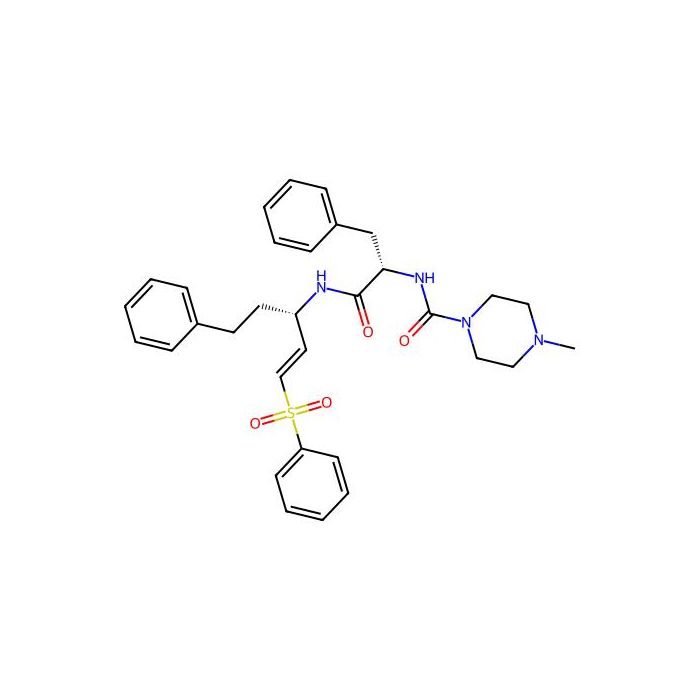
Determine the necessary mass, volume, or concentration for preparing a solution.
| Activity Type | Activity Value -log(M) | Mechanism of Action | Activity Reference | Publications (PubMed IDs) |
|---|

10mM in DMSO for sensitive chromatographic and analytical workflows requiring minimal baseline interference.
Store at -80°C Ships Dry ice packs + Cold packs Check lot-specific COA for exact specifications.
SDS, COA, datasheet, and spec sheet available for download. Lot-specific COA accessible via lot number lookup.
Cited in 0 peer-reviewed publications across chromatography, organic synthesis, and cross-coupling reactions.
K777 is a potent, orally active and irreversible cysteine protease inhibitor. K777 is also a potent CYP3A4 inhibitor with an IC 50 of 60 nM and a selective CCR4 antagonist featuring the potent chemotaxis inhibition. K777 irreversibly inhibits Cruzain, the major cysteine protease of Trypansoma cruzi , and cathepsins B and L . K777 is a broad-spectrum antiviral by targeting cathepsin-mediated cell entry. K777 inhibits SARS-CoV and EBOV pseudovirus entry with IC 50 values of 0.68 nM and 0.87 nM, respectively
In Vitro
K777 (K11777) can inhibit entry driven by other viral envelope proteins, including HIV-based pseudotypes bearing spikes from coronaviruses (SARS-CoV, HCoV-229E, NL63, MERS-CoV) or glycoproteins from filoviruses (EBOV, SUDV, TAFV, RESTV, BEBOV and MARV). K777 inhibits SARS-CoV, HCoV-229E, NL63, MERS-CoV, EBOV, SUDV, TAFV, RESTV, BEBOV, MARV and Nipah pseudovirus entry with IC 50 values of 0.68 nM, 1.48 nM, 6.78 nM, 46.12 nM, 0.87 nM, 1.14 nM, 2.26 nM, 3.37 nM, 5.91 nM, 1.9 nM and 0.42 nM, respectively. In contrast, 100 nM K777 does not inhibit infection mediated by envelope glycoproteins from an alphavirus (CHIKV), a rhabdovirus (VSV), a flavivirus (HCV), the retroviruses MLV-A and XMRV or two arenaviruses, Lassa and Junin virus. K777 alone demonstrates up to ~ 70% inhibition of 229E-S-mediated transduction. Simultaneous treatment with Camostat and K777 increases inhibition to ~ 90%. Similar inhibition patterns are obtained using the human intestinal epithelial cell line Caco-2, which express endogenous TMPRSS2 and cathepsins. K777 inhibits both CCL17 binding and CCL17-induced chemotaxis in Hut78 cells (IC 50 of 57 and 8.9 nM, respectively). The K777-mediated inhibition of chemotaxis is potent even in the presence of a 10-fold higher concentration of CCL17. K777 induces CCR4 internalization, with a ~50% reduction of cell surface CCR4. K777 does not inhibit CXCR4-induced chemotaxis or internalization and did not bring about Ca 2+ mobilization by itself. MCE has not independently confirmed the accuracy of these methods. They are for reference only.
In Vivo
K777 (K11777; 35-105 mg/kg; oral administration; twice a day; for 10 days; C57BL/6 IFN-γR-KO mice) treatment rescues mice from otherwise lethal infections. MCE has not independently confirmed the accuracy of these methods. They are for reference only. Animal Model: C57BL/6 IFN-γR-KO mice (6-8 weeks of age) injected with Cryptosporidium parvumDosage: 35 mg/kg, 70 mg/kg, and 105 mg/kg Administration: Oral administration; twice a day; for 10 days Result: Rescued mice from otherwise lethal infections.
IC50& Target:CCR4 CYP3
| Isomères SMILES | CN1CCN(CC1)C(=O)N[C@@H](CC2=CC=CC=C2)C(=O)N[C@@H](CCC3=CC=CC=C3)/C=C/S(=O)(=O)C4=CC=CC=C4 |
|---|---|
| CAS alternatif | 502960-90-9 |
| PubChem CID | 9851116 |
| Termes d'entrée MeSH | 4-methyl-N-((S)-1-oxo-3-phenyl-1-(((S)-1-phenyl-5- (phenylsulfonyl)pentan-3-yl)amino)propan-2-yl)piperazine-1-carboxamide;4-methylpiperazine-1-carboxylic acid(1-((3-benzenesufonyl-1-phenethylallyl)carbamoyl)-2-phenylethyl)amide;APC 3316;APC-3316;APC3316;C |
| Poids moléculaire | 574.73 |
Comprehensive hazard, handling, storage, and regulatory compliance document.
Download SDS →Lot-specific quality data. Enter your lot number to retrieve the exact COA.
Look up COA →Full quality attributes and acceptance criteria for this grade.
View spec sheet →| Activity Type | Activity Value -log(M) | Mechanism of Action | Activity Reference | Publications (PubMed IDs) |
|---|
| Activity Type | Activity Value -log(M) | Mechanism of Action | Activity Reference | Publications (PubMed IDs) |
|---|
| Activity Type | Activity Value -log(M) | Mechanism of Action | Activity Reference | Publications (PubMed IDs) |
|---|