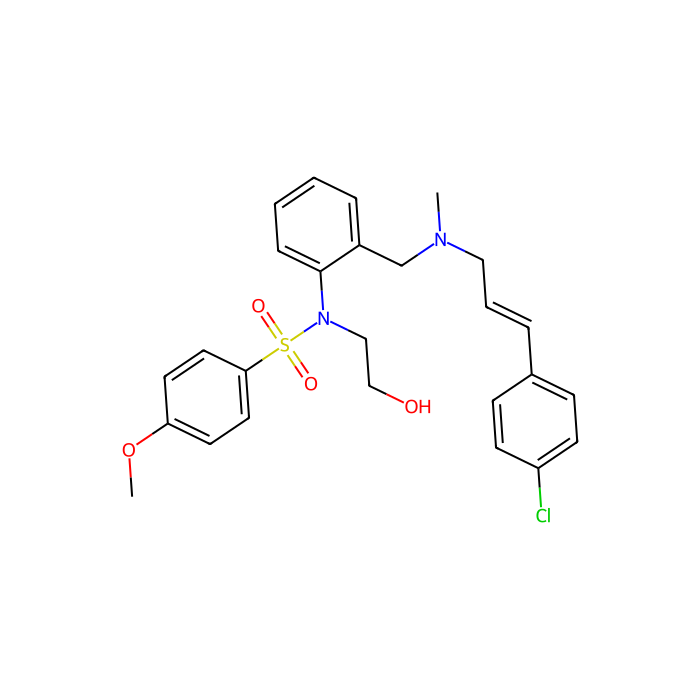
KN-93 - Moligand™, 10mM in DMSO , Inhibitor of calcium/calmodulin-dependent protein kinase II alpha subunit, CAS No.139298-40-1, Inhibitor of calcium/calmodulin-dependent protein kinase II alpha subunit

CAS: 139298-40-1 Cat. No.: K421478 Formule: C26H29ClN2O4S Poids moléculaire: 599.03
DISPONIBLE À COMMANDE
GRADE & PURITY Moligand™ ? Moligand™ — Aladdin's line of ligands and bioactive small molecules. Use for receptor, pathway, and binding studies needing defined small-molecule tools. 10mM in DMSO
Synonyms
AMY3402 | (2-[N -(2-hydroxyethyl)]-N -(4-methoxybenzenesulfonyl)]amino-N -(4-chlorocinnamyl)-N -methylbenzylamine) | AKOS015994570 | BCP9000817 | J-007263 | NCGC00162399-02 | SCHEMBL14569460 | N-[2-({[(2E)-3-(4-chlorophenyl)prop-2-en-1-yl](methyl)amino}me
Storage
Store at -80°C
Shipped In
Dry ice packs + Cold packs
★
Size
USA
Allemagne (EU)*
Price
Qty
1ml
K421478-1ml
2 En stock
—

164,90$US

241,90$US
Enregistrer 77,00 $US (31.83%)
Enter a quantity for the sizes you want to add.
🧪
Why this grade

Moligand™, 10mM in DMSO Moligand™ for sensitive chromatographic and analytical workflows requiring minimal baseline interference.

🌡

Storage & shipping

Store at -80°C Ships Dry ice packs + Cold packs Check lot-specific COA for exact specifications.

📋

Quality documents

SDS, COA, datasheet, and spec sheet available for download. Lot-specific COA accessible via lot number lookup.

📚

Literature proof

Cited in 2 peer-reviewed publications across chromatography, organic synthesis, and cross-coupling reactions.

Vue d’ensemble

KN-93 is a selective inhibitor of Ca2+/calmodulin-dependent kinase II (CaMKII), competitively blocking CaM binding to the kinase (Ki = 370 nM).
An effective inhibitor of CaMKII phosphorylating activity

Specifications

Synonymes
AMY3402 | (2-[N -(2-hydroxyethyl)]-N -(4-methoxybenzenesulfonyl)]amino-N -(4-chlorocinnamyl)-N -methylbenzylamine) | AKOS015994570 | BCP9000817 | J-007263 | NCGC00162399-02 | SCHEMBL14569460 | N-[2-({[(2E)-3-(4-chlorophenyl)prop-2-en-1-yl](methyl)amino}me
Spécifications et pureté
Moligand™, 10mM in DMSO
Mécanismes biochimiques et physiologiques
KN-93 is a selective inhibitor of Ca2+/calmodulin-dependent kinase II (CaMKII), competitively blocking CaM binding to the kinase (Ki = 370 nM). KN-93 inhibits histamine-induced aminopyrine uptake in parietal cells (IC50 = 300 nM). KN-93 has been used to i
Conditions de stockage de stockage
Store at -80°C
Expédié en
Dry ice packs + Cold packs
Ce produit nécessite l'expédition en chaîne froide. Les services terrestres et autres services économiques ne sont pas disponibles.
Grade
Moligand™
Type d'action
INHIBITOR
Mécanisme d'action
Inhibitor of calcium/calmodulin-dependent protein kinase II alpha subunit
Noms et identifiants
Isomères SMILES
CN(C/C=C/C1=CC=C(C=C1)Cl)CC2=CC=CC=C2N(CCO)S(=O)(=O)C3=CC=C(C=C3)OC
WGK Allemagne
3
Poids moléculaire
599.03
Reaxy-Rn
8357363
Reaxys-RN_link_address
https://www.reaxys.com/reaxys/secured/hopinto.do?context=S&query=IDE.XRN=8357363&ln=

Documentation

📋 Safety Data Sheet (SDS)

Comprehensive hazard, handling, storage, and regulatory compliance document.

Download SDS →

✅ Certificate of Analysis (COA)

Lot-specific quality data. Enter your lot number to retrieve the exact COA.

Look up COA →

📊 Datasheet

Quick-reference summary of product specifications and applications.

View datasheet →

🔬 Specification Sheet

Full quality attributes and acceptance criteria for this grade.

View spec sheet →

Advanced Data

Cibles associées (humaines)
CAMK2A Tchem Calcium/calmodulin-dependent protein kinase type II subunit alpha (1 Activities)
Activity TypeActivity Value -log(M)Mechanism of ActionActivity ReferencePublications (PubMed IDs)
Certificats (CoA, COO, BSE/TSE et tableau d'analyse)
C of A & Other Certificates(BSE/TSE, COO):
Analytical Chart:
Propriétés chimiques et physiques
SensibilitéHeat Sensitive
Indice de réfraction1.63
Point d'ébullition (°C)657.60° C at 760 mmHg
Citations of This Product
Calculateurs de solution
Avis

Avis des clients

Application Protocols

General guidance for handling bioactive small molecules in screening and assay workflows. Item-specific potency/solubility is not provided; adjust to your assay’s needs.

  • Stock preparation:
    • Equilibrate the vial to room temperature in a desiccator after removal from −80°C to prevent condensation. Briefly spin down contents.
    • Prepare a concentrated stock in anhydrous DMSO (e.g., 10–50 mM). Vortex and, if needed, sonicate briefly to fully dissolve. Record the exact concentration and lot.
  • Working solutions and dosing:
    • Perform serial dilutions in DMSO (e.g., 3-fold, 10-point) to build a dilution series. Back-dilute into assay buffer or cell culture media to the desired final concentrations, keeping final DMSO typically ≤0.1–0.5% v/v (verify assay tolerance).
    • Mix thoroughly to avoid local supersaturation; pre-warm media if precipitation is observed. Use low-retention tips/plates.
  • Controls:
    • Include vehicle controls matched for DMSO content, and where possible, a negative control compound of related scaffold.
    • For fluorescence- or absorbance-based assays, run counter-screens to identify compound interference.
  • Plate management:
    • Store master stocks at −80°C in single-use aliquots to avoid freeze–thaw. For working plates, seal with moisture/solvent-barrier films and minimize time at ambient temperature.
  • Documentation: Capture lot number, preparation date, solvent, and concentration in your ELN for reproducibility.
Biological Roles

This product is offered as a research-only, bioactive small molecule within the Moligand™ collection. Item-specific biological targets, pathways, or mechanisms of action are not provided in the current product data.

  • Target specificity and MOA: Not specified for this item; refer to primary literature for “KN-93” and confirm applicability to this specific catalog lot via CoA/SDS before drawing conclusions in your study design.
  • Typical research usage (general):
    • Employed as a chemical probe or reference compound in biochemical and cellular assays to perturb specific signaling pathways and quantify phenotypic responses.
    • Utilized in structure–activity relationship (SAR) comparisons alongside inactive or related analogs to assess on-target vs off-target effects.
  • Experimental considerations:
    • Validate activity in your system with appropriate controls (vehicle, unrelated probe, and where possible, a structurally related negative control).
    • Assess concentration–response behavior (10-point, 3-fold dilutions are common) and monitor for assay interference (fluorescence quenching, aggregation). Include counter-screens to deconvolute artifacts.

For research use only. No clinical or diagnostic use is intended or implied.

Buffer Applications

This product is a bioactive small molecule, not a buffering agent. It does not form classical buffer systems.

  • Practical note: When dosing into aqueous buffers or media, maintain a low final concentration of organic co-solvent (commonly ≤0.1–0.5% v/v DMSO) and verify compound stability in the chosen buffer over the assay time. Consider adding carrier proteins (e.g., 0.1% BSA) or mild detergents to mitigate nonspecific adsorption and precipitation where compatible with the assay.
Green Alternatives

Green chemistry considerations are generally not applicable to KN-93 as a specialized bioactive probe used at micromolar or lower concentrations rather than bulk process chemicals.

  • Practical tips to reduce environmental impact in screening workflows:
    • Minimize DMSO volumes by preparing concentrated stocks and using low-dead-volume dispensing.
    • Consolidate waste streams (DMSO-containing aqueous waste vs neat organic) to facilitate appropriate disposal.
    • Use sealed, low-evaporation plates to reduce solvent losses and repeat dispensing.

Because the compound is not a solvent or reagent with greener drop-in replacements, selection of “green alternatives” is more about operational practices (miniaturization, right-first-time design, and waste minimization) than substituting the molecule itself.

Pharmaceutical Uses

This material is supplied strictly for research use and is not manufactured under GMP for human or veterinary applications.

  • Typical research/formulation roles:
    • Reference standard or tool compound in preclinical research and assay development.
    • Stock solutions for in vitro studies (DMSO concentrates) and exploratory in vivo research in accordance with institutional approvals.
  • Pharmacopeial status: Not specified for this item; refer to CoA/Spec Sheet.
  • Excipients/vehicle guidance (research context only): If formulation is required for experimental dosing, select vehicles based on compound solubility and stability data (e.g., DMSO, PEG400, aqueous surfactant systems). Confirm compatibility independently; no item-specific formulation is provided here.
Physical Properties

Item-specific physicochemical specifications are not provided in the product data. For rigorous experimental planning, consult the CoA or SDS.

  • Appearance: Not specified for this item; refer to CoA/Spec Sheet.
  • Melting point, boiling point, density, refractive index: Not specified for this item; refer to CoA/Spec Sheet.
  • Solubility: Not specified for this item; refer to CoA/Spec Sheet. In practice with bioactive small molecules, initial dissolution is commonly performed in anhydrous DMSO to prepare concentrated stocks (see Application Protocols), then diluted into aqueous assay buffers with appropriate co-solvent control.
  • LogP, pKa: Not specified for this item; refer to CoA/Spec Sheet.

Notes for users (general/literature practice):

  • Many kinase-targeted tool compounds are moderately lipophilic and show limited aqueous solubility in the absence of organic co-solvent. Pre-warming DMSO (room temperature), brief vortexing, and sonication often assist dissolution.
  • Upon aqueous dilution, avoid exceeding compound solubility to prevent precipitation at the point of mixing; maintain a final DMSO content typically ≤0.1–0.5% v/v for sensitive biochemical assays (adjust per assay tolerance).
Quality and Grades
  • Grade: Moligand™
    • Moligand™ denotes a bioactive, screening-ready small molecule suitable for chemical biology, target validation, and assay development workflows. The focus is on identity and suitability for research applications rather than chromatographic solvent specifications.
    • This grade is intended for research use only and is not a GMP/clinical grade.

What this means for your work:

  • Identity/traceability: Supplied with catalog identifiers (SKU K421478, CAS 139298-40-1). For detailed identity confirmation (e.g., HPLC/LC–MS purity, NMR), consult the lot-specific CoA when available.
  • Purity: Not specified for this item; refer to CoA/Spec Sheet.
  • Stabilizers/additives: Not specified for this item; refer to CoA/Spec Sheet.
  • UV cutoff/absorptivity: Not specified for this item; refer to CoA/Spec Sheet.

Practical guidance:

  • For quantitative biology or SAR work, verify purity and identity with the provided CoA or by in-house QC (e.g., LC–MS). If conducting sensitive biophysical assays, pre-test for aggregation or interference (e.g., detergent screens, DLS, or counter-screens).
  • Record lot numbers in ELNs to ensure reproducibility across experiments.
Reaction and Applications

This catalog item is supplied as a bioactive small molecule for research use, not primarily as a synthetic reagent. Consequently, it is not typically employed as a solvent, catalyst, or building block in preparative organic reactions.

  • Applicable uses (research context):
    • Inclusion in small-molecule libraries for high-throughput screening, probe-validation experiments, and mechanistic studies in vitro or in cells.
    • Benchmarking assays as a positive/negative control compound where appropriate to the user’s research design.

If you intend to derivatize or conjugate this molecule for chemical biology (e.g., biotinylation, fluorescent tagging), first confirm structural information, reactive handles, and stability from the CoA/SDS or primary literature for KN-93, then design suitable linkers and protection strategies. Without item-specific structure confirmation, no reaction guidance is provided here.

Reaction Conditions

Not applicable. This product is not intended as a reagent or catalyst for preparative synthetic chemistry in this catalog context.

  • If using KN-93 in assay contexts, see Application Protocols for guidance on preparing stock solutions, dilutions, and dosing into biochemical or cellular systems.
Safety and Handling
  • GHS classification, signal word, pictograms, H-statements: Not specified for this item; refer to SDS for authoritative hazard information.
  • General laboratory precautions (good practice for bioactive small molecules):
    • Wear appropriate PPE: lab coat, nitrile gloves, and safety glasses. Handle powders and DMSO concentrates in a fume hood to minimize inhalation and dermal exposure.
    • Avoid contact with skin and eyes; prevent aerosolization when opening vials, especially after shipment on dry ice (allow to equilibrate in a desiccator before opening to reduce condensation).
    • Use dedicated tools for micro-weighing; minimize exposure time of frozen materials at room temperature.
  • Incompatibilities: Strong oxidizers and strong acids/bases may degrade many organic small molecules; segregate accordingly. Avoid moisture ingress for hygroscopic or hydrolytically sensitive compounds (store tightly capped, desiccated).
  • First aid (overview; defer to SDS):
    • Inhalation: Move to fresh air; seek medical attention if symptoms occur.
    • Skin/eye contact: Rinse with copious water for at least 15 minutes; remove contaminated clothing; seek medical advice if irritation persists.
    • Ingestion: Rinse mouth; do not induce vomiting; seek medical attention.
  • Waste: Collect solutions and contaminated disposables as organic hazardous waste; follow institutional and local regulations.
  • For research use only. Not for human or veterinary use.
Solvent Selection

Given the use of KN-93 as a bioactive tool compound, solvent selection focuses on stock preparation and assay compatibility rather than chromatographic use.

  • Primary solvent for stocks (common practice):
    • Anhydrous DMSO is typically used to prepare 10–50 mM stocks for screening libraries due to broad solubilizing power and compatibility with most biochemical/cell-based assays at ≤0.1–0.5% v/v final DMSO.
  • Alternative co-solvents (if needed):
    • Ethanol or DMF can be used for initial dissolution when DMSO is insufficient; check assay tolerance and include vehicle controls.
    • Aqueous buffers often require a small fraction of organic cosolvent and the presence of carrier proteins (e.g., 0.1% BSA) or mild detergents (e.g., 0.01–0.05% Tween-20) to maintain solubility and reduce nonspecific binding; validate per assay.
  • Solubility: Not specified for this item; refer to CoA/Spec Sheet. Perform a small-scale solubility test at intended temperatures and buffer compositions.

Comparison and selection tips:

  • DMSO vs ethanol: DMSO maximizes solubility and is less volatile; ethanol can improve cell membrane delivery but is more volatile and may affect assays at lower percentages.
  • Buffer compatibility: Avoid phosphate buffers with high divalent cations if precipitation is observed upon dilution; pre-dilute the DMSO stock into warm media with vigorous mixing to minimize crash-out.
Storage and Reconstitution
  • Storage conditions (item-specific): Store at −80°C.
  • Shipping (item-specific): Shipped on dry ice packs + cold packs.

Best practices:

  • Upon receipt, inspect packaging integrity. Transfer immediately to −80°C storage. Allow vials to equilibrate to room temperature in a desiccator before opening to prevent moisture condensation.
  • Aliquoting:
    • If solid: Quickly subdivide into single-use portions under dry conditions. If solution: Prepare single-use DMSO aliquots (light-protect if the compound is reported as photosensitive in the SDS/literature; otherwise avoid prolonged light exposure as a precaution).
    • Avoid repeated freeze–thaw cycles; they can accelerate degradation and adsorption losses at low concentrations.
  • Reconstitution:
    • Solvent: Anhydrous DMSO is typically recommended for initial dissolution of bioactive small molecules. Solubility for KN-93 is not specified for this item; refer to CoA/Spec Sheet and verify experimentally.
    • Mix by vortexing; sonicate briefly if needed. Filter through a low-binding 0.2 µm PTFE syringe filter only if particulate persists and if mass recovery permits.
  • Stability:
    • Working solutions in aqueous media should be prepared fresh. For DMSO stocks, store tightly sealed at −80°C; minimize headspace to reduce moisture ingress. Monitor for discoloration or precipitation and discard if degradation is suspected.
  • For research use only.
Structure and Identity
  • Product name: KN-93 (small-molecule bioactive; member of Moligand™ collection)
  • CAS: 139298-40-1
  • CID: 5312122 (literature identifier)
  • Molecular formula: Not specified for this item; refer to CoA/Spec Sheet.
  • Molecular weight: Not specified for this item; refer to CoA/Spec Sheet.
  • InChIKey: Not specified for this item; refer to CoA/Spec Sheet.
  • SMILES: Not specified for this item; refer to CoA/Spec Sheet.
  • Structural features (general, literature): KN-93 is described in the literature as a drug-like, heteroatom-containing small molecule used as a biochemical probe. Exact functional groups and ring systems should be verified against the CoA/SDS for this specific lot.
  • 2D structure (verbal): Without a confirmed structure record for this specific catalog item, a definitive 2D description is not provided here. Please consult the certificate of analysis or SDS for authoritative structural identifiers for K421478.
Synthetic Utility

KN-93 is supplied as a finished bioactive small molecule rather than a functionalized building block. Consequently, it is not commonly used as a synthon in multistep organic synthesis.

  • If derivatization is desired (e.g., affinity probes, photoaffinity tags):
    • First obtain the exact structure and functional groups from the CoA or literature specific to KN-93.
    • Evaluate potential handles for modification, the risk of abolishing bioactivity upon tagging, and the need for linkers to preserve binding.
    • Consider parallel synthesis of close analogs to benchmark retained activity.

Absent verified structural details for this catalog item, no reaction schemes or named transformations are recommended here.

Target Specificity

Not specified for this item; refer to CoA/Spec Sheet. No antigen/epitope or biological target details are provided in the current product data for SKU K421478.

Need help choosing the grade?

Our grade selection guide covers purity, stabilizer status, and application suitability for all variants in our catalog.

View Moligand™ grade guide →

Shall we send you a message when we have discounts available?

Remind me later

Thank you! Please check your email inbox to confirm.

Oops! Notifications are disabled.