GRADE & PURITYMoligand™?Moligand™ — Aladdin's line of ligands and bioactive small molecules. Use for receptor, pathway, and binding studies needing defined small-molecule tools.≥97%
Moligand™, ≥97% Moligand™ for sensitive chromatographic and analytical workflows requiring minimal baseline interference.
🌡
Storage & shipping
Store at 2-8°C Ships Wet ice Check lot-specific COA for exact specifications.
📋
Quality documents
SDS, COA, datasheet, and spec sheet available for download. Lot-specific COA accessible via lot number lookup.
📚
Literature proof
Cited in 0 peer-reviewed publications across chromatography, organic synthesis, and cross-coupling reactions.
Vue d’ensemble
L-Cycloserine is an irreversible inhibitor of 3-ketodihydrosphingosine synthetase, which is the first enzyme of the sphingolipid pathway, and causes the synthesis of sphingolipids to decrease. In vitro studies demonstrated that L-cyloserine inhibits 3-ketodihydrosphingosine synthetase 100 times more than D-Cycloserine .Research regarding L-Cycloserine and its effect on the immune response suggest that L-Cycloserine increases the level of IL-4 producing helper T cells and suppress the adhesion molecules CD29 and CD98. L-Cycloserine also inhibits SPTLC (serine palmitoyltransferase (SPT)), and HIV-1 investigations in the CD4+ lymphoid cell line (CEM) have shown that L-Cycloserine can inhibit HIV-1 replication. An irreversible inhibitor of 3-ketodihydrosphingosine synthetase
Specifications
Synonymes
(S)-4-Aminoisoxazolidin-3-one | (S)-Cycloserine
Spécifications et pureté
Moligand™, ≥97%
Mécanismes biochimiques et physiologiques
Blocks sphingosine biosynthesis by inhibition of ketosphinganine synthetase. Cytotoxicity toward neuroblastoma and medulloblastoma cells mediated by suppression of ganglioside synthesis.
Conditions de stockage de stockage
Store at 2-8°C
Expédié en
Wet ice
Ce produit nécessite l'expédition en chaîne froide. Les services terrestres et autres services économiques ne sont pas disponibles.
This compound belongs to the class of organic compounds known as alpha amino acids and derivatives. These are amino acids in which the amino group is attached to the carbon atom immediately adjacent to the carboxylate group (alpha carbon), or a derivative thereof.
External Descriptors
4-amino-1,2-oxazolidin-3-one
1. Djoumbou Feunang Y, Eisner R, Knox C, Chepelev L, Hastings J, Owen G, Fahy E, Steinbeck C, Subramanian S, Bolton E, Greiner R, and Wishart DS. ClassyFire: Automated Chemical Classification With A Comprehensive, Computable Taxonomy. Journal of Cheminformatics, 2016, 8:61.
insoluble in EtOH; ≥42.9 mg/mL in H2O; ≥8.78 mg/mL in DMSO
Indice de réfraction
1.48
Point de fusion (°C)
146°C
Poids moléculaire
102.090 g/mol
XLogP3
-1.500
Hydrogen Bond Donor Count
2
Hydrogen Bond Acceptor Count
3
Rotatable Bond Count
0
Exact Mass
102.043 Da
Monoisotopic Mass
102.043 Da
Topological Polar Surface Area
64.400 Ų
Heavy Atom Count
7
Formal Charge
0
Complexity
92.900
Isotope Atom Count
0
Defined Atom Stereocenter Count
1
Undefined Atom Stereocenter Count
0
Defined Bond Stereocenter Count
0
Undefined Bond Stereocenter Count
0
The total count of all stereochemical bonds
0
Covalently-Bonded Unit Count
1
Calculateurs de solution
Molarity Calculator
Determine the necessary mass, volume, or concentration for preparing a solution.
Dilution Calculator
Determine the dilution needed to prepare a stock solution.
Reconstitution Calculator
Avis
Avis des clients
Application Protocols
No standardized, item-specific biological application protocols (e.g., WB, IHC, IF, FC) are provided for this small-molecule product.
General research-use protocols (guidance only):
Stock solution preparation: Dissolve in water or DMSO to 10–100 mM. For aqueous stocks, adjust pH if necessary to ensure full dissolution; filter-sterilize (0.22 µm) for cell-free enzymatic assays.
Storage of stocks: Aliquot and store at 2–8°C for short term or at −20°C for longer term; avoid repeated freeze–thaw by using single-use aliquots.
Assay addition: For DMSO stocks, limit final DMSO content (e.g., ≤1–2%) to minimize effects on assay components.
Integrity check: Confirm by LC–MS immediately before critical experiments.
Note: Parameters such as concentration, incubation time, and buffer composition are assay-specific and should be optimized empirically.
Biological Roles
Research context (non-clinical; literature):
Structural analog of D-alanine: Cycloserine’s five-membered oxazolidinone with a primary amine mimics an amino acid framework, enabling interrogation of enzymes in alanine metabolism and cell-wall-related biochemical pathways in vitro.
Enzyme interaction probes: Frequently used as a mechanistic/transition-state analog for pyridoxal 5′-phosphate (PLP)-dependent enzymes such as alanine racemase. L-cycloserine offers stereochemical complementarity for comparative binding/turnover studies relative to the D-enantiomer.
Neurochemical studies (in vitro): Cycloserine analogs have been used as tool compounds to study receptor modulation in receptor-binding assays; any such use must remain strictly in vitro and research-only.
Practical laboratory guidance:
Confirm enantiopurity prior to stereosensitive assays (chiral HPLC).
Prepare fresh aqueous stocks; consider stabilizing at neutral pH and cold temperatures to preserve the cyclic carbamate.
Verify chemical integrity by LC–MS or 1H NMR before time-course experiments.
Notes:
No medical, diagnostic, or therapeutic claims are made for this product. All uses are for laboratory research only.
Specific biological activity values (Ki, IC50, etc.) are assay- and preparation-dependent and should be determined empirically under your conditions.
Buffer Applications
This compound is not a buffer reagent. It lacks a defined, narrow pH buffering range and is not commonly used to prepare buffer systems.
Practical guidance:
When using L-cycloserine in biochemical assays, select an appropriate external buffer (e.g., phosphate, HEPES, MOPS) in the pH range 6.5–8.0 depending on the target enzyme/protein.
Adjust pH after dissolving the compound, as protonation of the amine can slightly shift solution pH.
Filter-sterilize assay buffers where needed and verify compound stability under the chosen buffer conditions by LC–MS.
Green Alternatives
Context: L-Cycloserine is a research probe/small-molecule library member rather than a solvent or process reagent; “green alternatives” are less about replacement solvents and more about greener handling and synthesis strategies.
Greener handling strategies (general):
Prefer aqueous media for stock and assay solutions where feasible to minimize reliance on high-boiling aprotic solvents.
If DMSO is required, use minimal volumes and prepare concentrated aliquots to reduce waste.
Employ room-temperature reactions for derivatization when possible; use catalytic coupling methods (e.g., organocatalytic or enzymatic ligations) to reduce reagent load.
Tradeoffs: potential stability concerns in water at extreme pH; solubility limits in lower-toxicity organics
Waste and safety:
Segregate nitrogen-containing organics for appropriate disposal.
Use microscale screening formats (96/384-well) to reduce overall chemical footprint.
Pharmaceutical Uses
This product is supplied strictly for research use only and is not intended for human or veterinary use, clinical applications, or for manufacturing of drug substances.
Research/formulation-related contexts (general):
Reference standard/control: L-cycloserine may be included in analytical methods development as a structural comparator to other amino-acid analogs (e.g., for chiral separation method development).
Preformulation screening: Solubility and stability profiling in various aqueous media can inform assay design and compound handling in discovery research.
Notes:
No pharmacopeial status, excipient role, or clinical formulation guidance is provided for this item. Any GMP- or clinical-grade requirements are out of scope for Moligand™ materials.
For regulated applications, obtain appropriate grade, documentation, and regulatory clearance; this Moligand™ item is not suitable for such uses.
Physical Properties
Item-specific specifications:
Appearance: Not specified for this item; refer to CoA/Spec Sheet.
Molecular weight (item-specific): Not specified for this item; refer to CoA/Spec Sheet.
Literature/general properties for L-/D-cycloserine (for context only; verify against CoA for this item):
Physical state: typically a crystalline solid; many sources report it as water-soluble (literature qualitative).
Solubility: freely soluble in water; sparingly soluble in many organic solvents (literature qualitative).
pKa: cycloserine bears a primary amine (basic) and a cyclic carbamate (weakly acidic); overall amphoteric behavior (literature qualitative).
Hygroscopicity: some reports note moderate hygroscopicity; handle in a dry environment to maintain accurate massing (literature qualitative).
Properties not specified for this item (consult CoA/Spec Sheet):
Melting point (onset/decomposition)
Boiling point
Density
LogP/logD
Refractive index
Water, residue on ignition/ash, heavy metals, UV cutoff, or related analytical limits
Practical notes:
Given its polar, zwitterion-capable structure, aqueous solutions are generally favored. If preparing solutions for screening, measure pH post-dissolution and adjust if needed to maintain stability and solubility.
Avoid prolonged heating during dissolution to minimize potential degradation of the cyclic carbamate (general guidance).
Quality and Grades
Grade/Purity: Moligand™ (as provided). The Moligand™ designation indicates the compound is intended for research screening and small-molecule library applications (e.g., target identification, SAR exploration, phenotypic screening). It emphasizes reliable identity and suitability for in vitro research, not for clinical or GMP use.
What this means in practice:
Identity confirmation: Typically supported by spectroscopic/analytical methods appropriate for small-molecule libraries (e.g., 1H NMR/LC–MS). For this specific item, consult the CoA/Spec Sheet for the actual test suite.
Purity reporting: Screening-grade materials often report HPLC/LC–MS purity. Exact purity for this item is Not specified for this item; refer to CoA/Spec Sheet.
Stabilizers/additives: None stated in the Product Data. If stabilizers or salts are present, they will be listed on the CoA/Spec Sheet.
UV suitability: For analytical/bioassay use, verify UV background from the CoA if using UV-based detection.
Selecting this grade:
Appropriate for discovery research, biochemical assays, and method development where high identity and consistent handling are critical.
Not intended for GMP manufacturing, clinical, or diagnostic use.
Documentation to request/use:
Current Certificate of Analysis (batch-specific)
Specification sheet for acceptance criteria (identity, purity, residual solvents if applicable)
SDS for hazard communication.
Reaction and Applications
Research/manufacturer application scope: listed as part of a small-molecule and compound library (Moligand™), appropriate for biochemical target screening, mechanistic enzymology, and chemical biology assays (research use only).
Chemical applications (general/literature):
Enzyme probe (in vitro): Cycloserine analogs are classic mechanistic probes for PLP-dependent enzymes involved in D-alanine metabolism (e.g., alanine racemase, D-Ala–D-Ala ligase). L-cycloserine provides a stereochemically defined comparator for binding/turnover studies (non-clinical use only).
Derivatization chemistry: The primary amine allows standard transformations (acylation, sulfonylation, carbamate/urea formation) for generating tagged or protected derivatives for affinity or imaging assays.
Ring-opening reactivity: The oxazolidin-2-one ring can undergo nucleophilic or hydrolytic opening under forcing basic/acidic conditions to furnish amino alcohol/urea-type products; conditions require care to preserve stereochemistry (literature/general).
Solid-phase conjugation: The amine can be coupled to activated esters (NHS carbonates/carboxylates) to immobilize the molecule on resins for pull-down or target fishing workflows.
Practical tips:
Maintain neutral to mildly acidic conditions during coupling to limit ring degradation; use fast, low-temperature acylations where possible.
For kinetic or binding assays, prepare fresh aqueous stocks, verify concentration by quantitative NMR or UV (if derivatized), and confirm integrity by LC–MS.
If comparing enantiomers, confirm enantiopurity by chiral HPLC prior to biological evaluation.
Reaction Conditions
General, literature-informed guidance (verify experimentally for your system):
Amide formation (on the primary amine):
Solvents: DMF, DCM/DMF mixtures, or aqueous-organic (e.g., buffered water/DMF)
Coupling: HATU/HBTU/EDC·HCl with base (DIPEA/Et3N) at 0–25°C; short reaction times (0.5–3 h) minimize ring degradation.
Workup: Aqueous quench and rapid purification; avoid strong base washes.
Carbamate/urea formation: Use chloroformates or isocyanates at 0–5°C; monitor closely to prevent overreaction.
Sulfonylation: Sulfonyl chlorides in pyridine or Et3N/DCM at 0–10°C; brief reaction windows.
Ring-opening (if desired):
Hydrolytic: Aqueous base (e.g., NaOH) at low temperature with careful monitoring; neutralize promptly, isolate under mild conditions.
Nucleophilic: Amines or alkoxides under controlled, dilute conditions; anticipate stereochemical consequences and potential racemization.
Assay stock preparation:
DMSO or water stocks at 10–100 mM; filter (0.22 µm) if necessary; store aliquots cold and protected from light.
Expected outcomes:
High conversions are typical for fast acylations on primary amines; yields depend on protecting-group strategy and stability during workup (no item-specific yields provided).
Quality control:
Confirm product by LC–MS and 1H/13C NMR; assess enantiopurity by chiral HPLC if stereochemistry is critical.
Safety and Handling
Authoritative safety information for this item is provided in the SDS; always consult the SDS before use.
GHS and hazard data for this catalog item:
Signal word: Not specified for this item; refer to SDS.
H-statements: Not specified for this item; refer to SDS.
GHS classification and pictograms: Not specified for this item; refer to SDS.
General laboratory safety guidance (literature/general):
Potential hazards: Cyclic carbamates and primary amines may cause irritation to skin, eyes, and respiratory tract. Cycloserine analogs are biologically active; avoid inhalation, ingestion, and skin contact.
PPE: wear lab coat, gloves (nitrile recommended), and splash-resistant eye protection. Handle powders in a fume hood or ventilated enclosure to avoid aerosolization.
Incompatibilities: Strong acids/bases may promote ring opening or degradation; strong oxidizers should be avoided. Minimize exposure to moisture if accurate weighing is needed.
First aid (summary; see SDS for details):
Inhalation: move to fresh air; seek medical attention if symptoms persist.
Skin contact: wash with soap and water; remove contaminated clothing.
Eye contact: rinse cautiously with water for several minutes; remove contact lenses if present and easy to do; seek medical attention if irritation continues.
Ingestion: rinse mouth; do not induce vomiting; seek medical advice.
Handling tips: Use dedicated tools for microgram–milligram library handling. Prepare fresh solutions when possible; label with preparation date and concentration. Dispose according to local regulations.
Solvent Selection
Compound type: polar, heterocyclic amino-acid analog (cyclic carbamate with a primary amine). It behaves as an amphoteric, hydrogen-bonding solute.
Practical solvent guidance (general/literature):
Aqueous media: Readily dissolves in water and buffered saline across a moderate pH range; check pH after dissolution. For assay stock solutions, water or aqueous buffers (pH 6–8) are typically preferred.
Protic organics: Methanol and ethanol can dissolve many mg/mL, though solubility may be lower than in water (qualitative literature).
Polar aprotics: DMSO is an excellent co-solvent for preparing concentrated stocks for screening; dilute into aqueous buffer immediately before use to minimize precipitation.
Nonpolar solvents (e.g., hexanes, toluene, CPME): Generally unsuitable due to high polarity and hydrogen-bonding character.
When to choose what:
High-concentration stocks for libraries: DMSO (analytical grade) at 10–100 mM, then aliquot and store cold; avoid repeated freeze–thaw.
Direct biochemical assays: Water or physiological buffers to avoid DMSO effects on targets/cells; filter-sterilize if necessary (0.22 µm).
Notes:
If pH adjustments are required, mild acid (e.g., HCl) can protonate the amine to increase solubility; mild base may risk ring opening over time—limit exposure and verify integrity by LC–MS.
For lyophilization from aqueous stocks, consider volatile counterions and confirm residual salt content by conductivity/ion chromatography if relevant.
Storage and Reconstitution
Item-specific conditions (from Product Data):
Storage: Store at 2–8°C
Shipped in: Wet ice
Additional practical guidance (general):
Container: Keep tightly closed in the original container with desiccant to minimize moisture uptake.
Light/moisture: Protect from moisture; store in a dry cabinet or desiccator within the 2–8°C range if available.
Reconstitution: For assay use, dissolve in water or DMSO to prepare stock solutions. Adjust pH only as needed and avoid strong base/acid to maintain ring integrity. Filter-sterilize (0.22 µm) for biochemical assays if required.
Aliquoting: Prepare single-use aliquots to avoid repeated freeze–thaw; label with concentration and date.
Short-term stability: At 2–8°C, solid material is typically stable when protected from moisture (verify by CoA for this item). Aqueous solutions are best prepared fresh or stored refrigerated and used within a few days; frozen aliquots (−20°C) extend lifetime.
Research use note: For research use only.
Structure and Identity
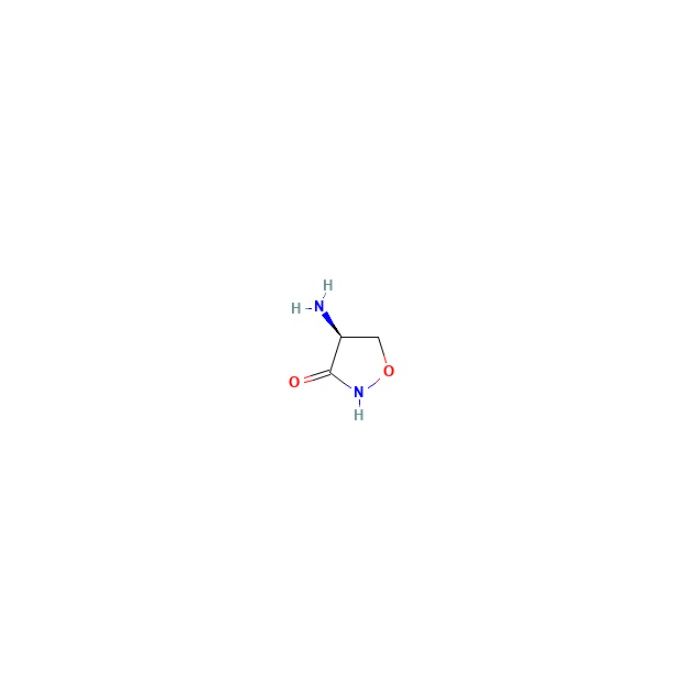
Brief overview: L-Cycloserine is the L-enantiomer of cycloserine, a small, heterocyclic amino-acid analog featuring an oxazolidin-2-one ring bearing a primary amino substituent. This item is supplied under Aladdin’s Moligand™ small-molecule library grade for research screening.
SKU: S136251
Product name: L-Cycloserine
CAS: 339-72-0 (literature association for L-cycloserine)
CID: 449215 (literature)
InChIKey: 75867 (as provided in Product Data)
SMILES: Not specified for this item; refer to CoA/Spec Sheet.
Molecular formula: Not specified for this item; refer to CoA/Spec Sheet.
Molecular weight: Not specified for this item; refer to CoA/Spec Sheet.
Structural features (general/literature description):
Core ring system: five-membered oxazolidin-2-one (a cyclic carbamate), containing one ring oxygen and one ring nitrogen.
Functional groups: a cyclic carbamate (urethan) and a primary amine at the 4-position of the ring (literature).
Stereochemistry: single stereocenter at the ring carbon bearing the amino group; this product corresponds to the L-configuration as designated in the listing (literature notes the D- and L-enantiomers are known for cycloserine).
2D description in words: a compact five-membered ring with a carbonyl at position 2 (C=O adjacent to ring nitrogen), an embedded O and N in the ring, and an exocyclic –NH2 substituent on the chiral carbon.
Notes:
Exact structural identifiers for this catalog item that are required for regulatory or analytical purposes should be taken from the item-specific CoA/Spec Sheet.
Synthetic Utility
Functional group overview:
Primary amine: amenable to acylation (acid chlorides/anhydrides/activated esters), sulfonylation, reductive amination (post-derivatization), and carbamate/urea formation.
Oxazolidin-2-one ring (cyclic carbamate): can participate in ring-opening under nucleophilic or hydrolytic conditions to yield amino alcohol or related derivatives; can also be preserved as a protecting/templating moiety in some transformations.
Applications (general/literature):
Probe derivatization: Install affinity tags (biotin/alkynes/azides) via amide linkages for chemoproteomics or pull-down experiments.
Chiral building block: As the L-enantiomer, it can serve as a starting point for enantioenriched small molecules after selective transformation at the amino-bearing stereocenter.
Conjugation to carriers: NHS-ester coupling to proteins/polymers for immobilization or assay development; control stoichiometry to avoid over-modification.
Select considerations:
Protecting-group strategy: If multi-step synthesis is planned, protect the amine (e.g., Boc/CBz) under conditions that do not compromise the cyclic carbamate; deprotect under mild conditions.
Stability: Avoid strong base or prolonged heating that can open the ring and racemize the stereocenter.
Analytics: Use chiral HPLC and LC–MS to monitor integrity and enantiomeric excess after key steps.
Target Specificity
No antibody or biological macromolecule target specificity is associated with this catalog item. It is a small-molecule research compound.
Antigen/epitope: Not applicable
Species reactivity/clone/isotype: Not applicable
For biochemical studies, users may examine interactions with enzymes of interest (e.g., PLP-dependent enzymes) strictly in vitro; however, no target specificity claims are made for this product.
Need help choosing the grade?
Our grade selection guide covers purity, stabilizer status, and application suitability for all variants in our catalog.
We use cookies to ensure the website functions properly and, where permitted, to improve your experience. You can manage your preferences at any time in Settings. Learn more in our Cookie Policy.
Shall we send you a message when we have discounts available?
Remind me later
Thank you! Please check your email inbox to confirm.
Products are supplied to verified businesses, institutions, and qualified professionals for research and development use only. Not for use in humans, animals, diagnosis, or therapy.

 K2429091