Methionine analogs that interfere with standard DNA methylation and other methylation pathways, leading to pancreatic toxicity and liver cancer. But in animal studies, it has also been shown to synchronize activity with methionine depletion to prevent methionine-dependent tumor growth and metastasis.
Conditions de stockage de stockage
Store at -20°C
Expédié en
Ice chest + Ice pads
Ce produit nécessite l'expédition en chaîne froide. Les services terrestres et autres services économiques ne sont pas disponibles.
This compound belongs to the class of organic compounds known as l-alpha-amino acids. These are alpha amino acids which have the L-configuration of the alpha-carbon atom.
External Descriptors
S-ethylhomocysteine
1. Djoumbou Feunang Y, Eisner R, Knox C, Chepelev L, Hastings J, Owen G, Fahy E, Steinbeck C, Subramanian S, Bolton E, Greiner R, and Wishart DS. ClassyFire: Automated Chemical Classification With A Comprehensive, Computable Taxonomy. Journal of Cheminformatics, 2016, 8:61.
Determine the necessary mass, volume, or concentration for preparing a solution.
Dilution Calculator
Determine the dilution needed to prepare a stock solution.
Reconstitution Calculator
Avis
Avis des clients
Application Protocols
No validated immunoassay protocols (e.g., WB, IHC, IF, FC) apply to this small-molecule reagent. For biochemical or synthetic uses:
Biochemical stock preparation (general):
Weigh the desired amount in a clean vessel.
Dissolve in sterile water or buffer (e.g., 10–100 mM). Adjust pH (2–3 with HCl or 8–9 with NaOH) to aid dissolution if needed.
Pass through a 0.22 µm filter for sterility. Store aliquots at −20 °C.
SPPS incorporation (general):
Use the appropriately protected derivative (e.g., Fmoc-L-ethionine). Follow standard coupling cycles (e.g., HBTU/HATU + DIPEA). Validate resin swelling and deprotection conditions are compatible with thioether stability.
These are literature-style general procedures. Optimize for your specific system and consult the CoA/Spec Sheet/SDS for product-specific constraints.
Biological Roles
Literature context (biochemistry; not medical claims):
L-Ethionine is a non-proteinogenic analog of L-methionine. In cellular systems, it can be metabolized to S-adenosyl-L-ethionine (SAE), which parallels S-adenosyl-L-methionine (SAM) as a methyl donor analog but often results in altered methyl transfer efficiencies and outcomes.
It may be misincorporated into nascent polypeptides by methionyl-tRNA synthetase in place of methionine, enabling studies on translational fidelity and the impact of side-chain modifications on protein folding and function.
Used to interrogate sulfur amino acid metabolism, trans-sulfuration pathways, and feedback regulation of methionine cycle enzymes.
Serves as a tool compound in epigenetics-related research to modulate or probe methylation-dependent processes via competition with methionine/SAM pathways.
Note: The above are general literature roles. This product is designated “For research use only” per product data.
Buffer Applications
L-Ethionine is not a standard biological buffer. While amino acids can exhibit buffering near their pKa values, L-ethionine is not typically used as a primary buffer system in analytical or cell culture workflows.
Practical guidance: If buffering is required, select established systems (phosphate, HEPES, MOPS, Tris) and dissolve L-ethionine in the chosen buffer at the assay-appropriate pH.
If using L-ethionine near its pKa values (literature: ~2.1 and ~9.1), limited buffering action is possible but is less effective and less conventional compared to dedicated buffering agents.
Green Alternatives
Greenness considerations for L-ethionine center on solvent choice and protecting-group strategy rather than the solid itself.
Prefer water or aqueous buffers for solution prep in biochemical studies, avoiding organic solvents where possible.
In peptide coupling, choose greener solvents (e.g., NBP/EtOAc mixtures) or water-compatible coupling systems where feasible, instead of DMF/DCM. Evaluate newer coupling reagents with improved EHS profiles.
Greener shift: NBP or 2-MeTHF for coupling/washing; reduced DMF; OxymaPure or COMU-type reagents; water-assisted couplings for fragments.
Trade-offs:
Greener solvents may affect resin swelling and coupling efficiency—method re-optimization is often required.
Water-based systems reduce VOCs but may necessitate altered protecting groups to maintain selectivity.
Alternative analogs:
If the goal is to probe sulfur amino acid chemistry with reduced hazard profiles, L-methionine is the natural counterpart with extensive safety data and similar handling characteristics (selection depends on experimental design, not on inherent "greenness").
Pharmaceutical Uses
This product is supplied for research use only. No clinical or therapeutic uses are claimed or supported.
Non-proteinogenic amino acids like L-ethionine are occasionally explored as process reagents, reference standards, or analytical spikes in development settings, but L-ethionine is not a common pharmaceutical excipient.
If used in preclinical research matrices, typical considerations include compatibility with aqueous vehicles, pH adjustment for solubility, and sterile filtration for parenteral-adjacent studies (research only).
Physical Properties
Item-specific physicochemical specifications (e.g., exact melting point, water content, metal limits) are not provided in the product data.
Literature/general reference values (for context; not product specifications):
Physical state: crystalline solid (typical for amino acids)
Melting point: often reported as decomposition in the ~260–280 °C range (literature, varies by source and form)
Acid–base properties: diprotic zwitterion
pKa1 (carboxyl): ~2.1–2.3 (literature)
pKa2 (amino): ~9.0–9.2 (literature)
Side chain: thioether is non-ionizable under aqueous conditions
Solubility: readily soluble in water and dilute aqueous acid/base; sparingly soluble in alcohols; practically insoluble in nonpolar solvents (literature, qualitative)
LogP: expected very low/negative (highly polar zwitterion; literature expectation)
Optical activity: L-configuration; specific rotation depends on solvent, concentration, and temperature (literature; not specified for this item).
Product-specific numeric properties (BP, density, refractive index, residual solvent, UV cutoff, etc.): Not specified for this item; refer to CoA/Spec Sheet.
Quality and Grades
Grade/Purity: Not specified for this item; refer to CoA/Spec Sheet for assay, chiral purity (enantiomeric excess), and contaminant profile.
Appearance: Not specified for this item; refer to CoA/Spec Sheet.
Context and expectations for this material type:
For amino acid reagents used in biochemical research and synthesis, key quality attributes typically include:
Identity confirmation (e.g., 1H/13C NMR, MS) and correct L-stereochemistry (optical rotation or chiral HPLC).
High assay (often ≥98% for research-grade solids; literature expectation, not a specification).
Low inorganic and organic impurities; controlled residual solvents.
Microbial/bioburden control if intended for sensitive biological workflows.
Stabilizers: None are typically required for dry amino acids; if any stabilizer or counter-ion is present, it will be disclosed on the CoA/Spec Sheet.
How to use grade information:
Chromatographic or peptide-synthesis applications may require tighter controls (e.g., heavy metals, water, and optical purity). Verify these on the item’s CoA/Spec Sheet prior to critical use.
Reaction and Applications
L-Ethionine is primarily used as a biochemical probe and as a chiral building block in synthesis.
Biochemical/analytical (literature):
Antimetabolite analog of L-methionine to study sulfur amino acid metabolism, methylation pathways, and translational incorporation fidelity (e.g., formation of S-adenosyl-L-ethionine in vitro).
Reference standard in chromatographic or electrophoretic amino acid profiling.
Synthetic chemistry:
Precursor to protected derivatives (Boc-/Fmoc-L-ethionine) for solid-phase peptide synthesis (SPPS); allows incorporation of a methionine analog into peptides/proteins to interrogate structure–function relationships.
Thioether side chain supports selective oxidations (to sulfoxide/sulfone) to modulate polarity and reactivity in target molecules.
Practical notes:
For SPPS, use orthogonal protection (e.g., Fmoc on the α-amine, tert-butyl-type on the acid), ensure the thioether tolerates chosen deprotection/oxidation steps.
For biochemical assays, prepare fresh aqueous stocks, filter-sterilize (0.22 µm) if sterility is required, and minimize prolonged exposure to strong oxidants (thioether oxidation).
Reaction Conditions
General literature guidance (not product-specific):
Peptide coupling with L-ethionine derivatives:
Typical solvents: DMF, NMP, or greener NBP/EtOAc mixtures. For solution-phase, DCM/DMF blends are common; water-compatible systems are possible with water-soluble coupling reagents.
Reagents/Bases: HATU or HBTU with DIPEA (2–4 equiv base relative to acid); or EDC·HCl with Oxyma/HOAt derivatives. Molar ratios: 1.0 (carboxy component):1.0–1.5 (amine):1.1–1.2 (coupling reagent) are typical starting points.
Temperature/Time: 20–25 °C, 30–120 min per coupling cycle in SPPS; monitor by Kaiser or chloranil tests.
Protection strategy:
α-Amine: Fmoc for base-labile, Boc for acid-labile workflows.
Carboxyl: methyl or benzyl esters for solution synthesis; tBu esters for acid-labile routes.
Side chain: thioether usually left unprotected; avoid strong oxidants and electrophiles that alkylate sulfur.
Oxidation to sulfoxide/sulfone:
Reagents: m-CPBA (≤1 equiv for sulfoxide; excess for sulfone) in DCM or MeOH at 0–25 °C; monitor to avoid over-oxidation.
Aqueous work:
Dissolve in water or buffer; adjust pH for solubility. Filter sterilize (0.22 µm) if required for biochemical assays. Prepare fresh stocks to minimize oxidative changes.
Yields and exact conditions depend on substrate and scale; consult primary literature and optimize experimentally.
Safety and Handling
GHS classification, signal word, hazard and precautionary statements: Not specified for this item; refer to SDS.
General hazards (literature/typical for amino acid analogs): May cause irritation to eyes, skin, and respiratory tract upon exposure to dust. Avoid inhalation of powders and contact with eyes/skin.
Personal protective equipment: Use laboratory coat, safety glasses, and appropriate chemical-resistant gloves. Handle powders in a fume hood or with local exhaust to minimize dust exposure.
Incompatibilities: Strong oxidizing agents (thioether group can be oxidized); strong acids/bases may cause degradation under forcing conditions.
First-aid overview (consult SDS for authoritative guidance):
Inhalation: Move to fresh air; seek medical attention if symptoms persist.
Skin contact: Wash with soap and water; remove contaminated clothing.
Eye contact: Rinse cautiously with water for several minutes; remove contacts if present and easy; seek medical attention if irritation continues.
Ingestion: Rinse mouth; seek medical advice.
Fire safety: Organic solid; use water spray, dry chemical, CO2, or foam as appropriate. Combustion may produce sulfur oxides and nitrogen oxides.
Spill/leak handling: Avoid dust formation; sweep up carefully and place in suitable container for disposal according to institutional and regulatory requirements.
Always defer to the product’s SDS for definitive safety, toxicological, and regulatory information.
Solvent Selection
As a zwitterionic amino acid, L-ethionine is polar and hydrophilic.
Primary solvents (literature):
Water: preferred; adjust pH to enhance dissolution (pH 2–3 or 8–9 can increase solubility by suppressing zwitterion pairing).
Aqueous buffers: phosphate, acetate, or HEPES, depending on downstream use.
Dilute acids/bases: 0.1 M HCl or NaOH for stock solutions followed by neutralization if necessary.
Limited solubility in: lower alcohols (MeOH, EtOH) and most aprotic organic solvents (ACN, THF, DCM); generally unsuitable for nonaqueous media unless converted to protected derivatives.
Selection tips:
For biochemical assays or cell-free enzyme systems, use deionized water or physiological buffers (verify compatibility with your assay pH and ionic strength).
For peptide coupling or organic synthesis, employ protected derivatives (e.g., Boc- or Fmoc-protected L-ethionine) which are soluble in DMF/DMSO/MeCN.
Comparison (general):
L-ethionine vs L-methionine: similar aqueous solubility behavior; L-ethionine’s thioether is slightly more hydrophobic due to the ethyl substituent, but overall solvation remains dominated by the zwitterionic backbone.
Storage and Reconstitution
Storage conditions (per product data): Store at −20 °C.
Shipping (per product data): Shipped in ice chest with ice pads.
Container: Keep tightly closed in a dry, inert container. Protect from moisture and strong oxidizers.
Stability: Amino acid solids are generally stable when dry and protected from light/oxidants. Avoid prolonged exposure to ambient humidity.
Reconstitution (general guidance):
Solvent: Use deionized water or appropriate buffer. Adjust pH to aid dissolution if necessary (slight acidification or basification).
Concentration: Prepare working stocks suitable for your application (e.g., 10–100 mM typical for biochemical studies). Exact limits are application-dependent.
Sterility: For biological assays, filter-sterilize through a 0.22 µm membrane.
Aliquoting: Prepare single-use aliquots to avoid repeated freeze–thaw cycles.
Storage of solutions: Store at −20 °C for short-to-medium term. For maximum consistency, prepare fresh before use and minimize exposure to air to limit thioether oxidation.
Item-specific limits (e.g., solution shelf life, allowable freeze–thaw cycles): Not specified for this item; refer to CoA/Spec Sheet.
Structure and Identity
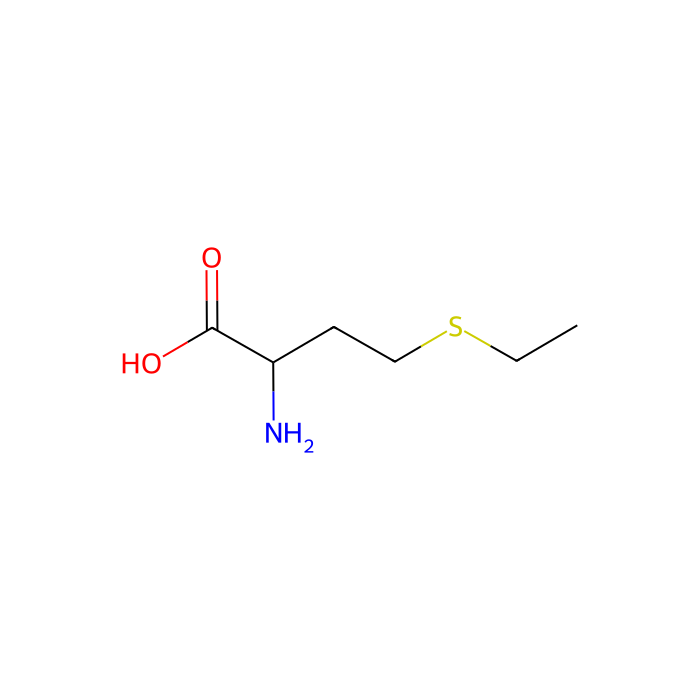
L-Ethionine is a sulfur-containing, non-proteinogenic amino acid and a homolog of L-methionine in which the sulfur substituent is ethyl rather than methyl.
CAS: 13073-35-3 (per product data)
CID: 25674 (literature)
IUPAC name (literature): (S)-2-amino-4-(ethylsulfanyl)butanoic acid
InChIKey: Not specified for this item; refer to CoA/Spec Sheet.
Structural features (literature-based description):
Contains a chiral α-carbon with L-configuration (S at the α center by CIP rules).
Functional groups: α-amino (–NH2/–NH3+), α-carboxylate (–COOH/–COO−), and a thioether side chain (–S–Et) extending via –CH2–CH2– from the α-carbon.
2D depiction (verbal): An α-amino acid backbone [NH2–CH(R)–COOH] where R = –CH2–CH2–S–CH2–CH3. No aromatic rings; one stereocenter at the α-carbon.
Note: Identity values labeled “literature” are general reference data and not product-specific specifications.
Synthetic Utility
As a chiral sulfur-containing amino acid, L-ethionine is a useful building block in both peptide chemistry and small-molecule synthesis.
Key reactivity (literature):
α-Amino acid manifold: amenable to standard N-protection (Boc, Fmoc, Cbz), carboxyl protection (methyl/benzyl esters), and peptide couplings (HATU, HBTU, EDCI, DIC/Oxyma).
Side-chain thioether: tolerates many conditions but can undergo selective oxidation to sulfoxide/sulfone, enabling polarity and conformational tuning in targets.
Chiral pool starting material: the L-stereocenter can be leveraged to impart asymmetry; transformations such as decarboxylative couplings or auxiliary-based strategies are possible with suitable protecting-group design.
Applications:
SPPS incorporation to create methionine-analog peptides for stability and function studies.
Preparation of labeled derivatives (e.g., isotopically 13C/15N-labeled) for NMR/MS tracer studies (general possibility; not a specification of this item).
Synthesis of S-adenosyl-L-ethionine analogs to probe methyltransferase mechanisms.
Target Specificity
Not applicable to this product type. L-Ethionine is a small-molecule amino acid analog, not an antibody or affinity reagent. No target/epitope specificity data apply.
Foire aux questions
What is the purity of this product?
This product is supplied at ≥99% purity (chemical assay). Lot-specific values are stated on the Certificate of Analysis.
How should this product be stored?
Store at ?20 °C. Freezer storage is required to maintain the specified shelf life.
How is this product shipped?
This product ships in an insulated container with ice pads. Unpack on arrival and transfer it to the storage condition stated above.
What are the CAS number, molecular formula and molecular weight?
The CAS Number is 13073-35-3, the molecular formula is C6H13NO2S, and the molecular weight is 163.24 g/mol. InChIKey GGLZPLKKBSSKCX-YFKPBYRVSA-N.
What documentation is provided?
Available product documentation, including Certificates of Analysis (COA), Safety Data Sheets (SDS), and specification sheets, is shown in the product document area. Document availability and access follow the current site policy.
Nous utilisons des cookies pour garantir le bon fonctionnement du site et, lorsque cela est autorisé, pour améliorer votre expérience. Vous pouvez gérer vos préférences à tout moment dans les Paramètres. Pour en savoir plus, consultez notre Politique relative aux cookies.
Souhaitez-vous que nous vous envoyions un message lorsque des réductions seront disponibles?
Me rappeler plus tard
Merci ! Veuillez vérifier votre boîte de réception e-mail pour confirmer.
Products are supplied to verified businesses, institutions, and qualified professionals for research and development use only. Not for use in humans, animals, diagnosis, or therapy.

 F2616032