QUALITÉ & PURETÉMoligand™?Moligand™ — Aladdin's line of ligands and bioactive small molecules. Use for receptor, pathway, and binding studies needing defined small-molecule tools.≥98 atom% D
L-Methionine-d3 is labelled L-Methionine, an essential amino acid for human development. Hepatoprotectant; antidote (acetominophen poisoning); urinary acidifier. A labled essential amino acid for human development.
This compound belongs to the class of organic compounds known as methionine and derivatives. These are compounds containing methionine or a derivative thereof resulting from reaction of methionine at the amino group or the carboxy group, or from the replacement of any hydrogen of glycine by a heteroatom.
External Descriptors
Not available
1. Djoumbou Feunang Y, Eisner R, Knox C, Chepelev L, Hastings J, Owen G, Fahy E, Steinbeck C, Subramanian S, Bolton E, Greiner R, and Wishart DS. ClassyFire: Automated Chemical Classification With A Comprehensive, Computable Taxonomy. Journal of Cheminformatics, 2016, 8:61.
Determine the necessary mass, volume, or concentration for preparing a solution.
Dilution Calculator
Determine the dilution needed to prepare a stock solution.
Reconstitution Calculator
Avis
Avis des clients
Application Protocols
Item-specific, tested application parameters are not provided for this SKU. Below are general, non-binding examples for research use (literature-based):
LC–MS internal standard (amino acid quantitation):
Prepare a 1 mg/mL stock in water or 0.1% formic acid. Serially dilute to working levels (e.g., 5–1000 ng/mL) in surrogate matrix. Spike at a constant concentration across calibrators and QCs.
Use reversed-phase LC with aqueous 0.1% FA and acetonitrile; monitor MRM transitions corresponding to +3 Da relative to unlabeled methionine. Assess and minimize in-source oxidation.
Formulate methionine-deficient medium and supplement with a defined ratio of unlabeled/labeled methionine (e.g., 0:100 for full labeling or mixed ratios for multiplexing). Optimize for viability and incorporation time (typically 1–3 cell doublings).
Confirm incorporation by LC–MS/MS of tryptic peptides containing methionine.
Peptide synthesis (SPPS concept):
Use Fmoc-L-Met(methyl-d3)-OH when available. Couple with HATU/DIPEA (2–5 equiv) for 5–20 min cycles. Protect from oxidation during synthesis and cleavage. Validate product mass with HRMS (expect +3 Da vs unlabeled sequence).
For validated, item-specific protocols and recommended conditions, refer to your method SOPs and the product’s CoA/SDS.
Biological Roles
General biology of methionine (literature; no clinical claims):
Essential amino acid: Precursor for protein biosynthesis; typically the initiating residue in eukaryotic translation.
Methyl donor pathway: Methionine is converted to S‑adenosyl-L-methionine (SAM), the universal biological methyl donor. In methyl-d3 methionine, the transferable methyl in SAM bears three deuteria, enabling tracing of methylation flux.
Transsulfuration and folate cycles: Involvement in the methionine cycle, homocysteine formation, and cysteine biosynthesis via transsulfuration (linked to one-carbon metabolism).
Redox chemistry: Sulfur in methionine can be reversibly oxidized to methionine sulfoxide in proteins, with implications for redox regulation; labeled methionine can assist in tracking these modifications by MS.
Isotope effects: The deuterium label is non-radioactive and biologically similar to 1H in most contexts; kinetic isotope effects are small for the non-exchangeable thioether methyl, making it suitable for metabolic incorporation and quantification.
Practical implications for research:
Use in SILAC/metabolic labeling to quantify proteome dynamics.
Application in epigenetics and methylome studies to monitor CD3 transfer to nucleic acids and proteins via SAM-dependent methyltransferases.
Serves as a mass tag to distinguish endogenous methionine-containing peptides and metabolites.
Buffer Applications
L‑Methionine-(methyl‑d3) is not a conventional buffering agent. Its acid–base functionality (one carboxyl and one amino group) can contribute to solution pH and buffering capacity near its pKa values, but it is not typically used to prepare defined laboratory buffers.
Practical note:
If dissolved in aqueous media, expect modest intrinsic buffering near pH ~2–3 and ~9–10 (literature pKa regions), but for controlled buffering choose standard systems (phosphate, HEPES, Tris, ammonium bicarbonate) compatible with your downstream method (e.g., LC–MS).
When used as an analytical standard, select a buffer that avoids adduct formation and suppresses oxidation (e.g., low concentrations of formic acid in water for LC–MS).
Green Alternatives
Because this product is a labeled amino acid rather than a volatile organic solvent or hazardous reagent, “green alternatives” focus on workflow design rather than substituting a different chemical.
Considerations and options (literature/general):
Aqueous systems: Favor water or aqueous buffers over organic-rich media for dissolution and handling.
Minimize hazardous additives: Use volatile, MS-compatible acids/bases (e.g., formic acid, ammonium bicarbonate) instead of persistent salts.
Alternative labels: For some proteomics/metabolomics experiments, 13C/15N uniform labeling can be greener from a waste and safety perspective (non-exchangeable heavy isotopes, no special handling), while still giving robust mass shifts; however, they change mass by larger increments and may affect peptide spacing differently than +3 Da S‑methyl labeling.
Process efficiency: Prepare concentrated stocks to reduce container waste; employ microvolumetric dispensing to minimize overage.
Tradeoffs:
Cost vs. performance: Deuterated reagents may be more cost-effective per Dalton shift than multi-atom labels, but 2H can slightly alter retention times in LC due to isotope effects; 13C/15N labels avoid this but at higher cost and different mass spacing.
Data analysis: Choose labels aligned with software and libraries to reduce computational overhead and reprocessing.
Pharmaceutical Uses
This product is intended for research use only (per Product Data) and is not formulated as an excipient or active ingredient.
Bioanalytical internal standard: Used to quantitate methionine in biological matrices by LC–MS/MS during nonclinical method development and validation (e.g., following regulatory guidance for internal standards).
Process development tools: Isotopically labeled amino acids can support metabolism studies, impurity tracing, and mechanistic investigations during upstream media development.
Pharmacopeial/compendial status: Not specified for this item; refer to CoA/Spec Sheet. No therapeutic claims are made.
Physical Properties
Item-specific specs: Not specified for this item; refer to CoA/Spec Sheet.
Literature/general properties for L-methionine and isotopologues (for reference only; deuteration of the S‑methyl has negligible effect on bulk constants):
Physical state: White to off-white crystalline solid (literature, L-methionine)
Melting point: ~281–285 °C (decomp., literature for L-methionine)
pKa values (25 °C, water, literature): pKa1 (–CO2H) ≈ 2.1; pKa2 (–NH3+) ≈ 9.1–9.3; side chain thioether non-ionizable under physiological pH.
Isoelectric point (pI, literature): ~5.7–5.8
LogP (literature, neutral form): Methionine is overall hydrophilic; reported cLogP for neutral form is low/negative; exact value varies by method.
Solubility (qualitative, literature): Freely soluble in water; sparingly soluble in alcohols; practically insoluble in nonpolar solvents.
Optical activity: L configuration; specific rotation values for L-methionine are reported in literature but vary with solvent, concentration, and temperature.
Notes:
Where precise numerical values are required for this SKU (e.g., solubility in a specified solvent, UV cutoff, refractive index), consult the item’s CoA/Spec Sheet. Deuteration at the sulfur-methyl group mainly affects mass (for MS/NMR) and does not materially change acid–base equilibria or general solubility relative to unlabeled L-methionine.
Quality and Grades
Item-specific grade: Moligand™ (as provided in Product Data). Detailed grade specifications (e.g., chemical purity %, chiral purity ee/er, isotopic enrichment, residual solvents, metals, bioburden) are Not specified for this item; refer to CoA/Spec Sheet.
Interpreting grade information for stable-isotope amino acids (general guidance):
Chemical purity vs isotopic enrichment: For quantitative MS applications, high isotopic enrichment at the labeled position(s) and low isobaric impurities are as critical as overall chemical purity.
Chirality: L-configuration is essential for biochemical incorporation. Verify ee/er on CoA, particularly for peptide synthesis or metabolic labeling.
Residual water/inorganics: Moisture content can impact precise weighing for isotope-dilution standards; consult Karl Fischer/LOD on CoA when available.
Trace metals/UV profile: Typically not limiting for amino acids, but relevant for certain catalyzed syntheses or UV-detection methods; check CoA if required.
Stabilizers/inhibitors: Not specified for this item; refer to CoA/Spec Sheet.
What this means practically:
For proteomics, metabolomics, or tracer studies, request and retain the CoA to document isotopic enrichment (e.g., %D at the S‑methyl) and optical purity.
For peptide synthesis, confirm identity by HRMS (showing +3 Da vs unlabeled), and, if critical, chiral HPLC and NMR.
Reaction and Applications
This isotopically labeled amino acid is primarily used as a tracer/standard rather than as a conventional synthetic reagent.
Analytical and biochemical applications (literature):
Stable isotope internal standard (LC–MS/GC–MS): Provides a +3 Da mass shift relative to unlabeled methionine for accurate quantification in metabolomics and bioanalytical assays.
Tracer for methyl group transfer: The S‑methyl of methionine becomes the transferable methyl in S‑adenosyl-L-methionine (SAM). Using methyl‑d3 methionine enables tracking of CD3 transfer in SAM-dependent methylation pathways (DNA/RNA/protein/lipid methylation) by MS.
SILAC and metabolic labeling: Can be incorporated into proteins in cell culture to tag methionine residues with a defined mass shift; consider medium formulation and competition with endogenous methionine.
NMR reference: Deuterium label simplifies 1H spectra around the thioether methyl and can provide confirmatory signatures in 2H NMR.
Practical tips:
Maintain isotopic integrity: Avoid dilution with unlabeled methionine; ensure media and reagents are isotopically controlled as needed.
Oxidation control: Include antioxidants or handle under inert atmosphere when necessary to prevent formation of methionine sulfoxide/sulfone, which complicates MS profiles.
Calibration: For quantitative work, prepare gravimetrically in clean glassware; verify concentration by amino acid analysis or quantitative NMR when possible.
Synthetic note:
Serves as a building block for labeled peptides; if coupling as free amino acid, activate via standard peptide coupling reagents (e.g., HATU/HBTU/EDC) under conditions that preserve the L-stereocenter.
Reaction Conditions
General guidance from literature for handling and using amino acids in synthesis and analysis (not item-specific specifications):
Activators/bases: HATU/HBTU/DIC/EDC with DIPEA or collidine; temperatures 0–25 °C for activation/coupling, often short times (5–60 min) to minimize racemization.
Protection: Use Fmoc for SPPS (base-labile) or Boc (acid-labile); take care to avoid over-oxidation of thioether during deprotection or cleavage.
Analytical sample prep (LC–MS):
Stocks: 1–10 mg/mL in water or 0.1% formic acid; store cold and protected from light/air to limit oxidation. Filter (0.2 µm) if needed.
Mobile phases: A: water + 0.1% FA; B: acetonitrile or methanol + 0.1% FA. Monitor for methionine sulfoxide formation.
Derivatization (GC–MS or chiral analysis):
Esterification/amide formation: Use anhydrous conditions with mild acids/bases to avoid racemization.
Oxidation sensitivity: If oxidation is desired (to sulfoxide) as a marker, control stoichiometry and temperature; otherwise exclude oxidants.
Yields/timeframes: Dependent on substrate and protection strategy; peptide couplings typically proceed in minutes to hours with high conversions under standard SPPS protocols (literature).
Safety and Handling
GHS/Classification (item-specific): Not specified for this item; refer to SDS.
Signal word / H-statements / Pictograms: Not specified for this item; refer to SDS.
General handling (amino acids, literature/good practice):
PPE: Wear lab coat, safety glasses, and appropriate gloves. Avoid generation of dust; use local exhaust when weighing to prevent aerosolization.
Incompatibilities: Strong oxidizers may react with sulfur-containing amino acids. Avoid strong acids/bases for extended periods if racemization or decomposition is a concern in solution.
Thermal stability: Amino acids can decompose on strong heating; dry powders should be handled away from ignition sources even though they are typically non-volatile.
First aid (overview): If inhaled, move to fresh air; if on skin/eyes, rinse with water for several minutes; if ingested, rinse mouth. Seek medical attention according to SDS guidance.
Special risks pertinent to this compound class:
Deuterium label integrity: Chemical exchanges do not typically remove deuterium from a thioether methyl; however, avoid harsh conditions that could induce side-chain oxidation/cleavage.
Dust control and cleanliness for isotope work: To minimize cross-contamination in isotope-dilution or SILAC-type workflows, dedicate tools and clean balances/benches before use.
Always consult the official SDS for authoritative hazard, exposure limits, spill/accident response, and disposal instructions.
Solvent Selection
Amino acids are zwitterionic near neutral pH and require polar media for dissolution.
General miscibility/solubility profile (literature):
Water: Freely soluble; rate and extent improve with gentle warming and pH adjustment (e.g., to ~pH 2–3 or 8–9 to increase solubility via full ionization).
Aqueous buffers: Phosphate, HEPES, ammonium bicarbonate commonly used for MS workflows. Maintain ionic strength compatible with downstream analysis.
Alcohols (MeOH/EtOH): Sparingly soluble; often used only as co-solvents in small percentages.
Polar aprotics (DMSO, DMF): Can dissolve at modest concentrations; dilute into water/buffer immediately for bio-related applications.
For MS internal standards: Prepare concentrated stocks in water or 0.1% formic acid, then dilute into mobile phase to minimize adsorption.
For peptide coupling: If using as free amino acid, pre-form salts (e.g., HCl) to aid dissolution in DMF/NMP; otherwise use protected derivatives (e.g., Fmoc-L-Met(methyl-d3)-OH) tailored for SPPS solvents.
pH considerations: Keep close to target application pH; avoid prolonged exposure to strong oxidants that could modify the thioether.
Dielectric constant/logP: Not specified for this item; refer to CoA/Spec Sheet. Literature values for unlabeled L-methionine reflect high polarity and low organic solubility.
Storage and Reconstitution
Item-specific storage (from Product Data):
Storage Conditions: Protected from light; Room temperature
Shipped In: Normal
Stability notes (general):
Solid amino acids are typically stable at ambient temperature when dry and protected from light and oxidants. For long-term storage or to minimize oxidation, many labs keep aliquots in desiccated, inert-atmosphere containers.
Reconstitution (general guidance):
Solvent: Use high-purity water or appropriate buffer (e.g., 0.1% formic acid for LC–MS).
Concentration: Common stocks 1–10 mg/mL. Dissolve with gentle mixing; slight warming may aid dissolution.
pH: Adjust to ~pH 2–3 (acid) or ~8–9 (base) if needed for higher solubility; avoid strong oxidants.
Filtration: 0.2 µm PTFE or PVDF syringe filter if particulate observed.
Aliquoting: Prepare single-use aliquots to avoid repeated freeze–thaw cycles if storing solutions.
Solution storage (general):
Store refrigerated (2–8 °C) or frozen (−20 °C) for extended periods; protect from light and air. Monitor for methionine sulfoxide formation by LC–MS if critical.
Specifications such as water content, isotopic enrichment, and exact shelf life: Not specified for this item; refer to CoA/Spec Sheet.
Structure and Identity
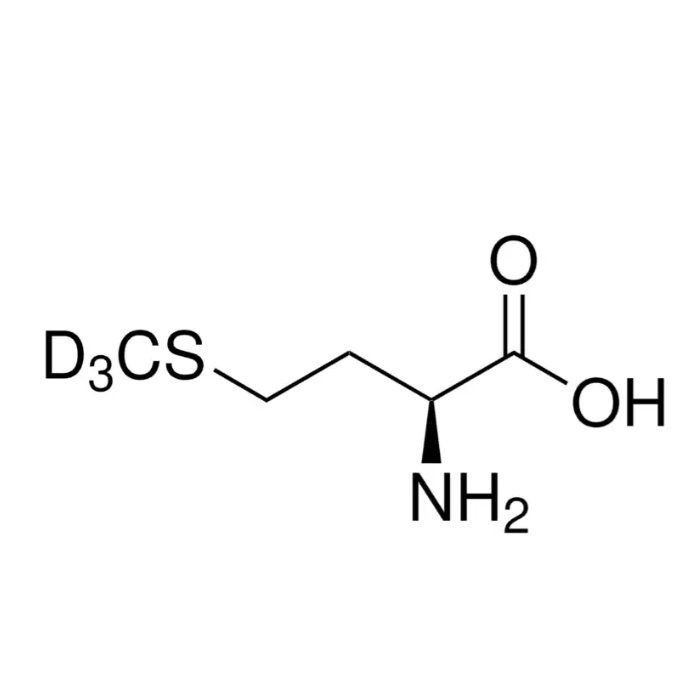
Stable-isotope labeled essential amino acid with a deuterated methyl group on sulfur (S–CD3) in the L-configuration.
Item-specific (from Product Data):
Product Name: L-Methionine-(methyl-d3)
SKU: L133003
CAS: 13010-53-2
CID: 15556503
InChIKey: 81195 (as provided)
Grade/Purity: Moligand™
Storage: Protected from light; Room temperature
Shipped In: Normal
Representative structure (literature/computed; for reference only):
Core features: α-amino acid backbone (α-CO2H, α-NH2), thioether side chain with terminal S–CD3; chiral α-carbon in the L-series (2S).
Functional groups: Carboxylic acid, primary amine, thioether (sulfide). No additional ionizable side chain beyond backbone.
Stereochemistry: L (2S) at the α-carbon; no stereocenters in side chain.
2D description in words: A zwitterionic α-amino acid skeleton (–NH3+ at α-carbon and –COO− at terminus at neutral pH), bearing a two‑carbon linker to sulfur that is bonded to a deuterated methyl (S–CD3).
Synthetic Utility
As a labeled chiral building block, L‑Methionine-(methyl‑d3) enables incorporation of a defined +3 Da mass tag into peptides, peptidomimetics, and metabolites.
Functional group reactivity (general):
Carboxyl group: Amenable to activation (HATU/HBTU/EDC/DIC) for amide bond formation; can form esters for protection/derivatization.
Amino group: Protect as Fmoc/Boc/Cbz for peptide synthesis; engage in reductive amination and acylation.
Thioether: Generally inert to many coupling conditions; susceptible to oxidation to sulfoxide/sulfone (use antioxidants if needed). The S‑CD3 label is robust to proton exchange.
Applications:
SPPS/LPPS: Incorporate as Fmoc- or Boc-protected derivatives to produce deuterium-labeled peptides for MS quantitation or mechanistic studies.
Derivatization for GC–MS: Formation of volatile derivatives (e.g., TBDMS, methyl/ethyl esters after appropriate protection) with the +3 Da signature preserved.
Provides a stereochemically defined synthon contributing both chirality (L, 2S) and a non-exchangeable isotopic tag localized at sulfur, simplifying spectral assignment and quantitation.
Target Specificity
Not applicable. This product is a small-molecule amino acid, not an antibody or affinity reagent. No antigen/epitope specificity, clone, isotype, or species reactivity applies.
Foire aux questions
What is the isotopic enrichment of this product?
This product is isotopically enriched to ≥98 atom% deuterium. Isotopic enrichment is a separate specification from chemical purity — a labelled compound has both. Lot-specific values are stated on the Certificate of Analysis.
What is Moligand??
Moligand? is one of Aladdin Scientific's premium product lines, formulated for high-purity applications across multiple workflows. Compared to standard grades in the same workflow, Moligand? products typically offer tighter specifications, more rigorous QC, and stronger lot-to-lot consistency.
How should this product be stored?
Store at room temperature, protected from light. The material is light-sensitive — keep it in its original opaque or amber container.
How is this product shipped?
This product ships under standard ambient conditions. No temperature-controlled packaging is required.
What are the CAS number, molecular formula and molecular weight?
The CAS Number is 13010-53-2, the molecular formula is C5H11NO2S, and the molecular weight is 152.23 g/mol. InChIKey FFEARJCKVFRZRR-OSIBIXDNSA-N.
What documentation is provided?
Available product documentation, including Certificates of Analysis (COA), Safety Data Sheets (SDS), and specification sheets, is shown in the product document area. Document availability and access follow the current site policy.
Notre guide de sélection des qualités couvre la pureté, le statut du stabilisant et l'adéquation à l'application pour toutes les variantes de notre catalogue.
Nous utilisons des cookies pour garantir le bon fonctionnement du site et, lorsque cela est autorisé, pour améliorer votre expérience. Vous pouvez gérer vos préférences à tout moment dans les Paramètres. Pour en savoir plus, consultez notre Politique relative aux cookies.
Souhaitez-vous que nous vous envoyions un message lorsque des réductions seront disponibles?
Me rappeler plus tard
Merci ! Veuillez vérifier votre boîte de réception e-mail pour confirmer.
Products are supplied to verified businesses, institutions, and qualified professionals for research and development use only. Not for use in humans, animals, diagnosis, or therapy.

 C23021040