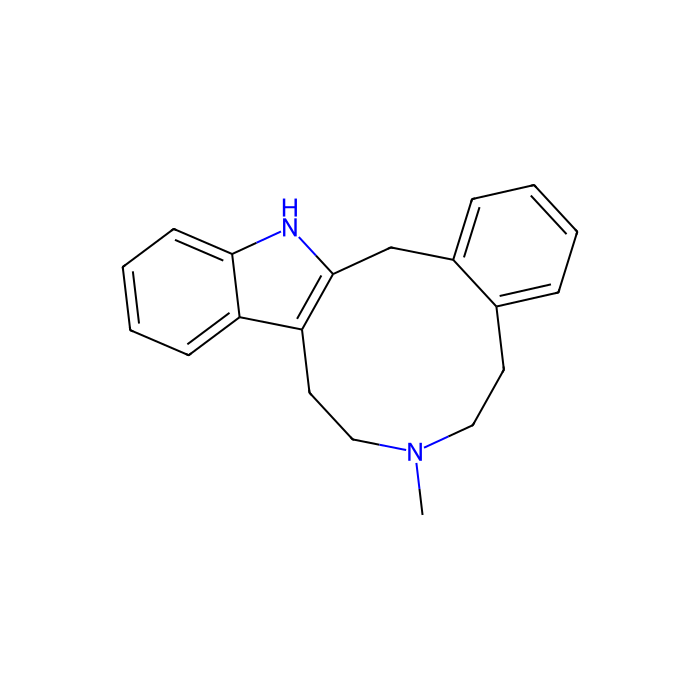
Determine the necessary mass, volume, or concentration for preparing a solution.
| Activity Type | Activity Value -log(M) | Mechanism of Action | Activity Reference | Publications (PubMed IDs) |
|---|

≥98%(HPLC) for sensitive chromatographic and analytical workflows requiring minimal baseline interference.
Store at -20°C Ships Ice chest + Ice pads Check lot-specific COA for exact specifications.
SDS, COA, datasheet, and spec sheet available for download. Lot-specific COA accessible via lot number lookup.
Cited in 0 peer-reviewed publications across chromatography, organic synthesis, and cross-coupling reactions.
Comprehensive hazard, handling, storage, and regulatory compliance document.
Download SDS →Lot-specific quality data. Enter your lot number to retrieve the exact COA.
Look up COA →Full quality attributes and acceptance criteria for this grade.
View spec sheet →Taxonomy Tree
| Kingdom | Organic compounds |
|---|---|
| Superclass | Organoheterocyclic compounds |
| Classe | Indoles and derivatives |
| Subclass | Indoles |
| Intermediate Tree Nodes | Not available |
| Direct Parent | 3-alkylindoles |
| Alternative Parents | Aralkylamines Benzenoids Pyrroles Heteroaromatic compounds Trialkylamines Azacyclic compounds Organopnictogen compounds Hydrocarbon derivatives |
| Molecular Framework | Aromatic heteropolycyclic compounds |
| Substituents | 3-alkylindole - Aralkylamine - Benzenoid - Heteroaromatic compound - Pyrrole - Tertiary aliphatic amine - Tertiary amine - Azacycle - Organic nitrogen compound - Organopnictogen compound - Hydrocarbon derivative - Organonitrogen compound - Amine - Aromatic heteropolycyclic compound |
| Description | This compound belongs to the class of organic compounds known as 3-alkylindoles. These are compounds containing an indole moiety that carries an alkyl chain at the 3-position. |
| External Descriptors | Not available |
| Activity Type | Activity Value -log(M) | Mechanism of Action | Activity Reference | Publications (PubMed IDs) |
|---|
| Activity Type | Activity Value -log(M) | Mechanism of Action | Activity Reference | Publications (PubMed IDs) |
|---|
| Activity Type | Activity Value -log(M) | Mechanism of Action | Activity Reference | Publications (PubMed IDs) |
|---|
| Activity Type | Activity Value -log(M) | Mechanism of Action | Activity Reference | Publications (PubMed IDs) |
|---|
| Activity Type | Relation | Activity value | Units | Action Type | Journal | PubMed Id | doi | Assay Aladdin ID |
|---|
| Activity Type | Relation | Activity value | Units | Action Type | Journal | PubMed Id | doi | Assay Aladdin ID |
|---|
| Activity Type | Relation | Activity value | Units | Action Type | Journal | PubMed Id | doi | Assay Aladdin ID |
|---|
| Activity Type | Relation | Activity value | Units | Action Type | Journal | PubMed Id | doi | Assay Aladdin ID |
|---|
| Activity Type | Relation | Activity value | Units | Action Type | Journal | PubMed Id | doi | Assay Aladdin ID |
|---|
| Activity Type | Relation | Activity value | Units | Action Type | Journal | PubMed Id | doi | Assay Aladdin ID |
|---|
| Activity Type | Relation | Activity value | Units | Action Type | Journal | PubMed Id | doi | Assay Aladdin ID |
|---|
| Activity Type | Relation | Activity value | Units | Action Type | Journal | PubMed Id | doi | Assay Aladdin ID |
|---|
| Activity Type | Relation | Activity value | Units | Action Type | Journal | PubMed Id | doi | Assay Aladdin ID |
|---|
| Activity Type | Relation | Activity value | Units | Action Type | Journal | PubMed Id | doi | Assay Aladdin ID |
|---|
| Activity Type | Relation | Activity value | Units | Action Type | Journal | PubMed Id | doi | Assay Aladdin ID |
|---|
| Activity Type | Relation | Activity value | Units | Action Type | Journal | PubMed Id | doi | Assay Aladdin ID |
|---|
| Activity Type | Relation | Activity value | Units | Action Type | Journal | PubMed Id | doi | Assay Aladdin ID |
|---|
| Activity Type | Relation | Activity value | Units | Action Type | Journal | PubMed Id | doi | Assay Aladdin ID |
|---|
| Activity Type | Relation | Activity value | Units | Action Type | Journal | PubMed Id | doi | Assay Aladdin ID |
|---|
| Activity Type | Relation | Activity value | Units | Action Type | Journal | PubMed Id | doi | Assay Aladdin ID |
|---|
| Activity Type | Relation | Activity value | Units | Action Type | Journal | PubMed Id | doi | Assay Aladdin ID |
|---|
| Activity Type | Relation | Activity value | Units | Action Type | Journal | PubMed Id | doi | Assay Aladdin ID |
|---|
| Activity Type | Relation | Activity value | Units | Action Type | Journal | PubMed Id | doi | Assay Aladdin ID |
|---|
| Activity Type | Relation | Activity value | Units | Action Type | Journal | PubMed Id | doi | Assay Aladdin ID |
|---|
| Activity Type | Relation | Activity value | Units | Action Type | Journal | PubMed Id | doi | Assay Aladdin ID |
|---|
| Activity Type | Relation | Activity value | Units | Action Type | Journal | PubMed Id | doi | Assay Aladdin ID |
|---|
| Activity Type | Relation | Activity value | Units | Action Type | Journal | PubMed Id | doi | Assay Aladdin ID |
|---|
| Activity Type | Relation | Activity value | Units | Action Type | Journal | PubMed Id | doi | Assay Aladdin ID |
|---|
| Activity Type | Relation | Activity value | Units | Action Type | Journal | PubMed Id | doi | Assay Aladdin ID |
|---|
| Activity Type | Relation | Activity value | Units | Action Type | Journal | PubMed Id | doi | Assay Aladdin ID |
|---|
| Activity Type | Relation | Activity value | Units | Action Type | Journal | PubMed Id | doi | Assay Aladdin ID |
|---|
| Activity Type | Relation | Activity value | Units | Action Type | Journal | PubMed Id | doi | Assay Aladdin ID |
|---|
| Activity Type | Relation | Activity value | Units | Action Type | Journal | PubMed Id | doi | Assay Aladdin ID |
|---|
| Activity Type | Relation | Activity value | Units | Action Type | Journal | PubMed Id | doi | Assay Aladdin ID |
|---|
| Activity Type | Relation | Activity value | Units | Action Type | Journal | PubMed Id | doi | Assay Aladdin ID |
|---|
| Activity Type | Relation | Activity value | Units | Action Type | Journal | PubMed Id | doi | Assay Aladdin ID |
|---|
| Activity Type | Relation | Activity value | Units | Action Type | Journal | PubMed Id | doi | Assay Aladdin ID |
|---|
| Activity Type | Relation | Activity value | Units | Action Type | Journal | PubMed Id | doi | Assay Aladdin ID |
|---|
| Activity Type | Relation | Activity value | Units | Action Type | Journal | PubMed Id | doi | Assay Aladdin ID |
|---|
| Activity Type | Relation | Activity value | Units | Action Type | Journal | PubMed Id | doi | Assay Aladdin ID |
|---|
| Activity Type | Relation | Activity value | Units | Action Type | Journal | PubMed Id | doi | Assay Aladdin ID |
|---|
| Activity Type | Relation | Activity value | Units | Action Type | Journal | PubMed Id | doi | Assay Aladdin ID |
|---|
| Activity Type | Relation | Activity value | Units | Action Type | Journal | PubMed Id | doi | Assay Aladdin ID |
|---|
| Activity Type | Relation | Activity value | Units | Action Type | Journal | PubMed Id | doi | Assay Aladdin ID |
|---|
| Activity Type | Relation | Activity value | Units | Action Type | Journal | PubMed Id | doi | Assay Aladdin ID |
|---|
| Activity Type | Relation | Activity value | Units | Action Type | Journal | PubMed Id | doi | Assay Aladdin ID |
|---|
| Activity Type | Relation | Activity value | Units | Action Type | Journal | PubMed Id | doi | Assay Aladdin ID |
|---|
| Activity Type | Relation | Activity value | Units | Action Type | Journal | PubMed Id | doi | Assay Aladdin ID |
|---|
| Activity Type | Relation | Activity value | Units | Action Type | Journal | PubMed Id | doi | Assay Aladdin ID |
|---|
| Activity Type | Relation | Activity value | Units | Action Type | Journal | PubMed Id | doi | Assay Aladdin ID |
|---|
| Solubilité | Solvent:1eq. HCl, Max Conc. mg/mL: 14.52, Max Conc. mM: 50; Solvent:DMSO, Max Conc. mg/mL: 29.04, Max Conc. mM: 100 |
|---|---|
| Poids moléculaire | 290.400 g/mol |
| XLogP3 | 4.300 |
| Hydrogen Bond Donor Count | 1 |
| Hydrogen Bond Acceptor Count | 1 |
| Rotatable Bond Count | 0 |
| Exact Mass | 290.178 Da |
| Monoisotopic Mass | 290.178 Da |
| Topological Polar Surface Area | 19.000 Ų |
| Heavy Atom Count | 22 |
| Formal Charge | 0 |
| Complexity | 369.000 |
| Isotope Atom Count | 0 |
| Defined Atom Stereocenter Count | 0 |
| Undefined Atom Stereocenter Count | 0 |
| Defined Bond Stereocenter Count | 0 |
| Undefined Bond Stereocenter Count | 0 |
| The total count of all stereochemical bonds | 0 |
| Covalently-Bonded Unit Count | 1 |
No tested applications or validated protocols are provided in the Product Data for this item.
For step-by-step, parameterized protocols (e.g., specific concentrations, incubation times), consult your internal SOPs or peer‑reviewed literature tailored to your assay and confirm compatibility with this compound.
Item-specific biological targets, mechanisms, or pathways for this catalog entry are not provided in the Product Data and should be obtained from primary literature using the CAS (274694-98-3) or CID (4350931), then verified against the purchased lot.
What can be reasonably stated (general)
Good practices to avoid misannotation
No clinical, diagnostic, or therapeutic use is implied. For authoritative biological role assignments, consult peer‑reviewed sources and annotate your ELN with DOIs/PMIDs.
This item is not a buffer reagent. However, it is often used in buffers as a test article for biochemical or cellular assays. The key considerations are vehicle compatibility and maintaining consistent conditions across controls.
Vehicle and buffer compatibility (general)
Practical notes
Item-specific buffer system recommendations, pH ranges, and recipes are not provided; tailor to your assay chemistry and validate empirically.
While LE 300 is a discrete small molecule (not a process solvent or reagent), greener practices focus on solvent choice and waste minimization during handling and assay preparation.
Greener solvent choices (general guidance)
Practical green lab tips
Illustrative comparison (general)
Always confirm that “greener” substitutions do not compromise data quality or compound stability.
No pharmacopeial status, excipient role, or manufacturing specification is provided for this item. This product is supplied strictly for research use and is not intended for human or veterinary applications.
Research-oriented pharmaceutical context (general)
Compliance notes
Item-specific pharmacopeial listings, impurity profiles, and compendial tests: Not specified for this item; refer to CoA/Spec Sheet.
Item-specific physicochemical specifications were not provided for this product.
Item-specific facts (from Product Data)
Literature/computed properties
Practical solubility guidance (general)
Hygroscopicity/volatility
Notes
Item-specific facts (from Product Data)
General guidance on grades for screening compounds
Stabilizers and form
Best practices
This product is cataloged as a discrete screening small molecule, not primarily as a synthetic reagent. Therefore, classical synthetic “reaction applications” (e.g., coupling reagent, base, catalyst) do not typically apply.
Research applications (general, non-clinical)
Practical tips
If you intend to use the material in synthesis (e.g., as a reference intermediate), treat it as a standard organic substrate: verify functional groups, test solubility, and optimize conditions by microscale scouting. No specific named-reaction utility is claimed for this item.
Not typically applicable. LE 300 is supplied as a discrete screening compound rather than a reagent or catalyst.
If employing in assay preparation (general, non-reaction use)
If repurposed as a synthetic substrate (only after confirming structure)
Expected yields, selectivity, or kinetics are not stated due to lack of item-specific structural and reactivity data.
Safety information specific to this item is incomplete in the Product Data and must be taken from the SDS for the shipped lot.
Item-specific facts (from Product Data)
General laboratory precautions (not a substitute for SDS)
First-aid overview (general)
Environmental and waste
Always defer to the product SDS and institutional EHS procedures for authoritative safety controls and emergency measures.
Because this is a small-molecule screening compound with unspecified intrinsic solubility, solvent choice should be validated empirically while following common practices for discovery chemistry and assay biology.
Practical default strategy (general)
Alternative solvents/co-solvents (evaluate case-by-case)
Considerations
Selection guidance table (general)
Verify all solvent choices against the compound’s actual stability profile from CoA/SDS and small-scale tests.
Item-specific facts (from Product Data)
Storage guidance (general best practices)
Reconstitution (general)
Stability
For research use only.
Brief overview: LE 300 is listed in our catalog as a discrete small-molecule screening compound. Detailed structural identifiers for this specific catalog item are incomplete in the provided Product Data and should be confirmed against the current CoA/SDS and authoritative databases by CAS or CID.
Item-specific facts (from Product Data)
Structural description (general guidance)
Best practice
This product is offered as a finished small molecule for research screening and reference use rather than as a building block or reagent.
General guidance if repurposed in synthesis
Typical transformations (hypothesis-driven; verify against the true structure before use)
No specific named-reaction roles are claimed for this catalog item due to absent structural detail in the provided Product Data.
Target specificity information (e.g., protein target, pathway, binding constants, species selectivity) is not provided in the Product Data for this item.
Item-specific facts
Guidance
No claims of biological target specificity are made by the catalog entry.