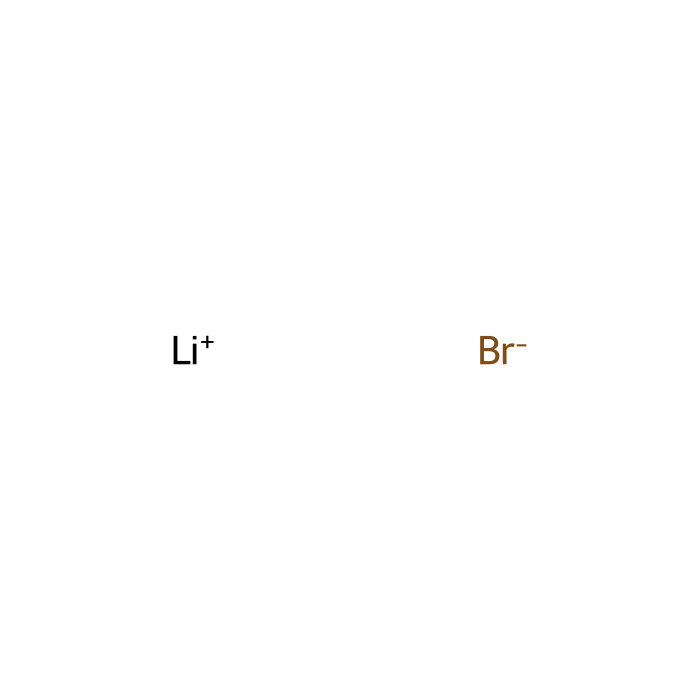
Lithium bromide - anhydrous, high-purity, Reagent grade, ≥99% , CAS No.7550-35-8

CAS: 7550-35-8 Cat. No.: L433600 Formule: LiBr Poids moléculaire: 86.85 Numéro CE: 231-439-8 PubChem CID: 82050
DISPONIBLE À COMMANDE
QUALITÉ & PURETÉ Anhydrous Grade ? Anhydrous grade — water removed and packaged dry for moisture-sensitive chemistry. Use in reactions where even trace water would interfere or quench. Reagent Grade ? General reagent-grade purity suitable for most laboratory work. Use as a dependable default when no specific higher grade is required. High-purity ? High-purity grade with substantially reduced impurity levels. Use when trace contaminants would interfere with your measurement or process. ≥99%
Synonyms
LITHIUM BROMATUM|Lithium monobromide|Lithium bromide (LiBr)|lithium;bromide|LITHIUM BROMIDE [WHO-DD]|bromolithium|LITHIUM BROMIDE [MI]|Lithium bromide, ultra dry|LiBr|Lithium bromide|Lithium Microsol (TN)|2,5-dimethylphenylene-1,4-diamine|LITHIUM BROMIDE, ANHYDROUS|LITHIUMBROMIDE|lithium-bromide|BrLi|Lithium Microsol|LITHIUM BROMATUM [HPUS]
Storage
Room temperature
★
Taille
USA
Allemagne (EU)*
Prix
Qté
100g
L433600-100g
2 En stock
—
69,90$US
500g
L433600-500g
7 En stock
1 En stock
159,90$US
6×500g
L433600-6×500g
Sur commande · 8–12 semaines
699,90$US
Enter a quantity for the sizes you want to add.

Spécifications

Synonymes
LITHIUM BROMATUM | Lithium monobromide | Lithium bromide (LiBr) | lithium;bromide | LITHIUM BROMIDE [WHO-DD] | bromolithium | LITHIUM BROMIDE [MI] | Lithium bromide, ultra dry | LiBr | Lithium bromide | Lithium Microsol (TN) | 2,5-dimethylphenylene-1,4-diamine | LITHIUM BROMIDE, ANHYDROUS | LITHIUMBROMIDE | lithium-bromide | BrLi | Lithiu Afficher plus
Spécifications et pureté
anhydrous, high-purity, Reagent grade, ≥99%
Conditions de stockage de stockage
Room temperature
Grade
Anhydrous Grade, High-purity, Reagent Grade
Pureté
≥99%
Noms et identifiants
Pubchem Sid
Pubchem Sid Url
https://pubchem.ncbi.nlm.nih.gov/substance/504755574
SMILES
[Li+].[Br-]
IUPAC Name
lithium;bromide
InChIKey
AMXOYNBUYSYVKV-UHFFFAOYSA-M
InChI
1S/BrH.Li/h1H;/q;+1/p-1
Isomères SMILES
[Li+].[Br-]
WGK Allemagne
3
PubChem CID
82050
Poids moléculaire
86.85

Données avancées

Taxonomic Classification

Taxonomy Tree

KingdomInorganic compounds
SuperclassMixed metal/non-metal compounds
ClasseAlkali metal salts
SubclassAlkali metal bromides
Intermediate Tree Nodes Not available
Direct ParentAlkali metal bromides
Alternative Parents Inorganic lithium salts  
Molecular FrameworkNot available
Substituents Alkali metal bromide - Inorganic lithium salt - Inorganic salt
DescriptionThis compound belongs to the class of inorganic compounds known as alkali metal bromides. These are inorganic compounds in which the largest halogen atom is Bromine, and the heaviest metal atom an alkali metal.
External Descriptors lithium salt - bromide salt
Structure 3D
Modèle de structure chimique interactif


Certificats (CoA, COO, BSE/TSE et tableau d'analyse)
C of A & Other Certificates(BSE/TSE, COO):
Analytical Chart:

Find and download the COA for your product by matching the lot number on the packaging.

9 results found

Lot NumberCertificate TypeDateArticle
E2608610E2608610Certificate of AnalysisApr 22, 2026 L433600
E2608612E2608612Certificate of AnalysisApr 22, 2026 L433600
E2608613E2608613Certificate of AnalysisApr 22, 2026 L433600
E2625658E2625658Certificate of AnalysisApr 22, 2026 L433600
F23161123F23161123Certificate of AnalysisJul 03, 2023 L433600
F23161118F23161118Certificate of AnalysisJul 03, 2023 L433600
F23161127F23161127Certificate of AnalysisJun 29, 2023 L433600
F23161114F23161114Certificate of AnalysisJun 20, 2023 L433600
I2519009I2519009Certificate of AnalysisJun 20, 2023 L433600
Propriétés chimiques et physiques
SensibilitéMoisture sensitive
Point d'ébullition (°C)1265°C
Point de fusion (°C)550℃
Poids moléculaire86.9
XLogP3
Hydrogen Bond Donor Count0
Hydrogen Bond Acceptor Count1
Rotatable Bond Count0
Exact Mass85.9343 Da
Monoisotopic Mass85.9343 Da
Topological Polar Surface Area0.000 Ų
Heavy Atom Count2
Formal Charge0
Complexity2.000
Isotope Atom Count0
Defined Atom Stereocenter Count0
Undefined Atom Stereocenter Count0
Defined Bond Stereocenter Count0
Undefined Bond Stereocenter Count0
The total count of all stereochemical bonds0
Covalently-Bonded Unit Count2
Sécurité et dangers (GHS)
Pictogramme(s)
Signal
Warning
Mentions de danger

H302:Harmful if swallowed

H315:Causes skin irritation

H317:May cause an allergic skin reaction

H319:Causes serious eye irritation

Conseils de prudence

P261:Avoid breathing dust/fume/gas/mist/vapors/spray.

P264:Wash hands [and …] thoroughly after handling.

P270:Do not eat, drink or smoke when using this product.

P272:Contaminated work clothing should not be allowed out of the workplace.

P280:Wear protective gloves/protective clothing/eye protection/face protection.

P321:Specific treatment (see ... on this label).

P330:Rinse mouth.

P302+P352:IF ON SKIN: wash with plenty of water.

P305+P351+P338:IF IN EYES: Rinse cautiously with water for several minutes. Remove contact lenses if present and easy to do - continue rinsing.

P333+P313:IF SKIN irritation or rash occurs: Get medical advice/attention.

P362+P364:Take off contaminated clothing and wash it before reuse.

P501:Dispose of contents/container to an approved waste disposal plant.

P264+P265:Wash hands [and …] thoroughly after handling. Do not touch eyes.

P301+P317:IF SWALLOWED: Get medical help.

P337+P317:If eye irritation persists: Get medical help.

P332+P317:If skin irritation occurs: Get medical help.

WGK Allemagne
3
Index Merck
14,5526
FAQ et articles
Formaldehyde
The Guide to Anhydrous Grade for Reagents
High-Purity Reagents: Overview and Aladdin Product Selection Guide
How to Choose Reagent Grades in Scientific Research? A Practical Guide to Reagent Grade
Selection of Common Research Salts: A Task Map for Alkali Metal Salts & Alkaline Earth Metal Salts (with Product Tables 1–6)
Perovskite PV/PeLED Precursor Guide: Selecting Metal Halide Salts, Key Conditions, and Reproducible Performance (including Product Tables 1–4 and a Selection Navigation Guide)
Experimental Judgment for Differential Deprotection of Double Boc and Related N-Boc Systems: Substrate Type, Site-Response Differences, and Initial Condition Selection
Strain Release of Azatricycloalkanes: Modular Bridge-Position Functionalization and Stereochemical Control of Three-Dimensional Bridged Aza Scaffolds
Construction and Transformation of Aziridines in Drug Synthesis: Ring Strain, N-Substituent Control, Selective Ring Opening, and Scaffold Expansion
Citations of This Product
Calculateurs de solution
Avis

Avis des clients

Besoin d'aide pour choisir la qualité ?

Notre guide de sélection des qualités couvre la pureté, le statut du stabilisant et l'adéquation à l'application pour toutes les variantes de notre catalogue.

Voir le guide des qualités Anhydrous Grade → Voir le guide des qualités Reagent Grade → Voir le guide des qualités High-purity →

Souhaitez-vous que nous vous envoyions un message lorsque des réductions seront disponibles?

Me rappeler plus tard

Merci ! Veuillez vérifier votre boîte de réception e-mail pour confirmer.

Oups ! Les notifications sont désactivées.