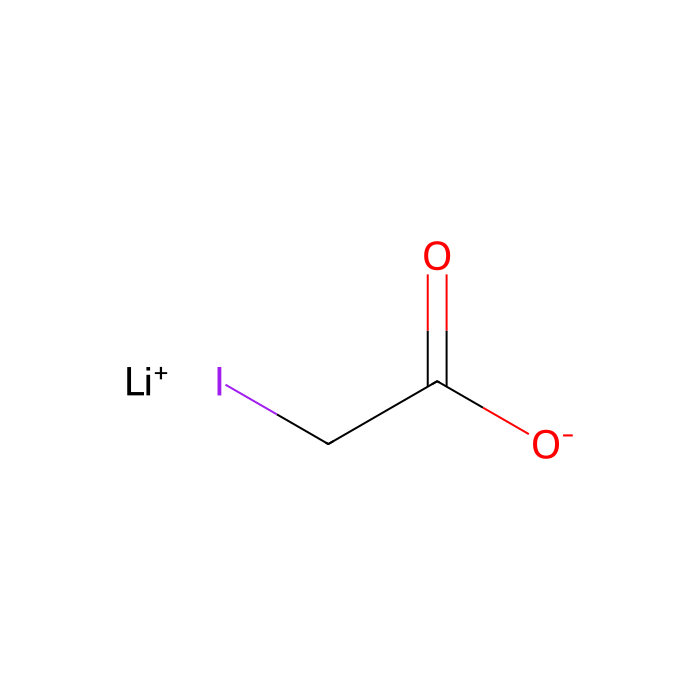
Alpha-halocarboxylic acid - Carboxylic acid salt - Organic metal halide - Organic lithium salt - Carboxylic acid - Organic alkali metal salt - Monocarboxylic acid or derivatives - Alkyl halide - Organooxygen compound - Organoiodide - Organohalogen compound - Organic salt - Hydrocarbon derivative - Organic oxide - Carbonyl group - Organic oxygen compound - Alkyl iodide - Aliphatic acyclic compound
Description
This compound belongs to the class of organic compounds known as alpha-halocarboxylic acids. These are carboxylic acids containing a halogen atom bonded to the alpha carbon atom.
External Descriptors
Not available
1. Djoumbou Feunang Y, Eisner R, Knox C, Chepelev L, Hastings J, Owen G, Fahy E, Steinbeck C, Subramanian S, Bolton E, Greiner R, and Wishart DS. ClassyFire: Automated Chemical Classification With A Comprehensive, Computable Taxonomy. Journal of Cheminformatics, 2016, 8:61.
Certificats (CoA, COO, BSE/TSE et tableau d'analyse)
C of A & Other Certificates(BSE/TSE, COO):
Analytical Chart:
Propriétés chimiques et physiques
Poids moléculaire
191.900 g/mol
XLogP3
Hydrogen Bond Donor Count
0
Hydrogen Bond Acceptor Count
2
Rotatable Bond Count
1
Exact Mass
191.926 Da
Monoisotopic Mass
191.926 Da
Topological Polar Surface Area
40.100 Ų
Heavy Atom Count
6
Formal Charge
0
Complexity
46.800
Isotope Atom Count
0
Defined Atom Stereocenter Count
0
Undefined Atom Stereocenter Count
0
Defined Bond Stereocenter Count
0
Undefined Bond Stereocenter Count
0
The total count of all stereochemical bonds
0
Covalently-Bonded Unit Count
2
Calculateurs de solution
Molarity Calculator
Determine the necessary mass, volume, or concentration for preparing a solution.
Dilution Calculator
Determine the dilution needed to prepare a stock solution.
Reconstitution Calculator
Avis
Avis des clients
Application Protocols
No item-specific, validated protocols are provided in the Product Data. The following is general guidance for a common research application (thiol blocking) using iodoacetate chemistry; users should optimize for their system.
Example: Cysteine blocking prior to proteolysis (literature/general)
Reduce protein disulfides with 5–10 mM DTT or 2–5 mM TCEP for 15–30 min at 37 °C; cool to RT.
Exchange buffer to remove excess reductant (e.g., desalting spin column) or allow a brief dilution.
Add lithium iodoacetate to 5–20 mM final (≥10× over estimated thiol content) in 50 mM phosphate, pH 8.0; include 1 mM EDTA.
Incubate 30–45 min at RT in the dark.
Quench excess electrophile with 5–10 mM cysteine or dilute thiol scavenger; proceed to digestion.
Notes
Avoid Tris or other primary amine buffers during alkylation to minimize side reactions.
Verify completion by MS (loss of free thiol signal/appearance of +58.0 Da mass for carboxymethylation on cysteine, literature value). Adjust stoichiometry/time as needed.
For application-specific SOPs, consult primary literature and validate conditions with small-scale trials.
Biological Roles
This compound is used in biochemical research as a thiol-reactive electrophile; it is not a metabolite or nutrient. The points below summarize roles and behaviors reported in the literature for the iodoacetate functional group (not item-specific specifications).
Enzyme chemistry (literature)
Iodoacetate irreversibly modifies cysteine residues by S-carboxymethylation, commonly used to block catalytic thiols (e.g., in cysteine proteases) and to cap free thiols prior to proteomic workflows.
GAPDH and other thiol-dependent enzymes are classic sensitivity benchmarks for iodoacetate reagents in mechanistic enzymology.
Proteomics/sample prep
After reduction of disulfides (e.g., with DTT/TCEP), iodoacetate or iodoacetamide reagents are applied to prevent disulfide re-formation prior to digestion/LC–MS analysis.
Lithium iodoacetate provides a carboxylate terminus on the adduct, which may influence peptide charge state and chromatographic behavior compared with amide-based capping reagents.
Selectivity considerations
Highest reactivity is observed toward thiolates; amine alkylation can occur at elevated pH.
Inclusion of metal chelators (e.g., EDTA) helps minimize side reactions catalyzed by trace metals.
Note: All uses are for research purposes only. No medical, diagnostic, or therapeutic applications are implied.
Buffer Applications
Lithium iodoacetate is not typically used as a buffer component. While the conjugate acid (iodoacetic acid) has a pKa around 3.1–3.3 (literature), the useful buffering range (≈2.1–4.1) is narrow and not commonly selected for biochemical reactions.
Practical guidance
Use standard buffer systems (phosphate, acetate, citrate, HEPES, MOPS) appropriate to your target pH.
If employing lithium iodoacetate in aqueous media, treat it as a reactive additive, not a buffering species. Adjust pH with a dedicated buffer, then add lithium iodoacetate last to minimize side reactions.
Compatibility notes
Avoid high concentrations of nucleophilic buffer components (e.g., primary amines like Tris) during thiol alkylation, as they can compete with target thiols.
Maintain pH ~7.5–8.5 for thiol-selective alkylation; outside this range, undesired reactions with amines or hydrolysis may increase.
For buffering recipes and capacities, select a conventional buffer and refer to its specific guidance.
Green Alternatives
Choosing greener options for carboxymethylation or thiol blocking balances reactivity, selectivity, and hazard minimization.
Environmental and safety profile (general)
Iodoacetates are potent alkylating agents; while efficient, they pose higher acute toxicity and environmental concern than many alternatives.
Alternatives and trade-offs (literature/general)
Bromoacetate/chloroacetate salts: Lower reactivity reduces hazard but may necessitate harsher conditions (higher pH/temperature), potentially decreasing selectivity and increasing energy input.
Iodoacetamide: Widely used for cysteine capping with amide functionality; similar hazard class as an alkylator; not inherently greener but can offer cleaner reactions minimizing repeats/waste.
Maleimide derivatives (e.g., N-ethylmaleimide): Excellent thiol selectivity at neutral pH; still hazardous but often used in buffered aqueous media with minimal organic solvent.
Enzymatic/orthogonal strategies: Where applicable, enzyme-mediated tagging or photochemical handles can avoid strong alkylators, though with increased complexity.
Process-intensity considerations
Prefer aqueous buffers over anhydrous aprotic solvents when feasible.
Use minimal excess reagent, monitor conversion in real time, and quench promptly to minimize residual alkylator.
Implement closed handling, pre-dissolved concentrates, and waste segregation for halogenated organics.
Summary
If high reactivity is essential and aqueous compatibility is required, lithium iodoacetate remains a strong choice. For lower hazard, consider less reactive haloacetates or maleimides, acknowledging potential changes in kinetics and selectivity.
Pharmaceutical Uses
Lithium iodoacetate is not a common excipient and has no compendial status noted here. It is primarily a research reagent used for chemical modification of biomolecules.
Potential roles in development workflows (general, non-clinical)
Bioconjugation and analytics: Cysteine blocking or carboxymethyl tagging in protein characterization and process development.
Linker installation: Introduction of a terminal carboxylate functionality for subsequent coupling (e.g., EDC/NHS-mediated amide formation) in research-scale conjugation chemistry.
Not typically applicable
No established roles as stabilizer, pH adjuster, tonicity agent, or filler are known for this compound in formulated drug products.
Regulatory note
For research use only. Not for human or veterinary use, clinical diagnostics, or as an active pharmaceutical ingredient. Any use in development must be supported by internal risk assessments and relevant safety data.
Physical Properties
Item-specific physicochemical specifications (melting point, water/peroxide content, UV cut‑off, density) are not provided in the Product Data for this SKU.
Item-specific values
Appearance: Not specified for this item; refer to CoA/Spec Sheet.
Molecular Formula: Not specified for this item; refer to CoA/Spec Sheet.
Molecular Weight: Not specified for this item; refer to CoA/Spec Sheet.
Literature/general properties for lithium iodoacetate (for planning only; not item specifications)
Approx. formula and FW (literature): C2H2ILiO2; ~191.88 g/mol
Phase: ionic organic salt; expected solid at ambient conditions
Solubility: lithium carboxylates are typically readily soluble in water; limited solubility expected in nonpolar solvents; miscibility enhanced in polar protic/aqueous media (literature/general trend)
pKa (conjugate acid, iodoacetic acid): ~3.1–3.3 (literature for iodoacetic acid), indicating that at neutral pH the salt remains deprotonated
Reactivity note: the C–I bond is highly labile toward SN2, especially with soft nucleophiles (thiolates), even in aqueous buffers
Practical implications
Use aqueous buffers (pH ~7.5–8.5) for thiol alkylation; avoid strong bases that could promote undesired side reactions (e.g., elimination or hydrolysis)
Protect from prolonged moisture/CO2 ingress if weighing for analytical use; ionic materials may cake under humid conditions (general handling guidance)
Always consult the item-specific CoA/SDS for definitive specifications and operational limits.
Quality and Grades
Item-specific grade/purity
Grade/Purity: Not specified for this item; refer to CoA/Spec Sheet.
How to interpret common grades (general guidance)
Analytical Reagent (AR) / ACS: Suitable for most analytical and synthetic applications; impurity limits defined.
Biochemical grade: Typically controlled for bioburden and key trace impurities affecting biomolecule reactivity.
HPLC grade (for solvents): Low UV background; not applicable to most solid salts like lithium iodoacetate, but low-absorbance impurity control can still matter for LC work.
Considerations specific to lithium iodoacetate
Trace halides and residual haloacids can impact reaction selectivity (e.g., over-alkylation). Review halide, moisture, and inorganic residue limits if your application is sensitive.
Water content can influence accurate solution molarity and reaction kinetics in thiol alkylation workflows; check Karl Fischer (if provided) on the CoA.
Metals: While not typically a metal-sensitive reagent, trace metals can catalyze side reactions in bioconjugation; consult CoA if such limits are critical.
Documentation
For regulated or QA-controlled workflows, request the batch CoA and specifications sheet for this SKU to confirm assay, identity, and impurity profiles prior to use.
Reaction and Applications
Lithium iodoacetate functions as a carboxymethylating electrophile via SN2 displacement at the iodomethyl carbon. Its carboxylate counterion enhances aqueous handling relative to the free acid.
Key application families (literature/general)
Thiol alkylation: Rapid S-carboxymethylation of cysteine residues in peptides/proteins and small-molecule thiols; forms stable thioether linkages.
Nucleophile carboxymethylation: O-, N-, and S-carboxymethylation of alcohols, amines, imidazoles, and other heteroatoms, with best chemoselectivity observed for soft sulfur nucleophiles.
Protecting/derivatization chemistry: Introduction of a terminal carboxylate handle for further coupling (e.g., amide formation after activation).
Why the lithium salt?
Facilitates direct use in neutral to slightly basic aqueous media without pre-neutralization of iodoacetic acid.
Lithium has minimal coordinating/phase-transfer effects; often preferred in biochemical workflows.
Practical tips
For protein thiol blocking: use ~1–10 mM lithium iodoacetate at pH 8.0–8.5, 30–60 min at room temperature; include EDTA to chelate metal ions that may catalyze side reactions (literature guidance).
Maintain excess reagent (5–20× over estimated free thiols) for complete modification; quench remaining electrophile with excess cysteine or DTT after the reaction window.
For small-molecule synthesis: run SN2 with deprotonated nucleophile (e.g., thiolate) in polar media (H2O/MeOH, DMF, or DMSO), 0–40 °C; monitor by TLC/LC-MS.
Limitations
Competing alkylation of amines can occur above pH ~9–10; choose pH and nucleophile carefully.
Iodoacetate can over-alkylate multi-nucleophilic substrates; control stoichiometry and time.
Reaction Conditions
The conditions below are general literature guidance for iodoacetate electrophiles and should be optimized per substrate. They are not item-specific specifications.
pH: 7.5–8.5 (favor thiolate formation while limiting amine alkylation).
Reagent: 1–10 mM lithium iodoacetate; 5–20× molar excess over total free thiols.
Temperature/time: RT, 15–60 min; protect from intense light.
Additives: 0.5–2 mM EDTA to chelate metals; exclude competing nucleophiles.
Small-molecule S-alkylation
Solvent: MeOH/H2O, DMF, or DMSO; concentration 0.05–0.5 M.
Base: NaHCO3, K2CO3, or tertiary amines (e.g., DIPEA) to generate thiolates.
Temperature: 0–40 °C; typical times 0.5–6 h.
N-alkylation of amines/heterocycles
Solvent: Polar aprotic (DMF, DMSO, MeCN) or mixed aqueous systems.
Base: Mild (K2CO3) or none for tertiary amines (quaternization).
Temperature: 20–60 °C; monitor for over-alkylation.
Workup/purification
Quench residual iodoacetate with a sacrificial thiol (e.g., cysteine) or aqueous sulfite; remove salts by aqueous washes or ion-exchange as appropriate.
Monitor by LC–MS; iodide release provides a helpful analytical handle.
Stability notes
Prepare fresh solutions; avoid extended exposure to high pH (>9) or heat that can promote decomposition or side reactions.
Safety and Handling
GHS classification and hazard statements
Signal Word: Not specified for this item; refer to SDS.
H-Statements / P-Statements / Pictograms: Not specified for this item; refer to SDS.
General hazard profile (literature/general for iodoacetate salts)
Iodoacetate is a potent alkylating agent; can react with nucleophilic residues (e.g., cysteine) and cellular thiols. Handle as acutely toxic/irritant unless SDS indicates otherwise.
May cause skin/eye irritation and respiratory irritation. Avoid inhalation, ingestion, and contact.
PPE and engineering controls
Wear appropriate PPE: lab coat, safety glasses or face shield, and nitrile gloves (change gloves regularly due to alkylating potential).
Handle solids and solutions in a chemical fume hood. Use secondary containment for solutions.
Incompatibilities and reactivity
Avoid contact with strong nucleophiles (unintended alkylation), strong bases (may accelerate side reactions), and reducing agents that can affect iodine chemistry.
Do not mix with amines/thiols unless intentional; iodoacetate rapidly alkylates soft nucleophiles.
Avoid prolonged exposure to light/heat that may promote decomposition.
First-aid overview (refer to SDS for full guidance)
Skin/eye contact: Immediate decontamination with copious water for ≥15 min; remove contaminated clothing. Seek medical attention.
Inhalation: Move to fresh air; monitor breathing; seek medical attention.
Ingestion: Rinse mouth; do not induce vomiting; seek medical attention.
Waste disposal
Collect halogenated organic waste and contaminated disposables per institutional and local regulations. Do not discharge to drains.
Always defer to the current SDS for authoritative safety information.
Solvent Selection
Lithium iodoacetate is an ionic organic salt; solvent choice should prioritize dissolution and controlled reactivity of the iodomethyl group.
Polarity and miscibility (literature/general)
Readily soluble in water and aqueous buffers (expected for lithium carboxylates); limited solubility in nonpolar solvents.
Soluble in polar protic solvents (e.g., methanol, ethanol) to varying degrees; also compatible with mixed aqueous/organic systems.
Practical selection guidance
Aqueous buffers (pH 7.5–8.5) are preferred for selective thiol alkylation on proteins/peptides, minimizing amine alkylation.
Use carbonate, phosphate, HEPES, or Tris buffers judiciously; primary/secondary amine buffers (e.g., Tris) can compete as nucleophiles at higher pH—evaluate experimentally.
For small-molecule synthesis, polar aprotic co-solvents (DMF, DMSO) can increase substrate solubility; keep base strength moderate to avoid side reactions.
Comparison with alternatives (general)
Iodoacetic acid: More acidic; solubility at neutral pH is lower unless neutralized in situ. The lithium salt avoids pH swings when preparing buffered solutions.
Bromo-/chloroacetates: Less reactive electrophiles; may require stronger bases or higher temperatures, impacting selectivity.
Tips
Prepare fresh solutions to limit hydrolysis/decomposition.
Degassing is generally unnecessary, but exclude strong nucleophiles and high pH to preserve electrophile integrity.
Validate solvent composition for downstream analytics (LC/MS compatibility).
Storage and Reconstitution
Storage (from Product Data)
Storage Conditions: Room temperature.
Shipped In: Normal.
Item-specific guidance
Appearance: Not specified for this item; refer to CoA/Spec Sheet.
Hygroscopicity/photostability: Not specified for this item; refer to CoA/Spec Sheet.
General handling and solution preparation (literature/general)
Store tightly capped in a dry environment, protected from moisture and prolonged light exposure. Use clean, dry tools to minimize adventitious water.
Prepare fresh aqueous or buffer solutions immediately before use to limit decomposition; filter sterilize (0.22 µm) if sterility is required for biochemical work.
Typical stock solutions: 0.1–1.0 M in water or compatible buffer (pH adjusted to ~7.5–8.5 immediately before use). Clearly label as “alkylating agent.”
Avoid repeated freeze–thaw of solutions; aliquot and store short-term stocks at 2–8 °C if necessary. Discard if discoloration or precipitate forms.
Documentation
For exact shelf-life, assay, and reconstitution limits, consult the batch CoA and SDS for this SKU.
Research use only. Not for human or veterinary use.
Structure and Identity
Lithium iodoacetate is the lithium salt of iodoacetic acid, combining a lithium cation with the iodoacetate anion (–O2C–CH2–I). It is an electrophilic, haloacetic carboxylate commonly used to carboxymethylate nucleophiles (especially thiols) in chemical biology and synthesis.
Item-specific identifiers (from Product Data)
SKU: L349501
CAS: 65749-30-6
PubChem CID: 23677321
InChIKey: Not specified for this item; refer to CoA/Spec Sheet.
SMILES: Not specified for this item; refer to CoA/Spec Sheet.
Core structural features (literature/computed)
Composition: lithium cation paired with the iodoacetate anion (carboxylate bearing an iodomethyl substituent)
Functional groups: carboxylate (–CO2–) adjacent to a primary iodide (–CH2–I); strong SN2 leaving group (I−)
Typical molecular formula (salt, literature): C2H2ILiO2
2D description: a two‑carbon chain; carbon-1 is the carboxylate carbon (C(=O)O−) coordinated to Li+; carbon-2 bears iodine (–CH2–I). No stereocenters.
Notes
The iodo substituent activates the methylene toward nucleophilic substitution; the carboxylate moderates solubility and can facilitate aqueous use.
Identity particulars (InChI, exact SMILES for the lithium salt) can vary by representation; consult the CoA/SDS for definitive line notations for this item.
Synthetic Utility
Lithium iodoacetate is a versatile electrophile for installing a carboxymethyl group via SN2 at the iodomethyl carbon. The resultant products bear a terminal carboxylate (or its derivatives), enabling downstream coupling.
Transformations (literature/general)
S-alkylation of thiols/thiolates → thioether–acetic acids (R–S–CH2–CO2H after acidification); high chemoselectivity toward soft nucleophiles.
N-alkylation of amines → carboxymethylated amines and quaternary ammonium salts (for tertiary amines), useful as zwitterions or phase-transferable intermediates.
O-alkylation of alcohols/phenoxides → carboxymethyl ethers (RO–CH2–CO2H), providing hydrophilic linkers.
Heterocycle functionalization at nucleophilic nitrogens (imidazoles, pyridines) under basic conditions.
Retrosynthetic value
Serves as a masked two-carbon unit with terminal CO2H; after coupling, the acid can be activated (e.g., EDC/NHS, SOCl2) to form amides/esters.
Practical notes
Employ mild bases (e.g., NaHCO3, K2CO3, or tertiary amines) in polar solvents to generate nucleophiles without excessive elimination.
For aqueous bioconjugation, maintain pH 7.5–8.5; add reagent last and use excess to drive completion; quench unreacted reagent deliberately.
Iodide byproduct is benign in many systems but can affect halide-sensitive catalysts/assays; consider workup or scavenging if needed.
Complementarity
Compared with bromo-/chloroacetates, the iodo derivative affords higher rates at lower temperatures and milder bases, often with improved selectivity.
Target Specificity
Not applicable to this product type. Lithium iodoacetate is a small-molecule reagent, not an antibody or affinity reagent. No antigen/epitope, clone, isotype, or species reactivity information applies.
We use cookies to ensure the website functions properly and, where permitted, to improve your experience. You can manage your preferences at any time in Settings. Learn more in our Cookie Policy.
Shall we send you a message when we have discounts available?
Remind me later
Thank you! Please check your email inbox to confirm.
Products are supplied to verified businesses, institutions, and qualified professionals for research and development use only. Not for use in humans, animals, diagnosis, or therapy.