Determine the necessary mass, volume, or concentration for preparing a solution.
| Activity Type | Activity Value -log(M) | Mechanism of Action | Activity Reference | Publications (PubMed IDs) |
|---|

10mM in DMSO for sensitive chromatographic and analytical workflows requiring minimal baseline interference.
Store at -80°C Ships Dry ice packs + Cold packs Check lot-specific COA for exact specifications.
SDS, COA, datasheet, and spec sheet available for download. Lot-specific COA accessible via lot number lookup.
Cited in 0 peer-reviewed publications across chromatography, organic synthesis, and cross-coupling reactions.
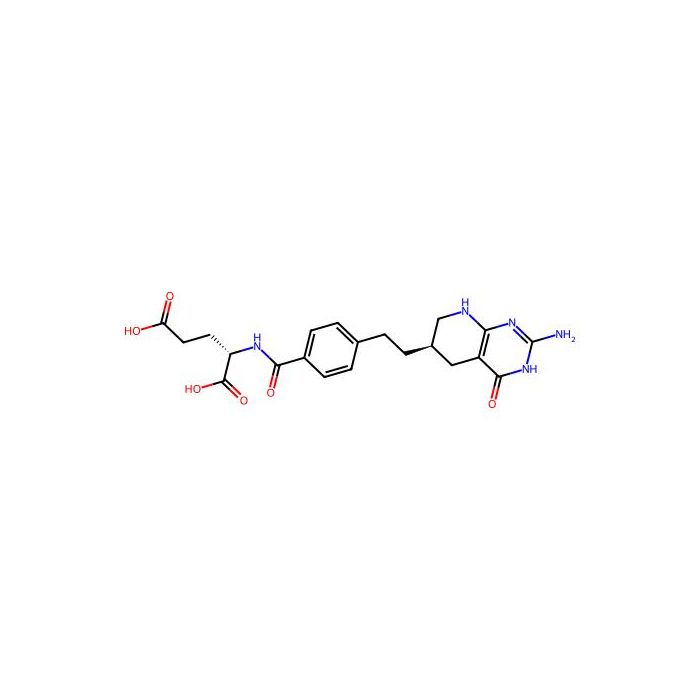
Lometrexol (DDATHF), an antipurine antifolate , can inhibit the activity of glycinamide ribonucleotide formyltransferase (GARFT) but do not induce detectable levels of DNA strand breaks. Lometrexol can further inhibit de novo purine synthesis, causing abnormal cell proliferation and apoptosis , even cell cycle arrest. Lometrexol has anticancer activity. Lometrexol also is a potent human Serine hydroxymethyltransferase1/2 ( hSHMT1/2 ) inhibitor .
In Vitro
Lometrexol (DDATHF) binds tightly to GART, resulting in a rapid and prolonged depletion of intracellular purine ribonucleotides. Lometrexol (1-30 μM; 2-10 hours) induces rapid and complete growth inhibition in L1210 cells. Lometrexol (1 μM; 2-24 hours) induces cell cycle arrest in murine leukemia L1210 cells. MCE has not independently confirmed the accuracy of these methods. They are for reference only. Cell Viability AssayCell Line: Mouse leukemia L1210 cells Concentration: 1, 30 μM Incubation Time: 2, 4, 6, 8, 10 hours Result: Induced rapid and complete growth inhibition. Cell Cycle AnalysisCell Line: L1210 cells Concentration: 1 μM Incubation Time: 2, 4, 8, 12, 24 hours Result: Caused a rapid loss of the G2/M phase population of cells and an early S phase accumulation of cells by 8 hours. By 24 h, the S phase population appeared to be slowly shifting to higher DNA content, and hence, from mid-to-late S phase.
In Vivo
Lometrexol (DDATHF; i.p.; 15-60 mg/kg; on gestation day 7.5) induces neural tube defects (NTDs) by disturbing purine metabolism and increases the rate of embryonic resorption and growth retardation in a dose-dependent manner . Lometrexol (i.p.; 40 mg/kg; on gestation day 7.5) decreases glycinamide ribonucleotide formyl transferase (GARFT) activity and Changes of ATP, GTP, dATP and dGTP levels . Lometrexol (i.p.; 40 mg/kg; on gestation day 7.5) induces abnormal proliferation and apoptosis exist in neural tube defects (NTDs) . MCE has not independently confirmed the accuracy of these methods. They are for reference only. Animal Model: C57BL/6 mice (7-8 week, 18-20 g) Dosage: 15, 30, 35, 40, 45 and 60 mg/kg Administration: Intraperitoneal injection; on gestation day 7.5 Result: Increased the rate of embryonic resorption and growth retardation in a dose-dependent manner. Animal Model: C57BL/6 mice (7-8 week, 18-20 g) Dosage: 40 mg/kg Administration: Intraperitoneal injection; on gestation day 7.5, for 0, 6, 24, 48 and 96 hours Result: Inhibited glycinamide ribonucleotide formyl transferase (GARFT) activity and GARFT activity was maximally inhibited after at 6 hours. Decreased the levels of ATP, GTP, dATP, and dGTP of NTDs embryonic brain tissue significantly at 6 hours. Animal Model: C57BL/6 mice (7-8 week, 18-20 g) Dosage: 40 mg/kg Administration: Intraperitoneal injection; on gestation day 7.5, for 4 days Result: Decreased the expression of proliferation-related genes (Pcna, Foxg1 and Ptch1) and increased the expression of apoptosis-related genes (Bax, Casp8 and Casp9) in NTD groups.
| Isomères SMILES | C1[C@H](CNC2=C1C(=O)NC(=N2)N)CCC3=CC=C(C=C3)C(=O)N[C@@H](CCC(=O)O)C(=O)O |
|---|---|
| CAS alternatif | 106400-81-1;120408-07-3;1435784-14-7 |
| Termes d'entrée MeSH | 5,10-DDTF;5,10-dideaza-5,6,7,8-tetrahydrofolic acid;5,10-dideazatetrahydrofolate;5,10-dideazatetrahydrofolic acid;DDATHF;lometrexol;lometrexol, (6R)-isomer;lometrexol, (6S)-isomer |
| Poids moléculaire | 443.5 |
Comprehensive hazard, handling, storage, and regulatory compliance document.
Download SDS →Lot-specific quality data. Enter your lot number to retrieve the exact COA.
Look up COA →Full quality attributes and acceptance criteria for this grade.
View spec sheet →| Activity Type | Activity Value -log(M) | Mechanism of Action | Activity Reference | Publications (PubMed IDs) |
|---|