Determine the necessary mass, volume, or concentration for preparing a solution.
Dilution Calculator
Determine the dilution needed to prepare a stock solution.
Reconstitution Calculator
Avis
Avis des clients
Application Protocols
No tested application protocols are provided for this item.
General guidance for small-molecule screening use (not item-specific):
Stock preparation: Dissolve in anhydrous DMSO to a convenient concentration (commonly 10 mM). Filter through 0.22 µm PTFE if sterility is required.
Serial dilution: Prepare intermediary DMSO dilutions to minimize aqueous precipitation; back-dilute into assay buffer to achieve final solvent content typically ≤0.5–1% v/v (assay-dependent).
Controls: Include vehicle control (matching DMSO %), positive control (known active if available), and negative control. Run technical replicates and at least 8–10-point dose–response for potency estimation.
Stability checks: Verify compound integrity in the assay plate over the experiment duration (light sensitivity, adsorption to plastic) using LC–MS or UV–vis where feasible.
All parameters above are general recommendations; optimize for your specific assay system.
Biological Roles
Item-specific biological function, target class, or pathway association for LY3405105 is not provided in this listing. Without structural and mechanistic details, no definitive biological role can be assigned.
General guidance for small-molecule library members in research:
Potential roles: tool compound for interrogating biochemical pathways, validating screening hits, or benchmarking assay performance when a known MoA is available. For uncharacterized compounds, begin with broad profiling (e.g., cytotoxicity counterscreens, off-target panels when feasible).
ADME considerations (general): Basic physicochemical profiling (clogP, pKa, TPSA) and simple in vitro assays (solubility, microsomal stability, permeability) can help rationalize observed bioactivity and guide assay conditions.
Aggregation and interference: Screen for PAINS-like motifs and colloidal aggregation to avoid false positives; use orthogonal readouts and detergent controls.
Important: This product is for research use only. No medical, diagnostic, or clinical claims are made or implied.
Buffer Applications
Not typically applicable. LY3405105 is listed as a small-molecule library compound and is not a buffering agent or pH standard.
Practical note (general):
When preparing assay buffers that include organic co-solvents (e.g., DMSO ≤0.5–1% v/v), confirm that buffer capacity and pH remain stable upon compound addition. Filter-sterilize and degas as required by your assay. Record final solvent percentage to ensure comparability across experiments.
Green Alternatives
This product is a discrete small-molecule library compound rather than a process solvent or commodity reagent. As such, “green alternative” substitution is generally not applicable in the conventional sense.
General sustainability considerations for discovery compounds:
Solvent choice: Prefer greener diluents (ethanol, water-compatible systems) where assay tolerance allows; minimize DMSO volumes and waste.
Miniaturization: Use low-volume screening formats to reduce solvent and compound consumption.
Waste management: Segregate halogenated vs. non-halogenated solvent waste; quench reactive solutions prior to disposal per institutional EHS guidance.
Shipping/storage: Consolidate shipments on cold packs and avoid dry ice unless necessary, to reduce carbon footprint.
If you intend to employ this compound within a synthetic route (e.g., as a building block), evaluate whether functionally similar reagents with greener profiles exist; however, no structural information is provided here to support such a substitution analysis.
Pharmaceutical Uses
No pharmacopeial status or excipient role is provided for this item. It is supplied strictly for research use only.
General context for discovery compounds:
Research-use small molecules may be employed in pre-formulation screening or as tool compounds in non-clinical studies under appropriate institutional oversight. They are not manufactured to GMP and are not intended for human or veterinary use.
If formulation studies are conducted for in vitro/in vivo research, establish solubilization strategies (co-solvents, cyclodextrins, micellar systems) and verify stability and compatibility with the intended route (research context only). All such activities should remain within non-clinical laboratory research frameworks.
Physical Properties
Item-specific physical constants are not supplied in this listing.
Appearance: Not specified for this item; refer to CoA/Spec Sheet.
Molecular weight: Not specified for this item; refer to CoA/Spec Sheet.
Molecular formula: Not specified for this item; refer to CoA/Spec Sheet.
Melting point: Not specified for this item; refer to CoA/Spec Sheet.
Boiling point: Not specified for this item; refer to CoA/Spec Sheet.
Density: Not specified for this item; refer to CoA/Spec Sheet.
Refractive index: Not specified for this item; refer to CoA/Spec Sheet.
Solubility: Not specified for this item; refer to CoA/Spec Sheet.
logP/logD, pKa: Not specified for this item; refer to CoA/Spec Sheet.
General guidance for small-molecule library members (literature/general):
Many screening compounds are supplied as solids or as DMSO stock solutions (e.g., 10 mM). If solid, typical first-line solvents for reconstitution are anhydrous DMSO, DMF, or ethanol, followed by dilution into aqueous buffers containing co-solvent as needed.
Solubility can vary widely with salt form and polymorph. If poor solubility is encountered, consider gentle warming (≤40 °C), sonication, or co-solvent systems (DMSO→aqueous buffer with 0.1–1% DMSO final).
Please consult the batch CoA/Spec Sheet for definitive, item-specific physical data.
Quality and Grades
Grade/Purity: Not specified for this item; refer to CoA/Spec Sheet.
Context and expectations for small-molecule library compounds (general guidance):
Library/screening grade compounds are commonly provided with LC–MS identity confirmation and HPLC purity (often ≥95% or ≥98%), but exact thresholds vary. Always review the batch-specific CoA, which should list analytical method(s), purity by HPLC/UPLC, LC–MS m/z, and, when available, 1H NMR.
If a stabilizer, salt form, or counterion is used, it should be declared on the CoA. Absence of such a note in this listing does not confirm absence—verify with documentation.
For photo/air/moisture-sensitive compounds, packaging under inert gas with desiccant/amber vials may be used; check label/CoA for such notations.
If you require specialized grades (e.g., salt-free base, chiral enrichment, isotopic labeling, or ultra-dry specifications), contact Technical Support with the SKU (L413667) to discuss availability and lead time.
Recommendation:
Prior to SAR or quantitative biology, confirm purity on your platform (orthogonal HPLC method) and verify identity by HRMS or NMR, especially if the structure is used for publication-quality data.
Reaction and Applications
Manufacturer Applications: Not provided in the listing. The compound is categorized under a small-molecule/compound library, suggesting use in discovery research rather than as a general-purpose synthetic reagent.
General applications for library compounds (non-item-specific):
Biochemical and cell-based screening: Evaluate target engagement, phenotypic responses, or as a tool compound for pathway interrogation. Establish DMSO stock solutions (e.g., 10 mM) and apply serial dilutions for dose–response curves.
Mechanistic studies: Probe structure–activity relationships (SAR) in conjunction with analog series. Use orthogonal readouts (biochemical vs. cellular) to deconvolute permeability/efflux effects.
Chemical biology: Potential use with chemoproteomic workflows if tagged analogs are available; otherwise, perform competition assays to assess selectivity.
Notes and practical tips (general):
Validate compound identity and purity prior to critical experiments; re-check after long storage.
Assess stability in assay media (pH 7.4, presence of reductants, serum proteins). Conduct a short-term stability panel (room temperature vs. 4 °C over 24–48 h) by LC–MS.
Control for solvent effects and colloidal aggregation (consider detergent controls, e.g., 0.01% Tween-20, and DLS if available).
Because no structure or reactivity information is provided, this item is not recommended for use as a synthetic reagent without further documentation.
Reaction Conditions
Not applicable. This item is not presented as a reagent and lacks structural/functional information needed to specify reaction conditions.
General laboratory handling of small-molecule stocks (non-reaction context):
Prepare concentrated DMSO stocks (e.g., 10–50 mM) under dry conditions; vortex and, if needed, sonicate briefly to ensure dissolution.
Filter sterilize through 0.22 µm PTFE for cell-based assays when appropriate and compatible.
Upon dilution into aqueous media, confirm absence of precipitation by visual inspection and by analytical readouts (UV–vis baseline, LC–MS).
Safety and Handling
Hazard classification for this specific item is not provided in the listing. Always consult the SDS for authoritative safety information.
GHS classification: Not specified for this item; refer to SDS.
Signal word / H-statements / Pictograms: Not specified for this item; refer to SDS.
General laboratory precautions for small organic molecules:
PPE: Wear lab coat, safety glasses, and suitable chemical-resistant gloves. Handle powders/aliquots in a fume hood to avoid inhalation of dust or aerosols.
Avoid skin/eye contact and inhalation. Prevent environmental release. Use secondary containment during weighing and solution prep.
Incompatibilities: Unknown for this specific compound; avoid strong oxidizers and strong acids/bases unless compatibility is confirmed. Keep away from ignition sources if solvent is flammable.
First aid (overview): In case of skin/eye contact, rinse with water for at least 15 minutes; remove contaminated clothing. If inhaled, move to fresh air. If ingested or if symptoms occur, seek medical attention. Provide SDS to responders.
Spill/accidental release: Absorb with inert material; collect in a compatible, labeled waste container. Decontaminate surfaces per institutional protocols.
Storage per Product Data:
Store at −20 °C (as provided). Maintain container tightly closed under dry, inert conditions when feasible. Minimize freeze–thaw cycles of solutions by aliquoting.
Waste disposal: Dispose according to local regulations for organic chemical waste.
Solvent Selection
Item-specific solubility/miscibility are not provided. The guidance below is general for small-molecule screening compounds.
Primary reconstitution solvent (general): Anhydrous DMSO is most commonly used due to broad solvating power and compatibility with screening workflows.
Alternative solvents: DMF, ethanol, methanol, acetonitrile. Transition to aqueous media by serial dilution into buffers containing 0.1–1% co-solvent to minimize precipitation.
Water solubility: Unknown for this item; assess experimentally. If a salt form is available, it may enhance aqueous solubility.
Dielectric/polarity considerations (general):
DMSO (ε ≈ 47, literature) dissolves many polar and moderately nonpolar compounds.
DMF (ε ≈ 37, literature) similar but more volatile concerns.
EtOH/MeOH provide faster evaporation but narrower solubility scope for very lipophilic scaffolds.
DMF: strong solvent; higher toxicity; often avoided in bioassays.
EtOH/MeOH: good for less hydrophobic compounds; higher assay tolerance up to ~1–2% v/v (protocol-dependent).
Tip: Run a miniature solubility screen (e.g., DMSO, EtOH, ACN) and check for precipitation after dilution into assay buffer at intended final solvent %. Record solvent lot and water content for reproducibility.
Storage and Reconstitution
Storage (item-specific):
Store at −20 °C (as provided).
Shipped in an ice chest with ice pads (as provided). Inspect upon receipt; return to recommended storage promptly.
Additional handling guidance (general for small molecules):
Keep container tightly sealed in a dry environment. If moisture- or light-sensitive, protect with desiccant and amber vials (verify sensitivity on CoA/SDS).
Minimize freeze–thaw by aliquoting solids/solutions into single-use portions.
Initial solvent: Anhydrous DMSO is a common first choice. Start with a small volume, vortex, and sonicate gently if needed. Record exact concentration and solvent lot.
Working solutions: Dilute into assay buffer or medium, targeting a final DMSO content typically ≤0.5–1% v/v to reduce solvent effects. Confirm clarity and absence of precipitate.
Long-term solution storage: Store DMSO stocks at −20 °C to −80 °C in tightly sealed, inert-atmosphere vials. Avoid repeated freeze–thaw cycles; use aliquots.
Labeling and documentation:
Clearly label SKU (L413667), batch/lot, concentration, solvent, and preparation date. Retain CoA/SDS for reference.
Note: Where specific parameters are required (e.g., exact solubility limits, stability in light/air), they are Not specified for this item; refer to CoA/Spec Sheet.
Structure and Identity
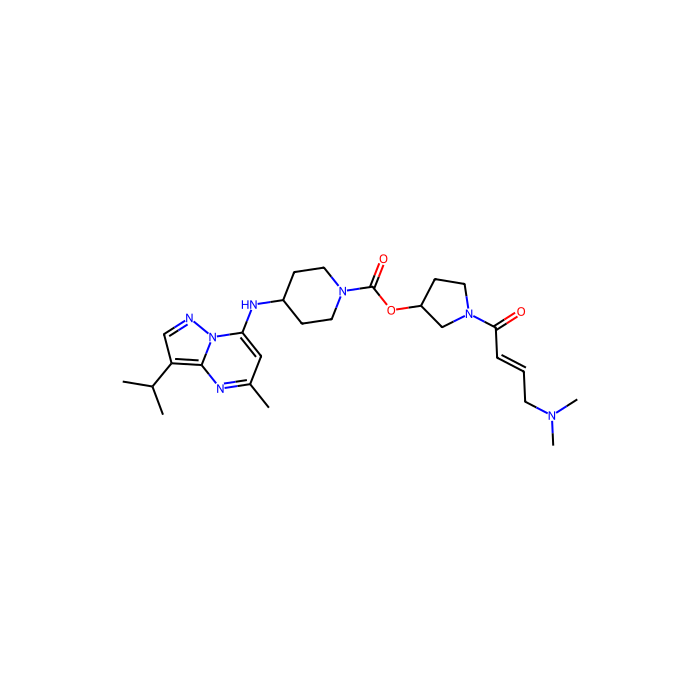
Brief overview: LY3405105 is listed as a small-molecule library compound. Item-specific structural identifiers are largely not provided in the current product data.
CAS: 2326428-25-3 (as provided)
PubChem CID: 138608764 (as provided)
InChIKey: 109371 (as provided; note: this is not a standard-length InChIKey; consult CoA/SDS or PubChem record for the canonical identifier)
SMILES: Not specified for this item; refer to CoA/Spec Sheet.
Molecular formula: Not specified for this item; refer to CoA/Spec Sheet.
Molecular weight: Not specified for this item; refer to CoA/Spec Sheet.
Specific functional groups, ring systems, and stereochemistry are not provided in this listing. Without a structure, a precise 2D description cannot be given. Please refer to the supplier’s CoA/Spec Sheet or the cited CAS/CID record for the definitive structural representation.
Identification guidance (general):
For library compounds with limited public identifiers, cross-verify CAS, internal SKU, and any batch-specific barcodes. If available, request NMR, LC–MS, and HPLC purity traces for confirmation prior to critical experiments.
Synthetic Utility
Not applicable based on available information. LY3405105 is listed as a small-molecule library compound with no disclosed structure or functional group annotations; therefore, no specific synthetic transformations or building-block applications can be recommended.
General note:
If structural information becomes available (e.g., presence of handle groups such as aryl halides, boronates, alkynes, amines, or carboxylic acids), standard cross-couplings (Suzuki–Miyaura, Buchwald–Hartwig, Sonogashira), amide couplings, or click chemistry might be considered to generate analogs or probes. Absent such data, treat the compound as a finished entity rather than a synthetic intermediate.
Target Specificity
No target, enzyme/receptor class, or binding data are provided for LY3405105 in this listing.
Target/epitope/clone/isotype: Not specified for this item; refer to CoA/Spec Sheet.
Recommendation:
If this compound is intended as a tool for a defined target, request or generate target engagement data (e.g., biochemical IC50/Ki, thermal shift, CETSA, NanoBRET) and include orthogonal confirmation to mitigate assay interference risk.
We use cookies to ensure the website functions properly and, where permitted, to improve your experience. You can manage your preferences at any time in Settings. Learn more in our Cookie Policy.
Shall we send you a message when we have discounts available?
Remind me later
Thank you! Please check your email inbox to confirm.
Products are supplied to verified businesses, institutions, and qualified professionals for research and development use only. Not for use in humans, animals, diagnosis, or therapy.

 C2624091