Determine the necessary mass, volume, or concentration for preparing a solution.
Dilution Calculator
Determine the dilution needed to prepare a stock solution.
Reconstitution Calculator
Avis
Avis des clients
Application Protocols
Not applicable. There are no WB/IHC/IF/FC protocols for this chemical linker. For synthetic use, see the Reaction Conditions and Reaction & Applications sections for general literature guidance on substitutions and workups.
Biological Roles
This product is a synthetic PEG linker for research and materials applications. It is not intended for biological administration. The following points summarize general, literature-based roles of PEG segments; they are provided for context only and are not specific performance claims for this item.
PEG segment behavior (general)
Hydration and stealth: PEG chains form a tightly bound water shell, reducing protein adsorption and surface fouling (antifouling coatings, biomaterials).
Flexibility: PEG functions as a flexible spacer in bioconjugation, distancing ligands from surfaces to improve accessibility.
Solubility enhancement: Short PEGs improve solubility of hydrophobic motifs in organic and mixed media.
Utility of an activated end group (tosylate)
Provides a handle to introduce bio-orthogonal termini (e.g., azide, alkyne after further conversion) enabling click chemistry, or amines/thiols for conjugation to surfaces and macromolecules in subsequent synthetic steps.
Surface and materials context
mPEG-functional motifs are used to prepare PEGylated nanoparticles, polymer brushes, and self-assembled monolayers where the terminal group (after substitution) dictates biological interfacing (e.g., –OH, –NH2, –COOH, –SH).
Buffer Applications
Not typically applicable. mPEG5-OTs is a reactive small-molecule linker rather than a buffering agent. It does not define a conjugate acid/base pair for pH control. For aqueous work, use established buffer systems (e.g., phosphate, HEPES) and perform PEG derivatizations in anhydrous organic solvents before introducing products into buffered media.
Green Alternatives
Greener choices focus on solvent selection, minimizing sulfonate waste, and using catalysis/phase-transfer to reduce energy input. While the tosylate leaving group is efficient, alternatives and greener conditions may be considered.
Greener solvent options (literature/general)
MeCN or 2-MeTHF over DCM/THF when feasible; CPME as an ether alternative with lower peroxide tendency and broader recyclability.
Anhydrous ethanol/i-PrOH for reactions where alcohol nucleophilicity is not problematic (e.g., with strong, selective nucleophiles under basic control).
Process-intensification
Use of solid-supported nucleophiles or phase-transfer catalysts enables reactions in less hazardous media (e.g., toluene or water-lean biphasic systems), reducing DMF/DMSO usage.
Leaving group considerations
Mesylates (OMs) and nosylates (ONs) are alternative sulfonates; mesyl chloride-derived esters can reduce aromatic sulfonyl waste mass but may be less crystalline. Carbonate-based activations (e.g., p-NPC, CDI) may provide milder byproducts (CO2) at the expense of lower SN2 rates.
Energy and waste
Favor room-temperature or mild heating with catalytic iodide (Finkelstein assistance) to accelerate displacement, shortening reaction times and lowering energy usage.
Comparison snapshot (general)
DMF vs MeCN: MeCN reduces EHS concerns and simplifies workup but may dissolve inorganic salts less effectively; consider crown ethers or phase-transfer agents.
Tosylate vs mesylate: tosylates often displace faster on primary PEG termini and are easier to characterize (aromatic probes) but generate more persistent aromatic waste.
Pharmaceutical Uses
No pharmacopeial status or excipient grade is specified for this item; refer to CoA/Spec Sheet. The following are general, non-clinical notes on how related materials are used in formulation chemistry (for research/manufacturing development only):
PEG-based linkers in process chemistry (general)
Serve as soluble spacers to prepare conjugatable intermediates (e.g., mPEG–NH2, –SH, –N3) that can be further coupled to polymers, surfaces, or APIs in prodrug/linker studies.
Enhance solubility of hydrophobic moieties through short PEG tethers in synthetic intermediates.
Manufacturability considerations
Residual p-toluenesulfonate species are strongly UV-active; thorough purification and analytical release testing are required for any GMP pathway.
Moisture control is critical to limit hydrolysis to mPEG–OH and p-TsOH, which can catalyze side reactions.
Regulatory note
This catalog item is sold for research use only. It is not approved for human or veterinary use. Any cGMP application would necessitate dedicated qualification, impurity profiling, and stability studies.
Physical Properties
Appearance: Not specified for this item; refer to CoA/Spec Sheet.
Grade/Purity: Not specified for this item; refer to CoA/Spec Sheet.
Molecular Weight and Formula: Not specified for this item; refer to CoA/Spec Sheet.
General/literature characteristics for mPEGn tosylates (for context only; not specifications for this item):
Physical state: typically a white to off-white solid or a waxy/viscous material at ambient temperature, depending on exact oligomer length and dispersity.
Moderate to poor: nonpolar hydrocarbons (hexanes, heptane). Often extractable with EtOAc or DCM from aqueous media.
Hygroscopicity: PEG segments are hygroscopic; materials can take up moisture from air, which may accelerate tosylate hydrolysis. Handle under dry inert gas.
Partitioning: PEG chain imparts hydrophilicity; tosylate end increases lipophilicity relative to hydroxyl end. Overall amphiphilic behavior typical of short PEGs.
Thermal behavior: alkyl tosylates decompose before boiling at atmospheric pressure; avoid prolonged heating. Store cold and dry to minimize solvolysis.
Note: Do not treat the above as product specifications. For experiment-critical parameters (water content, residual solvents, UV cut-off, refractive index, etc.), consult the item’s CoA/Spec Sheet.
Quality and Grades
Item-specific grade/purity: Not specified for this item; refer to CoA/Spec Sheet.
Guidance on quality attributes for mPEG tosylates (general; for researchers planning applications):
Grade meaning
Research grade mPEG-OTs is supplied for synthetic use where activated end-group fidelity is critical. Low moisture and low acid content are important to preserve the tosylate.
End-group verification
End-group capping efficiency (Me-capped vs. OH-capped impurities) and tosylation completeness materially affect reactivity and degree of functionalization. Typical verification uses 1H/13C NMR (aromatic Ts signals, methoxy singlet), IR (S=O stretches), and sometimes MALDI/ESI MS for oligomer distributions.
Dispersity
Discrete mPEG5 targets a narrow oligomer length; nevertheless, trace distributions (n±1) can occur depending on synthesis. Reported Mn/Mw and dispersity (Ð) should be consulted on the CoA when reaction stoichiometry is critical.
Residuals to monitor
Moisture, p-toluenesulfonic acid, p-toluenesulfonyl chloride, unreacted mPEG–OH, inorganic salts. For chromatography or bioconjugation, residual UV-active toluenesulfonyl species may be undesirable.
Stabilization/packaging
Argon-charged vials, light protection, and cold chain shipment reduce hydrolysis. Desiccant and moisture-barrier packaging are preferred.
For method validation, request the batch CoA/Spec Sheet for actual assay/purity, residual solvent, water content, and analytical data.
Reaction and Applications
mPEG5-OTs is an activated PEG linker enabling terminal substitution via SN2 at the primary carbon bearing the tosylate, while preserving the methoxy cap at the other end. Typical uses include installing azide, halide, thiol, amine, and other functionalities to generate a modular toolbox of mPEG5 derivatives.
Azidation: mPEG5–OTs → mPEG5–N3 using NaN3 (dry DMF or DMSO, 50–80 °C). The azide serves as a precursor to amines (Staudinger reduction) or as a handle for CuAAC click chemistry after further derivatization (e.g., via terminal alkyne on the counterpart).
Halide exchange: mPEG5–OTs → mPEG5–Br/Cl/I using corresponding metal halides (e.g., LiBr in acetone/DMF). Alkyl bromides/iodides show enhanced reactivity in subsequent substitutions.
Thiolation: substitution with KSAc (potassium thioacetate) affords thioacetate, followed by hydrolysis to mPEG5–SH. Useful for Au-thiol SAMs, maleimide coupling, or disulfide chemistry.
Amination: via Gabriel synthesis (phthalimide potassium) then hydrazinolysis to mPEG5–NH2; or direct displacement with ammonia/amine under phase-transfer or high-pressure conditions (primary carbon improves SN2 viability).
Cyanation/SCN: KCN or KSCN in polar aprotic media to introduce versatile masked functionalities.
Practical tips
Maintain anhydrous, inert atmosphere to suppress hydrolysis to mPEG–OH and p-TsOH.
Use slight excess of nucleophile (1.2–3.0 equiv) and salt activators (e.g., KI) to drive SN2.
Monitor by 1H NMR (disappearance of Ts aromatic signals), IR (loss of S=O), or LC-MS/GPC as appropriate.
Reaction Conditions
General, literature-based conditions for converting mPEGn tosylates; adjust based on nucleophile and scale. These are not product specifications.
Azidation (to mPEG–N3)
Solvent: dry DMF or DMSO. Reagents: NaN3 (1.5–3.0 equiv). Temp: 50–80 °C. Time: 4–24 h. Optional: catalytic KI (0.1 equiv). Workup by aqueous quench and extraction (EtOAc/DCM), then silica plug to remove aromatic byproducts.
Halide exchange (to mPEG–Br/I)
Solvent: acetone/DMF. Reagents: LiBr or NaI (3–6 equiv). Temp: reflux in acetone or 40–60 °C in DMF. Time: 2–16 h. Note: Iodide accelerates subsequent substitutions but is more light/air sensitive.
Thiolation (to mPEG–SH)
Step 1: KSAc (2–3 equiv) in dry DMF, 25–60 °C, 4–16 h → thioacetate. Step 2: Hydrolysis (K2CO3/MeOH–H2O) or aminolysis (NH3/MeOH) at 0–25 °C to liberate –SH. Protect from air to avoid disulfide formation.
Amination
Gabriel route: potassium phthalimide (1.5–2.5 equiv) in DMF, 60–80 °C, 8–24 h; then hydrazinolysis (NH2NH2·H2O, EtOH/THF) at 0–25 °C. Direct ammonolysis may require pressure or PTC.
Bases and additives
Mild inorganic bases (K2CO3, Cs2CO3) can activate weak nucleophiles; excess base risks elimination only minimally for primary tosylates but may increase hydrolysis.
Monitoring/purification
NMR (loss of Ts aromatic peaks), IR (loss of S=O), LC-MS/MALDI (mass shift). Purify by precipitation (cold Et2O/hexanes) or chromatography using gradient polarity; remove p-TsOH/TsO− with basic washes.
Always maintain anhydrous, oxygen-limited conditions; inert gas blanket and dry glassware are strongly recommended.
Safety and Handling
Item-specific hazard data (GHS, H-statements, pictograms, signal word): Not specified for this item; refer to SDS.
General safety considerations for alkyl tosylates and PEG derivatives (literature/practice; not a substitute for SDS):
Hazards
Alkyl tosylates are electrophilic and can be irritants to skin, eyes, and respiratory tract; handle in a fume hood.
Hydrolysis and solvolysis can generate p-toluenesulfonic acid (p-TsOH), a strong organic acid that is corrosive.
PPE
Wear suitable lab coat, safety glasses, and chemical-resistant gloves (e.g., nitrile). Use splash protection for scale-up.
Handling and storage
Keep tightly closed under inert gas (argon) in a dry environment. Avoid moisture, bases, strong nucleophiles, and prolonged exposure to light/heat.
Open bottles only after equilibrating to room temperature to prevent condensation; promptly re-purge headspace with inert gas after use.
Incompatibilities (general)
Strong nucleophiles (amines, alkoxides, thiolates), strong bases, and aqueous media promote substitution/hydrolysis.
Avoid contact with reducing agents that may affect the aryl sulfonyl group under forcing conditions.
First aid (overview)
Skin/eye contact: rinse with plenty of water for ≥15 min; remove contaminated clothing. Seek medical attention.
Inhalation: move to fresh air; obtain medical advice if symptoms persist.
Ingestion: rinse mouth; do not induce vomiting; seek immediate medical attention.
Always consult the product’s SDS for authoritative hazard, exposure limits, spill response, and disposal guidance.
Solvent Selection
mPEG5-OTs is an amphiphilic, polar organic–soluble reagent. Solvent choice should balance nucleophile solubility, suppression of competing hydrolysis, and SN2 kinetics.
Polarity/miscibility profile (literature)
Highly soluble: DMF, DMSO, NMP, acetonitrile, THF, dioxane, DCM, acetone, EtOAc; soluble in lower alcohols (MeOH, EtOH) but these compete as nucleophiles under basic conditions.
Limited: aliphatic hydrocarbons (hexanes, heptane). Partly miscible with water depending on concentration; avoid aqueous media unless intentionally hydrolyzing.
Preferred media for substitutions
Polar aprotic solvents (DMF, DMSO, MeCN) maximize SN2 rates and dissolve inorganic nucleophiles (NaN3, KSCN, CsF). For thiolations via thioacetate, dry DMF or MeCN is common.
For phase-transfer approaches, toluene/DCM with quaternary ammonium catalysts can be effective when nucleophiles are inorganic salts.
Drying and water control
Rigorously anhydrous conditions are recommended; pre-dry solvents (molecular sieves, solvent purification systems). Trace water promotes hydrolysis to mPEG–OH and p-TsOH.
Comparison (general)
DMF vs DMSO: DMF offers lower viscosity and easier workup; DMSO better dissolves salts but can over-stabilize anions and complicate extractions.
MeCN: good compromise for many SN2 reactions; lower boiling point aids removal.
THF/dioxane: useful for organometallic/nonaqueous conditions; may require salt solubilizers (crown ethers) for inorganic nucleophiles.
Storage and Reconstitution
Item-specific storage and shipping (from Product Data)
Storage Conditions: Protected from light; Store at −20 °C; Argon charged.
Shipped In: Ice chest + Ice pads.
General handling recommendations (literature/practice)
Minimize moisture exposure. Open vials only after equilibration to room temperature to prevent condensation; promptly re-purge with argon before re-closing.
Store in a desiccator or drybox if possible. Keep in original amber or foil-wrapped container to limit light.
For solution preparation, use anhydrous solvents (e.g., dry DMF, MeCN, DCM, THF). Prepare small aliquots to avoid repeated freeze–thaw and headspace exchange.
Working solutions: for most nucleophilic substitutions, 0.05–0.5 M solutions are practical. Store solutions at ≤−20 °C under inert gas; shelf life depends on solvent dryness and absence of nucleophiles.
Signs of degradation: appearance of p-toluenesulfonic acid odor, increased acidity, or new aromatic signals in NMR; revert to fresh material if detected.
Reconstitution
Not applicable (solid/liquid reagent), but if solidified, gently warm to room temperature under inert gas to liquefy before dispensing. Avoid heating above necessary temperatures and avoid wet solvents.
For long-term stability claims or re-test dates, consult the batch CoA/Spec Sheet.
Structure and Identity
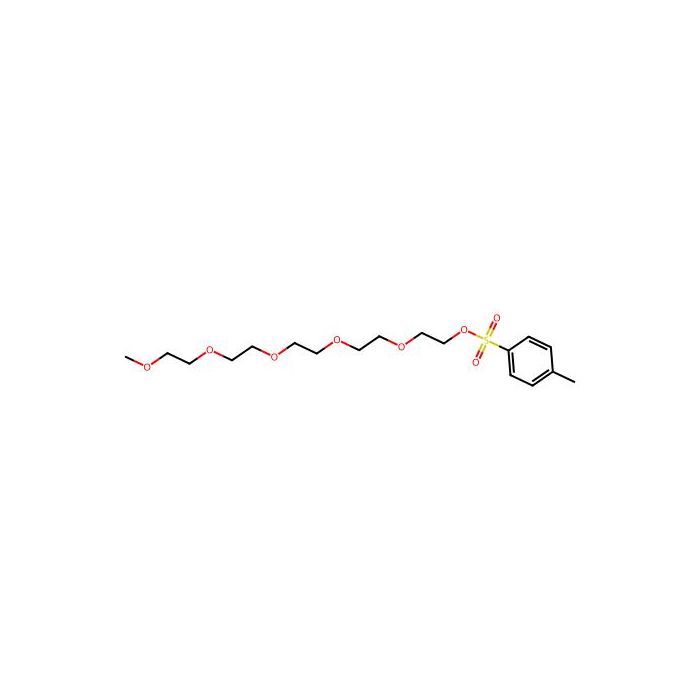
A monofunctional polyethylene glycol oligomer bearing a terminal p-toluenesulfonate (tosylate) leaving group and a methoxy cap on the opposite end. The product is commonly described as mPEG5-OTs, i.e., MeO-(CH2CH2O)5-OTs.
Item-specific identifiers (from Product Data)
SKU: M595730
Product Name: mPEG5-OTs
CAS: 80755-67-5
CID: 10341292
InChIKey: Not specified for this item; refer to CoA/Spec Sheet.
SMILES: Not specified for this item; refer to CoA/Spec Sheet.
Molecular Formula: Not specified for this item; refer to CoA/Spec Sheet.
Molecular Weight: Not specified for this item; refer to CoA/Spec Sheet.
Structural features (general description, literature)
Backbone: linear oligomer of five ethylene oxide units (–CH2–CH2–O–)5.
End groups: one terminus is methoxy (–O–CH3); the other is converted from –OH to a tosylate ester (–O–SO2–C6H4–CH3, para).
Functional group class: alkyl tosylate (activated sulfonate ester), an excellent SN2 leaving group for downstream derivatization.
Stereochemistry: none (achiral oligomer; aryl tosyl group is para-substituted).
2D structure in words
A linear polyether chain of five repeating –CH2–CH2–O– units, capped on one end by a methyl ether and on the other by an oxygen linked to a p-toluenesulfonyl group (para-methylphenyl–SO2–).
Synthetic Utility
The tosylate end group transforms a terminal primary alcohol of mPEG5 into a powerful electrophile for SN2 chemistry while retaining the methoxy cap. This enables modular access to a wide array of monofunctional PEG derivatives with precise spacer length.
Functional group portfolio enabled from mPEG5–OTs (literature/general)
–N3 (NaN3) → amine via Staudinger or catalytic hydrogenation; click-ready when paired with alkyne partners after further derivatization.
–X (X = Br, I) via halide exchange → increased reactivity for further substitutions.
–SH via thioacetate substitution and deprotection → gold/silver surface coupling, Michael additions to maleimides.
–NH2 via Gabriel or direct ammonolysis → amide couplings, urea/thiourea formation, NHS-ester reactions after activation.
–SCN/–CN or other heteroatom installs (e.g., Se, P) for specialized coupling strategies.
Retrosynthetic value
Treats the PEG chain as a masked alcohol electrophile; allows late-stage diversification of a single stocked intermediate into many terminally functionalized PEG5 variants, reducing inventory.
Selectivity and orthogonality
Methoxy cap prevents undesired bifunctionalization; PEG backbone is inert to many conditions, enabling orthogonal transformations on the terminal carbon only.
Characterization advantages
Tosyl aromatic signals (δ ~7.3–7.8 ppm) provide convenient NMR handles for reaction monitoring and completeness checks.
Target Specificity
Not applicable. This product is a small-molecule polymer linker (mPEG5 tosylate), not an antibody or biological probe with antigen/epitope specificity. No clone, isotype, or species reactivity information applies.
Foire aux questions
What is the purity of this product?
This product is supplied at ≥98% purity (chemical assay). Lot-specific values are stated on the Certificate of Analysis.
How should this product be stored?
Store at ?20 °C, protected from light, under argon. It is supplied under an argon blanket; reseal under inert gas after each use.
How is this product shipped?
This product ships in an insulated container with ice pads. Unpack on arrival and transfer it to the storage condition stated above.
What are the CAS number, molecular formula and molecular weight?
The CAS Number is 80755-67-5, the molecular formula is C18H30O8S, and the molecular weight is 406.49 g/mol.
What documentation is provided?
Available product documentation, including Certificates of Analysis (COA), Safety Data Sheets (SDS), and specification sheets, is shown in the product document area. Document availability and access follow the current site policy.
Nous utilisons des cookies pour garantir le bon fonctionnement du site et, lorsque cela est autorisé, pour améliorer votre expérience. Vous pouvez gérer vos préférences à tout moment dans les Paramètres. Pour en savoir plus, consultez notre Politique relative aux cookies.
Souhaitez-vous que nous vous envoyions un message lorsque des réductions seront disponibles?
Me rappeler plus tard
Merci ! Veuillez vérifier votre boîte de réception e-mail pour confirmer.
Products are supplied to verified businesses, institutions, and qualified professionals for research and development use only. Not for use in humans, animals, diagnosis, or therapy.

 J2613671