≥98% for sensitive chromatographic and analytical workflows requiring minimal baseline interference.
🌡
Storage & shipping
Store at -20°C Ships Ice chest + Ice pads Check lot-specific COA for exact specifications.
📋
Quality documents
SDS, COA, datasheet, and spec sheet available for download. Lot-specific COA accessible via lot number lookup.
📚
Literature proof
Cited in 0 peer-reviewed publications across chromatography, organic synthesis, and cross-coupling reactions.
Vue d’ensemble
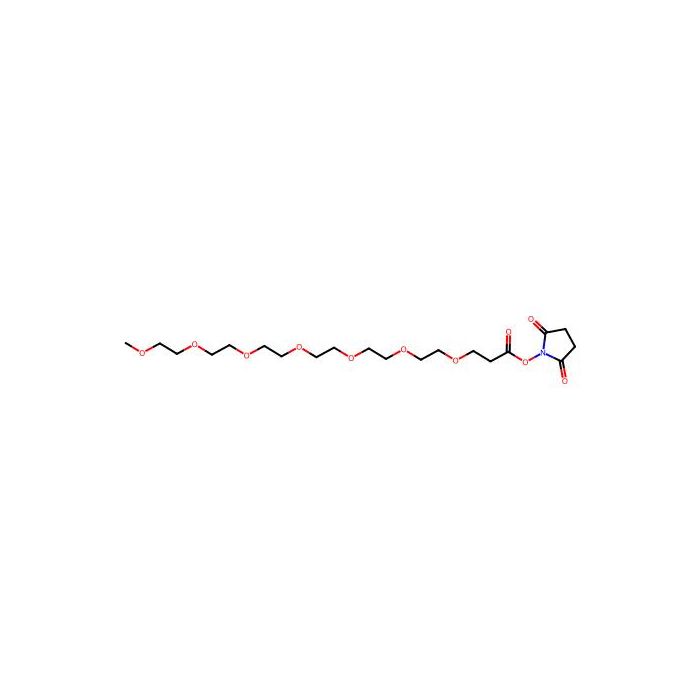
m-PEG7-NHS ester is a PEG derivative containing an NHS ester. The NHS ester can be used to label the primary amines (-NH2) of proteins, amine-modified oligonucleotides, and other amine-containing molecules. The hydrophilic PEG spacer increases solubility in aqueous media.
Specifications
Spécifications et pureté
≥98%
Conditions de stockage de stockage
Store at -20°C
Expédié en
Ice chest + Ice pads
Ce produit nécessite l'expédition en chaîne froide. Les services terrestres et autres services économiques ne sont pas disponibles.
Pureté
≥98%
Noms et identifiants
Sourires canoniques
COCCOCCOCCOCCOCCOCCOCCC(=O)ON1C(=O)CCC1=O
Isomères SMILES
COCCOCCOCCOCCOCCOCCOCCC(=O)ON1C(=O)CCC1=O
PubChem CID
57890912
Poids moléculaire
465.5
Documentation
📋 Safety Data Sheet (SDS)
Comprehensive hazard, handling, storage, and regulatory compliance document.
Certificats (CoA, COO, BSE/TSE et tableau d'analyse)
C of A & Other Certificates(BSE/TSE, COO):
Analytical Chart:
Propriétés chimiques et physiques
Poids moléculaire
465.500 g/mol
XLogP3
-1.900
Hydrogen Bond Donor Count
0
Hydrogen Bond Acceptor Count
11
Rotatable Bond Count
23
Exact Mass
465.221 Da
Monoisotopic Mass
465.221 Da
Topological Polar Surface Area
128.000 Ų
Heavy Atom Count
32
Formal Charge
0
Complexity
502.000
Isotope Atom Count
0
Defined Atom Stereocenter Count
0
Undefined Atom Stereocenter Count
0
Defined Bond Stereocenter Count
0
Undefined Bond Stereocenter Count
0
The total count of all stereochemical bonds
0
Covalently-Bonded Unit Count
1
Calculateurs de solution
Molarity Calculator
Determine the necessary mass, volume, or concentration for preparing a solution.
Dilution Calculator
Determine the dilution needed to prepare a stock solution.
Reconstitution Calculator
Avis
Avis des clients
Application Protocols
Tested application details (WB, IHC, IF, FC, etc.) and recommended dilutions are not provided for this item. Refer to the literature and your internal SOPs for protocol development. For general guidance on coupling conditions with NHS esters, see the Reaction Conditions and Buffer Applications sections. Always validate reaction parameters (stoichiometry, pH, time) empirically for your specific substrate.
Biological Roles
Scope (literature/general; no medical claims)
Poly(ethylene glycol) (PEG) is biologically inert, hydrophilic, and reduces non-specific interactions and protein adsorption. Attaching PEG chains (PEGylation) can modulate hydrodynamic size, solubility, and reduce surface fouling in biological systems.
m-PEG7 introduces a short, flexible spacer that can improve aqueous compatibility and decrease aggregation of conjugates in research settings.
Biochemical considerations
Site selectivity: NHS esters preferentially modify accessible primary amines on proteins (lysine residues or N-termini). Protein function may be affected depending on modification site and degree—empirically determine acceptable substitution levels.
Charge and hydrophilicity: Installation of a neutral PEG reduces net positive charge density when consuming lysine amines; this can alter isoelectric point and binding profiles (literature).
Stability: The resulting amide bond is generally stable to physiological pH; hydrolysis of unreacted NHS occurs rapidly in aqueous media, which can be used to self-quench after reaction.
Practical notes for biological workflows
Use amine-free buffers (phosphate, HEPES) during conjugation; avoid Tris/glycine.
For cell-facing research materials, thoroughly remove residual NHS and organic cosolvent via dialysis, spin filtration, or SEC to minimize non-specific effects.
Reminder
Research use only. Not for diagnostic, therapeutic, or in vivo clinical use.
Buffer Applications
This product is not itself a buffering agent; however, NHS–amine conjugations are conducted in specific buffers. Guidance below is general (literature) and intended to support experimental design.
Suitable buffer systems (amine-free)
Phosphate (50–100 mM), HEPES, or bicarbonate/carbonate buffers at pH 7.5–8.5 provide good rates with manageable hydrolysis.
Ionic strength: Moderate salt (e.g., 150 mM NaCl) can maintain protein stability without strongly affecting reaction kinetics.
Buffers to avoid
Primary/secondary amine-containing buffers (Tris, glycine, ammonium bicarbonate) will consume NHS ester and suppress conjugation.
Practical recipes (general)
PBS (amine-free): 50 mM phosphate, 150 mM NaCl, pH 7.8–8.0.
Carbonate: 50–100 mM NaHCO3/Na2CO3, pH 8.3–8.5 for faster reaction on less reactive amines (balance with hydrolysis risk).
Workflow tips
Prepare a fresh anhydrous stock of m-PEG7-NHS in DMF/DMSO. Add to the buffered amine solution with mixing. Typical reaction time: 15–120 min at room temperature (literature).
After conjugation, quench residual NHS ester with ethanolamine or Tris, then exchange buffer (dialysis, SEC, ultrafiltration) to remove by-products and organic cosolvent.
Green Alternatives
Context (literature/general)
The principal environmental concerns with NHS-PEG couplings are solvent choice, moisture-driven waste from hydrolysis, and the use of DMF/DCM. Greener practices focus on solvent substitution, process intensification, and minimizing excess reagent.
Greener solvent options
Replace DCM with ethyl acetate or 2-MeTHF for non-aqueous couplings when solubility allows.
Substitute DMF with dimethyl carbonate (DMC) or propylene carbonate for some small-molecule couplings; for bioconjugation, aqueous buffers with minimal DMSO (≤10%) often suffice.
Process improvements
Micro- or flow-scale addition of anhydrous stocks into buffered streams reduces hydrolysis losses.
Use solid-phase or immobilized amine substrates to simplify workup and reduce solvent volumes.
Optimize pH to minimize hydrolysis while maintaining acceptable kinetics, reducing the amount of excess reagent required.
Comparison summary (general)
DMF/DMSO: High performance, but environmental/worker exposure concerns; good when limited to small volumes and single-use aliquots.
2-MeTHF/Ethyl acetate: Better EHS profile than DCM; viability depends on reagent and substrate solubility.
Aqueous buffer with minimal cosolvent: Often the greenest route for biomolecule conjugations if stability permits.
Note: Selection must be validated experimentally; solubility of m-PEG7-NHS and the substrate governs feasible green substitutions.
Pharmaceutical Uses
No therapeutic or clinical claims are made for this product. The following describes general formulation/manufacturing roles (literature/general) relevant to research and development only.
Role in R&D and manufacturing
PEGylation reagent: m-PEG7-NHS ester is used to derivatize amine-containing actives, peptides, or excipients to adjust solubility, reduce aggregation, and alter surface properties in pre-formulation studies.
Surface passivation: Short PEG layers can decrease protein adsorption on device components or analytical surfaces during development testing.
Excipient context
PEG derivatives and PEGylated excipients are broadly used in formulations for stability and processability; specific pharmacopeial monographs typically cover base PEGs rather than functionalized NHS esters.
Practical considerations
Residuals: Remove NHS and organic solvents thoroughly after reactions (e.g., by precipitation, dialysis, or chromatography).
Characterization: Verify degree of substitution and free-PEG content by SEC, LC-MS, or NMR to ensure batch-to-batch consistency in research materials.
Compliance note
Any use in regulated products requires full qualification of raw materials and processes. This catalog item is for research use only, as stated in the Product Data.
Physical Properties
Item-specific (Product Data)
Appearance: Not specified for this item; refer to CoA/Spec Sheet.
Grade/Purity: Not specified for this item; refer to CoA/Spec Sheet.
Literature/general physical data (non-item-specific)
Physical state: typically a white to off-white solid or waxy solid for low-PEG-length NHS esters.
Solubility: NHS-activated PEGs are soluble in polar organic solvents (anhydrous DMF, DMSO, acetonitrile) and miscible to varying degrees with water; hydrolysis occurs in aqueous media, especially above neutral pH (literature).
Hygroscopicity: PEG segments are hygroscopic; NHS esters are moisture-sensitive and hydrolyze to the non-reactive carboxylate (literature).
Partitioning: PEG confers hydrophilicity (low logP compared with alkyl analogs); exact logP for m-PEG7-NHS is not typically reported (literature).
pKa relevance: The NHS leaving group is part of an activated ester; no intrinsic ionizable center dominates in aprotic media. Hydrolysis rate increases with base catalysis in water (literature).
Thermal behavior: NHS esters can decompose or hydrolyze upon prolonged heating; avoid elevated temperatures during handling (literature).
Practical implications
Prepare solutions immediately before use in anhydrous solvent. For aqueous conjugations, dissolve in dry DMF/DMSO and add to buffered amine solution to minimize pre-hydrolysis.
Quality and Grades
Item-specific (Product Data)
Grade/Purity: Not specified for this item; refer to CoA/Spec Sheet.
How to interpret grade for NHS-PEG reagents (literature/general)
PEGylation-grade or “bioconjugation-grade” materials are typically produced with low residual solvents and minimized reactive impurities (free NHS, acids) that could consume amine targets or cause crosslinking.
Narrow mass distribution: For m-PEG7 reagents, suppliers may provide either discrete (monodisperse) structures or narrowly distributed oligomers. The CoA typically includes average molecular weight and distribution metrics (e.g., Mn, Mw) and residual solvent content.
Low water content: Moisture accelerates hydrolysis; Karl Fischer water and hydrolysis assay (active ester content) are commonly reported on CoAs for NHS esters.
Practical quality checks you can perform (general)
Verify active ester content by amine titration or NMR monitoring of NHS resonance before use.
Inspect by LC-MS or MALDI to confirm mass profile suitable for your application.
Assess hydrolysis by monitoring for succinimide release or carboxylate formation.
Implications for this item
In absence of an explicit grade in the Product Data, consult the CoA/Spec Sheet for purity, active ester content, residual solvent, and water; match these to your application (protein conjugation vs. surface functionalization).
Reaction and Applications
Core chemistry (literature/general)
NHS ester–amine coupling: Rapid acylation of primary amines to form stable amide bonds. Reaction proceeds via nucleophilic attack on the activated carbonyl with NHS as the leaving group.
Selectivity: Primary aliphatic amines react fastest; lysine ε-amines and N-termini on proteins are common targets. Competing hydrolysis is the principal side reaction.
Representative applications
Protein PEGylation: Install a single mPEG7 chain to modulate solubility and reduce non-specific interactions. Control site-selectivity via pH, stoichiometry, or prior protection.
Surface modification: Functionalize amine-presenting surfaces (e.g., aminosilanized glass, nanoparticles, resins) to add a hydrophilic spacer and reduce fouling.
Small-molecule derivatization: Convert amines into PEGylated analogs to tune pharmacokinetic surrogates in discovery research or to adjust chromatographic behavior.
Polymer chemistry: Graft-to strategies on amine-bearing polymers to alter mechanical properties and water uptake.
Practical guidance
pH 7.5–8.5 in aqueous buffers balances reactivity and protein stability; higher pH increases rate but also hydrolysis (literature).
Use 1.2–10 equivalents of reagent per amine depending on desired substitution level; add reagent last as a fresh anhydrous solution.
Reaction times: 15 min to 2 h at room temperature are common; monitor by MS or TNBS/OPA amine assays (literature).
Quenching: Add excess ethanolamine or Tris after conjugation to cap unreacted NHS ester (note: do not use during conjugation).
Reaction Conditions
General conditions for NHS–amine coupling (literature/general)
Solvent: Anhydrous DMF or DMSO stocks; for bioconjugation, add to phosphate or HEPES buffer pH 7.5–8.5. For non-aqueous systems, ACN or DCM may be used when compatible with substrates.
Temperature: 20–25°C typical; 0–4°C for sensitive biomolecules with longer reaction times; 30–37°C may accelerate reactions but increases hydrolysis risk.
Stoichiometry: 1.2–10 equivalents per amine depending on substrate accessibility and desired substitution.
Concentration: 0.1–10 mM for proteins; 5–100 mM for small molecules/surfaces, balancing solubility and rate.
Time: 15–120 minutes is common; monitor progression by MS, SEC, or amine assays (TNBS/OPA).
Additives: Maintain amine-free buffers; include NaCl for protein stability; avoid primary amine buffers.
Expected outcomes (literature)
High conversion to amide with controlled PEGylation when water content is minimized and pH optimized. Principal by-product is N-hydroxysuccinimide.
Workup
Quench with ethanolamine (10–50 mM) after completion. For proteins, purify by SEC or ultrafiltration (10–30 kDa MWCO depending on target). For small molecules, extract or precipitate, then chromatograph if needed.
Notes
Hydrolysis half-life of NHS esters decreases with increasing pH and temperature; prepare and use solutions immediately to maximize effective concentration.
Safety and Handling
Item-specific (Product Data)
Storage Conditions: Store at -20°C
Shipped In: Ice chest + Ice pads
GHS Classification / Signal Word / H-Statements / Pictograms: Not specified for this item; refer to SDS.
Research Use: For research use only.
General safety considerations (literature/general; defer to SDS for authoritative guidance)
Hazards: NHS esters are irritants and react with nucleophiles, particularly primary amines. Moisture sensitivity leads to hydrolysis with heat/alkali.
PPE: Use gloves (nitrile), lab coat, and eye protection. Handle powders in a fume hood to avoid dust inhalation.
Incompatibilities: Water, alcohols, strong bases, and nucleophiles accelerate hydrolysis/consumption. Avoid amine-containing buffers during stock preparation (e.g., Tris, glycine).
First aid (overview): If contacted, rinse skin/eyes with water for ≥15 minutes. If inhaled, move to fresh air. If ingested, rinse mouth; seek medical attention. Always follow institutional SOPs and consult the SDS.
Handling tips specific to NHS esters:
Work quickly under dry conditions; keep containers tightly closed with desiccant.
Prepare fresh solutions in anhydrous DMF/DMSO; add to buffered targets immediately.
Minimize exposure to elevated temperature and light to reduce degradation.
Solvent Selection
Role of solvent for m-PEG7-NHS ester (literature/general)
Polarity: The PEG chain favors polar media; the NHS ester requires anhydrous conditions to avoid hydrolysis.
Recommended anhydrous solvents: DMF, DMSO, acetonitrile, and dichloromethane (for less polar targets). For protein conjugation, prepare a concentrated stock in anhydrous DMF/DMSO and add to buffered aqueous solutions immediately.
Avoid: Alcohols and water during stock preparation; primary/secondary amine-containing buffers (Tris, glycine) in reaction media.
Aqueous buffer compatibility (literature/general)
Use phosphate, HEPES, or bicarbonate buffers (typically pH 7.5–8.5) to maximize reaction rate while limiting hydrolysis. Keep organic cosolvent ≤10–20% v/v to maintain biomolecule stability.
Small comparison (general)
DMF: Excellent solubilizing power; low volatility; straightforward to dry. Preferred for stocks.
DMSO: Biocompatible at low percentages; highly hygroscopic—use molecular sieves.
ACN: Volatile; good for small-molecule couplings; limited protein compatibility.
DCM: Useful for non-aqueous, surface or polymer couplings; immiscible with water.
Practical tips
Degas and dry solvents (3 Å sieves or distillation). Prepare single-use aliquots to minimize moisture uptake.
For hydrophobic targets, consider adding a small proportion of DMF to heterogeneous aqueous reactions to maintain dispersion while minimizing hydrolysis.
Storage and Reconstitution
Item-specific (Product Data)
Storage Conditions: Store at -20°C.
Shipped In: Ice chest + Ice pads.
General handling and storage (literature/general)
Protect from moisture and light. Keep container tightly closed with desiccant. Minimize headspace and warming cycles; NHS esters hydrolyze upon moisture exposure.
Upon receipt, allow the sealed container to equilibrate to room temperature before opening to prevent condensation.
Reconstitution guidance (general)
Prepare single-use aliquots as concentrated stocks (e.g., 10–100 mM) in anhydrous DMF or DMSO. Use freshly prepared solutions; avoid storing solutions unless absolutely necessary.
If short-term storage of solutions is required, keep under dry inert gas at ≤–20°C; expect some loss of activity due to hydrolysis. Validate by test coupling before critical work.
For aqueous reactions, add the anhydrous stock to the buffered target solution immediately prior to use. Do not pre-dissolve in aqueous buffer.
Freeze–thaw guidance
Avoid repeated freeze–thaw of the neat solid and of stock solutions. Aliquot into moisture-tight vials to maintain performance.
Disposal
Dispose of unused solutions and hydrolyzed material according to institutional and local regulations. NHS-containing waste should be collected as organic hazardous waste.
Structure and Identity
Brief overview: m-PEG7-NHS ester is a monofunctional, methoxy-terminated polyethylene glycol with approximately seven ethylene glycol repeat units and an N-hydroxysuccinimide (NHS) activated ester at the opposite terminus. It is a widely used amine-reactive PEGylation reagent for forming stable amide linkages to primary amines on proteins, peptides, small molecules, and surfaces.
Item-specific (Product Data)
SKU: M595605
Product Name: m-PEG7-NHS ester
CAS: 874208-92-1
Molecular Formula: Not specified for this item; refer to CoA/Spec Sheet.
Molecular Weight: Not specified for this item; refer to CoA/Spec Sheet.
SMILES: Not specified for this item; refer to CoA/Spec Sheet.
InChIKey: Not specified for this item; refer to CoA/Spec Sheet.
Structural features: flexible, hydrophilic PEG backbone confers high aqueous compatibility; NHS ester is an excellent leaving group enabling rapid acylation of primary amines to form amide bonds.
2D description in words: a methoxy group linked to a chain of ~7 –CH2–CH2–O– units, terminating in –O–(C=O)–N–O–(succinimide ring) as the activated ester.
Polydispersity: PEG reagents often exhibit a narrow mass distribution around the modal “7-mer” repeat length (literature), unless stated as discrete/monodisperse.
Synthetic Utility
Functional group reactivity (literature/general)
The NHS ester is an activated carboxyl derivative that couples efficiently to primary amines to form amides; secondary amines react more slowly. The methoxy cap prevents crosslinking, enabling monofunctional PEG installation.
Value in synthesis
Spacer installation: Introduces a hydrophilic, conformationally flexible linker that improves solubility and can separate functional modules in bifunctional constructs.
Polarity tuning: PEGylation can shift retention in LC separations and modulate partitioning, aiding purification and analytics for discovery compounds.
Sequential ligations: Install PEG first, then introduce orthogonal functionalities elsewhere on the substrate.
Practical tips
Use slight excess (1.2–3 eq) for small molecules; higher excess for crowded or low-reactivity amines.
Monitor by LC-MS or 1H NMR (disappearance of amine signals/appearance of PEG methylene envelope) and by detection of NHS release.
For solid surfaces, XPS/FTIR and contact-angle measurements confirm successful grafting.
Target Specificity
Not applicable. This product is a chemical PEGylation reagent, not a biological affinity reagent. No antigen/epitope specificity, clone, isotype, or species reactivity applies. Consult the Reaction & Applications and Synthetic Utility sections for relevant use guidance.
Foire aux questions
What is the purity of this product?
This product is supplied at ≥98% purity (chemical assay). Lot-specific values are stated on the Certificate of Analysis.
How should this product be stored?
Store at ?20 °C. Freezer storage is required to maintain the specified shelf life.
How is this product shipped?
This product ships in an insulated container with ice pads. Unpack on arrival and transfer it to the storage condition stated above.
What are the CAS number, molecular formula and molecular weight?
The CAS Number is 874208-92-1, the molecular formula is C20H35NO11, and the molecular weight is 465.5 g/mol.
What documentation is provided?
Available product documentation, including Certificates of Analysis (COA), Safety Data Sheets (SDS), and specification sheets, is shown in the product document area. Document availability and access follow the current site policy.
Nous utilisons des cookies pour garantir le bon fonctionnement du site et, lorsque cela est autorisé, pour améliorer votre expérience. Vous pouvez gérer vos préférences à tout moment dans les Paramètres. Pour en savoir plus, consultez notre Politique relative aux cookies.
Souhaitez-vous que nous vous envoyions un message lorsque des réductions seront disponibles?
Me rappeler plus tard
Merci ! Veuillez vérifier votre boîte de réception e-mail pour confirmer.
Products are supplied to verified businesses, institutions, and qualified professionals for research and development use only. Not for use in humans, animals, diagnosis, or therapy.