≥98% pour les flux de travail chromatographiques et analytiques sensibles nécessitant une interférence de ligne de base minimale.
🌡
Stockage & expédition
Store at -20°C Expédition Ice chest + Ice pads. Consultez le COA spécifique au lot pour les spécifications exactes.
📋
Documents qualité
SDS, COA, fiche technique et fiche de spécifications disponibles au téléchargement. COA spécifique au lot accessible via la recherche par numéro de lot.
📚
Preuve documentaire
Cité dans 0 publications à comité de lecture couvrant la chromatographie, la synthèse organique et les réactions de couplage croisé.
Vue d’ensemble
m-PEG9-NHS ester is a PEG derivative containing an NHS ester. The NHS ester can be used to label the primary amines (-NH2) of proteins, amine-modified oligonucleotides, and other amine-containing molecules. The hydrophilic PEG spacer increases solubility in aqueous media.
Spécifications
Spécifications et pureté
≥98%
Conditions de stockage de stockage
Store at -20°C
Expédié en
Ice chest + Ice pads
Ce produit nécessite l'expédition en chaîne froide. Les services terrestres et autres services économiques ne sont pas disponibles.
Pureté
≥98%
Noms et identifiants
Poids moléculaire
553.6
Documentation
📋 Fiche de données de sécurité (FDS)
Document complet couvrant les dangers, la manipulation, le stockage et la conformité réglementaire.
Certificats (CoA, COO, BSE/TSE et tableau d'analyse)
C of A & Other Certificates(BSE/TSE, COO):
Analytical Chart:
Calculateurs de solution
Molarity Calculator
Determine the necessary mass, volume, or concentration for preparing a solution.
Dilution Calculator
Determine the dilution needed to prepare a stock solution.
Reconstitution Calculator
Avis
Avis des clients
Application Protocols
The following are general, literature-based procedures to illustrate typical use. Adjust conditions to your system.
Protein PEGylation (lysine-targeted):
Prepare protein at 1–10 mg/mL in 50 mM phosphate buffer, pH 7.4–7.8. Optionally include 0–10% dry DMSO.
Make a fresh stock of m-PEG9–NHS ester in dry DMSO (e.g., 50–200 mM). Add to protein with gentle stirring to reach 2–10 molar equivalents per estimated accessible lysine.
Incubate 30–60 min at room temp or 4–10°C for sensitive proteins.
Quench residual NHS ester with 20–50 mM Tris or 50 mM ethanolamine (pH 7.5) for 10–15 min.
Purify by desalting column, SEC, or dialysis; analyze by SDS-PAGE/SEC/MS.
Small-molecule amide formation:
Dissolve amine substrate (1.0 equiv) and base (2.0 equiv DIPEA) in dry DMF or DCM under N2.
Add m-PEG9–NHS ester (1.1–1.5 equiv) at 0–5°C; warm to rt and stir 2–6 h.
Workup by aqueous quench, extract, and purify by column chromatography or HPLC.
Clean/activate surface (e.g., oxygen plasma for polymers or acid wash for silica). Dry thoroughly.
Immerse in dry solvent containing m-PEG9–NHS ester (5–50 mM) and DIPEA (10–100 mM) under anhydrous conditions for 1–4 h at rt.
Rinse with dry solvent, then with alcohol, then water; cure/dry. Verify by contact angle, FTIR, or XPS.
All steps should minimize moisture to preserve NHS activity.
Biological Roles
This product is a synthetic conjugation reagent and does not have intrinsic biological roles. The following context is general background for PEG-based materials in research settings (not clinical claims):
Poly(ethylene glycol) (PEG) is widely used to impart hydrophilicity and steric stabilization to biomolecules and surfaces. Short PEG9 spacers can reduce nonspecific protein adsorption and modulate biodistribution characteristics in model systems.
NHS esters preferentially react with primary amines (e.g., lysine side chains, N-termini) under mild aqueous conditions, allowing chemoselective modification without harsh catalysts.
In biophysical studies, PEG linkers are used to tune molecular spacing, reduce intermolecular interactions, and provide flexible tethers for surface-immobilized ligands or biosensor assay designs.
In cell-free model systems, PEGylation can alter protein isoelectric point and hydrodynamic radius, aiding separation (SEC) or precipitation behavior for analytical purposes.
Limitations and considerations:
Over-PEGylation may impair binding interactions or enzyme activity; empirical optimization of stoichiometry and reaction time is essential.
NHS ester hydrolysis competes with amine coupling in aqueous buffers; rapid addition and controlled pH are crucial for efficient labeling.
Note: For research use only, as indicated in Product Data. No medical or clinical applications are implied.
Buffer Applications
As an amine-reactive NHS ester, this reagent is typically used in mildly basic, minimally nucleophilic buffers for bioconjugation. There is no classical “buffering” role by the reagent itself; rather, buffer choice enables efficient coupling.
Recommended buffers (literature guidance):
Phosphate buffer: 50–100 mM sodium phosphate, pH 7.2–7.8. Balanced rate of amine acylation vs hydrolysis.
Bicarbonate/carbonate buffer: 50–100 mM, pH 8.0–8.6. Faster coupling, but hydrolysis increases; shorten reaction time.
HEPES or MOPS: 25–50 mM, pH 7.2–7.8. Low nucleophilicity and good protein compatibility.
Avoid (competitive nucleophiles):
Tris, glycine, ethanolamine, imidazole—these contain amines that quench NHS esters.
Practical tips:
Include 0–10% v/v dry DMSO or DMF as co-solvent to dissolve hydrophobic substrates while keeping aqueous content high for protein stability.
Maintain temperature at 4–25°C depending on protein stability; colder temperatures reduce hydrolysis but slow reaction.
Typical reaction time: 15–120 minutes with gentle mixing; monitor progress and quench residual reactivity post-coupling (e.g., with Tris or ethanolamine).
All numeric conditions above are general literature guidance; optimize per substrate.
Green Alternatives
Greener practice focuses on solvent selection, process intensification, and minimizing hydrolysis waste rather than changing the functional group (NHS) itself.
Solvent choices (comparison, literature):
DMF vs 2-MeTHF/EtOAc: DMF offers superior solubility/stability but is a reproductive toxin and problematic to remove; 2-MeTHF or ethyl acetate can be greener alternatives for organic-phase couplings when substrate solubility allows and with non-nucleophilic bases (DIPEA). Note: NHS esters are less stable in protic solvents; EtOAc must be rigorously dry.
DMSO (anhydrous) is a viable alternative to DMF with a better environmental profile; ensure low water content.
For bioconjugation, aqueous phosphate or bicarbonate buffers with minimal organic co-solvent reduce VOC usage; keep exposure times short to limit hydrolysis.
Process improvements:
Use concentrated stocks and on-demand addition (flow or microfluidic dosing) to reduce reagent waste.
Adopt in-line desalting or diafiltration to remove NHS byproduct without chlorinated solvents.
Low-temperature storage and aliquoting minimize expired materials.
Alternative activating groups (context):
Carbonate-activated PEGs (e.g., p-NPC) or sulfo-NHS variants can improve water compatibility but introduce different hazards/tradeoffs. Selection should be driven by substrate, aqueous tolerance, and EHS assessments.
Tradeoffs:
Greener solvents may reduce solubility or reactivity; conduct small-scale screens to balance EHS gains with coupling efficiency and hydrolysis control.
Pharmaceutical Uses
This product is provided for research use only. No therapeutic or clinical uses are claimed. In a manufacturing or formulation development context (general background):
Role as a conjugation intermediate: m-PEG9–NHS esters are employed in R&D to derivatize amine-containing APIs, peptides, or excipient matrices, introducing a short PEG spacer to modulate solubility and processability.
Excipient prototyping: PEGylated linkers can be explored to adjust viscosity, wetting, and interfacial properties in experimental delivery systems and coatings for devices (research stage).
Analytical standards: Used to generate PEGylated reference compounds for method development (e.g., LC-MS retention behavior of PEGylated species).
Regulatory/compendial status:
Pharmacopeial monographs and quality attributes are not specified for this item; refer to CoA/Spec Sheet and applicable regulations if considering use beyond basic research.
Process considerations:
Residual NHS and hydrolyzed acid must be controlled through purification (dialysis, SEC, HIC, preparative chromatography) when generating research-grade conjugates.
Document moisture control and storage history of the reagent to ensure reproducibility of conjugation efficiency.
Physical Properties
Item-specific physico-chemical specifications are not provided in the Product Data.
Appearance: Not specified for this item; refer to CoA/Spec Sheet.
Molecular weight: Not specified for this item; refer to CoA/Spec Sheet. (m-PEG reagents of fixed EO count are commonly reported as an average value in literature.)
Molecular formula: Not specified for this item; refer to CoA/Spec Sheet.
General/literature characteristics for short-chain m-PEG–NHS esters (informational):
Physical state: typically low-melting solids or waxy/viscous materials; exact form depends on chain length and purity (literature).
Solubility (literature): readily soluble in polar aprotic solvents (anhydrous DMF, DMSO, acetonitrile), miscible with many alcohols; variable water solubility increases with PEG length. NHS esters hydrolyze in aqueous media.
Partitioning (literature): PEG chains impart hydrophilicity; overall reagent is amphiphilic.
Stability (literature): NHS ester is moisture-sensitive; hydrolyzes faster at higher pH and in water; more stable in dry, aprotic solvents at low temperature.
Refractive index, density, mp/bp, pKa/logP: Not specified for this item; consult literature for analogous m-PEG–NHS reagents if needed for method development.
Note: Use the item’s CoA/Spec Sheet for any numeric property required for regulated or quantitative applications.
Quality and Grades
Grade/Purity: Not specified for this item; refer to CoA/Spec Sheet.
Guidance on interpreting quality for m-PEG–NHS reagents (general):
Purity reporting: often by 1H NMR/13C NMR, HPLC/UPLC, and/or SEC/GPC. For PEGs with discrete EO count, an average MW is typical; minor oligomer distribution can be present.
Functional group integrity: NHS content and residual N-hydroxysuccinimide are commonly assessed. Hydrolysis to the corresponding acid lowers effective activity—freshness and storage history matter.
Water content: critical for reactive esters; Karl Fischer (KF) is typically used. For this specific item, water specification is Not specified for this item; refer to CoA/Spec Sheet.
Residual solvents/metals/UV cutoff: Not specified for this item; refer to CoA/Spec Sheet.
Stabilizers: Many NHS esters are supplied without stabilizers and rely on dry, cold storage; if stabilizers are used, they should be disclosed on the CoA. Not specified for this item; refer to CoA/Spec Sheet.
What the grade means in practice (general):
Research-grade m-PEG–NHS suitable for bioconjugation typically emphasizes low moisture, high assay, and minimal hydrolyzed acid content to ensure efficient coupling to primary amines in proteins, peptides, small molecules, and surfaces.
Reaction and Applications
This reagent is an amine-reactive NHS ester tailored for introducing a short PEG9 spacer via amide bond formation.
Primary application domains (as indicated by the Materials Science category and general NHS ester chemistry):
Protein/peptide PEGylation: coupling to lysine ε-amines or N-termini to modulate hydrophilicity, reduce nonspecific adsorption, and adjust surface properties (research use only).
Surface and material functionalization: grafting m-PEG9 onto amine-bearing substrates (polymers, silica, nanoparticles, membranes) to create antifouling, hydrophilic layers or tune interfacial energy.
Small-molecule derivatization: installation of an m-PEG9 handle to enhance solubility or provide a spacer for subsequent conjugation events.
Mechanistic notes:
NHS esters react with primary amines to form amide bonds via tetrahedral intermediate; NHS is the leaving group. Reaction is base-catalyzed and fastest at mildly basic pH (≈7.5–8.5, literature).
Competing hydrolysis to the carboxylic acid consumes reagent; water and higher pH accelerate this side reaction.
Practical guidance:
Use 1.1–5.0 equivalents of m-PEG9–NHS relative to the nucleophilic amine, depending on substrate accessibility (literature practice).
Maintain low temperatures for stock solutions; add to reaction last to minimize exposure to aqueous media.
For proteins: control stoichiometry, pH, and time to limit over-modification; quench unreacted NHS ester with ethanolamine or Tris (post-conjugation only).
Analytics:
Monitor by LC-MS (small molecules), SDS-PAGE/SEC (proteins), XPS/FTIR/contact angle (surfaces), or 1H NMR for small-molecule models.
Reaction Conditions
General literature guidance for NHS ester–amine coupling (optimize per substrate):
Base: DIPEA, triethylamine, or lutidine (non-nucleophilic) at 1–3 equiv relative to amine.
Temperature: 0–25°C; colder temperatures can suppress side reactions.
Stoichiometry: 1.1–2.0 equiv m-PEG9–NHS per amine; increase if sterically hindered.
Time: 0.5–16 h depending on substrate and temperature.
Aqueous/bioconjugation conditions:
Buffer: 50–100 mM phosphate or bicarbonate, pH 7.2–8.5; avoid amine buffers.
Co-solvent: 0–30% dry DMSO or DMF to aid solubility.
Temperature: 4–25°C depending on biomolecule stability.
Stoichiometry: 2–20 equiv relative to accessible lysines for proteins; titrate to control degree of labeling.
Time: 15–120 min typical; monitor and quench with ethanolamine or Tris after reaction.
Notes on stability and kinetics:
Hydrolysis competes with amine coupling, with rates increasing at higher pH and temperature (literature). Prepare fresh solutions and add last to reaction mixtures.
For surfaces, pre-activate amine sites (cleaning/plasma treatment) to improve coverage; verify by contact angle or XPS.
Expected outcomes:
High conversion to amide under dry conditions with suitable base; yields vary with sterics and substrate accessibility (literature).
Safety and Handling
Hazard classification details are not supplied in the Product Data. Always review the SDS before use.
GHS/Signal word/Pictograms/H-Statements: Not specified for this item; refer to SDS.
Anticipated hazards (general for NHS esters): may cause skin/eye irritation; harmful if inhaled or ingested; causes serious eye irritation; moisture-sensitive reactive ester. Avoid dust/aerosols.
Incompatibilities: water, alcohols, amines, strong bases/acids—these accelerate NHS ester hydrolysis or cause uncontrolled reaction. Keep away from nucleophiles during storage/handling.
PPE: lab coat, safety glasses or face shield, appropriate chemical-resistant gloves (e.g., nitrile), and use in a fume hood when weighing/dissolving. For large-scale operations, consider splash goggles and sleeves.
Handling tips:
Work quickly under dry conditions; pre-dry glassware and solvents.
Minimize exposure to ambient humidity; keep container tightly closed under inert atmosphere or desiccant.
Prepare fresh solutions immediately before use; aliquot to avoid repeated freeze–thaw cycles.
First aid (general):
Skin: wash with soap and water; remove contaminated clothing.
Eyes: rinse cautiously with water for several minutes; seek medical attention if irritation persists.
Inhalation: move to fresh air; seek attention if symptoms occur.
Ingestion: rinse mouth; seek medical advice—do not induce vomiting unless directed.
Waste: collect solutions and rinses as organic waste; quench residual NHS ester by hydrolysis (aqueous buffer) before disposal per institutional and local regulations.
Solvent Selection
m-PEG9–NHS ester is amphiphilic and reactive toward nucleophiles; solvent choice must balance solubility and stability while supporting the intended coupling chemistry.
DMF (dry), DMSO (dry), acetonitrile (dry). These minimize NHS hydrolysis and dissolve PEG reagents efficiently.
For organic-phase couplings to amines: dichloromethane, THF, or 2-MeTHF with a non-nucleophilic base (e.g., DIPEA) can be used when solubility permits.
Aqueous/buffered systems (for biomolecule conjugation):
Use minimally nucleophilic buffers (e.g., phosphate, bicarbonate/carbonate, HEPES) at pH 7.2–8.5 (literature) to promote amine acylation while limiting NHS hydrolysis.
Avoid buffers containing primary/secondary amines (Tris, glycine, imidazole) which compete with the target amine.
Miscibility profile (literature):
Soluble in polar aprotic solvents; often miscible with alcohols (not recommended for reactivity reasons). Water solubility increases with EO count; brief exposure is acceptable during bioconjugation.
Practical tips:
Prepare concentrated anhydrous stock (e.g., in dry DMF or DMSO) and dilute into buffer immediately before use.
If conjugating to poorly soluble amines, co-solvent systems (DMF or DMSO up to 10–30% v/v in buffer) can improve performance while keeping hydrolysis manageable.
Degassing is typically unnecessary; exclude moisture rigorously.
Storage and Reconstitution
Storage conditions (item-specific): Store at -20°C (per Product Data). Keep tightly capped in original container.
Shipping: Shipped in ice chest with ice pads (per Product Data) to maintain low temperature.
Moisture protection: Store under desiccation or inert gas. NHS esters are moisture-sensitive; exposure to ambient humidity shortens shelf life.
Light/temperature: Protect from prolonged light and heat. Thaw only what is needed; return promptly to -20°C after use.
Aliquoting: If supplied in larger quantity, split into small, dry aliquots under inert atmosphere to avoid repeated freeze–thaw and moisture ingress.
Reconstitution and use (general guidance):
Dissolve immediately before use in anhydrous solvent (e.g., dry DMF, DMSO, MeCN). For bioconjugation, dilute the anhydrous stock into the target buffer just prior to addition to the biomolecule.
Typical stock concentrations (literature): 10–200 mM depending on solubility and application. Filter through a dry PTFE syringe filter if particulates are present.
Stability of solutions: Anhydrous stocks are relatively stable on ice for the working day; discard if water contamination is suspected. Aqueous solutions hydrolyze; prepare fresh and use within the experiment timeframe.
Research use note: For research use only (per Product Data). Consult the CoA/Spec Sheet and SDS for any additional, lot-specific handling instructions.
Structure and Identity
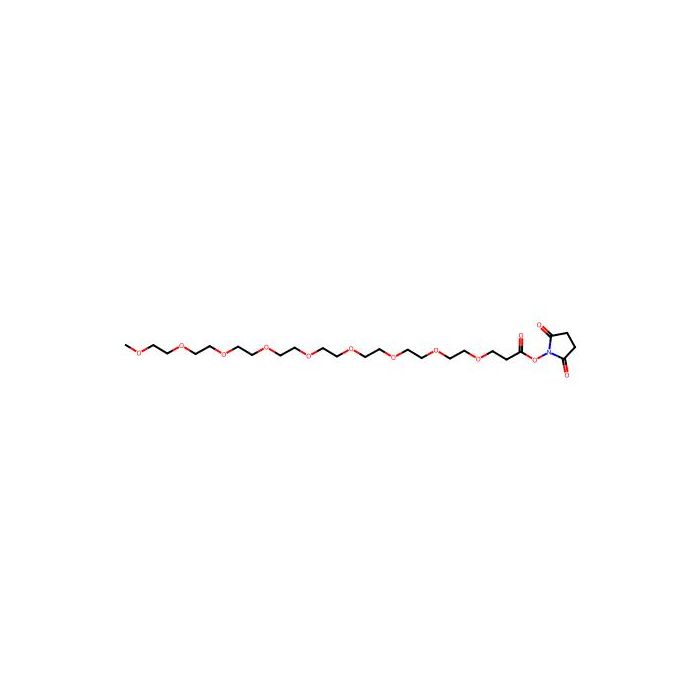
A heterobifunctional polyethylene glycol reagent bearing a terminal methoxy cap (m-PEG) and a terminal N-hydroxysuccinimide (NHS) activated ester for amine coupling. The PEG chain length is nine ethylene oxide (EO) repeat units (m-PEG9), providing a short, hydrophilic spacer.
SKU: M595686
Product name: m-PEG9-NHS ester
CAS: 1316189-13-5
Molecular formula: Not specified for this item; refer to CoA/Spec Sheet.
Molecular weight: Not specified for this item; refer to CoA/Spec Sheet. (Note: PEG reagents of defined EO count are often reported as an average.)
SMILES: Not specified for this item; refer to CoA/Spec Sheet.
InChIKey: Not specified for this item; refer to CoA/Spec Sheet.
Structural features (general description):
Contains ~9 repeating –CH2–CH2–O– units (PEG9) terminated on one end by a methoxy group (–O–CH3) and on the other by an NHS-activated carboxylate (succinimide leaving group).
Functional groups: polyether backbone (PEG), activated ester (NHS). No stereocenters in the PEG backbone; succinimide ring is achiral.
2D description: linear polyether chain (zig-zag –O–CH2–CH2– repeats), left terminus capped with –OCH3; right terminus connected via carbonyl to an N-hydroxysuccinimide ring (five-membered imide).
Synthetic Utility
m-PEG9–NHS ester is a versatile amine-acylating agent for installing an m-PEG9 spacer through robust amide bond formation.
Key functional attributes:
Activated ester: The NHS group enables rapid coupling to primary amines under mild conditions without additional coupling reagents.
PEG9 spacer: Improves aqueous solubility, reduces aggregation, and provides flexibility and distance between a core scaffold and appended functionality.
Applications in synthesis:
Small-molecule diversification: Convert amine-containing scaffolds to PEGylated amides to tune polarity/logS and improve chromatographic behavior.
Solid support modification: Functionalize amine-bearing resins, membranes, or nanoparticles to create hydrophilic interfaces or to introduce spacing prior to further conjugations (e.g., click handles added downstream).
Bioconjugation building block: Site-averaged modification of proteins/peptides at lysine residues for probe generation, pull-down handles, or immobilization.
Orthogonality and sequencing:
NHS/amine coupling can be orthogonal to thiol–maleimide chemistry; combine with protected amines or masked nucleophiles to achieve selective multi-point attachments.
After amide formation, the distal methoxy end is non-reactive, stabilizing the conjugate.
Analytical verification:
For small molecules: LC-MS and NMR confirm amide formation and PEG incorporation.
For macromolecules: SEC, SDS-PAGE, and MS (where feasible) monitor mass shifts and polydispersity.
Target Specificity
Not applicable. This product is a chemical conjugation reagent and not a biological targeting molecule or antibody. No antigen/epitope or species specificity is associated with this item.
Foire aux questions
What is the purity of this product?
This product is supplied at ≥98% purity (chemical assay). Lot-specific values are stated on the Certificate of Analysis.
How should this product be stored?
Store at ?20 °C. Freezer storage is required to maintain the specified shelf life.
How is this product shipped?
This product ships in an insulated container with ice pads. Unpack on arrival and transfer it to the storage condition stated above.
What are the CAS number, molecular formula and molecular weight?
The CAS Number is 1316189-13-5, the molecular formula is C24H43NO13, and the molecular weight is 553.6 g/mol.
What documentation is provided?
Available product documentation, including Certificates of Analysis (COA), Safety Data Sheets (SDS), and specification sheets, is shown in the product document area. Document availability and access follow the current site policy.
Nous utilisons des cookies pour garantir le bon fonctionnement du site et, lorsque cela est autorisé, pour améliorer votre expérience. Vous pouvez gérer vos préférences à tout moment dans les Paramètres. Pour en savoir plus, consultez notre Politique relative aux cookies.
Souhaitez-vous que nous vous envoyions un message lorsque des réductions seront disponibles?
Me rappeler plus tard
Merci ! Veuillez vérifier votre boîte de réception e-mail pour confirmer.
Products are supplied to verified businesses, institutions, and qualified professionals for research and development use only. Not for use in humans, animals, diagnosis, or therapy.