≥98% for sensitive chromatographic and analytical workflows requiring minimal baseline interference.
🌡
Storage & shipping
Store at -20°C Ships Ice chest + Ice pads Check lot-specific COA for exact specifications.
📋
Quality documents
SDS, COA, datasheet, and spec sheet available for download. Lot-specific COA accessible via lot number lookup.
📚
Literature proof
Cited in 0 peer-reviewed publications across chromatography, organic synthesis, and cross-coupling reactions.
Vue d’ensemble
m-PEG9-Tos is a PEG derivative containing a tosyl group. The tosyl group is a very good leaving group for nucleophilic substitution reactions. The hydrophilic PEG spacer increases solubility in aqueous media.
Specifications
Spécifications et pureté
≥98%
Conditions de stockage de stockage
Store at -20°C
Expédié en
Ice chest + Ice pads
Ce produit nécessite l'expédition en chaîne froide. Les services terrestres et autres services économiques ne sont pas disponibles.
Pureté
≥98%
Noms et identifiants
Poids moléculaire
538.7
Documentation
📋 Safety Data Sheet (SDS)
Comprehensive hazard, handling, storage, and regulatory compliance document.
Purify by silica (EtOAc/hexanes or DCM/MeOH gradient) or precipitation into MTBE.
Preparation of m-PEG9–SH (via thioacetate):
Dissolve m-PEG9-Tos in dry DMF (0.1 M); add KSAc (2.0 equiv) at rt.
Heat to 60 °C for 12 h; concentrate and dissolve in MeOH/H2O with K2CO3 to hydrolyze to –SH (1–3 h, rt).
Neutralize, extract, and dry. Optionally re-protect –SH depending on downstream use.
Surface passivation (research example):
Convert to m-PEG9–NH2, then couple to activated carboxylates (EDC/NHS) on substrates.
Rinse thoroughly to remove p-toluenesulfonate and unreacted species.
Note: The above are generalized outlines. For exact stoichiometry, conditions, and safety measures, consult primary literature and adapt to the reactivity of your substrates.
Biological Roles
This product is a synthetic, monofunctional PEG reagent and does not possess intrinsic biological activity. It is intended for laboratory and materials research only.
General/literature context for PEG motifs (non-clinical, non-therapeutic):
PEG segments are widely used to impart hydrophilicity, reduce nonspecific adsorption, and modulate hydration layers on surfaces and macromolecules.
In biochemical assay development, PEG spacers can reduce steric hindrance and improve spatial presentation of ligands on supports, beads, and nanoparticles.
PEGylated linkers often decrease protein and cell adhesion to surfaces (antifouling behavior), enhancing signal-to-noise in biosensing and analytical devices.
Note: Any use involving biological systems should be performed strictly as laboratory research. This product is not approved for clinical or diagnostic purposes.
Buffer Applications
Not a buffering agent. m-PEG9-Tos does not form a classical acid/base conjugate pair for pH control and is not typically used to prepare biological or analytical buffers.
Practical note:
Avoid formulating or storing m-PEG9-Tos in aqueous buffers; moisture and protic media promote hydrolysis of the tosylate ester to the corresponding alcohol and p-toluenesulfonic acid. If aqueous work is required after substitution (e.g., with m-PEG9–N3 or –NH2 products), adjust pH and ionic strength using standard buffers (PBS, HEPES) appropriate for the final, hydrolytically stable derivative.
Green Alternatives
Greener practice focuses on solvent choice, atom economy of the leaving group, and minimizing hydrolysis/waste during PEG functionalization. While the tosylate handles are widely used for reliability, several options can reduce environmental impact.
Strategy comparisons (literature/general):
Solvent substitution:
Replace DMF/DMSO with MeCN or 2-MeTHF where solubility allows; both are easier to remove and have improved EHS profiles (MeCN still flammable/toxic—assess risk).
Use acetone for Finkelstein-type iodide substitutions; it enables in situ precipitation of halide salts, driving equilibrium.
Employ ethyl acetate or 2-MeTHF for extractions instead of DCM/CHCl3.
Leaving group alternatives:
Mesylate (OMs) often provides similar reactivity with lower aromatic content, reducing persistent aryl sulfonate waste; however, volatility/odor of MsCl in synthesis is a consideration.
Carbonates (p-nitrophenyl carbonate) or activated carbonates enable urea/carbamate linkages for specific applications; reactivity profile differs from alkyl tosylates (trade-off in scope).
Process efficiency:
Run at higher concentration to reduce solvent volumes; use mechanical stirring to manage viscosity.
Apply catalytic phase-transfer conditions (e.g., TBAB) to operate in greener, lower-polarity media when appropriate.
Favor telescoped sequences (e.g., azidation → click) without isolating intermediates when purity specifications allow, reducing workups.
Summary table (qualitative):
DMF/DMSO: High reactivity; challenging EHS/workup.
MeCN/Acetone: Good compromise; flammable; broadly recyclable.
2-MeTHF/EtOAc: Greener; may need PTC or warming; check solubility.
Tosylate vs mesylate: Tosylate = robust/leaving group; Mesylate = less aryl waste but sometimes slightly less reactive in hindered cases.
Pharmaceutical Uses
No pharmacopeial status or excipient grade is provided for this item.
m-PEG9-Tos is a synthetic intermediate used to prepare defined-length PEGylated building blocks (e.g., m-PEG9–N3, –NH2, –SH, –CO2R via multi-step sequences). These intermediates may be used in the research-scale preparation of conjugates, linkers, and materials.
The controlled chain length (n ≈ 9) enables tuning of hydrophilicity and spacing in analytical tools, affinity matrices, and device coatings.
For any application contemplating cGMP or regulated environments, lot-specific CoA data (assay, residuals, moisture, Đ) and process validation are required; this catalog item is supplied for research use only unless explicitly stated otherwise.
Item-specific pharmacopeial/grade information: Not specified for this item; refer to CoA/Spec Sheet.
Physical Properties
Item-specific physico-chemical specifications:
Appearance: Not specified for this item; refer to CoA/Spec Sheet.
Molecular formula: Not specified for this item; refer to CoA/Spec Sheet.
Molecular weight: Not specified for this item; refer to CoA/Spec Sheet.
General/literature guidance for m-PEGn tosylates (n ≈ 9):
Phase/handling: Typically a low-melting waxy solid or viscous liquid; forms clear, highly viscous solutions due to PEG chain entanglement (literature/general for PEG oligomers).
Hygroscopicity: PEG chains are hygroscopic; moisture uptake can promote slow hydrolysis of sulfonate esters (literature).
Solubility (literature/general):
Highly soluble: DMF, DMSO, NMP, acetonitrile, acetone, THF, dioxane, dichloromethane, chloroform, toluene (warming may aid dissolution in less polar media).
Limited/variable: Water and alcohols; the tosylate ester can undergo hydrolysis/transesterification in protic media over time.
LogP/partitioning: PEG segments impart hydrophilicity; the para-tolyl sulfonate increases hydrophobic character vs. hydroxyl-terminated PEG (qualitative literature note).
Boiling/melting points, density, refractive index: For discrete PEG9 tosylates, sharp values are rarely assigned due to oligomeric distribution; consult CoA/SDS for lot-specific data.
Note: Use only literature/general trends above for preliminary planning; for precise specifications relevant to your lot, defer to the item CoA/Spec Sheet.
Quality and Grades
Item-specific grade/purity: Not specified for this item; refer to CoA/Spec Sheet.
How to interpret quality for m-PEGn tosylates (general guidance for professional users):
Purity profile: Reported as assay (area% by HPLC/UPLC or 1H NMR integral normalization). Absence of di-functional byproducts (e.g., di-tosylates) and residual p-toluenesulfonyl chloride or p-toluenesulfonic acid is important for predictable reactivity.
Chain-length distribution: PEG oligomers are commonly specified by average n (here n ≈ 9) and polydispersity index (Đ). Narrow Đ improves batch-to-batch consistency in conjugation densities and material properties.
Moisture and stability: Karl Fischer water and hydrolysable sulfonate content (or tosylate integrity by NMR/MS) are typical controls to ensure minimal loss of electrophilicity. Residual inorganic salts (e.g., Na+, K+) from workup may be limited.
Metals/UV cut-off: Not specified for this item; refer to CoA/Spec Sheet.
Stabilizers: Tosylated PEGs typically do not require stabilizers; desiccation and low-temperature storage are preferred to limit hydrolysis (general note).
What this means in practice:
Sensitive nucleophilic substitutions (e.g., azidation, thiolation) benefit from high tosylate integrity and low moisture. Verify with a fresh NMR check (disappearance of terminal –CH2–OTs resonance after reaction is a useful conversion marker).
For surface and materials applications, narrow Đ minimizes heterogeneity in interfacial packing and brush thickness.
Always consult the lot-specific CoA for definitive grade and acceptance criteria before regulated or highly sensitive work.
Reaction and Applications
m-PEG9-Tos is a versatile electrophilic PEGylation handle. The terminal alkyl tosylate undergoes efficient SN2 substitutions to install functional groups while retaining a defined nona(ethylene glycol) spacer.
Azidation: m-PEG9-N3 via NaN3 (dry DMF/MeCN, 60–90 °C). The azide can be reduced to amine (Staudinger, catalytic hydrogenation) or engaged in CuAAC “click” chemistry with alkynes to form triazoles.
Halide exchange: m-PEG9–I/Br from NaI/KI/LiBr (acetone/MeCN, reflux), useful for further alkylations or as intermediate to thiols (via thioacetate routes).
Thiolation: Displacement with potassium thioacetate (DMF, 40–70 °C) followed by hydrolysis to m-PEG9–SH for Au/Ag surface attachment or Michael additions.
Oxygen and nitrogen nucleophiles: Formation of PEGylated ethers (RO−) and secondary amines (RNH−) under basic conditions; for primary amines, an azide–reduction sequence generally gives cleaner outcomes than direct SN2 with NH3.
Surface/materials modification: Grafting to hydroxylated substrates (via pre-formation of suitable nucleophiles) to build PEG brushes; fabrication of amphiphilic block-like constructs; antifouling monolayers and particle passivation (research/materials scope).
Practical tips:
Use anhydrous conditions and slight excess of nucleophile (1.2–2.0 equiv) to drive conversion and suppress hydrolysis to the corresponding alcohol.
Monitor by 1H NMR: Loss of –CH2–OTs benzylic coupling patterns and aromatic tosyl resonances (2.44 ppm p-CH3) indicates displacement; appearance of diagnostic new end-group signals confirms product formation.
Scavenging released p-toluenesulfonate: Aqueous base washes (NaHCO3) or ion-exchange resins facilitate removal; avoid prolonged aqueous exposure of reactive products.
Reaction Conditions
Typical conditions for common substitutions on m-PEGn tosylates (literature/general guidance; optimize per substrate):
Azidation (m-PEG9–N3):
Reagents: NaN3 (1.5–3.0 equiv).
Solvent: Dry DMF or MeCN (0.05–0.3 M).
Temperature/time: 60–90 °C, 4–16 h.
Notes: Monitor by 1H NMR/LC-MS; ensure rigorous dryness. Work up by aqueous quench and extraction; remove DMF by high-vacuum or azeotrope with toluene.
Iodide formation (Finkelstein):
Reagents: NaI (3–5 equiv).
Solvent: Acetone (dry), reflux.
Temperature/time: 55–60 °C, 6–18 h.
Notes: NaOTs precipitates; filter hot if needed. Iodides are more reactive but less stable; use promptly.
Thiolation (via thioacetate):
Reagents: Potassium thioacetate (1.5–2.5 equiv).
Solvent: Dry DMF.
Temperature/time: 40–70 °C, 6–24 h → then K2CO3/MeOH–H2O to hydrolyze to –SH.
Notes: Protect –SH as needed (e.g., Ac, Trt) depending on subsequent steps.
Amine installation (two-step):
Step 1: Azidation as above.
Step 2: Reduction: PPh3/H2O (THF/H2O, rt–50 °C, 2–6 h) or H2 (1–3 bar)/Pd-C (EtOH or MeOH, rt–40 °C, 2–8 h).
Notes: Avoid strong base with PEG chains to minimize elimination/side reactions.
General tips:
Use 1.2–2.0 equiv nucleophile for clean conversion; higher excess may be needed for hindered cases.
Purification: Precipitation into MTBE/Et2O or flash chromatography on silica pretreated with 1–2% triethylamine to prevent adsorption of PEG tails.
Expected conversions: Frequently 70–95% isolated yields for clean SN2 substitutions on primary tosylates (literature ranges; substrate-dependent).
Safety and Handling
Authoritative safety information is provided in the SDS. No item-specific GHS data were provided in the Product Data for this listing.
Item-specific hazard listing (from Product Data):
Signal word: Not specified for this item; refer to SDS.
H-statements: Not specified for this item; refer to SDS.
GHS classification: Not specified for this item; refer to SDS.
Pictograms: Not specified for this item; refer to SDS.
General laboratory safety guidance for PEG tosylates (literature/practice-based):
Hazards: Alkyl tosylates are electrophilic and may cause irritation to skin, eyes, and respiratory tract. Prolonged contact can lead to defatting/irritation. Avoid inhalation of aerosols.
Peroxide formation: Not applicable (no ether solvent peroxide risk), but PEG chains can oxidize slowly; store under inert conditions when feasible.
PPE: Lab coat, safety glasses, and appropriate chemical-resistant gloves (e.g., nitrile). Work in a fume hood when handling powders/aerosols or when charging reactive nucleophiles.
First aid (overview; consult SDS):
Skin/eye contact: Rinse with water for ≥15 min; remove contaminated clothing; seek medical attention if irritation persists.
Inhalation: Move to fresh air; obtain medical advice if symptoms occur.
Ingestion: Rinse mouth; do not induce vomiting; seek medical attention.
Spill response: Absorb with inert material (e.g., vermiculite). Collect for disposal. Wash area with mild alkaline solution to neutralize any liberated p-toluenesulfonic acid.
Storage and shipping (from Product Data):
Storage: Store at −20 °C.
Shipping: Ice chest + ice pads.
Practice: Keep tightly closed, desiccated, protected from light; consider inert gas blanket after opening.
Solvent Selection
Polarity/compatibility (literature/general for m-PEGn tosylates):
Polarity class: Polar, aprotic-soluble oligomer; amphiphilic behavior due to PEG backbone and aryl sulfonate.
Best solvents for dissolution: DMF, DMSO, NMP, acetonitrile, acetone, THF, dioxane, dichloromethane. Warm to 30–40 °C if needed to reduce viscosity.
Limited solubility: Alkanes/hexanes; water/protic alcohols may dissolve but risk hydrolysis/transesterification over time.
Choosing solvent by application:
Nucleophilic substitutions (SN2): Dry polar aprotic media (DMF, DMSO, MeCN) maximize rates with anionic nucleophiles (N3−, I−, RS−). For halide exchange (NaI), acetone is classic.
Phase-transfer catalysis: Toluene or CH2Cl2 with PTC (e.g., TBAB) can enable reactions of inorganic nucleophiles; monitor for hydrolysis.
Purification: Ethyl acetate/MTBE/hexane mixtures or precipitation into cold diethyl ether/MTBE from minimal DCM/MeCN can aid isolation of PEG products.
Quick comparison (literature/general):
DMF: Excellent solubility and SN2 kinetics; high boiling; challenging removal; consider azeotropic drying post-reaction.
MeCN: Good balance of rate/volatility; solubility sometimes lower for higher-n PEGs; often preferred for azidation/halide exchange.
DMSO: Strongly solvating; can complicate workup; avoid with base-sensitive partners.
2-MeTHF/EtOAc: Greener options for less polar nucleophiles or PTC-enabled variants; verify solubility.
Always dry solvents (molecular sieves or distillation) to suppress hydrolysis of the tosylate.
Storage and Reconstitution
Storage (from Product Data):
Store at −20 °C.
Shipped in an ice chest with ice pads.
Best practices (general guidance for PEG tosylates):
Keep tightly sealed under dry, inert atmosphere (argon or nitrogen) to limit hydrolysis of the tosylate ester.
Store with desiccant, protected from light. Allow vials to warm to room temperature in a desiccator before opening to prevent moisture condensation.
Minimize headspace and recapit with PTFE-lined closures after each use.
Reconstitution and handling:
Solvents: Dissolve in dry DMF, DMSO, acetonitrile, THF, dioxane, DCM, or toluene as appropriate for your application. Warm gently (30–40 °C) to aid dissolution if viscous.
Concentration: Prepare stock solutions at 0.1–1.0 M in anhydrous solvent; aliquot and store at −20 °C under inert gas to reduce freeze–thaw cycles.
Stability: Solutions in dry aprotic solvents are generally stable for weeks at −20 °C in sealed vials; inspect by 1H NMR for signs of hydrolysis (appearance of p-toluenesulfonic acid and terminal –CH2–OH signals) before critical use.
Disposal:
Collect waste streams containing sulfonate byproducts and polar aprotic solvents separately. Neutralize acidic residues (from p-TsOH) prior to disposal according to institutional and local regulations.
Structure and Identity
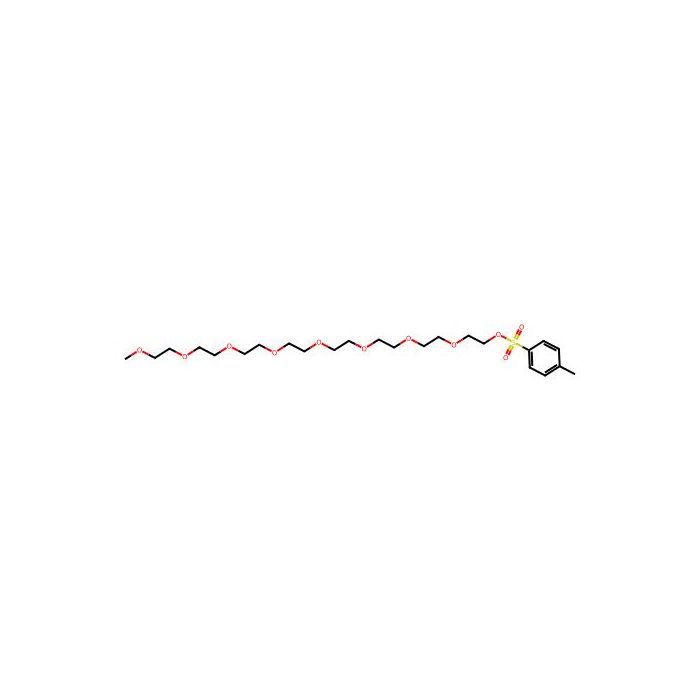
Monomethoxy PEG9 tosylate (m-PEG9-Tos) is an activated, monofunctional polyethylene glycol oligomer bearing a terminal p-toluenesulfonate (tosylate, OTs) leaving group opposite a methoxy cap. This makes it a versatile electrophile for SN2 substitution to install a broad range of terminal functionalities on a nona(ethylene glycol) spacer.
SKU: M595742
Product name: m-PEG9-Tos
CAS: 82217-01-4
Category: Materials Science (research reagent)
Research use: For research use only
Item-specific identifiers (from Product Data):
Molecular formula: Not specified for this item; refer to CoA/Spec Sheet.
Molecular weight: Not specified for this item; refer to CoA/Spec Sheet.
SMILES: Not specified for this item; refer to CoA/Spec Sheet.
InChIKey: Not specified for this item; refer to CoA/Spec Sheet.
Structural features (descriptive, literature/general):
End groups: One end is methoxy (–OCH3; nonreactive cap). The other end is an alkyl tosylate (–O–SO2–C6H4–CH3, para), acting as a leaving group.
Functional group class: Alkyl sulfonate ester; excellent substrate for nucleophilic substitution (SN2) at the terminal primary carbon (–CH2–OTs).
2D description: Methoxy-capped PEG chain terminating in –CH2–CH2–O–SO2–(p-tolyl). Aromatic ring is para-methyl substituted.
Polydispersity: As with PEG oligomers prepared by EO polymerization, materials are typically distributed around n ≈ 9 (literature note; exact distribution is item-specific and found on the CoA).
Synthetic Utility
Functional group profile:
Electrophile: Primary alkyl tosylate (–CH2–OTs) enables SN2 substitution with a broad range of nucleophiles under mild to moderate conditions.
Spacer: Nona(ethylene glycol) provides flexible, hydrophilic separation between the terminal group installed and the methoxy cap, useful for modulating solubility and interfacial behavior.
Key transformations (literature/general):
Nucleophilic substitution to install:
–N3 (NaN3) → –NH2 by reduction (PPh3/H2O or H2/Pd/C).
–I/–Br (NaI/KI/LiBr) → subsequent substitutions or metal–halogen exchange in specialized contexts.
–SR (thiolate; via KSAc then hydrolysis or direct RS−) → gold surface anchoring or thiol–ene chemistry.
–OR (alkoxides) → mixed PEG ethers; useful for dendritic growth or surface anchoring.
Click-ready handles: Azide introduction enables CuAAC with terminal alkynes to afford triazole-linked conjugates while preserving the PEG9 spacer.
Polymer/materials construction: Serves as a pegylated chain extender or end-group modifier in the synthesis of amphiphiles, surfactants, and crosslinkable macromonomers.
Retrosynthetic considerations:
m-PEG9-Tos is commonly accessed by tosylation of m-PEG9–OH with TsCl/pyridine or Ts2O/base under anhydrous conditions (literature). For downstream chemistry, plan for removal of liberated p-toluenesulfonate (aqueous workup or ion exchange) and confirm full conversion to avoid mixed end-group populations.
Target Specificity
Not applicable. This product is a small-molecule/oligomeric reagent, not an antibody, enzyme, or affinity ligand with defined biological targets.
For applications requiring selective binding or biorecognition, use m-PEG9-Tos to install the desired recognition element (e.g., azide → click to a peptide/aptamer) and then evaluate specificity with appropriate biochemical assays.
Foire aux questions
What is the purity of this product?
This product is supplied at ≥98% purity (chemical assay). Lot-specific values are stated on the Certificate of Analysis.
How should this product be stored?
Store at ?20 °C. Freezer storage is required to maintain the specified shelf life.
How is this product shipped?
This product ships in an insulated container with ice pads. Unpack on arrival and transfer it to the storage condition stated above.
What are the CAS number, molecular formula and molecular weight?
The CAS Number is 82217-01-4, the molecular formula is C24H42O11S, and the molecular weight is 538.7 g/mol.
What documentation is provided?
Available product documentation, including Certificates of Analysis (COA), Safety Data Sheets (SDS), and specification sheets, is shown in the product document area. Document availability and access follow the current site policy.
Nous utilisons des cookies pour garantir le bon fonctionnement du site et, lorsque cela est autorisé, pour améliorer votre expérience. Vous pouvez gérer vos préférences à tout moment dans les Paramètres. Pour en savoir plus, consultez notre Politique relative aux cookies.
Souhaitez-vous que nous vous envoyions un message lorsque des réductions seront disponibles?
Me rappeler plus tard
Merci ! Veuillez vérifier votre boîte de réception e-mail pour confirmer.
Products are supplied to verified businesses, institutions, and qualified professionals for research and development use only. Not for use in humans, animals, diagnosis, or therapy.