GRADE & PURITYMoligand™?Moligand™ — Aladdin's line of ligands and bioactive small molecules. Use for receptor, pathway, and binding studies needing defined small-molecule tools.10 mM in DMSO
Moligand™, 10 mM in DMSO Moligand™ for sensitive chromatographic and analytical workflows requiring minimal baseline interference.
🌡
Storage & shipping
Store at -80°C Ships Dry ice packs + Cold packs Check lot-specific COA for exact specifications.
📋
Quality documents
SDS, COA, datasheet, and spec sheet available for download. Lot-specific COA accessible via lot number lookup.
📚
Literature proof
Cited in 0 peer-reviewed publications across chromatography, organic synthesis, and cross-coupling reactions.
Vue d’ensemble
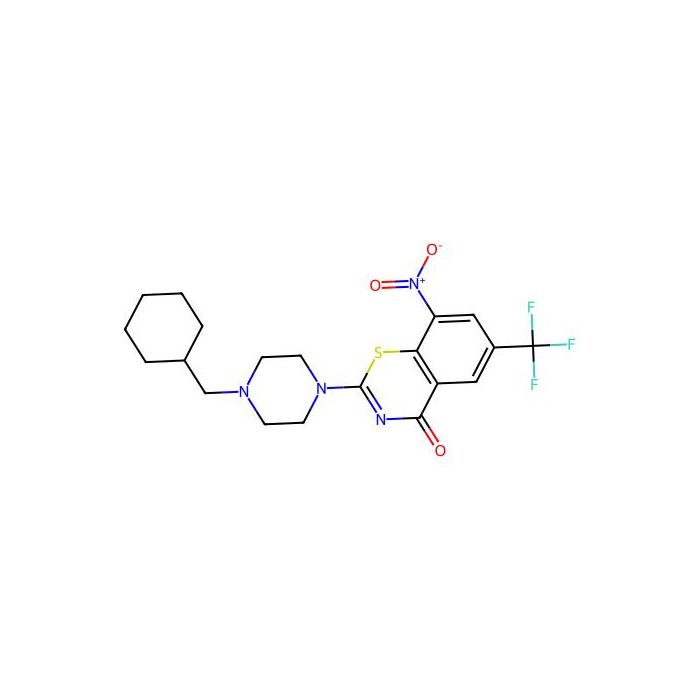
Macozinone (PBTZ169) is a bactericidal benzothiazinone and a potent DprE1 (decaprenylphosphoryl-β-d-ribose 2′-oxidase) inhibitor.Macozinone inhibits the essential flavoprotein DprE1 by forming a covalent bond with the active-site Cys387 residue. Macozinone has antituberculosis effect .
Specifications
Spécifications et pureté
Moligand™, 10 mM in DMSO
Conditions de stockage de stockage
Store at -80°C
Expédié en
Dry ice packs + Cold packs
Ce produit nécessite l'expédition en chaîne froide. Les services terrestres et autres services économiques ne sont pas disponibles.
Certificats (CoA, COO, BSE/TSE et tableau d'analyse)
C of A & Other Certificates(BSE/TSE, COO):
Analytical Chart:
Calculateurs de solution
Molarity Calculator
Determine the necessary mass, volume, or concentration for preparing a solution.
Dilution Calculator
Determine the dilution needed to prepare a stock solution.
Reconstitution Calculator
Avis
Avis des clients
Application Protocols
No tested application protocols are provided in the Product Data for this item.
General small-molecule handling protocols (non–item-specific)
Preparing DMSO stocks
Warm the vial to room temperature in a desiccator, quickly open to minimize moisture uptake, and weigh the required amount.
Dissolve in anhydrous DMSO to target concentration (e.g., 10–50 mM). Sonication may aid dissolution. Filter through 0.2 µm PTFE if particulate persists and if compatible.
Aliquot into amber, low-bind tubes or plates; seal tightly and store at −80°C.
Assay setup
Prepare serial dilutions in assay-compatible vehicle, maintaining constant final solvent across wells.
Include vehicle-only controls and, where available, a positive control. Confirm absence of assay interference (autofluorescence, absorbance overlap) by spectral scans.
Documentation
Record lot number, exact mass, solvent, concentration, and storage history. Attach the CoA to your ELN entry for traceability.
Biological Roles
Item-specific biological target(s), pathways, or mode of action are not provided in the Product Data for this listing.
General guidance for small-molecule research tools (not item-specific)
Potential roles in research may include acting as a ligand or modulator in biochemical assays, serving as a comparator in structure–activity relationship (SAR) studies, or being used as a control in analytical/bioanalytical method development.
If you intend to study cellular effects, first establish compound integrity (purity, identity), solubility limits in your culture medium, and non-specific assay interference (e.g., detergent sensitivity, redox cycling, inner-filter effects). Employ orthogonal readouts to mitigate false positives.
Map putative targets using chemoproteomics or competition assays only after independent verification of the compound’s structure and literature claims. Document concentrations, exposure times, and vehicle controls rigorously.
Note: This product is for research use only. No biological efficacy, safety, or clinical performance is claimed or implied by this listing.
Buffer Applications
This product is a small-molecule library member rather than a buffering agent. It is not typically used to establish or maintain pH in laboratory systems.
Practical note (general)
When preparing assay buffers that include small-molecule stocks in DMSO or other solvents, match vehicle concentrations across all samples, and verify that the buffer composition (pH, ionic strength, detergents) maintains the compound in solution over the assay duration.
Use low-UV buffers (e.g., phosphate, HEPES, ammonium bicarbonate) when LC–UV or spectroscopic quantification is needed; ensure solvent compatibility to avoid precipitation.
Green Alternatives
Without item-specific solubility and stability data, substitution guidance is necessarily general.
Greener stock solvent options (general): Where feasible, consider ethanol or aqueous cosolvent systems (e.g., ≤10% ethanol or isopropanol with a nonionic surfactant) instead of 100% DMSO. Validate compound stability and assay compatibility prior to use.
Process and waste minimization:
Use miniaturized assay formats (384/1536-well) to reduce solvent volume per data point.
Favor volatile, lower-toxicity mobile phases in analytical methods (ACN/water with ammonium buffers) over halogenated solvents.
Handling practices:
Store concentrated master stocks to minimize freeze–thaw cycles and wastage.
Implement plate sealing and low-dead-volume tips to reduce evaporative losses.
Comparison (general considerations)
DMSO vs ethanol: DMSO maximizes solubility but is less green; ethanol is greener but may limit solubility and affect some assays. A mixed approach (DMSO master stock, ethanol/water working solutions) can balance performance and sustainability.
All solvent/format changes should be supported by stability and performance data for your specific assay.
Pharmaceutical Uses
No pharmacopeial status, excipient role, or formulation use is specified for this item. This product is supplied strictly for research use only.
General considerations (non–item-specific)
If used as a research reference compound in preformulation studies, typical evaluations include: solubility screening (kinetic and thermodynamic), pKa determination, partitioning (logD vs pH), and stability in biorelevant media. These characterizations should be generated de novo for this item using your internal methods.
Any discussion of therapeutic applications or clinical use is beyond the scope of this listing and is not implied.
Physical Properties
Item-specific physicochemical properties were not supplied in the Product Data.
Appearance: Not specified for this item; refer to CoA/Spec Sheet.
Melting point, boiling point, density, refractive index, pKa/logP, UV-vis cutoff, solubility: Not specified for this item; refer to CoA/Spec Sheet.
General/literature guidance (non–item-specific)
Small-molecule screening compounds are commonly provided as solids and are typically dissolved for use in DMSO to prepare concentrated stocks (e.g., 10–50 mM), then diluted into assay buffers. Always verify actual solubility for this item before preparing working solutions.
If solubility is uncertain, a staged approach is recommended: micro-scale solubility screening in DMSO, DMF, ethanol, and aqueous co-solvent systems (e.g., 2–5% DMSO + 0.05–0.1% nonionic surfactant) while monitoring by HPLC/UV.
Hygroscopicity, polymorphism, or light sensitivity may affect handling and stability; evaluate experimentally on receipt if your application is sensitive to these parameters.
Quality and Grades
Grade/Purity: Moligand™ (as listed). Exact assay/purity, residual solvents, and analytical limits: Not specified for this item; refer to CoA/Spec Sheet.
About Moligand™ (general description)
Moligand™ denotes a discovery-grade small-molecule format intended for chemical biology, screening, and hit-validation workflows. Lots are typically qualified by LC–MS/UPLC for identity and purity and packaged for compatibility with plate-based operations.
Practical implications for users:
Expect suitability for in vitro biochemical and cell-free assays, and for early SAR hypothesis testing. Verify purity thresholds required by your assay (e.g., chromatographic purity, single major component) using the CoA.
If ultra-low UV background, trace-metal limits, water/peroxide content, or residual solvent specifications are critical, confirm on the lot-specific CoA—these parameters are Not specified for this item.
If your use involves quantitative bioanalysis, consider running orthogonal purity assessment (qNMR) and documenting counter-ions/solvates if present.
Packaging/format
Specific pack sizes, stabilizers, and form (solid vs. DMSO solution) are not stated; verify on your label/CoA before designing dilution workflows.
Reaction and Applications
Manufacturer application field is not populated for this listing. The compound is provided for research use; no specific synthetic or biochemical application was declared.
General research-use contexts for small-molecule library members (non–item-specific)
Hit identification and validation: Prepare DMSO stocks for biochemical or biophysical screening, confirm activity with dose–response curves, and orthogonally validate by counter-assays to rule out assay interference.
Analytical reference: Use as a reference standard for method development (HPLC/UPLC retention characterization, MS fragments, stability-indicating methods) once identity/purity are verified.
Mechanistic probes: If the molecular target is known from literature sources you consult independently, design target-engagement assays (e.g., CETSA, SPR, enzymology). Target details are not provided in this product data and should be verified independently.
Practical tips
Confirm concentration by UV or qNMR where possible to avoid pipetting/solubility artifacts.
Evaluate redox/light sensitivity by side-by-side storage (ambient vs. amber, aerobic vs. inert) and monitor by LC.
For cell-free assays, maintain final DMSO ≤1% v/v (or as your assay tolerates); pre-clear precipitates by 0.2 µm filtration if compatible.
Reaction Conditions
Specific reaction conditions are not applicable because the product is offered as a research small molecule rather than a reagent for named reactions.
General handling/assay preparation conditions (non–item-specific)
Stock solutions: Common practice is to prepare 10–50 mM in anhydrous DMSO, aliquot, and store at −80°C. Exact solubility for this item must be determined experimentally.
Thawing and dilution: Thaw on ice or at ambient temperature briefly, vortex to ensure homogeneity, and dilute into assay buffer to a final DMSO content tolerated by your assay (often ≤0.5–1% v/v). Inspect for precipitation; if observed, adjust vehicle or surfactant content.
Stability checks: Establish short-term bench stability (e.g., 4–24 h at room temperature) and freeze–thaw tolerance by LC–UV or LC–MS. Protect from light until photostability is known.
These conditions are general guidance and should be tailored to your assay and the verified properties of your lot.
Safety and Handling
Hazard information (item-specific)
Signal word: Not specified for this item; refer to SDS.
H-statements, GHS classification, pictograms: Not specified for this item; refer to SDS.
General laboratory precautions (non–item-specific; follow your institutional EHS requirements)
Wear appropriate PPE: lab coat, safety glasses, and nitrile gloves. Handle powders and solutions in a fume hood to minimize inhalation and exposure.
Avoid contact with skin and eyes. Prevent aerosolization and dust generation when weighing.
Incompatibilities: Absent item-specific data, segregate from strong oxidizers and acids/bases until compatibility is known. Use amber containers if light sensitivity is suspected.
First aid (summary; defer to SDS): In case of skin/eye contact, rinse with water for ≥15 minutes. If inhaled, move to fresh air. If ingested or in case of exposure concerns, seek medical attention and provide the SDS.
Waste: Collect in labeled organic waste compatible with your solvent system; do not dispose to drain. Follow local regulations.
Always consult the product SDS for authoritative safety, toxicology, and spill/cleanup guidance specific to this item.
Solvent Selection
Item-specific solubility and polarity data are not provided for this compound.
General guidance for small-molecule library members (literature/practice-based)
Primary stock solvent: DMSO is the default due to broad solubilizing power and assay compatibility at ≤0.5–1% v/v final. If precipitation occurs upon dilution, increase surfactant (e.g., 0.01–0.05% Tween-20 or Pluronic F-127) or co-solvent (≤10% v/v acetonitrile or ethanol) as assay permits.
Alternative solvents: DMF and NMP offer high solvency but may be less assay-friendly; ethanol/isopropanol can work for moderately lipophilic compounds.
Aqueous formulations: Consider cosolvent systems (2–10% DMSO + buffer, pH 6–8) or cyclodextrin inclusion if the compound is highly hydrophobic. Validate by HPLC for stability and carryover.
Decision tips (general)
If the compound contains ionizable groups (unknown here), assess pH-dependent solubility via mini titration (buffer pH 4–9). Use volatile buffers (ammonium salts) for LC–MS compatibility.
For biophysical assays (SPR/DSF/ITC), prefer low-refractive-index and low-UV solvents; minimize DMSO mismatch between sample and reference channels (±0.1%).
Always determine actual solubility and stability for your lot before scaling.
Storage and Reconstitution
Storage conditions (item-specific): Store at −80°C.
Appearance: Not specified for this item; refer to CoA/Spec Sheet.
General reconstitution guidance (non–item-specific)
On receipt, keep the product frozen until use. Allow the container to equilibrate to room temperature in a desiccator before opening to prevent moisture condensation.
For initial reconstitution, use anhydrous solvent (commonly DMSO) to prepare a concentrated stock. Verify complete dissolution visually and by analytical means if critical.
Aliquot to single-use portions to avoid repeated freeze–thaw; store aliquots at −80°C in tightly sealed, inert (preferably amber) containers.
Stability/expiry: Lot-specific retest or expiry information is not provided here; consult the product label/CoA. If no guidance is available, establish in-house stability indicating methods (LC–UV/MS) and define a conservative in-use period for thawed solutions (e.g., same day) pending data.
Research use only: Not for human or veterinary use.
Structure and Identity
Product name: Macozinone (SKU: M1495951)
CAS: 1377239-83-2; PubChem CID: 57331386
Molecular formula: Not specified for this item; refer to CoA/Spec Sheet.
Molecular weight: Not specified for this item; refer to CoA/Spec Sheet.
SMILES: Not specified for this item; refer to CoA/Spec Sheet.
InChIKey: Not specified for this item; refer to CoA/Spec Sheet.
Structural features
Item-specific structural details are not provided in this listing. For unequivocal identification (including stereochemistry, ring systems, and functional groups), consult the CoA/SDS or authoritative databases using the CAS/CID above.
Notes for researchers (general)
When integrating into screening collections or analytical workflows, cross-verify the structure using an orthogonal source (e.g., vendor CoA plus PubChem record) and confirm by LC–MS/NMR as needed.
For cheminformatics registration, populate synonyms, CAS, and external identifiers; defer definitive structure fields until you obtain the CoA structure block.
Synthetic Utility
No item-specific functional-group map or reactivity profile is provided. As supplied, Macozinone is intended as a finished small molecule for research rather than a building block.
General perspectives (non–item-specific)
Derivatization workflows (if pursued) typically start by confirming exact structure and identifying handles for modification (e.g., heteroatoms suitable for N-alkylation/acylation, aryl halides for cross-coupling, or nitro groups for reduction). Because the structure is not listed here, consult the CoA before planning synthetic transformations.
Uses as an analytical comparator: The compound can serve as a reference to benchmark new analogs (retention time windows, MS fragmentation, stability), aiding SAR campaigns once a structural series is established.
If isotopically labeled or impurity standards are needed, generate them from the confirmed scaffold following standard synthetic and purification protocols; ensure orthogonal characterization (NMR, HRMS, HPLC purity).
Target Specificity
Item-specific target, epitope, clone/isotype, or species reactivity data are not provided in the Product Data for this product.
Target name: Not specified for this item; refer to literature and CoA if available.
Assay-validated specificity: Not specified for this item.
Note: Any target claims should be independently verified by the end user using appropriate biochemical or biophysical assays.
Need help choosing the grade?
Our grade selection guide covers purity, stabilizer status, and application suitability for all variants in our catalog.
We use cookies to ensure the website functions properly and, where permitted, to improve your experience. You can manage your preferences at any time in Settings. Learn more in our Cookie Policy.
Shall we send you a message when we have discounts available?
Remind me later
Thank you! Please check your email inbox to confirm.
Products are supplied to verified businesses, institutions, and qualified professionals for research and development use only. Not for use in humans, animals, diagnosis, or therapy.