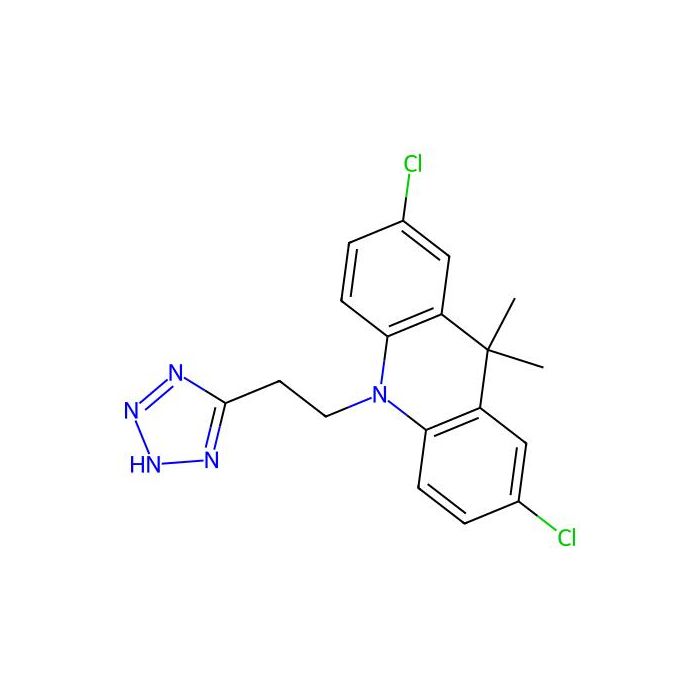
GRADE & PURITYMoligand™?Moligand™ — Aladdin's line of ligands and bioactive small molecules. Use for receptor, pathway, and binding studies needing defined small-molecule tools.10 mM in DMSO
Moligand™, 10 mM in DMSO Moligand™ for sensitive chromatographic and analytical workflows requiring minimal baseline interference.
🌡
Storage & shipping
Store at -80°C Ships Dry ice packs + Cold packs Check lot-specific COA for exact specifications.
📋
Quality documents
SDS, COA, datasheet, and spec sheet available for download. Lot-specific COA accessible via lot number lookup.
📚
Literature proof
Cited in 0 peer-reviewed publications across chromatography, organic synthesis, and cross-coupling reactions.
Vue d’ensemble
ML67-33 is a selective activator of temperature- and mechano-sensitive K 2P channels . ML67-33 rapidly and reversibly affects K 2P 2.1 (TREK-1) with EC 50 s of 36.3 μM and 9.7 μM in cell-free and HEK293 cells, respectively.
Specifications
Spécifications et pureté
Moligand™, 10 mM in DMSO
Conditions de stockage de stockage
Store at -80°C
Expédié en
Dry ice packs + Cold packs
Ce produit nécessite l'expédition en chaîne froide. Les services terrestres et autres services économiques ne sont pas disponibles.
Certificats (CoA, COO, BSE/TSE et tableau d'analyse)
C of A & Other Certificates(BSE/TSE, COO):
Analytical Chart:
Calculateurs de solution
Molarity Calculator
Determine the necessary mass, volume, or concentration for preparing a solution.
Dilution Calculator
Determine the dilution needed to prepare a stock solution.
Reconstitution Calculator
Avis
Avis des clients
Application Protocols
No manufacturer-validated application protocols are provided for this item.
General small-molecule handling for screening (not item-specific)
Stock preparation: Dissolve in anhydrous DMSO to a convenient concentration (commonly 10–50 mM). Sonication or brief warming (≤37°C) may aid dissolution; avoid prolonged heating.
Working solutions: Dilute into assay buffer to the desired final concentration, keeping DMSO constant across samples (typical 0.1–1% v/v). Mix thoroughly to prevent precipitation.
Plate handling: Use low-binding polypropylene plates/tubes for hydrophobic compounds. Seal plates to limit evaporation; equilibrate to assay temperature before reading.
Stability checks: Verify by LC–MS or HPLC at start/end of assay. Protect from light if chromophores are suspected; minimize air exposure.
Controls: Include negative (vehicle) and, if available, positive controls; run duplicates/triplicates and dose–response curves.
If you require a validated, step-by-step protocol for a specific target or assay format, please provide the target and detection method to tailor guidance.
Biological Roles
This catalog entry does not include validated biological target, pathway, or mechanism details for ML67-33.
General guidance for small-molecule library members (not item-specific)
Potential roles: Depending on structure, discovery compounds may function as enzyme inhibitors/activators, receptor ligands, allosteric modulators, or chemical probes in cell-based or biochemical assays.
Profiling strategy: Employ multi-concentration dose–response, time-course, and orthogonal confirmation. Consider counter-screens to exclude assay interference (fluorescence quench/auto-fluorescence, redox cycling, aggregation).
ADME flags to assess early: Solubility, permeability (PAMPA/Cell monolayers), metabolic stability (microsomes/S9), and protein binding can contextualize observed potency in cells.
Important limitations
No medical or clinical claims are made. ML67-33 is supplied strictly for research use.
Target specificity and selectivity data are not provided in the Product Data; consult primary literature for CAS 1443290-89-8 if your workflow requires mechanistic annotations and confirm experimentally in your system.
Buffer Applications
This product is not a buffering agent and has no manufacturer-provided buffer system recommendations.
Practical notes (general; not item-specific)
When preparing assay dilutions, use a biologically compatible buffer (e.g., PBS, HEPES, Tris) validated for your target assay. Maintain a consistent DMSO percentage across all wells/samples.
If precipitation is observed upon aqueous dilution, reduce compound concentration, increase DMSO carryover slightly (while remaining within assay tolerance), adjust buffer pH/ionic strength, or add a small amount of nonionic surfactant (e.g., 0.01–0.05% Tween-20).
Filter clarified solutions through 0.22 µm PVDF/nylon alternatives as appropriate, and verify compound recovery to avoid adsorption losses.
No item-specific buffer pKa/range or recipe information is available for ML67-33.
Green Alternatives
Because ML67-33 is supplied as a discrete screening compound rather than a process solvent or reagent, “green alternative” considerations are generally not applicable.
Sustainable handling considerations (general)
Minimize solvent use in assay preparation by employing concentrated DMSO stocks and low final co-solvent percentages.
Prefer aqueous buffers and miniaturized assay formats (e.g., 384/1536-well) to reduce waste.
Choose greener co-solvents where feasible (ethanol, water) while confirming assay compatibility.
Consolidate shipping by coordinating orders; promptly transfer to long-term storage to avoid waste from freeze–thaw degradation.
If ML67-33 is used as a tool compound in synthetic method development (at analytical scale), select greener reaction media when possible (e.g., water/ethanol/2-MeTHF) and apply energy-efficient conditions (microwave/flow). However, no specific green chemistry substitutions are relevant to this item itself.
Pharmaceutical Uses
No pharmacopeial status, excipient role, or manufacturing use is provided for this item. ML67-33 is offered solely for research applications within discovery and screening.
Context (general; not item-specific)
Tool compounds are occasionally used in formulation feasibility studies or as positive controls in bioassays; ensure appropriate documentation (CoA, SDS) and internal approvals.
If compatibility with pharmaceutical processes is required (e.g., stability in excipients, impurity profile, residual solvents), perform fit-for-purpose characterization. No such specifications are stated for this item.
Compliance note
Research use only. Not intended for human or veterinary use, diagnostic procedures, or as an API/excipient in commercial products.
Physical Properties
Item-specific physicochemical properties are not disclosed in this listing. Where values are required for assay design or formulation, consult the CoA/Spec Sheet or primary literature for CAS 1443290-89-8.
Appearance: Not specified for this item; refer to CoA/Spec Sheet.
Melting point: Not specified for this item; refer to CoA/Spec Sheet.
Boiling point: Not specified for this item; refer to CoA/Spec Sheet.
Density: Not specified for this item; refer to CoA/Spec Sheet.
Refractive index: Not applicable/unknown for solids; otherwise not specified for this item; refer to CoA/Spec Sheet.
Solubility: Not specified for this item; refer to CoA/Spec Sheet. General practice for screening molecules is dissolution in anhydrous DMSO to prepare concentrated stocks (see Storage & Reconstitution).
logP/logD: Not specified for this item; refer to CoA/Spec Sheet.
pKa: Not specified for this item; refer to CoA/Spec Sheet.
UV–Vis characteristics: Not specified for this item; refer to CoA/Spec Sheet.
General guidance (literature/practice; not item-specific)
For small, hydrophobic discovery compounds, initial solubility screening is typically performed in DMSO (10–50 mM), with subsequent dilution into assay buffers containing co-solvent (e.g., 0.1–1% DMSO) and surfactant (0.01–0.05% Tween-20 or Pluronic) as needed.
Always verify solubility and stability experimentally under your assay conditions.
Quality and Grades
Grade/Purity: Moligand™. This designation indicates inclusion in a discovery-oriented small-molecule collection intended for screening, probe development, and mechanistic studies.
What Moligand™ typically implies (general description; not item-specific specifications)
Intended use: Research screening and early-stage SAR exploration.
Typical QC for library compounds may include identity confirmation by LC–MS and/or 1H NMR, and a stated purity threshold by HPLC/UPLC. However, specific tests, thresholds, and chromatographic conditions for this item are not specified here; refer to the CoA/Spec Sheet for current batch data.
Stabilizers/additives: Not specified for this item; refer to CoA/Spec Sheet.
Residual solvents, water content, inorganic impurities, or metal content: Not specified for this item; refer to CoA/Spec Sheet.
How to interpret grade for your application
Biochemical/cellular screening: Moligand™ grade is suitable for hit finding and follow-up profiling with appropriate controls (vehicle, counter-screens, orthogonal assays).
Demanding analytical or in vivo-like studies: Verify purity, identity, and stability under your exact conditions; additional purification may be warranted depending on sensitivity.
Documentation: For regulated workflows or publications, request the lot-specific CoA to cite identity/purity and any analytical methods used.
Reaction and Applications
This product is positioned as a screening/ligand candidate rather than a synthetic reagent. No manufacturer-provided reaction applications are listed.
Potential research applications (general; not item-specific)
Biochemical and cellular screening as part of diversity or targeted libraries.
Mechanistic probes in target validation workflows, once the compound’s activity is established in-house or from literature.
Structure–activity relationship (SAR) studies if analogs or matched pairs are available.
Practical tips for assay deployment (general)
Establish robust vehicle controls (DMSO-only) and test multiple final DMSO concentrations (e.g., 0.1%, 0.5%, 1.0%) to evaluate solvent tolerance.
Run orthogonal/biophysical confirmation (e.g., DSF, MST, SPR, NMR) to deconvolute false positives (aggregate, redox, covalent PAINS behavior). Include detergent controls when appropriate.
Confirm compound integrity by LC–MS before and after assay incubation to assess stability (hydrolysis/oxidation/adduct formation). Store and handle under inert atmosphere if instability is suspected.
Note: No named-reaction utility or catalytic roles are provided for this item; if you require a synthetic intermediate, consider alternative catalog entries tailored for preparative chemistry.
Reaction Conditions
No reaction-condition guidance is applicable because ML67-33 is provided as a screening compound rather than a reagent or catalyst, and its functional groups are not disclosed in this listing.
If you intend to use ML67-33 in chemical transformations (general advice; not item-specific)
Determine functional groups and stability windows (acid/base, redox) from the structure and preliminary tests.
Start with small-scale scouting (≤10 mg) across benign solvents (EtOH, MeCN, 2-MeTHF) and mild bases/acids to assess compatibility before committing material.
Monitor with LC–MS to track conversions and degradation; isolate and characterize any byproducts.
For biological assays, see Application Protocols and Storage & Reconstitution for preparation of test solutions.
Safety and Handling
GHS and hazard details are not provided in this summary. Always consult the product SDS for authoritative safety information before use.
Signal word: Not specified for this item; refer to SDS.
Hazard statements (H-codes): Not specified for this item; refer to SDS.
Pictograms/GHS classification: Not specified for this item; refer to SDS.
PPE: Wear lab coat, safety glasses, and appropriate chemically resistant gloves. Handle powders and DMSO solutions in a chemical fume hood to avoid inhalation/dermal exposure.
Avoid: Aerosol generation, ingestion, and skin/eye contact. Do not pipette by mouth. For potential unknown toxicity, treat as harmful if swallowed, inhaled, or in contact with skin.
Incompatibilities: Unknown for this specific item. As a precaution, keep away from strong oxidizers and strong acids/bases until compatibility is confirmed from SDS.
First aid (general): In case of skin contact, wash with soap and water; for eye contact, rinse cautiously with water for several minutes and seek medical attention; if inhaled, move to fresh air; if swallowed, rinse mouth and seek medical advice. Refer to SDS for detailed instructions.
Spill response: Contain and collect with inert absorbent. Avoid dust formation; ventilate area. Dispose according to institutional and local regulations.
Transport/storage risks: Shipments are provided on dry ice/cold packs; keep frozen on receipt (see Storage & Reconstitution). Do not refreeze-thaw repeatedly to minimize degradation risk.
Solvent Selection
Item-specific solubility data are not provided. The following guidance reflects common practice for small-molecule library members (general information; not item-specific).
Primary stock solvent: DMSO is typically preferred due to broad solvating power and assay compatibility at 0.1–1% v/v in aqueous media.
Secondary options: DMF, acetonitrile, ethanol, or isopropanol may be used if compatible with downstream assays. Water solubility varies widely; test empirically.
Aqueous dilution: Prepare concentrated DMSO stock (e.g., 10–50 mM), then dilute into buffer while vortexing to minimize precipitation. Consider including 0.01–0.05% nonionic surfactant for hydrophobic compounds.
Filtration: If particulate persists, filter through 0.22 µm PTFE (for organics) or PVDF (for aqueous with ≤1% DMSO/alcohol). Avoid nylon if compound is strongly adsorptive or sensitive to amide sites.
Light/air sensitivity: Unknown for this item; protect from light and minimize air exposure until stability is confirmed.
Comparison (general)
DMSO: Highest success rate for initial dissolution; widely compatible in HTS. Potential to affect targets above 1–2%.
DMF/MeCN: Lower viscosity, rapid mixing; consider cytotoxicity and volatility (MeCN).
Alcohols: Good for mid-polar molecules; may disrupt some protein assays.
Aqueous buffers: Only if solubility confirmed; adjust pH/ionic strength as needed.
Storage and Reconstitution
Item-specific storage/shipping
Storage conditions (per Product Data): Store at -80°C.
Shipped in: Dry ice packs + Cold packs.
Appearance: Not specified for this item; refer to CoA/Spec Sheet.
General reconstitution guidance (not item-specific)
Upon receipt: Keep frozen at -80°C. Allow the container to equilibrate to room temperature in a desiccator before opening to avoid moisture condensation.
Stock solutions: Prepare in anhydrous DMSO (typical 10–50 mM). If aqueous use is required, dilute the DMSO stock into buffer with vigorous mixing; consider 0.01–0.05% nonionic surfactant for hydrophobic compounds.
Aliquoting: Dispense single-use aliquots to avoid repeated freeze–thaw cycles. Store aliquots at -80°C in airtight, light-protective vials.
Stability: Not specified for this item; refer to CoA/Spec Sheet. In absence of data, limit storage time of solutions (e.g., ≤3 months at -80°C; days to weeks at -20°C; hours to days at 4°C) and verify integrity by LC–MS/HPLC prior to critical experiments.
Thawing: Thaw on ice or at room temperature; mix thoroughly to redissolve any precipitate. Do not heat above ambient unless stability is confirmed.
Disposal: Follow institutional guidelines for organic chemical waste; do not discharge to drains.
Research use only: For laboratory research use; not for human or veterinary use.
Structure and Identity
Brief overview: ML67-33 is offered as a discovery/screening small molecule in the Moligand™ collection. Item-specific structural identifiers are not disclosed in this listing.
Product name: ML67-33 (SKU: M1495272)
CAS: 1443290-89-8
PubChem CID: 86272454
InChIKey: Not specified for this item; refer to CoA/Spec Sheet.
SMILES: Not specified for this item; refer to CoA/Spec Sheet.
Molecular formula: Not specified for this item; refer to CoA/Spec Sheet.
Molecular weight: Not specified for this item; refer to CoA/Spec Sheet.
Structural features (general): Not specified for this item; refer to CoA/Spec Sheet.
2D structure description
Not available in this product summary. If your workflow requires an atom-by-atom description (functional groups, heterocycles, stereocenters), please request the current CoA/Spec Sheet or consult the cited CAS/PubChem record.
Notes
This entry belongs to: 全部 / 可售 / 小分子和化合物库 (small molecules and compound libraries).
Research use only; not for human or veterinary use.
Synthetic Utility
ML67-33 is not positioned as a synthetic building block in this catalog entry, and functional-group information is not disclosed here.
General considerations for using library compounds in synthesis (not item-specific)
Unless structural data indicate otherwise, library molecules are typically not selected for derivatization. If analog synthesis is desired, obtain the full structure (SMILES/SD file) and assess diversification vectors (e.g., halide handles, heteroatoms for cross-coupling, amine/acid for amide formation).
Prior to any transformation, confirm purity and identity by LC–MS/NMR and assess stability to base/acid, heat, and oxidants/reductants.
If planning SAR elaboration, consider ordering related analogs rather than modifying a single library member to maintain data integrity and avoid batch-to-batch variability.
No named-reaction applicability, protecting-group strategy, or retrosynthetic role can be provided for ML67-33 without structural disclosure.
Target Specificity
No target information is provided for ML67-33 in this catalog entry.
Validated targets, binding sites/epitopes, selectivity panels, species cross-reactivity, and mechanism-of-action data: Not specified for this item; refer to CoA/Spec Sheet and primary literature for CAS 1443290-89-8.
Guidance (general; not item-specific)
Establish target engagement with orthogonal assays (biophysical and functional). Include counterscreens against close homologs to assess selectivity.
We use cookies to ensure the website functions properly and, where permitted, to improve your experience. You can manage your preferences at any time in Settings. Learn more in our Cookie Policy.
Shall we send you a message when we have discounts available?
Remind me later
Thank you! Please check your email inbox to confirm.
Products are supplied to verified businesses, institutions, and qualified professionals for research and development use only. Not for use in humans, animals, diagnosis, or therapy.