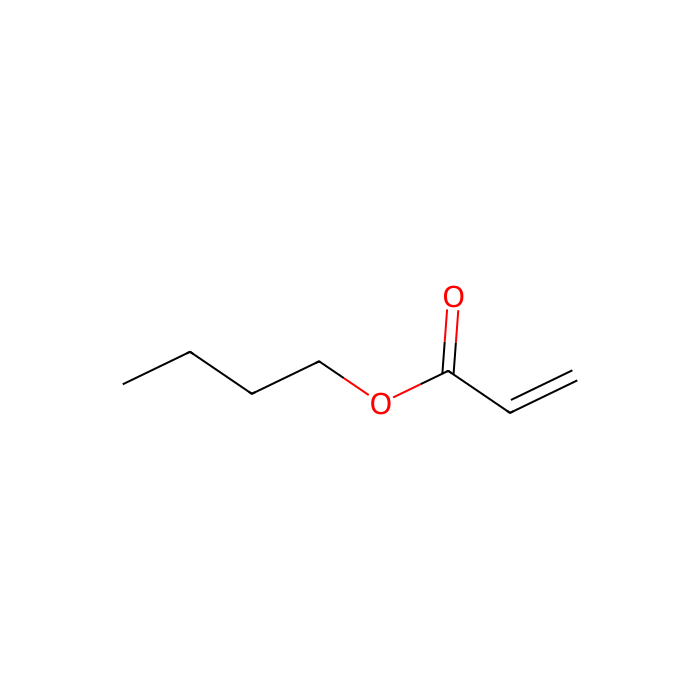
n-Butyl acrylate - Standard for GC, ≥99.5%(GC), stabilized with 50 ppm MEHQ , CAS No.141-32-2

CAS: 141-32-2 Cat. No.: B100034 Formule: CH2=CHCOOC4H9 Poids moléculaire: 128.17 Beilstein Registry Number: 1749970 Numéro CE: 205-480-7
DISPONIBLE À COMMANDE
QUALITÉ & PURETÉ Standard for GC ? GC reference standard — characterized compound for calibrating GC methods. Use to build calibration curves and verify GC quantitation. ≥99.5%(GC) stabilized with 50 ppm MEHQ
Synonyms
Acrylsaeurebutylester|n-Butyl propenoate|Butylester kyseliny akrylove [Czech]|n-Butyl acrylate|Butylester kyseliny akrylove|N-BUTYL ACRYLATE [MI]|N-BUTYL ACRYLATE (IARC)|BUTYL ACRYLATE [INCI]|2-propenoic acid butyl ester|Acrylic acid-butyl ester|Butylacrylate, inhibited|2-propenoic acid n-butyl ester|n-butylacrylate|n-butyl-acrylate|2-Propenoic acid, butyl ester|Butyl acrylate resin|normal butyl acrylate|BUTYL ACRYLATES, STABILIZED|n-butyl acrylat|Acrylate de butyle|Butyl acrylates, inhibited|Acrilato de n-butilo|Acrylic acid, butyl ester|butyl prop-2-enoate|butylacrylate|BUTYL-2-PROPENOATE|Propensaure-n-butylester|N-BUTYL ACRYLATE [IARC]|PERM GLUE|BUTYL 2-PROPENATE|BUTYL ACRYLATE|Acrylic acid butyl ester|BUTYL ACRYLATE [HSDB]|Acrylic acid n-butyl ester|Acrylic acid, n-butyl ester|n-Butyl-2-propenoate|Butyl acrylate, n-|BUTYL ACRYLATE, STABILIZED|Butyl acrylates, inhibited [UN2348] [Flammable liquid]
Storage
Room temperature
Shipped In
FedEx DG Service
★
Taille
USA
Allemagne (EU)*
Prix
Qté
5ml
B100034-5ml
5 En stock
—

23,90$US

28,90$US
Enregistrer 5,00 $US (17.30%)
Enter a quantity for the sizes you want to add.

Spécifications

Synonymes
Acrylsaeurebutylester | n-Butyl propenoate | Butylester kyseliny akrylove [Czech] | n-Butyl acrylate | Butylester kyseliny akrylove | N-BUTYL ACRYLATE [MI] | N-BUTYL ACRYLATE (IARC) | BUTYL ACRYLATE [INCI] | 2-propenoic acid butyl ester | Acrylic acid-butyl ester | Butylacrylate, inhibited | 2-propenoic acid n-butyl ester | n-butylacrylat Afficher plus
Spécifications et pureté
Standard for GC, ≥99.5%(GC), stabilized with 50 ppm MEHQ
Conditions de stockage de stockage
Room temperature
Expédié en
FedEx DG Service
Grade
Standard for GC
Pureté
≥99.5%(GC)
Noms et identifiants
Pubchem Sid
SMILES
CCCCOC(=O)C=C
IUPAC Name
butyl prop-2-enoate
InChIKey
CQEYYJKEWSMYFG-UHFFFAOYSA-N
InChI
1S/C7H12O2/c1-3-5-6-9-7(8)4-2/h4H,2-3,5-6H2,1H3
Isomères SMILES
CCCCOC(=O)C=C
WGK Allemagne
1
RTECS
UD3150000
Numéro ONU
2348
Groupe d'emballage
III
Poids moléculaire
128.17
Beilstein
1749970
Reaxys
1749970
Reaxys-RN_link_address
https://www.reaxys.com/reaxys/secured/hopinto.do?context=S&query=IDE.XRN=1749970&ln=

Données avancées

Taxonomic Classification

Taxonomy Tree

KingdomOrganic compounds
SuperclassOrganic acids and derivatives
ClasseCarboxylic acids and derivatives
SubclassAcrylic acids and derivatives
Intermediate Tree Nodes Not available
Direct ParentAcrylic acid esters
Alternative Parents Enoate esters  Monocarboxylic acids and derivatives  Organic oxides  Hydrocarbon derivatives  Carbonyl compounds  
Molecular FrameworkAliphatic acyclic compounds
Substituents Acrylic acid ester - Alpha,beta-unsaturated carboxylic ester - Enoate ester - Carboxylic acid ester - Monocarboxylic acid or derivatives - Organic oxygen compound - Organic oxide - Hydrocarbon derivative - Organooxygen compound - Carbonyl group - Aliphatic acyclic compound
DescriptionThis compound belongs to the class of organic compounds known as acrylic acid esters. These are organic compounds containing and ester acrylic acid (CH2=CHC(=O)OH).
External Descriptors acrylate ester
Structure 3D
Modèle de structure chimique interactif


Cibles associées (humaines)
TSHR Tclin Thyroid stimulating hormone receptor (29986 Activities)
Activity TypeRelationActivity valueUnitsAction TypeJournalPubMed IddoiAssay Aladdin ID
Lymphoblastoid cell (5959 Activities)
Activity TypeRelationActivity valueUnitsAction TypeJournalPubMed IddoiAssay Aladdin ID
Mécanismes d'action
Certificats (CoA, COO, BSE/TSE et tableau d'analyse)
C of A & Other Certificates(BSE/TSE, COO):
Analytical Chart:

Find and download the COA for your product by matching the lot number on the packaging.

4 results found

Lot NumberCertificate TypeDateArticle
I2426098I2426098Certificate of AnalysisJul 14, 2026 B100034
G2313243G2313243Certificate of AnalysisApr 08, 2025 B100034
I2426097I2426097Certificate of AnalysisSep 23, 2024 B100034
K2201180K2201180Certificate of AnalysisOct 20, 2022 B100034
Propriétés chimiques et physiques
SensibilitéMoisture sensitive.
Indice de réfraction1.417-1.419
Point d'éclair (°F)100.4 °F
Point d'éclair (°C)35-40℃
Point d'ébullition (°C)145°C
Point de fusion (°C)-64°C
Poids moléculaire128.17
XLogP32.400
Hydrogen Bond Donor Count0
Hydrogen Bond Acceptor Count2
Rotatable Bond Count5
Exact Mass128.084 Da
Monoisotopic Mass128.084 Da
Topological Polar Surface Area26.300 Ų
Heavy Atom Count9
Formal Charge0
Complexity97.100
Isotope Atom Count0
Defined Atom Stereocenter Count0
Undefined Atom Stereocenter Count0
Defined Bond Stereocenter Count0
Undefined Bond Stereocenter Count0
The total count of all stereochemical bonds0
Covalently-Bonded Unit Count1
Sécurité et dangers (GHS)
Pictogramme(s)
GHS02,   GHS07
Signal
Warning
Mentions de danger

H226:Flammable liquid and vapor

H315:Causes skin irritation

H317:May cause an allergic skin reaction

H319:Causes serious eye irritation

H335:May cause respiratory irritation

Conseils de prudence

P210:Keep away from heat, hot surface, sparks, open flames and other ignition sources. - No smoking.

P233:Keep container tightly closed.

P240:Ground/bond container and receiving equipment.

P241:Use explosion-proof [electrical/ventilating/lighting/.../] equipment.

P242:Use only non-sparking tools.

P243:Take precautionary measures against static discharge.

P261:Avoid breathing dust/fume/gas/mist/vapors/spray.

P264:Wash hands [and …] thoroughly after handling.

P271:Use only outdoors or in a well-ventilated area.

P272:Contaminated work clothing should not be allowed out of the workplace.

P280:Wear protective gloves/protective clothing/eye protection/face protection.

P321:Specific treatment (see ... on this label).

P302+P352:IF ON SKIN: wash with plenty of water.

P303+P361+P353:IF ON SKIN (or hair): Take off Immediately all contaminated clothing. Rinse SKIN with water [or shower].

P304+P340:IF INHALED: Remove person to fresh air and keep comfortable for breathing.

P305+P351+P338:IF IN EYES: Rinse cautiously with water for several minutes. Remove contact lenses if present and easy to do - continue rinsing.

P333+P313:IF SKIN irritation or rash occurs: Get medical advice/attention.

P362+P364:Take off contaminated clothing and wash it before reuse.

P370+P378:In case of fire: Use ... to extinguish.

P405:Store locked up.

P403+P233:Store in a well-ventilated place. Keep container tightly closed.

P403+P235:Store in a well-ventilated place. Keep cool.

P501:Dispose of contents/container to an approved waste disposal plant.

P264+P265:Wash hands [and …] thoroughly after handling. Do not touch eyes.

P337+P317:If eye irritation persists: Get medical help.

P332+P317:If skin irritation occurs: Get medical help.

P319:Get medical help if you feel unwell.

WGK Allemagne
1
RTECS
UD3150000
Reaxys
1749970
Reaxys-RN_link_address
https://www.reaxys.com/reaxys/secured/hopinto.do?context=S&query=IDE.XRN=1749970&ln=
Classe
3
Index Merck
1539
FAQ et articles
Standard for GC: A Practical Guide
Application and Selection Guide for Alkyd Resin Coatings: Advantages, Limitations, Formulation Control, and Modification Directions
Structural and Performance Design of Acrylic Resins for Coatings: Monomer Composition, Key Parameters, and Film Formation/Curing Mechanisms
PVDF, FEVE and Functional Fluororesins: System Differences and Application Selection in Fluorocarbon Coatings
When Should You Choose Silicone Resin? Selection Comparison with Epoxy, Acrylic, Polyurethane, Fluororesin, and Other Coating Resins
Vinyl Acetate-Acrylic Emulsion (Vinyl Acrylic Emulsion): A Cost-Performance Balance Solution for Architectural Coatings
How to Select Vinyl-Related Resins: Building Formulation Judgment Based on Substrate, Performance Targets, and Failure Risks
Applicability Boundaries, Failure Risks, and Alternative System Selection for Chlorinated Rubber Resin in Coatings
Waterborne Resin Technology Explained: Waterborne Forms, Performance Balance, and a Technology Map
Guide to Common Waterborne Resin Types and Application-Based Selection: How to Choose Acrylics, PUD, Waterborne Epoxy, Waterborne Alkyd, VAE, and Related Chemicals
From Water to Film: Film-Formation Mechanisms and Performance Development of Waterborne Emulsions and Dispersions
Diagnosis of Coating Performance Issues and Selection of Resin Modification Routes
Mechanisms and Control of Coating Yellowing: From Chromophoric Structure Formation to Source Diagnosis and Formulation Optimization
Structural Design Logic of Common Resin Modification Technologies: Molecular Chain Structure, Functional Groups, Phase Structure, Crosslinked Networks, and Hybrid/Functional Design
Resin Polarity in Coating Formulations: From Molecular Structure to Dissolution, Compatibility, Interfacial Interactions, and Formulation Design
Application of Conductive Carbon Black in Coatings: Selection Criteria, Dispersion Control, and Conductive Network Construction
Key Variable in the Long-Term Stability of Waterborne Pigment Concentrates: How Dispersant Molecular Weight Distribution (MWD) Affects Pigment Dispersion, Surface Adsorption-Layer Formation, and Storage Stability
Citations of This Product
Calculateurs de solution
Avis

Avis des clients

Souhaitez-vous que nous vous envoyions un message lorsque des réductions seront disponibles?

Me rappeler plus tard

Merci ! Veuillez vérifier votre boîte de réception e-mail pour confirmer.

Oups ! Les notifications sont désactivées.