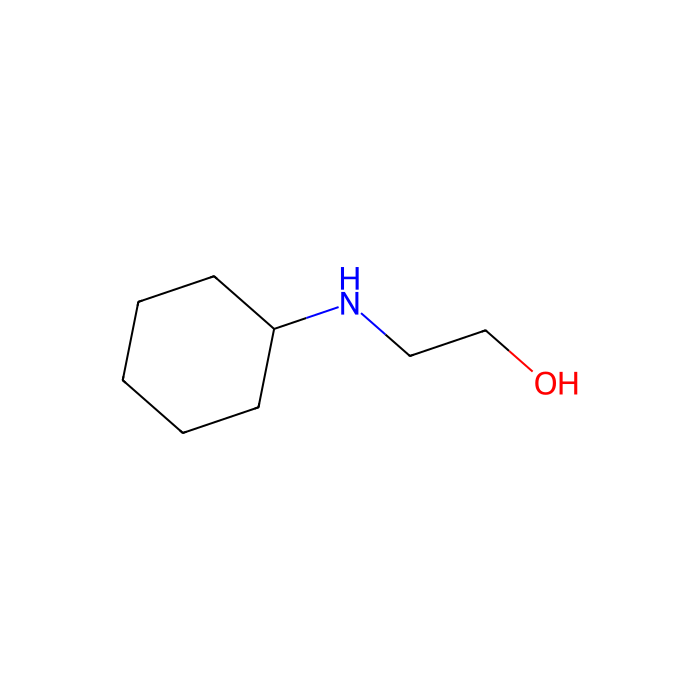
N-Cyclohexylethanolamine - ≥98%(T) , CAS No.2842-38-8

CAS: 2842-38-8 Cat. No.: N140389 Formule: C8H17NO Poids moléculaire: 143.23 Beilstein Registry Number: 1071413 Numéro CE: 220-636-4
DISPONIBLE À COMMANDE
GRADE & PURITY ≥98%(T)
Synonyms
MFCD00021326 | EN300-18800 | Ethanol, 2-(cyclohexylamino)- | N-Cyclohexylaminoethanol | N-Hydroxyethylcyclohexylamine | Z90504557 | D95373 | Abromeen E-25 | AKOS000121422 | N-Cyclohexylethanolamine | BRN 1071413 | SCHEMBL131659 | N-(2-Hydroxyethyl)-N-cycl
Storage
Store at 2-8°C,Argon charged
Shipped In
Wet ice
★
Size
USA
Allemagne (EU)*
Price
Qty
5g
N140389-5g
3 En stock
—

18,90$US

28,90$US
Enregistrer 10,00 $US (34.60%)
25g
N140389-25g
1 En stock
—

44,90$US

67,90$US
Enregistrer 23,00 $US (33.87%)
100g
N140389-100g
2 En stock
—

136,90$US

205,90$US
Enregistrer 69,00 $US (33.51%)
500g
N140389-500g
1 En stock
—

513,90$US

770,90$US
Enregistrer 257,00 $US (33.34%)
Enter a quantity for the sizes you want to add.
🧪
Why this grade

≥98%(T) for sensitive chromatographic and analytical workflows requiring minimal baseline interference.

🌡

Storage & shipping

Store at 2-8°C,Argon charged Ships Wet ice Check lot-specific COA for exact specifications.

📋

Quality documents

SDS, COA, datasheet, and spec sheet available for download. Lot-specific COA accessible via lot number lookup.

📚

Literature proof

Cited in 0 peer-reviewed publications across chromatography, organic synthesis, and cross-coupling reactions.

Specifications

Synonymes
MFCD00021326 | EN300-18800 | Ethanol, 2-(cyclohexylamino)- | N-Cyclohexylaminoethanol | N-Hydroxyethylcyclohexylamine | Z90504557 | D95373 | Abromeen E-25 | AKOS000121422 | N-Cyclohexylethanolamine | BRN 1071413 | SCHEMBL131659 | N-(2-Hydroxyethyl)-N-cycl
Spécifications et pureté
≥98%(T)
Conditions de stockage de stockage
Store at 2-8°C,Argon charged
Expédié en
Wet ice
Ce produit nécessite l'expédition en chaîne froide. Les services terrestres et autres services économiques ne sont pas disponibles.
Pureté
≥98%(T)
Noms et identifiants
Pubchem Sid
Pubchem Sid Url
https://pubchem.ncbi.nlm.nih.gov/substance/504752849
Sourires canoniques
C1CCC(CC1)NCCO
IUPAC Name
2-(cyclohexylamino)ethanol
InChIKey
MGUMZJAQENFQKN-UHFFFAOYSA-N
INCHI
1S/C8H17NO/c10-7-6-9-8-4-2-1-3-5-8/h8-10H,1-7H2
Isomères SMILES
C1CCC(CC1)NCCO
RTECS
KK3530000
Poids moléculaire
143.23
Beilstein
1071413
Reaxy-Rn
1071413
Reaxys-RN_link_address
https://www.reaxys.com/reaxys/secured/hopinto.do?context=S&query=IDE.XRN=1071413&ln=

Documentation

📋 Safety Data Sheet (SDS)

Comprehensive hazard, handling, storage, and regulatory compliance document.

Download SDS →

✅ Certificate of Analysis (COA)

Lot-specific quality data. Enter your lot number to retrieve the exact COA.

Look up COA →

📊 Datasheet

Quick-reference summary of product specifications and applications.

View datasheet →

🔬 Specification Sheet

Full quality attributes and acceptance criteria for this grade.

View spec sheet →

Advanced Data

Taxonomic Classification

Taxonomy Tree

KingdomOrganic compounds
SuperclassOrganic nitrogen compounds
ClasseOrganonitrogen compounds
SubclassCyclohexylamines
Intermediate Tree Nodes Not available
Direct ParentCyclohexylamines
Alternative Parents 1,2-aminoalcohols  Dialkylamines  Primary alcohols  Organopnictogen compounds  Hydrocarbon derivatives  
Molecular FrameworkAliphatic homomonocyclic compounds
Substituents Cyclohexylamine - 1,2-aminoalcohol - Secondary amine - Secondary aliphatic amine - Alkanolamine - Organic oxygen compound - Organopnictogen compound - Hydrocarbon derivative - Primary alcohol - Organooxygen compound - Amine - Alcohol - Aliphatic homomonocyclic compound
DescriptionThis compound belongs to the class of organic compounds known as cyclohexylamines. These are organic compounds containing a cyclohexylamine moiety, which consist of a cyclohexane ring attached to an amine group.
External Descriptors Not available
Structure 3D
Modèle de structure chimique interactif


Cibles associées (non humaines)
Pseudomonas aeruginosa (123386 Activities)
Activity TypeRelationActivity valueUnitsAction TypeJournalPubMed IddoiAssay Aladdin ID
Mécanismes d'action
Certificats (CoA, COO, BSE/TSE et tableau d'analyse)
C of A & Other Certificates(BSE/TSE, COO):
Analytical Chart:

Find and download the COA for your product by matching the lot number on the packaging.

9 results found

Lot NumberCertificate TypeDateArticle
I2604141Certificate of AnalysisSep 11, 2026 N140389
I2219008Certificate of AnalysisJul 06, 2026 N140389
I2219009Certificate of AnalysisJul 06, 2026 N140389
I2219010Certificate of AnalysisJul 06, 2026 N140389
I2219011Certificate of AnalysisJul 06, 2026 N140389
C2209188Certificate of AnalysisDec 10, 2025 N140389
L2121028Certificate of AnalysisOct 11, 2025 N140389
J1922223Certificate of AnalysisAug 14, 2023 N140389
L2405198Certificate of AnalysisSep 22, 2022 N140389
Propriétés chimiques et physiques
SolubilitéSoluble in water
SensibilitéAir sensitive
Indice de réfraction1.48
Point d'ébullition (°C)112℃/3mm
Point de fusion (°C)34-38℃
Poids moléculaire143.230 g/mol
XLogP30.900
Hydrogen Bond Donor Count2
Hydrogen Bond Acceptor Count2
Rotatable Bond Count3
Exact Mass143.131 Da
Monoisotopic Mass143.131 Da
Topological Polar Surface Area32.299 Ų
Heavy Atom Count10
Formal Charge0
Complexity79.300
Isotope Atom Count0
Defined Atom Stereocenter Count0
Undefined Atom Stereocenter Count0
Defined Bond Stereocenter Count0
Undefined Bond Stereocenter Count0
The total count of all stereochemical bonds0
Covalently-Bonded Unit Count1
Calculateurs de solution
Avis

Avis des clients

Application Protocols

No assay or imaging protocols are specified for this item. As a small-molecule reagent, it is used in synthetic and materials workflows rather than in immunoassays or direct bioanalytical applications.

General laboratory usage tips (literature/practice):

  • For solution preparation, weigh the reagent quickly under inert gas if possible (argon, as specified), and dissolve in a dry, compatible solvent (e.g., ACN, THF, MeOH, water as appropriate to the task).
  • For coupling/derivatization steps, pre-dry glassware and solvents; minimize exposure to CO2 to avoid carbamate formation.
  • For workups, anticipate basicity: neutralize carefully, and consider pre-saturating silica with a base (e.g., 1–2% TEA in eluent) to mitigate amine tailing during chromatography.

For any application requiring precise conditions (e.g., surface functionalization, polymer modification), develop and document a SOP based on small-scale trials, and refer to the CoA/SDS for handling constraints.

Biological Roles

No endogenous biological role is known for N-cyclohexylethanolamine; it is a synthetic secondary alkanolamine used primarily as a chemical intermediate and functional reagent.

General biochemical considerations (literature/context):

  • Protonation state: With a conjugate acid pKa in the ~9.5–10.5 range (literature), it exists predominantly as a protonated ammonium species at physiological pH, enhancing aqueous solubility and ionic interactions.
  • Amphiphilicity: The combination of a hydrophilic ethanolamine moiety and a hydrophobic cyclohexyl ring can promote interactions with lipidic environments and surfaces; however, specific receptor or enzyme binding has not been established.
  • Reactivity toward biomolecules: As a nucleophilic secondary amine, it can react with electrophiles (e.g., activated esters, isocyanates), which is leveraged in bioconjugation chemistry in vitro, not in vivo.
  • Metabolic expectations: If introduced into biological systems, secondary alkanolamines are often subject to oxidative deamination and phase II conjugation (sulfation/glucuronidation) in general terms; specific ADME data for this compound are not delineated here.

Caution: This product is provided for research use only, as stated in the Product Data. It is not intended for diagnostic, therapeutic, or human/animal consumption. Any biological handling should follow institutional biosafety and chemical hygiene practices, and rely on the SDS for exposure controls.

Buffer Applications

This compound is not a standard biological buffer component. While secondary alkanolamines can provide basic buffering capacity, N-cyclohexylethanolamine is not commonly used in defined buffer systems.

Literature/practical notes for exploratory use:

  • pKa (conjugate acid) is typically around ~10 for secondary alkanolamines, suggesting potential buffering in the pH ~9–11 window. For precise work, titrate to determine the actual pKa under your ionic strength and temperature.
  • Potential buffer composition (research-only concept): prepare a solution of N-cyclohexylethanolamine in water and titrate with a strong acid (HCl) to the desired pH between 9 and 10.5. Ionic strength can be adjusted with NaCl. Verify compatibility with your assay components.
  • Cautions: Secondary amines can react with electrophilic reagents and can interfere with enzyme assays or protein function. They can also absorb CO2 from air, causing pH drift. If used, prepare fresh, exclude CO2 where possible, and verify pH stability over time.

Recommendation: For routine buffering, use established buffers (e.g., Tris, CAPS, CHES) with well-characterized properties. Reserve N-cyclohexylethanolamine for synthetic/derivatization roles rather than as a primary buffering agent.

Green Alternatives

Green chemistry considerations focus on solvent/base choice, energy input, and minimizing protecting-group manipulations when working with N-cyclohexylethanolamine.

  • Greener media (literature guidance):

    • Prefer water, ethanol, or 2-propanol as media for epoxide openings and salt formations where feasible. These reduce reliance on chlorinated solvents and facilitate safer workups.
    • For coupling/acylation, acetonitrile or 2-MeTHF can replace DCM/THF in many cases. 2-MeTHF offers partial bio-based sourcing and good performance in acyl-transfer.
  • Base and activation strategies:

    • Use carbonate bases (K2CO3, NaHCO3) in aqueous/biobased alcohols when O-acylation or carbonate formation is targeted, minimizing strong base hazards.
    • Employ green coupling reagents or enzyme catalysis (lipase-mediated esterification in iPrOH) to reduce hazardous waste.
  • Energy and process intensification:

    • Microwave-assisted aminolysis in ethanol or water can cut reaction times and energy consumption.
    • Flow processing for exothermic acylations improves heat management and reduces solvent volumes.

Comparison snapshot (literature; tradeoffs depend on application):

| Option | Advantages | Tradeoffs | |---|---|---| | Water/EtOH | Renewable, low toxicity, easy workup | Hydrolysis risk, slower for some acylations | | 2-MeTHF | Bio-based, good for acylations, easy phase split | Peroxide management, limited polarity vs DMF | | ACN | Low viscosity, recyclable, good for couplings | Toxicity classification, nitrile handling | | Avoid DCM | Reduces chlorinated waste | May require re-optimization |

Note: Selection must consider safety, product quality, and regulatory constraints. Validate performance at lab scale before scale-up.

Pharmaceutical Uses

No pharmacopeial grade or excipient designation is provided for this item. It is offered for research use only.

General, non-clinical roles of related alkanolamines (literature/manufacturing context):

  • Neutralizing/solubilizing agent: Secondary alkanolamines are sometimes used to neutralize acidic functional groups in polymers or actives during process development, increasing solubility or controlling viscosity in non-clinical formulations.
  • Intermediate: N-cyclohexylethanolamine can serve as a building block for synthesizing ureas, carbamates, and amide-containing intermediates that may be evaluated during drug discovery.
  • Surface treatment/functionalization: The amino alcohol motif can anchor to inorganic surfaces (e.g., silica, metal oxides) via hydrogen bonding or through further derivatization, creating platforms for adsorption studies.

Important boundaries:

  • No therapeutic, diagnostic, or clinical claims are made or implied for this product.
  • If considering use in any regulated context (GMP, clinical), specification, impurity profile, residual solvents, bioburden/endotoxin, and elemental impurities must be established; such data are Not specified for this item; refer to CoA/Spec Sheet.

Conclusion: Treat this material strictly as a research reagent or synthetic intermediate in non-clinical development and laboratory workflows.

Physical Properties

Item-specific physical specifications (e.g., exact BP, density, refractive index cutoffs) are not provided in the Product Data. Consult the CoA/Spec Sheet for certified values. The following are literature/general properties to assist with method development:

  • Aggregate state/appearance (literature): typically a colorless to pale yellow viscous liquid at ambient temperature.
  • Boiling point (literature): commonly reported in the ~245–255 °C range at 1 atm for analogous secondary amino alcohols; specific reported value for this compound is often cited near ~247–250 °C (literature, consult primary sources).
  • Melting point (literature): low; often remains liquid well below room temperature (exact MP not widely tabulated).
  • Density (literature): approximately 0.98–1.01 g/mL at 20–25 °C.
  • Refractive index n20/D (literature): typically around 1.48–1.50 for similar amino alcohols.
  • pKa (conjugate acid, literature): secondary alkanolamines generally pKaH ~9.5–10.5; cyclohexyl substitution often yields pKaH near ~10.
  • LogP/logD (literature): amphiphilic; logP often near 0–1 due to one OH and one NRH functionality offsetting the hydrophobic cyclohexyl.
  • Solubility (literature): high solubility in polar protic solvents (water, alcohols); miscibility with water likely substantial; readily soluble in DMSO and other polar aprotic solvents; limited solubility in nonpolar hydrocarbons.

Important: Treat these as literature guidance only. For design-critical parameters (e.g., Karl Fischer water, UV cutoff, metal traces), Not specified for this item; refer to CoA/Spec Sheet.

Quality and Grades
  • Grade/Purity: Not specified for this item; refer to CoA/Spec Sheet.
  • Appearance: Not specified for this item; refer to CoA/Spec Sheet.

Interpretation and guidance (general, for professional users):

  • Without an explicit grade (e.g., AR, ACS Reagent, HPLC, Anhydrous), assume research-grade suitable for general synthetic and materials workflows. For trace analysis or chromatography-sensitive contexts, verify UV cutoffs, metal content, amine number, water, and residue-on-evaporation on the CoA.
  • Stabilizers: None stated for this listing. If exceptionally low peroxide/oxidation profile is needed, consider freshly opened material, maintain the argon blanket (as specified for this item), and, if necessary, verify by peroxide test or amine value titration.
  • Impurity considerations for amino alcohols (general): residual water, alkylamines/alkanolamines homologs, and oxidative by-products (e.g., nitroso/imine traces) can affect catalysis and coupling chemistry. Request batch-specific NMR/GC/HPLC where critical.
  • Suitability for application classes:
    • Organic synthesis and materials modification: typically acceptable provided routine drying and inert handling are followed.
    • Bioconjugation or surface functionalization: confirm bioburden/endotoxin if relevant; not specified here.
    • Chromatography: if used as modifier, low UV absorbance profile and particulate limits should be confirmed.

Conclusion: Use the item under the provided storage/inert conditions. For application-critical thresholds (water ppm, UV cutoff, trace metals, stabilizers), Not specified for this item; refer to CoA/Spec Sheet.

Reaction and Applications

N-Cyclohexylethanolamine combines a secondary amine and a primary alcohol, enabling orthogonal reactivity. Typical research and manufacturing applications (literature/practice):

  • Nucleophilic acyl substitution at nitrogen:
    • Formation of secondary/tertiary amides, carbamates (with chloroformates), and ureas (with isocyanates or CDI-activated amines). Control exotherms and HCl/CO2 evolution as applicable.
  • O-derivatization at the alcohol:
    • Esterification (Fischer, Steglich/DMAP), carbonate formation, or tosylation/mesylation to create leaving groups for subsequent intramolecular substitutions.
  • Bifunctional linker in materials:
    • Acts as a curing/chain extender for epoxides and activated esters; anchors to surfaces (via –OH) while presenting a secondary amine for further grafting.
  • Epoxide ring-opening:
    • The secondary amine is a strong nucleophile toward terminal epoxides, producing β-amino alcohols; intramolecular H-bonding can influence regioselectivity.
  • Reductive alkylation at nitrogen:
    • Reductive amination with aldehydes/ketones (NaBH3CN, BH(OAc)3) to access tertiary amino alcohols while retaining the –CH2CH2OH handle.
  • Salt formation for separations:
    • Readily forms crystalline ammonium salts with mineral or sulfonic acids; useful for purification and handling.

Practical tips:

  • Dry/inert operation reduces carbamate formation from atmospheric CO2 and limits oxidative discoloration.
  • For selective O- vs N-acylation, employ base and acylation conditions tuned to Hard/Soft preferences (e.g., acyl chlorides with non-nucleophilic base tend to favor N-acylation). Using carbonate activation or acyl-transfer catalysts (DMAP) can favor O-acylation.
  • Monitor by 1H NMR for diagnostic signals: –CH2–OH (~3.5–3.7 ppm), –CH2–NH– (~2.7–3.1 ppm), cyclohexyl multiplets (~1.0–2.0 ppm).
Reaction Conditions

General literature-guided conditions for common transformations involving N-cyclohexylethanolamine (optimize per substrate):

  • N-Acylation (amide/carbamate formation):

    • Typical: acyl chloride (1.05–1.2 eq), base (DIPEA or TEA, 2–3 eq), solvent (DCM, THF, or ACN), 0–25 °C, 0.5–4 h. For chloroformates, maintain 0–5 °C during addition to control exotherm; then warm to RT.
    • Workup: aqueous bicarbonate wash, then brine; dry and concentrate. Purify by silica gel; amine pre-treatment of silica can reduce tailing.
  • O-Acylation (ester/carbonate):

    • Steglich conditions: carboxylic acid (1.1 eq), DCC (1.1 eq), DMAP (0.05 eq), solvent (DCM or ACN), 0–25 °C, 2–16 h. Favor O-selectivity by transient N-protection (e.g., Boc) if required.
  • Urea formation:

    • With CDI: activate amine partner with CDI (1.1–1.5 eq) in ACN/THF at RT, then add N-cyclohexylethanolamine; stir 2–6 h at RT to 50 °C.
    • With isocyanate: add isocyanate (1.0–1.1 eq) in dry DCM/THF to the amine at 0–25 °C; catalytic base may accelerate.
  • Epoxide ring-opening (on external epoxides):

    • Solvent: EtOH, iPrOH, or THF; base not strictly required for terminal epoxides. 25–60 °C, 2–12 h. Regioselectivity typically favors less substituted carbon.
  • Reductive amination (to tertiary amine):

    • Carbonyl (1.1 eq), N-cyclohexylethanolamine (1.0 eq), AcOH (0.2 eq) in MeOH/EtOH; add NaBH3CN (1.2 eq) at 0–25 °C; 2–6 h. Alternatively, NaBH(OAc)3 in DCE/MeOH (anhydrous) at RT.

Expected yields (literature): good to excellent (60–90%) with proper control of moisture and stoichiometry. Always monitor by TLC/LC–MS and confirm selectivity (N vs O) by NMR (HMBC/HSQC helpful).

Safety and Handling
  • GHS classification, signal word, pictograms, and H-statements: Not specified for this item; refer to the SDS for authoritative hazard communication.

General safety considerations for secondary alkanolamines (literature/practice):

  • Hazards: Can be corrosive/irritating to skin, eyes, and respiratory tract; causes serious eye irritation; may be harmful if swallowed. Amines may be sensitizers in some individuals. Vapor pressure is low, but mists can be irritating.
  • PPE: Wear chemical-resistant gloves (e.g., nitrile), lab coat, splash goggles/face protection. Use in a fume hood to avoid aerosol/mist exposure.
  • First aid (overview; defer to SDS):
    • Skin contact: Remove contaminated clothing, rinse with water for ≥15 min. Seek medical advice if irritation persists.
    • Eye contact: Rinse cautiously with water for ≥15 min, remove contact lenses if easy. Seek immediate medical attention.
    • Inhalation: Move to fresh air; if symptoms occur, obtain medical attention.
    • Ingestion: Rinse mouth; do not induce vomiting; seek medical attention.
  • Incompatibilities: Strong oxidizers; strong acids (exothermic neutralization and possible salt formation); acid chlorides/anhydrides and isocyanates (reactive); carbon dioxide (absorbed over time, forming alkylammonium carbamates/bicarbonates). Avoid copper and copper alloys (potentially catalyze oxidation/ discoloration of amines).
  • Stability/handling tips: Store under inert atmosphere (argon) as specified; minimize air/CO2 and moisture exposure; keep container tightly closed. Secondary amines can slowly oxidize; avoid prolonged light/air exposure.
  • Spill/cleanup: Absorb with inert material (vermiculite), collect for disposal. Neutralize residues cautiously. Prevent entry into drains.

Always consult the SDS for definitive safety, exposure limits, and regulatory information.

Solvent Selection

This product is a reagent (secondary amino alcohol), not a bulk solvent. Solvent choice should facilitate its dissolution, control reactivity, and support downstream workup.

  • Polarity/miscibility profile (literature):

    • Highly soluble in polar protic media (water, methanol, ethanol, isopropanol) due to –OH/–NH functionality.
    • Readily soluble in polar aprotic solvents (DMSO, DMF, DMAc, NMP, acetonitrile).
    • Limited solubility in nonpolar solvents (hexanes, heptane); moderate in chlorinated solvents depending on temperature.
  • Practical selection guidance:

    • Nucleophilic acyl substitutions (forming amides/carbamates): use non-nucleophilic polar aprotic solvents (DCM, acetonitrile, THF, DMF) with a base scavenger when needed.
    • Carbonate/urea formation with carbonates or CDI: ACN, THF, or DCM provide good balance of solubility and control; maintain low water.
    • Epoxide ring-opening: protic solvents (EtOH, iPrOH) or mixed THF/MeOH enhance rate/selectivity and simplify quench.
    • Salt formation (with acids) to increase water solubility: aqueous alcohols are convenient for crystallization or ion-exchange cleanup.
  • Comparison snapshot (literature expectations):

    • Water: green, excellent solubility; may accelerate side reactions (hydrolysis) in acylations.
    • MeOH/EtOH: good for solvating both reactants and enabling easy removal; consider transesterification risk in base.
    • ACN/THF: broadly useful for coupling/activation chemistry; lower proticity preserves reactive intermediates.
    • DMSO/DMF: powerful solvents for difficult substrates; challenging removal; consider workup load.

Note: Choose solvents consistent with process safety and downstream isolation; dry/inert conditions are recommended given amine reactivity.

Storage and Reconstitution
  • Storage (item-specific from Product Data): Store at 2–8 °C, Argon charged. Keep container tightly closed.
  • Shipping (item-specific): Shipped on wet ice.
  • Research use note (item-specific): For research use only.

Best practices (general):

  • Headspace management: Maintain the argon blanket to limit contact with air/CO2 and to minimize oxidative discoloration or carbamate formation.
  • Moisture control: Secondary alkanolamines are hygroscopic to varying degrees; recap promptly. If water content is critical, verify by Karl Fischer (Not specified for this item; refer to CoA/Spec Sheet for any batch data).
  • Light/heat: Store in amber or opaque containers if available; avoid elevated temperatures and direct light to reduce oxidative by-products.
  • Reconstitution/preparation: If solidified or viscous at low temperature, allow to warm to room temperature under inert gas. Dissolves readily in water, alcohols, and polar aprotic solvents; filter through 0.2 μm PTFE/nylon if particulate is observed.
  • Freeze–thaw: Generally not required; avoid repeated freezing which can draw in moist air upon thawing. If long-term storage is needed, aliquot under inert gas.
  • Disposal: Treat waste as amine-containing organic waste; neutralize cautiously and follow institutional and local regulations.

For any additional item-specific limits (peroxide content, stabilizers, assay/purity), Not specified for this item; refer to CoA/Spec Sheet.

Structure and Identity

N-Cyclohexylethanolamine is a secondary amino alcohol featuring a cyclohexyl group bound to nitrogen and a terminal primary alcohol on a two‑carbon linker.

  • Item identifiers (as provided in Product Data)

    • SKU: N140389
    • CAS: 2842-38-8
    • PubChem CID: 17827
    • InChIKey (as provided): 218724
    • SMILES: Not specified for this item; refer to CoA/Spec Sheet.
  • Literature/computed identifiers and composition (for reference; not item-specific specs)

    • Common name (IUPAC-style): 2-(cyclohexylamino)ethan-1-ol (literature)
    • Molecular formula: C8H17NO (literature)
    • Molecular weight: ~143.23 g/mol (literature)
    • Example SMILES: OCCNC1CCCCC1 (literature)
  • Structural features (general description)

    • Functional groups: one secondary amine (–NH–) and one primary alcohol (–CH2CH2–OH).
    • Ring system: saturated cyclohexyl substituent attached to nitrogen (non-aromatic, chair conformations dominate).
    • Stereochemistry: none (achiral) in the parent structure.
    • 2D description: HO–CH2–CH2–NH–C6H11, where the ethanol moiety is tethered to nitrogen; nitrogen bears one hydrogen and one cyclohexyl substituent.

Notes: Item-specific structural identifiers beyond what is listed above are not specified for this item; refer to the CoA/Spec Sheet for definitive identity data. The literature details are provided to support planning and method development by experienced chemists.

Synthetic Utility

The orthogonal –NH– and –OH functionalities, coupled with a hydrophobic cyclohexyl group, make N-cyclohexylethanolamine a versatile scaffold in synthesis and materials chemistry.

  • Bifunctional handle:
    • N-center: acylation (amides/carbamates), alkylation (quaternization requires strong electrophiles), urea formation.
    • O-center: esterification, carbonate formation, activation (e.g., Ms/Ts) for subsequent substitution or cyclization.
  • Linker design:
    • Provides a two-carbon spacer from nitrogen to oxygen, enabling intramolecular hydrogen bonding or chelation; useful in ligand design and for tethering to surfaces/polymers.
  • Protection/selectivity strategies:
    • Temporarily protect either N (Boc, Cbz) or O (silyl, carbonate) to direct reactivity. For selective O-acylation, use acyl-transfer catalysis (DMAP) and mild bases. For selective N-acylation, use acyl chlorides/anhydrides with stoichiometric non-nucleophilic base (DIPEA, TEA) in aprotic media.
  • Cyclization/derivatization:
    • After O-activation (e.g., O-tosyl), intramolecular N-attack can access morpholine analogs via ring closure on substituted derivatives.
  • Conjugation chemistry:
    • Formation of N-sulfonyl derivatives (e.g., with arylsulfonyl chlorides) affords robust sulfonamides with tunable basicity; the –OH enables further diversification.

Analytical tips:

  • Monitor reactions by LC–MS in APCI/ESI+; protonated [M+H]+ at m/z ~144 (literature) is expected for the free base.
  • Drying: Remove residual water by azeotropy (toluene) or by brief exposure to 3Å molecular sieves before moisture-sensitive steps; avoid prolonged contact to prevent amine adsorption and discoloration.
Target Specificity

Not applicable. This product is a small-molecule reagent, not a biological targeting agent (e.g., antibody, peptide, or inhibitor with defined biomolecular specificity). No antigen/epitope, clone, isotype, or species reactivity information applies.

Shall we send you a message when we have discounts available?

Remind me later

Thank you! Please check your email inbox to confirm.

Oops! Notifications are disabled.