Determine the necessary mass, volume, or concentration for preparing a solution.
40% Solution in H2O pour les flux de travail chromatographiques et analytiques sensibles nécessitant une interférence de ligne de base minimale.
Store at 2-8°C Expédition Wet ice. Consultez le COA spécifique au lot pour les spécifications exactes.
SDS, COA, fiche technique et fiche de spécifications disponibles au téléchargement. COA spécifique au lot accessible via la recherche par numéro de lot.
Cité dans 0 publications à comité de lecture couvrant la chromatographie, la synthèse organique et les réactions de couplage croisé.
Document complet couvrant les dangers, la manipulation, le stockage et la conformité réglementaire.
<<<<<<< HEAD Télécharger la SDS → ======= Télécharger la SDS → >>>>>>> release248-p3Données qualité spécifiques au lot. Saisissez votre numéro de lot pour récupérer le COA exact.
Rechercher le COA →Résumé de référence rapide des spécifications et applications du produit.
Voir la fiche technique →Attributs de qualité complets et critères d'acceptation pour cette qualité.
Voir la fiche de spécifications →Taxonomy Tree
| Kingdom | Inorganic compounds |
|---|---|
| Superclass | Homogeneous non-metal compounds |
| Classe | Non-metal oxoanionic compounds |
| Subclass | Non-metal nitrates |
| Intermediate Tree Nodes | Not available |
| Direct Parent | Non-metal nitrates |
| Alternative Parents | Inorganic salts Inorganic oxides |
| Molecular Framework | Not available |
| Substituents | Non-metal nitrate - Inorganic oxide - Inorganic salt |
| Description | This compound belongs to the class of inorganic compounds known as non-metal nitrates. These are inorganic non-metallic compoundscontaining a nitrate as its largest oxoanion. |
| External Descriptors | Not available |
| Point d'ébullition (°C) | 120.5 °C |
|---|---|
| Poids moléculaire | 64.006 g/mol |
| XLogP3 | 0.200 |
| Hydrogen Bond Donor Count | 1 |
| Hydrogen Bond Acceptor Count | 3 |
| Rotatable Bond Count | 0 |
| Exact Mass | 63.9927 Da |
| Monoisotopic Mass | 63.9927 Da |
| Topological Polar Surface Area | 66.100 Ų |
| Heavy Atom Count | 4 |
| Formal Charge | 0 |
| Complexity | 24.800 |
| Isotope Atom Count | 1 |
| Defined Atom Stereocenter Count | 0 |
| Undefined Atom Stereocenter Count | 0 |
| Defined Bond Stereocenter Count | 0 |
| Undefined Bond Stereocenter Count | 0 |
| The total count of all stereochemical bonds | 0 |
| Covalently-Bonded Unit Count | 1 |
No vendor-validated biological assay protocols (e.g., WB, IHC, IF, FC) apply to this chemical reagent. For chemistry and analytical workflows, consider the following general, non-item-specific practices:
Note: Exact operating procedures, concentrations, and safety steps must be adapted from your lab’s SOPs and the product’s SDS/CoA. This reagent is for research use only.
This product is for research use only. The following discusses general biochemical context of nitrate/nitric species and the role of 15N labeling.
Notes:
Nitric acid is not commonly used to prepare classical biological buffers due to its strong oxidizing character and potential to interfere with biomolecules.
Applicable, limited uses (general):
Not typically applicable:
Practical guidance:
Perspective: Nitric acid is effective but presents significant EHS burdens (corrosive, oxidizer, NOx generation). For some tasks, greener choices can reduce risk; for 15N labeling, options are more limited.
Potential alternatives (literature; suitability depends on application):
Comparison snapshot (general):
Conclusion: When isotopic tracing of nitrogen is required, 15N nitric acid or 15N nitrate sources remain the most direct approach; mitigate impact via micro-scale, closed systems, temperature control, and efficient scrubbing of NOx.
No therapeutic claims are made. Isotope-labeled nitric acid is not a typical pharmaceutical excipient. The following notes concern general manufacturing/analytical contexts:
Limitations:
Item-specific values below are only available on the CoA. For aqueous nitric-(15-N) acid solutions, properties depend strongly on concentration.
Literature reference values (neat nitric acid, for context only; solution-dependent in practice):
Practical notes (general):
How to interpret grades for 15N nitric acid solutions (general guidance):
Verification checklist on receipt (best practice):
Applications specific to 15N labeling (general, literature):
Synthesis/analytical (general nitric acid uses; literature):
Practical tips:
Guidance below reflects literature practices for nitric acid; adapt to your substrate and scale. Concentration and 15N enrichment must be taken from the CoA.
Electrophilic aromatic nitration (mixed acid):
• Typical media: HNO3/H2SO4 (varying ratios); temperatures 0–80 °C depending on substrate activation.
• Practical: Pre-cool acids; add substrate slowly; maintain rigorous temperature control. Workup involves quench onto ice and neutralization; expect formation of nitrate salts and possible oxidation byproducts.
• Isotopic note: Using 15N-HNO3 provides uniform 15N incorporation into the nitro group.
Nitrate ester formation:
• Conditions: Alcohol + HNO3 with catalytic H2SO4 or via mixed anhydrides (e.g., N2O5). Low temperatures (−20 to 0 °C) often used to control exotherm and side reactions.
• Caution: Energetic products; assess thermal stability.
Oxidations (substrate dependent):
• Secondary alcohols/aldehydes to acids under controlled conditions; temperatures from ambient to reflux, often diluted to moderate oxidizing strength.
• Metal/inorganic oxidations occur rapidly; NOx evolution likely.
Sample digestion for ICP:
• Aqueous HNO3 (often 2–10 mL) with or without H2O2; microwave programs 140–200 °C depending on matrix.
• Use high-purity acids and closed vessels to minimize contamination and loss of volatiles.
Analytical use (IRMS):
• Prepare standards with gravimetric dilutions using 18 MΩ·cm water; minimize headspace to limit 14N contamination and NOx off-gassing.
Always consult primary literature/SDS and perform small-scale trials before scale-up.
Safety overview (general nitric acid behavior; defer to product SDS for item-specific classification):
This product is a strong aqueous acid/oxidizer rather than a general-purpose organic solvent. As such, “solvent selection” is not typically applicable. However, choosing the correct acidic medium is important for analytics and synthesis.
General properties (literature):
When to choose nitric acid medium:
Brief comparison (literature):
Note: Select concentration and compatible materials (PTFE, PFA, glass for many uses) per your method.
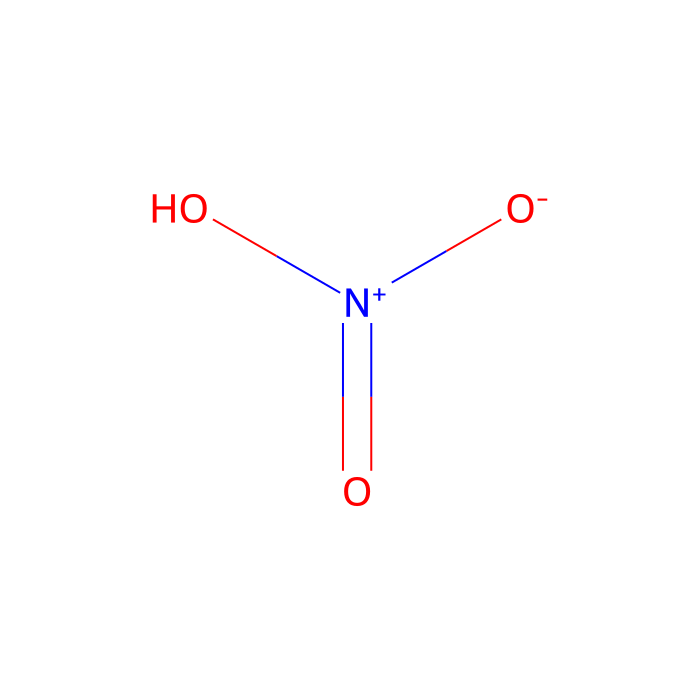
Brief description: Nitric-(15-N) acid solution is an aqueous solution of isotopically labeled nitric acid in which the nitrogen is 15N. This provides a convenient 15N source for tracer studies, isotopic labeling, and MS/NMR workflows.
Structural features (general, literature):
2D structure in words (literature): central 15N atom double-bonded to one O and single-bonded to two O atoms, one of which is protonated in HNO3; in water it largely dissociates to 15NO3– and H3O+.
General reactivity profile (literature):
15N-specific synthetic value:
Retrosynthetic considerations:
Practical notes:
Not applicable. This product is a chemical reagent (isotope-labeled nitric acid solution), not a biological targeting reagent (e.g., antibody/ligand). No antigen/epitope, species reactivity, clone, or isotype information applies.