Potent and selective NADPH oxidase 1 (NOX1) inhibitor (IC50= 20 nM). Exhibits selectivity for NOX1 over NOX2, NOX4, NOX5 and xanthine oxidase. Inhibits NOX1-derived O2-production in HT-29 human colon cancer cells. Attenuates VEGF-induced human pulmonary artery endothelial cell migration under hypoxic conditionsin vitro. Cell permeable.
Séquence
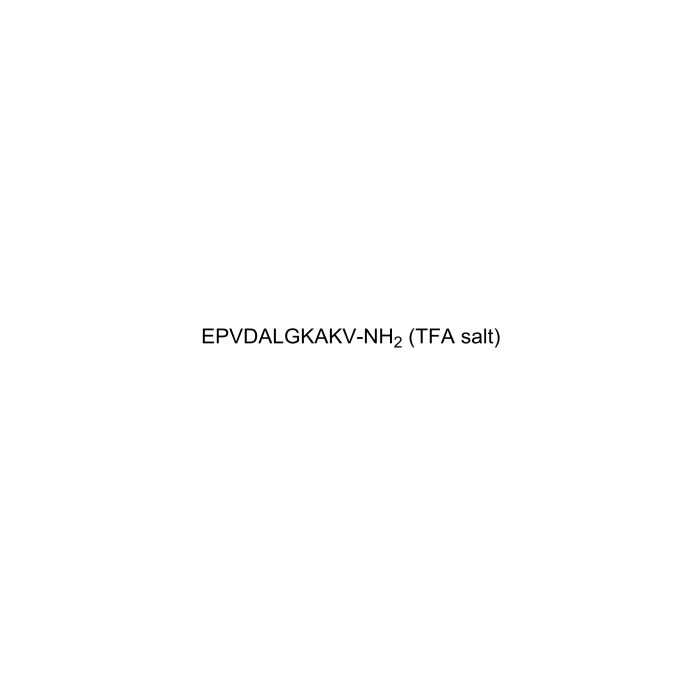
EPVDALGKAKV
Type d'action
INHIBITOR
CAS
1435893-78-9(free)
Type de molécule
Peptide
Stockage et expédition
Conditions de stockage de stockage
Store at -20°C
Expédié en
Ice chest + Ice pads
Données avancées
Certificats (CoA, COO, BSE/TSE et tableau d'analyse)
C of A & Other Certificates(BSE/TSE, COO):
Analytical Chart:
Find and download the COA for your product by matching the lot number on the packaging.
Determine the necessary mass, volume, or concentration for preparing a solution.
Dilution Calculator
Determine the dilution needed to prepare a stock solution.
Reconstitution Calculator
Avis
Avis des clients
Application Protocols
Item-specific, tested application protocols are not provided in the Product Data for this SKU.
General example workflow (literature-style guidance; not item-specific)
Stock preparation: dissolve the peptide in sterile water or DMSO to 1–10 mM. Filter-sterilize if used in cells. Aliquot and store at −20°C.
Cell-based assay example:
Plate cells and allow to adhere/recuperate overnight.
Preincubate with peptide (e.g., 1–30 µM) or vehicle for 30–60 minutes in serum-free medium if compatible.
Stimulate the pathway of interest; quantify ROS with a validated probe.
Include scrambled-peptide and inhibitor-class controls; maintain constant vehicle across wells.
Biochemical binding/competition assay: titrate peptide against a fixed concentration of binding partners; monitor by fluorescence polarization, SPR, or pull-down, as appropriate.
Important
Optimize conditions (concentration, time, temperature, vehicle %) for each cell line or assay. Validate with orthogonal readouts to confirm specificity.
NOXA1 (NADPH oxidase activator 1) is a cytosolic organizer/activator protein that participates in assembly and activation of NOX1-based NADPH oxidase complexes, which catalyze regulated production of reactive oxygen species (ROS) from NADPH and O2.
Docking-sequence peptides modeled on NOXA1 can modulate protein–protein interactions that underlie complex assembly, providing a precise biochemical probe for redox signaling pathways in diverse cell types.
Use cases in basic research include dissecting stimulus–response coupling, mapping binding interfaces, and distinguishing NOX1-dependent ROS from other cellular sources (e.g., mitochondria or xanthine oxidase).
Because peptides can exhibit limited membrane permeability and are susceptible to proteolysis, experimental systems often consider delivery strategies (e.g., transient permeabilization, carrier peptides) and protease-rich environments when interpreting biological effects.
Off-target considerations: cationic and amphipathic peptides may perturb membranes or bind nonspecifically to proteins; control experiments with scrambled sequences and concentration titrations are essential to confirm target-mediated effects.
Item-specific note
The Product Data do not disclose sequence, modifications, or confirmed selectivity for this item; consult the CoA/Spec Sheet and primary literature when designing experiments that rely on NOX isoform selectivity or specific binding.
Buffer Applications
Not a buffer component per se, but dissolution and use in buffers are central to peptide handling. Item-specific buffer guidance is not provided in the Product Data.
General preparation guidance (context; not item-specific specs)
Common assay buffers: PBS (pH 7.2–7.4), HEPES (10–25 mM, pH 7.2–7.5) with physiological ionic strength (e.g., 150 mM NaCl).
Reconstitution: start in sterile water or buffer; adjust pH slightly if needed to aid solubility, or pre-dissolve in a small volume of DMSO before dilution into buffer.
Filtration: for sterile applications, pass through a 0.22 µm low-protein-binding filter.
Storage in buffer: for short-term refrigerated use (≤1–2 days), keep at 2–8°C; for longer storage, aliquot and freeze at −20°C or below to limit hydrolysis and microbial growth.
Protein binding: adsorption to plastics can occur at low µg/mL levels; minimize by using low-bind tubes and including carrier proteins (e.g., 0.1% BSA) if compatible with the assay.
Green Alternatives
Applicability
As a peptide research reagent, NoxA1ds TFA is not a solvent or bulk process chemical; “green alternative” considerations focus on formulation, counterion choice, and handling rather than process substitution.
Counterion exchange: if TFA content is a concern (organofluorine waste, acidity), consider exchanging to acetate or chloride via ion-exchange cartridges or repeated dissolution/lyophilization from volatile acid (e.g., acetic acid). Verify peptide stability first.
Solvent minimization: dissolve at higher stock concentrations to limit DMSO use; use aqueous buffers whenever compatible.
Waste reduction: prepare aliquots sized to immediate needs to minimize freeze–thaw and discard.
Packaging: store in durable, resealable vials; consolidate shipments on cold packs to reduce packaging waste when logistics permit.
Comparison (general; not item-specific)
TFA salt vs acetate salt:
TFA: often improves solubility; introduces fluorinated waste and can acidify solutions.
Acetate: more environmentally benign; may slightly alter solubility or assay pH; typically compatible with biological assays.
DMSO vs aqueous buffer stocks:
DMSO: powerful solvent, but hazard/waste considerations; keep final assay % low.
Buffer: greener, but may limit achievable stock concentration for hydrophobic sequences.
Pharmaceutical Uses
This product is supplied strictly for research use only (per Product Data). No pharmacopeial status, excipient role, or clinical application is specified.
General context (not item-specific, no therapeutic claims)
Research peptides similar to docking-sequence inhibitors are sometimes explored in preclinical settings as biochemical probes; however, without explicit specifications and regulatory documentation, they are not suitable for pharmaceutical manufacture or human/animal administration.
If formulation behavior is being investigated in vitro, typical variables include counterion (TFA vs acetate), isotonicity (e.g., saline), and stabilizers (e.g., sugars, amino acids).
Any consideration of GMP manufacturing, sterile drug product development, or clinical use is outside the scope of this catalog item and would require comprehensive quality, regulatory, and safety packages not provided here.
Physical Properties
Item-specific (from Product Data)
Appearance: Not specified for this item; refer to CoA/Spec Sheet.
Molecular weight: Not specified for this item; refer to CoA/Spec Sheet.
General/literature properties for peptide TFA salts (context only; not item-specific specs)
Physical state: typically white to off-white amorphous solid or lyophilized powder.
Hygroscopicity: peptides can be mildly hygroscopic; brief handling at ambient conditions is recommended.
Solubility behavior: many peptides dissolve in water, PBS, or buffers; difficult-to-dissolve sequences may require initial wetting with a small volume of DMSO or dilute acid/base based on overall charge.
pH dependence: solubility often improves when the peptide is in its predominant charged state (e.g., acidic pH for basic peptides; basic pH for acidic peptides).
Counterion effects: TFA salts can enhance apparent aqueous solubility due to protonation of basic sites; residual TFA can influence pH upon dissolution.
Partitioning: peptides are generally non-volatile and have very low logP; amphiphilicity depends strongly on sequence.
Practical notes (general)
Reconstitution: start with sterile water or buffer; if insoluble, try 1–10% DMSO v/v as a cosolvent, then dilute to working concentrations.
Filtration: if needed, use low-protein-binding 0.22 µm filters to sterilize.
Do not assign boiling/melting points for peptides (they typically decompose before melting).
Quality and Grades
Item-specific (from Product Data)
Grade/purity: Not specified for this item; refer to CoA/Spec Sheet.
General guidance on peptide quality (context; not item-specific)
Typical peptide grades:
Crude: minimal purification; not recommended for most bioassays.
Desalted: low salts/TFA; modest purity.
Research grade: commonly ≥95% by HPLC, suitable for most cell and biochemical assays.
Higher grades (e.g., ≥98%): for sensitive biophysical measurements.
Characterization: quality is typically supported by analytical RP-HPLC chromatogram and mass spectrometry (ESI or MALDI). Amino acid analysis or NMR may be included for select products.
Counterion content: TFA content varies with workup; residual TFA may affect assay pH/ionic strength. If counterion is critical, consider counterion exchange (e.g., to acetate) after consulting the CoA.
Endotoxin/bioburden: unless specified, peptides are not guaranteed endotoxin-free or sterile; sterile filtration after reconstitution is recommended for cell work.
Lot-to-lot consistency: verify sequence, purity, and counterion on the lot-specific CoA prior to critical experiments.
Recommendation
Because the Product Data do not state grade/purity, confirm the target purity specification and analytical results on the accompanying CoA/Spec Sheet before use in quantitative assays.
Reaction and Applications
Item-specific (from Product Data)
Manufacturer applications: Not specified in the Product Data; see below for general research use context.
General research applications (literature context; not item-specific claims)
Redox enzyme studies: peptides modeled on NOXA1 docking sequences are widely used as tool inhibitors to probe NOX1-containing NADPH oxidase complexes, enabling studies of regulated ROS generation in biochemical and cell-based systems.
Assembly interference: such peptides can competitively disrupt subunit interactions within NOX1 activation pathways in vitro, informing mechanism-of-action analyses.
Assay modalities:
Cell-based ROS readouts (e.g., chemiluminescence or fluorogenic probes) to assess NOX activity under defined stimulation.
In vitro reconstitution assays examining subunit binding/competition.
Structure–activity optimization when designing analogs with altered charge/hydrophobicity.
Controls and benchmarking: use scrambled-sequence or inactive analogs to control for sequence-specific effects and to detect off-target physicochemical interference (e.g., detergent-like membrane effects).
Analytical confirmation: verify uptake/stability by LC–MS when feasible; consider protease inhibitors or serum-free conditions to limit degradation during assays.
Important note
The specific sequence, potency, and selectivity of this catalog item are not provided in the Product Data. Users should consult the CoA/Spec Sheet and primary literature to align concentrations and exposure times with their experimental system.
Reaction Conditions
This product is a peptide research reagent rather than a reagent for chemical transformations; classical reaction-condition guidance (solvents, catalysts, yields) is not applicable.
General experimental-use conditions (literature context; not item-specific)
Stock solutions: often prepared at 1–10 mM in sterile water or DMSO, then diluted into assay buffer; actual achievable concentrations depend on sequence and solubility.
Working concentrations: in cell-based or biochemical assays, peptide tool inhibitors are commonly used in the low- to mid-micromolar range; titrate to determine the minimal effective concentration while monitoring for off-target effects.
Incubation: preincubation of 15–60 minutes prior to stimulus may help ensure target engagement; maintain constant vehicle content across samples.
Stability: limit repeated freeze–thaw; keep on ice during use; avoid prolonged exposure to room temperature, light, and proteases.
Compatibility: confirm that DMSO or co-solvent levels remain within assay tolerances (e.g., ≤0.1–0.5% v/v for sensitive cells).
Analytics: LC–MS or HPLC can be used to monitor peptide integrity in assay matrices over time.
Safety and Handling
Item-specific (from Product Data)
GHS signal word: Not specified for this item; refer to SDS.
H-statements: Not specified for this item; refer to SDS.
GHS classification/pictograms: Not specified for this item; refer to SDS.
Storage conditions: Store at −20°C.
Shipped in: Ice chest + ice pads.
Research use: For research use only.
General safety guidance (for peptide TFA salts; consult SDS for authoritative information)
Hazards: research peptides are typically of low volatility; dust may cause mechanical irritation. The TFA counterion can contribute to acidity; avoid contact with skin/eyes.
PPE: lab coat, safety glasses, and appropriate disposable gloves (e.g., nitrile). Avoid inhalation of powders; handle in a clean area or fume hood during weighing.
Incompatibilities: strong oxidizers and strong bases/acids may degrade peptides; avoid prolonged exposure to elevated temperatures and moisture.
First aid (overview): in case of contact, rinse affected area with water for at least 15 minutes; remove contaminated clothing. If inhaled, move to fresh air. If ingested, rinse mouth with water. Seek medical attention as needed.
Spill response: gently dampen to minimize dust, absorb with inert material, and dispose of according to institutional and local regulations.
Waste: dispose as laboratory chemical waste; avoid release to the environment.
Solvent Selection
Context-specific guidance for dissolving peptide TFA salts (general; not item-specific specs)
Primary choices:
Water or physiological buffers (e.g., PBS, HEPES) for hydrophilic sequences.
A minimal volume of DMSO to wet and dissolve hydrophobic sequences, followed by dilution with aqueous buffer.
Polarity class: peptides are highly polar overall; actual behavior depends on sequence hydrophobicity and charge distribution.
Dielectric considerations: high-dielectric media (water, buffers) favor ionization and solvation of charged residues.
Practical solvent selection workflow
Attempt dissolution in sterile water at room temperature with gentle vortex/sonication.
If insoluble, adjust pH subtly toward the net-charged state (e.g., add a few µL of dilute HCl for basic peptides or dilute NaOH for acidic peptides).
If still insoluble, dissolve first in a small volume of DMSO (e.g., 5–10% of final volume), then bring to volume with buffer.
For very hydrophobic peptides, use water with 10–30% acetonitrile or ethanol as a co-solvent, verifying assay compatibility.
Comparison (general)
Water/buffer: biocompatible; may require pH tuning.
DMSO: strong solvating power; keep final DMSO ≤0.1–0.5% for sensitive cells.
Acetonitrile/ethanol: helpful co-solvents; monitor protein interactions and assay readouts.
Storage and Reconstitution
Item-specific (from Product Data)
Storage conditions: Store at −20°C.
Shipped in: Ice chest + ice pads.
Research use: For research use only.
General reconstitution and handling guidance (context; not item-specific specs)
Reconstitution solvent: use sterile water or buffer for hydrophilic sequences; if insoluble, pre-dissolve in a small volume of DMSO, then dilute with buffer.
Concentration: prepare concentrated stocks (e.g., 1–10 mM) to minimize freeze–thaw and solvent carryover; exact solubility depends on sequence.
Aliquoting: divide into single-use aliquots in low-bind tubes; avoid repeated freeze–thaw cycles.
Storage after reconstitution: short-term (≤24–48 h) at 2–8°C; for longer periods, store aliquots at −20°C or below.
Thawing: thaw on ice; mix gently to avoid foaming; briefly centrifuge to collect contents.
Sterility: for cell-based use, filter through a 0.22 µm low-protein-binding membrane after dissolution.
Documentation: record lot number, reconstitution solvent, concentration, and date; consult the CoA/Spec Sheet for any lot-specific instructions or stability notes.
Structure and Identity
Brief description: NoxA1ds TFA is supplied as the trifluoroacetate (TFA) salt of a research peptide derived from the NOXA1 (NADPH oxidase activator 1) docking sequence concept; it is used as a biochemical tool in redox biology studies. Item-specific identifiers are not provided in the Product Data.
Item-specific (from Product Data)
CAS: 1435893-78-9 (free)
Molecular formula: Not specified for this item; refer to CoA/Spec Sheet.
Molecular weight: Not specified for this item; refer to CoA/Spec Sheet.
SMILES: Not specified for this item; refer to CoA/Spec Sheet.
InChIKey: Not specified for this item; refer to CoA/Spec Sheet.
General/literature description (for context; not item-specific)
Chemical class: peptide (research-grade), isolated as a trifluoroacetate salt; TFA− serves as the counterion to protonated basic residues and/or N-terminus.
Structural features: linear peptide backbone with amide bonds; side chains include typical amino-acid functionalities (e.g., basic, acidic, hydrophobic residues) depending on sequence; may include N- or C-terminal capping in some preparations (sequence- and vendor-dependent).
2D structure (verbal): a sequence of α-amino acid residues linked by amide bonds, with pendant side chains; the TFA counterion(s) are associated ionically and are not covalently bound.
Important note
Exact sequence, number of TFA equivalents, and any modifications are not specified for this item; consult the CoA/Spec Sheet for definitive structural details.
Synthetic Utility
As a peptide reagent, NoxA1ds TFA is not typically employed as a small-molecule building block or general synthetic reagent.
General notes (context; not item-specific)
Peptide derivatives can serve as biochemical tools rather than feedstocks for organic synthesis.
Chemical modifications (e.g., N-terminal acetylation, C-terminal amidation, side-chain protection, fluorescent labeling) are sometimes introduced to study structure–activity relationships, stability, or localization; such modifications require custom synthesis workflows and are not implied for this item.
If conjugation is desired (e.g., to carriers or solid supports), strategies include NHS-ester coupling to primary amines, maleimide-thiol chemistry if a cysteine is present, or click chemistry after appropriate functionalization.
Item-specific note
No sequence or functional groups are disclosed in the Product Data; consult the CoA/Spec Sheet to assess feasibility of any downstream derivatization.
Target Specificity
Item-specific details are not provided in the Product Data. No antigen/epitope, isoform selectivity, species reactivity, clone, or isotype information is available for this SKU.
Note
If target specificity (e.g., toward NOX1 vs other NOX isoforms) is critical to your study, consult the lot-specific CoA/Spec Sheet and primary literature, and confirm in-house with appropriate positive/negative controls and orthogonal assays.
Foire aux questions
What is the purity of this product?
This product is supplied at ≥98% purity (chemical assay). Lot-specific values are stated on the Certificate of Analysis.
How should this product be stored?
Store at ?20 °C. Freezer storage is required to maintain the specified shelf life.
How is this product shipped?
This product ships in an insulated container with ice pads. Unpack on arrival and transfer it to the storage condition stated above.
What are the CAS number, molecular formula and molecular weight?
The CAS Number is 1435893-78-9(free).
What documentation is provided?
Available product documentation, including Certificates of Analysis (COA), Safety Data Sheets (SDS), and specification sheets, is shown in the product document area. Document availability and access follow the current site policy.
Nous utilisons des cookies pour garantir le bon fonctionnement du site et, lorsque cela est autorisé, pour améliorer votre expérience. Vous pouvez gérer vos préférences à tout moment dans les Paramètres. Pour en savoir plus, consultez notre Politique relative aux cookies.
Souhaitez-vous que nous vous envoyions un message lorsque des réductions seront disponibles?
Me rappeler plus tard
Merci ! Veuillez vérifier votre boîte de réception e-mail pour confirmer.
Products are supplied to verified businesses, institutions, and qualified professionals for research and development use only. Not for use in humans, animals, diagnosis, or therapy.

 B2418493