GRADE & PURITYMoligand™?Moligand™ — Aladdin's line of ligands and bioactive small molecules. Use for receptor, pathway, and binding studies needing defined small-molecule tools.10 mM in DMSO
Moligand™, 10 mM in DMSO Moligand™ for sensitive chromatographic and analytical workflows requiring minimal baseline interference.
🌡
Storage & shipping
Store at -80°C Ships Dry ice packs + Cold packs Check lot-specific COA for exact specifications.
📋
Quality documents
SDS, COA, datasheet, and spec sheet available for download. Lot-specific COA accessible via lot number lookup.
📚
Literature proof
Cited in 0 peer-reviewed publications across chromatography, organic synthesis, and cross-coupling reactions.
Vue d’ensemble
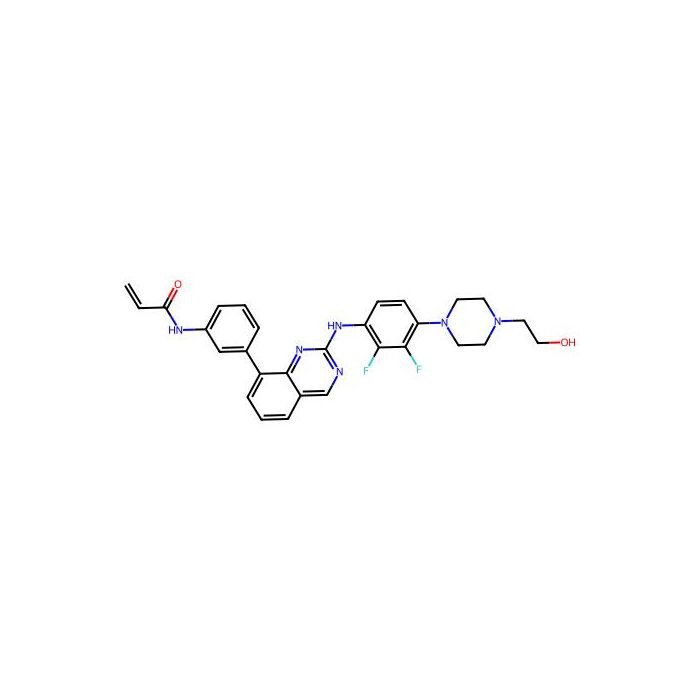
Olafertinib is a third-generation EGFR TKI, with GI 50 values of 5 nM ( EGFR L858R/T790M), 10 nM ( EGFR del19) and 689 nM ( EGFR WT), respectively. Olafertinib has the potential for NSCLC research.
Specifications
Spécifications et pureté
Moligand™, 10 mM in DMSO
Conditions de stockage de stockage
Store at -80°C
Expédié en
Dry ice packs + Cold packs
Ce produit nécessite l'expédition en chaîne froide. Les services terrestres et autres services économiques ne sont pas disponibles.
Certificats (CoA, COO, BSE/TSE et tableau d'analyse)
C of A & Other Certificates(BSE/TSE, COO):
Analytical Chart:
Calculateurs de solution
Molarity Calculator
Determine the necessary mass, volume, or concentration for preparing a solution.
Dilution Calculator
Determine the dilution needed to prepare a stock solution.
Reconstitution Calculator
Avis
Avis des clients
Application Protocols
Validated application protocols are not provided for this item. The following are general, non-item-specific practices for small-molecule tool compounds:
Stock solution: Prepare at 10 mM in anhydrous DMSO; vortex and sonicate gently if needed. Filter through a low-binding 0.22 µm PTFE syringe filter if particulate persists.
Working dilutions: Prepare fresh in assay buffer immediately before use to minimize precipitation and degradation. Maintain final DMSO typically at 0.1–1.0% v/v.
Dose–response: Use half-log or quarter-log serial dilutions (8–12 points) with triplicate wells; include vehicle controls matched for DMSO.
Storage of plates: If pre-plating compounds, seal to minimize evaporation and store at –20°C or colder; validate freeze–thaw effects on potency.
Analytical reference: For LC–MS, prepare a calibration curve across expected concentrations with at least six non-zero levels and appropriate QC samples; assess carryover and matrix effects.
Because item-specific assay types (e.g., WB, IHC, IF, FC) and recommended dilutions are not provided, users should adapt these general steps to their established SOPs and consult the CoA/SDS for any constraints.
Biological Roles
Context (general, literature-level): Olafertinib is referenced in the literature as a synthetic small-molecule modulator designed for kinase signaling research, particularly in pathways involving receptor tyrosine kinases. Specific binding constants, selectivity profiles, and cellular phenotypes are assay- and source-dependent and are not provided in this product data.
Typical research roles for small-molecule kinase-pathway probes:
Target engagement studies: CETSA, NanoBRET, or biochemical enzyme assays to quantify potency and residence time.
Pathway interrogation: evaluation of downstream phosphorylation states (e.g., via Western blot or phospho-specific ELISA) upon compound treatment.
Mechanistic profiling: time-course and washout experiments to explore reversibility and recovery of signaling.
Chemical biology: tool use in genetic–chemical epistasis experiments alongside RNAi/CRISPR perturbations.
Critical notes:
Potency, selectivity, permeability, and efflux liability of Olafertinib under your conditions must be established experimentally; these are Not specified for this item.
Assay interference risks (aggregation, autofluorescence, redox cycling) should be assessed with orthogonal readouts.
All statements above are presented as general research context; no medical or clinical claims are made. For definitive target and selectivity data for Olafertinib, consult peer-reviewed sources associated with CAS 1660963-42-7 and verify against your CoA.
Buffer Applications
This product is a small-molecule research tool and is not a buffering agent. Traditional buffer system design (e.g., phosphate, HEPES, Tris) does not apply to Olafertinib as a buffer component.
Practical considerations for assay buffers (general):
Prepare compound stocks in DMSO, then dilute into your assay buffer (e.g., HEPES- or Tris-based) to a final DMSO content typically between 0.1–1.0% v/v, consistent with your biological system’s tolerance.
Maintain ionic strength and pH appropriate for the target assay while avoiding excipients that might nonspecifically bind hydrophobic small molecules (e.g., excessive serum proteins can alter free concentration).
Filter buffers (0.22 µm) to minimize particulate-induced precipitation when adding hydrophobic compounds.
Because no compound-specific pKa, solubility, or stability in common buffers is provided, optimization should be empirical and documented per your lab’s SOPs.
Green Alternatives
As Olafertinib is a discrete bioactive small molecule intended as a tool compound, greener “alternatives” are generally not applicable in the same sense as solvent replacement. However, greener practice can be incorporated into how it is handled, formulated, and tested.
Greener handling strategies (general):
Use minimal DMSO volumes and prepare concentrated master stocks to reduce solvent consumption.
Employ microplate-based assays and automated liquid handling to decrease waste and improve dosing accuracy.
Favor aqueous assay buffers with the lowest feasible DMSO carryover that still maintains solubility (often 0.1–0.5% v/v).
Design stability/solubility pretests to avoid repeated freeze–thaw and re-preparation cycles.
Comparison of common vehicles (general considerations):
DMSO: Excellent solubilizer; high boiling point; readily biodegradable, but use sparingly and avoid unnecessary disposal to drain.
DMF/DMAC: Good solvency but higher EHS concerns; avoid unless necessary.
Ethanol/PEG 400: Sometimes viable for less hydrophobic compounds; evaluate assay compatibility and protein interactions.
Note: There is no direct “green substitute” for Olafertinib as an active research tool. Sustainability measures focus on solvent minimization, right-sizing experiments, and proper waste segregation per institutional and local regulations.
Pharmaceutical Uses
This listing is provided strictly for research use only. No therapeutic, diagnostic, or clinical claims are made.
Relevant non-clinical, laboratory-centric uses:
Analytical reference: Utilize as a system suitability or calibration reference in method development for LC–MS/MS, HPLC-UV, or stability-indicating assays. Confirm purity and identity with the accompanying CoA.
Preformulation research: Evaluate solubility in various vehicles (DMSO, ethanol, PEG 400, aqueous cosolvent systems) to inform in vitro assay compatibility. Any dosage-form experimentation should remain in the research domain.
Permeability and metabolism studies: Conduct in vitro assessments (e.g., microsomes, hepatocytes, Caco-2) as part of discovery ADME workflows; ensure proper institutional approvals for all studies.
Regulatory status:
Pharmacopeial monographs, excipient status, or GMP grades are not provided for this item. It is not offered for human or veterinary administration.
Important: If used as a reference standard, establish traceability to an internal or external primary reference and document storage conditions, potency (if applicable), and expiration per your QA procedures.
Physical Properties
Item-specific physicochemical specifications are not provided in the current product data and should be confirmed on the CoA/SDS for the shipped lot.
Appearance: Not specified for this item; refer to CoA/Spec Sheet.
Molecular weight: Not specified for this item; refer to CoA/Spec Sheet.
Molecular formula: Not specified for this item; refer to CoA/Spec Sheet.
Melting point (MP): Not specified for this item; refer to CoA/Spec Sheet.
Boiling point (BP): Not applicable/rarely reported for complex bioactive solids; check CoA if needed.
Density: Not specified for this item; refer to CoA/Spec Sheet.
LogP/logD, pKa, refractive index: Not specified for this item; refer to CoA/Spec Sheet.
Solubility (general, literature-level guidance for kinase inhibitors):
Frequently soluble in DMSO at 10–50 mM; aqueous solubility is often limited without cosolvent or salt forms. Exact solubility for Olafertinib must be verified experimentally or via CoA.
Notes for use:
For stock preparation, DMSO is commonly used for small-molecule screening compounds. If aqueous use is required, consider a cosolvent approach (e.g., DMSO to final 0.1–1% v/v in buffer) after verifying Olafertinib’s compatibility.
Hygroscopicity, polymorphism, and hydrate state are not specified; handle under dry conditions until confirmed.
Quality and Grades
Grade/Purity: Moligand™ (as listed in product data).
What Moligand™ signifies (general program description):
Moligand™ refers to a library/screening-oriented small-molecule offering intended for discovery chemistry, target validation, and method-development workflows. While exact acceptance criteria vary by compound, this line typically emphasizes:
Identity confirmation by orthogonal analytical techniques (e.g., LC–MS, 1H NMR) appropriate to the compound class.
Purity suitable for biochemical screening and cellular assays. Specific purity thresholds, residual solvents, and counterion/solvate content are not specified for this item; refer to the CoA/Spec Sheet for lot-specific values.
Packaging that supports traceability and minimal freeze–thaw cycles for library maintenance.
What is specific to this item:
No item-specific purity percentage, residual solvent profile, water content, or stabilizers are provided in the product data. All such specifications are Not specified for this item; refer to CoA/Spec Sheet.
Practical implications:
For high-sensitivity assays (e.g., low-signal biochemical readouts), confirm purity and counterion state from the CoA and perform a quick incoming QC (spot LC–MS) if your workflow requires.
If you require specialized grades (e.g., salt form selection, particle-size control, or pre-weighed single-use vials), contact technical support with SKU O1498936.
Reaction and Applications
This product is positioned as a finished small-molecule tool compound rather than a synthetic reagent. As such, it is typically used in discovery workflows rather than as a substrate/reagent in preparative organic reactions.
Research applications (general, non-clinical):
Chemical biology: probe studies in signaling pathways using concentration-response profiling and target engagement assays.
Screening: inclusion in focused/targeted panels for kinase or pathway-relevant biochemical and cell-based assays.
Reference standard: analytical development for LC–MS/MS quantification, impurity profiling, and stability-indicating methods.
Practical guidance:
Prepare concentrated DMSO stocks (e.g., 10 mM) and dispense via low-retention tips. For multi-point dose–response curves, confirm top concentration lacks precipitation upon aqueous dilution.
Validate assay interference: check for fluorescence overlap or redox activity in readout-specific counter-screens.
Consider lot verification by LC–MS to confirm identity and assess purity aligned with your assay’s sensitivity.
Synthetic reaction usage:
Not typically applied as a reagent or intermediate. If derivatization or conjugation chemistry is planned (e.g., to generate an affinity probe), obtain structural information from the CoA/literature to select accessible positions and compatible chemistries.
All uses are for research only. No claims are made regarding diagnostic or therapeutic applications.
Reaction Conditions
This product is not generally employed as a reagent in chemical reactions; therefore, classical reaction conditions (catalysts, temperatures, stoichiometries) are not applicable.
Analytical and handling conditions (general guidance):
Solution preparation: Dissolve in anhydrous DMSO to prepare 10 mM master stocks, then aliquot and store at –80°C. Confirm solubility empirically for your lot.
Stability checks: Perform a short-term stability study (e.g., 24–48 h at room temperature and 4°C in assay-relevant diluents) and a freeze–thaw challenge to define handling windows.
LC–MS method development: Start with water/acetonitrile (0.1% formic acid) gradients; monitor in positive ESI unless literature suggests otherwise. Optimize source parameters to maximize signal while minimizing in-source fragmentation.
Solid-state handling: Minimize exposure to ambient humidity and light until stability is confirmed. Work quickly on the bench and return to cold storage.
Any references to “reaction conditions” for transformations of Olafertinib (e.g., synthesis, derivatization) require structural details and are outside the scope of this product listing. Consult the primary literature for CAS 1660963-42-7 if such chemistry is intended.
Safety and Handling
Hazard classification details (GHS, H-statements, pictograms) are not provided in the product data and must be obtained from the SDS accompanying your lot.
GHS classification: Not specified for this item; refer to SDS.
Signal word / H-statements / pictograms: Not specified for this item; refer to SDS.
General laboratory safety (good practice):
Handle in a chemical fume hood to avoid inhalation of dust or aerosols.
PPE: lab coat, safety glasses, and appropriate chemically resistant gloves (e.g., nitrile). Avoid skin/eye contact and ingestion.
Avoid generating dust; use antistatic measures for fine powders.
Incompatibilities: Until specific data are available, segregate from strong oxidizers and acids/bases. Use clean, dry tools to prevent contamination.
First aid (overview; consult SDS for full instructions):
Inhalation: Move to fresh air; seek medical attention if symptoms persist.
Skin contact: Wash with soap and water; remove contaminated clothing.
Eye contact: Rinse cautiously with water for several minutes; seek medical attention if irritation continues.
Ingestion: Rinse mouth; do not induce vomiting; seek medical advice.
Environmental considerations:
Prevent release to drains; collect spills with inert absorbent and dispose of according to institutional and local regulations.
Always defer to the official SDS for authoritative hazard, toxicology, and disposal guidance.
Solvent Selection
Intended use: Olafertinib is supplied as a small-molecule research tool; routine handling typically involves organic solvency and DMSO-based stock solutions.
General solvent recommendations (literature-level for kinase inhibitors):
Primary stock solvent: DMSO, owing to strong solvating power for heteroaromatic, polyfunctional scaffolds; typical screening stocks: 10 mM (sometimes up to 50 mM if solubility permits).
Cosolvent approach for assays: Dilute DMSO stocks into aqueous buffers to 0.1–1.0% v/v final DMSO, balancing solubility and biological compatibility.
Alternative organic solvents (as needed): DMF, acetonitrile, or ethanol may dissolve the solid for intermediate manipulations; verify stability and assay compatibility.
Polarity/miscibility notes:
DMSO is fully miscible with water and most organics, facilitating serial dilution. If aqueous precipitation occurs upon dilution, add slowly with mixing, and consider temperature or surfactant-free carrier proteins only if validated for your assay.
Selection tips:
Prefer fresh, anhydrous DMSO for preparing master stocks to minimize hydrolysis or moisture-induced degradation (if any). Aliquot to avoid repeated freeze–thaw.
For LC–MS reference solutions, a 50:50 acetonitrile:water + 0.1% formic acid system commonly provides robust ionization; confirm Olafertinib’s ionization mode with your instrument method.
Note: Exact solubility and stability for Olafertinib are Not specified for this item; confirm empirically and consult the CoA/SDS.
Storage and Reconstitution
Storage conditions (from product data):
Store at –80°C.
Shipped on dry ice packs + cold packs to preserve material integrity during transit.
General handling and reconstitution guidance for small-molecule tool compounds:
Upon receipt: Inspect packaging and allow vials to equilibrate in a desiccator at low temperature to avoid condensation. Open only after materials reach a controlled environment.
Aliquoting: If supplied as solid, subdivide under dry conditions into single-use portions. If supplied as solution, immediately create single-use aliquots to avoid repeated freeze–thaw.
Stock preparation: Dissolve in anhydrous DMSO to a convenient concentration (e.g., 10 mM). Record exact concentration gravimetrically or by quantitative NMR/UV if required by QA.
Storage of stocks: Store aliquots at –80°C in tightly sealed, chemically resistant vials. Protect from light until stability is known. Avoid frost-free freezers that cycle temperatures.
Freeze–thaw: Minimize cycles; thaw on ice, mix gently, and promptly return unused material to –80°C. Discard aliquots that show precipitation, discoloration, or unexpected LC–MS profiles.
Aqueous working solutions: Prepare fresh immediately prior to use. If stability in buffer is required, conduct a short-term stability study under your exact conditions.
Specifications such as stabilizers, hydrate/solvate form, and measured solubility are Not specified for this item; refer to the CoA/Spec Sheet.
Structure and Identity
Brief overview: Olafertinib is supplied as a research-use small molecule in our Moligand™ collection. Structural identifiers for this specific lot are not listed in the product data.
Chemical name: Olafertinib
CAS: 1660963-42-7
PubChem CID: 117909640
Molecular formula: Not specified for this item; refer to CoA/Spec Sheet.
Molecular weight: Not specified for this item; refer to CoA/Spec Sheet.
SMILES: Not specified for this item; refer to CoA/Spec Sheet.
InChIKey: Not specified for this item; refer to CoA/Spec Sheet.
Structural features (general, literature-level context):
Olafertinib is reported in the literature as a synthetic small-molecule tyrosine kinase inhibitor scaffold. Without item-specific structure data provided here, detailed functional group assignment, ring systems, and stereochemical descriptors cannot be confirmed for this catalog listing.
2D structure description (general):
Literature sources describe kinase inhibitors of this class as polyheteroaromatic frameworks bearing anilide/amide or related hinge-binding motifs designed to occupy the ATP-binding cleft. The exact atom connectivity for Olafertinib should be confirmed against the CoA/SDS or primary literature corresponding to CAS 1660963-42-7 for this item.
Synthetic Utility
Olafertinib is supplied as a finished small-molecule research tool rather than as a building block. Consequently, it is not typically leveraged as a synthon in routine organic synthesis.
Use cases where synthetic manipulation may be contemplated (general):
Probe derivatization: If generating tagged analogs (e.g., biotinylated, alkyne/azide handles for click chemistry) or immobilized ligands, consult structural literature for accessible positions that preserve activity. Without the structure in this product data, any modification strategy must be guided by primary references for CAS 1660963-42-7.
Impurity/degradation studies: Forced-degradation experiments (acid/base, oxidative, photolytic, thermal) can support stability-indicating method development, but reaction conditions and products should be characterized by LC–HRMS and NMR.
Limitations:
Lacking item-specific structural details (SMILES/InChIKey), we do not recommend planning retrosynthetic routes or coupling strategies based solely on this catalog entry. Request the CoA or consult peer-reviewed sources to obtain definitive functional group information before any derivatization.
Summary:
Treat Olafertinib as an end-use research ligand/standard. Any synthetic modifications should be considered advanced, structure-informed projects outside typical reagent use.
Target Specificity
No target specificity data are provided in the product data for this catalog entry.
Target(s): Not specified for this item; refer to CoA/Spec Sheet or primary literature for CAS 1660963-42-7.
Potency/selectivity values (e.g., IC50, KD): Not specified for this item; refer to peer-reviewed sources and verify under your assay conditions.
Species cross-reactivity and off-target panels: Not specified for this item.
If target profiling is critical to your application, we recommend generating an in-house selectivity panel or consulting published kinase profiling datasets for Olafertinib and confirming alignment with your lot via orthogonal assays.
Foire aux questions
What is Moligand??
Moligand? is one of Aladdin Scientific's premium product lines, formulated for high-purity applications across multiple workflows. Compared to standard grades in the same workflow, Moligand? products typically offer tighter specifications, more rigorous QC, and stronger lot-to-lot consistency.
How should this product be stored?
Store at ?80 °C. Ultra-low temperature storage is required to maintain the specified shelf life.
How is this product shipped?
This product ships frozen with dry ice and cold packs. Unpack on arrival and transfer it to the storage condition stated above; handle dry ice with insulated gloves in a ventilated area.
What are the CAS number, molecular formula and molecular weight?
The CAS Number is 1660963-42-7, the molecular formula is C29H28F2N6O2, and the molecular weight is 530.57 g/mol.
What documentation is provided?
Available product documentation, including Certificates of Analysis (COA), Safety Data Sheets (SDS), and specification sheets, is shown in the product document area. Document availability and access follow the current site policy.
Need help choosing the grade?
Our grade selection guide covers purity, stabilizer status, and application suitability for all variants in our catalog.
Nous utilisons des cookies pour garantir le bon fonctionnement du site et, lorsque cela est autorisé, pour améliorer votre expérience. Vous pouvez gérer vos préférences à tout moment dans les Paramètres. Pour en savoir plus, consultez notre Politique relative aux cookies.
Souhaitez-vous que nous vous envoyions un message lorsque des réductions seront disponibles?
Me rappeler plus tard
Merci ! Veuillez vérifier votre boîte de réception e-mail pour confirmer.
Products are supplied to verified businesses, institutions, and qualified professionals for research and development use only. Not for use in humans, animals, diagnosis, or therapy.