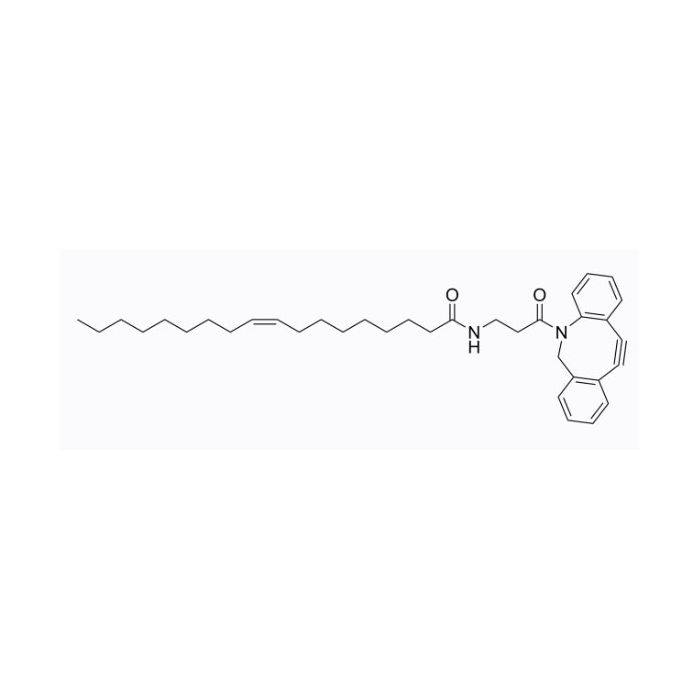
Oleic-DBCO - ≥95% , CAS No.2279951-78-7

CAS: 2279951-78-7 Cat. No.: O595729 Formule: C36H48N2O2 Poids moléculaire: 540.78
DISPONIBLE À COMMANDE
QUALITÉ & PURETÉ ≥95%
Storage
Store at -20°C
Shipped In
Ice chest + Ice pads
★
Taille
USA
Allemagne (EU)*
Prix
Qté
10mg
O595729-10mg
2 En stock
—
139,90$US
50mg
O595729-50mg
1 En stock
—
499,90$US
100mg
O595729-100mg
Sur commande · 8–12 semaines
759,90$US
Enter a quantity for the sizes you want to add.

Vue d’ensemble

Oleic-DBCO is an alkyl chain-based PROTAC linker that can be used in the synthesis of PROTACs. Oleic-DBCO is a click chemistry reagent, it contains a DBCO group that can undergo strain-promoted alkyne-azide cycloaddition (SPAAC) with molecules containing Azide groups.

Spécifications

Spécifications et pureté
≥95%
Conditions de stockage de stockage
Store at -20°C
Expédié en
Ice chest + Ice pads
Ce produit nécessite l'expédition en chaîne froide. Les services terrestres et autres services économiques ne sont pas disponibles.
Pureté
≥95%
Noms et identifiants
Poids moléculaire
540.78

Données avancées

Certificats (CoA, COO, BSE/TSE et tableau d'analyse)
C of A & Other Certificates(BSE/TSE, COO):
Analytical Chart:

Find and download the COA for your product by matching the lot number on the packaging.

3 results found

Lot NumberCertificate TypeDateArticle
I2523462I2523462Certificate of AnalysisJul 17, 2025 O595729
I2523476I2523476Certificate of AnalysisJul 17, 2025 O595729
I2523477I2523477Certificate of AnalysisJul 17, 2025 O595729
Propriétés chimiques et physiques
SolubilitéSolubility in DMSO, DCM, DMF
Calculateurs de solution
Avis

Avis des clients

Application Protocols

Below are general, non-item-specific procedures to guide use. Optimize for your system.

A. SPAAC labeling of an azide-functionalized peptide (aqueous-compatible):

  1. Prepare a 50 mM stock of Oleic-DBCO in anhydrous DMSO.
  2. Dissolve the azide-peptide at 0.2–1.0 mM in PBS or HEPES, pH 7.4.
  3. Add Oleic-DBCO to achieve 1.5 eq and ≤2% v/v DMSO. Optionally include 0.01% Tween-20.
  4. Incubate at 25–37 °C for 1–4 h with gentle mixing.
  5. Monitor by LC-MS. Desalt via spin column or HPLC purification.

B. Post-insertion onto azide-decorated liposomes:

  1. Formulate azide-bearing liposomes by thin-film hydration and extrusion.
  2. Dilute liposomes to 1–10 mM total lipid in HEPES-buffered saline, 25–37 °C.
  3. Add Oleic-DBCO from DMSO stock (final DMSO ≤2%) at 2–5 mol% relative to azide handles.
  4. Incubate 1–3 h with gentle agitation; avoid foaming. Remove free small molecules by SEC.

C. Polymer modification in organic media:

  1. Dissolve azide-terminated polymer (e.g., 5–20 mg/mL) and Oleic-DBCO (1.2 eq) in THF or DMF.
  2. Stir at 25–40 °C for 2–6 h. Monitor by IR (loss of azide at ~2100 cm−1).
  3. Precipitate polymer into a non-solvent (e.g., cold methanol or hexanes), collect, and dry.

Notes:

  • Exclude sodium azide from all solutions.
  • Validate product by NMR and MS where feasible. Adjust equivalents for sterically hindered azides.
Biological Roles

Item-specific biological roles are not applicable; Oleic-DBCO is a synthetic research reagent designed for bioorthogonal conjugation.

General context (biochemistry):

  • Oleic component: Oleic acid (C18:1, Δ9-cis) is a common monounsaturated fatty acid in membranes and lipid droplets, conferring fluidity relative to saturated C18 lipids. When appended to probes or cargos, an oleyl chain can promote membrane insertion, endosomal interactions, or altered biodistribution in model systems (in vitro/in vivo research contexts), though outcomes are system-dependent.
  • DBCO component: The dibenzocyclooctyne moiety participates in strain-promoted azide–alkyne cycloaddition (SPAAC) with azide-functionalized biomolecules. This reaction is considered bioorthogonal—proceeding in complex biological media without interfering with native functional groups—making it useful for labeling azide-bearing glycans, proteins, or nucleic acids in research.

Use considerations:

  • In cell-free or cell-based experiments, delivery of hydrophobic DBCO–lipids often requires co-solvent, serum carriers (e.g., albumin), or nanoformulation (micelles, liposomes). Optimize concentration to avoid membrane perturbation artifacts.
  • The reagent itself has no endogenous receptor or enzyme target. Any observed biological effects typically stem from the hydrophobic oleyl chain altering membrane properties or from the conjugated cargo.

Compliance: This product is for research use only; no diagnostic or therapeutic claims are made.

Buffer Applications

Oleic-DBCO is not a buffering agent and does not constitute a defined buffer system.

Practical guidance for use in aqueous buffers (general):

  • Recommended buffers: PBS (pH 7.2–7.4) or HEPES (pH 7.2–7.8) are commonly used for SPAAC with azide-labeled biomolecules. Maintain physiological ionic strength if working with proteins or cells.
  • Organic cosolvent: Introduce Oleic-DBCO from a concentrated anhydrous DMSO or DMF stock to a final organic content ≤2–5% v/v to limit protein denaturation.
  • Solubilization aids: 0.01–0.05% nonionic surfactant (e.g., Tween-20) or 1–10 mM cyclodextrin can help maintain dispersion in aqueous media without quenching SPAAC.
  • Avoid sodium azide in buffers when performing SPAAC, as free azide will consume DBCO. If azide is necessary as a preservative, remove it prior to conjugation by desalting/dialysis.
  • pH effects: SPAAC is largely pH-insensitive across neutral pH (6.5–8.0). Extreme pH may hydrolyze labile linkers (if present; specific linkage for this SKU not specified).

For lipid film hydration:

  • Hydrate dried lipid films containing Oleic-DBCO with the target buffer warmed to 37–55 °C with gentle agitation. Sonication or extrusion can improve size homogeneity of vesicles.
Green Alternatives

Greener choices can be considered at two levels: solvent system and the bioorthogonal handle. While Oleic-DBCO is intrinsically valuable for copper-free click chemistry, process choices can reduce environmental impact.

Solvent considerations (general):

  • Prefer ethyl acetate, 2-MeTHF, CPME, or isopropanol over chlorinated solvents where feasible (solubility permitting). For lipid film methods, partial substitution of chloroform with ethanol or isopropanol can reduce chlorinated waste, though drying may be slower.
  • Use minimal DMSO/DMF percentages in aqueous conjugations. Replace DMF with NBP (N-butylpyrrolidone) or Cyrene where compatible.

Alternative cycloalkynes (tradeoffs, literature):

  • BCN (bicyclo[6.1.0]non-4-yne): Often exhibits comparable SPAAC efficiency with reduced aromatic content; sometimes slower than DBCO with certain azides but may offer improved stability in biological media.
  • DIBAC/ADIBO variants: Similar to DBCO in reactivity; choice affects hydrophobicity and membrane partitioning.

Alternative ligation chemistries:

  • Tetrazine–TCO iEDDA: Faster kinetics (up to 10^4–10^6 M−1 s−1), but tetrazines can be less stable; may enable lower reagent loadings.
  • Thiol–ene or Michael additions: Catalyst-free under UV/thermal initiation, but lack azide specificity.

Summary table (qualitative):

  • DBCO: very fast SPAAC; aromatic; hydrophobic; copper-free.
  • BCN: fast SPAAC; less aromatic; potentially greener profile.
  • iEDDA (TCO/Tetrazine): fastest; components may be air/light sensitive; distinct selectivity.

Select greener options based on matrix, waste profile, and required kinetics.

Pharmaceutical Uses

This product is supplied for research use only and is not intended for human or veterinary use.

Formulation and process roles in research settings (general):

  • Lipid anchor: Oleic-DBCO can endow cargos or surfaces with an oleyl chain, facilitating incorporation into lipid-based delivery systems (liposomes, LNP-like model systems) during formulation studies.
  • Post-assembly functionalization: DBCO in membranes enables copper-free, on-particle conjugation of azide-bearing ligands (peptides, sugars, polymers) to explore structure–activity relationships in delivery vehicles.
  • Excipient screening: Serves as a model hydrophobe–reactive hybrid for studying stability, aggregation, and release profiles when coupled to azide-modified APIs or excipients (preclinical research).
  • Analytical reference: Useful for developing/validating chromatographic methods for amphiphilic, click-reactive lipids (e.g., RP-HPLC with gradient ACN/IPA water systems).

Regulatory notes:

  • No pharmacopeia monograph is associated with this conjugate (general). Any use in regulated manufacturing would require independent qualification, impurity profiling, and stability data.

Processing cautions:

  • Residual organic solvents must be controlled during formulation work. Confirm removal by GC or gravimetric methods where applicable.
  • Copper-free click compatibility mitigates concerns of residual metal catalyst, simplifying downstream analysis compared with CuAAC-based approaches.
Physical Properties

Item-specific physicochemical specifications:

  • Appearance: Not specified for this item; refer to CoA/Spec Sheet.
  • Purity/Grade: Not specified for this item; refer to CoA/Spec Sheet.
  • Molecular Weight: Not specified for this item; refer to CoA/Spec Sheet.
  • Melting/Freezing Point: Not specified for this item; refer to CoA/Spec Sheet.
  • Boiling Point: Not specified for this item; refer to CoA/Spec Sheet.
  • Density: Not specified for this item; refer to CoA/Spec Sheet.
  • Refractive Index/UV Cutoff: Not specified for this item; refer to CoA/Spec Sheet.
  • Water/peroxide/metal limits: Not specified for this item; refer to CoA/Spec Sheet.

General/literature expectations for oleyl–DBCO conjugates (non-spec):

  • Physical state: typically viscous oil or low-melting waxy solid at room temperature due to the long C18 chain and cis-alkene (reduces crystallinity).
  • Solubility: highly soluble in nonpolar and moderately polar aprotic organic solvents (e.g., chloroform, DCM, toluene, THF); soluble in anhydrous DMSO and DMF; negligible aqueous solubility unless formulated with surfactants, cyclodextrins, or micelles/liposomes.
  • LogP: expected high (>6) owing to the oleyl chain (literature, qualitative).
  • Aggregation: can self-assemble in aqueous media; use co-solvent or detergents for dispersion.

Practical notes (general guidance):

  • Prepare stock solutions at 1–50 mM in anhydrous DMSO, DMF, THF, or chloroform depending on the intended matrix (bioconjugation vs. lipid formulation).
  • For analytical characterization, RP-HPLC (C18) with acetonitrile/isopropanol gradients and MS detection is commonly used for such amphiphilic DBCO-lipids.
Quality and Grades

Item-specific grade/purity information: Not specified for this item; refer to CoA/Spec Sheet.

Guidance on quality attributes for Oleic-DBCO (general/literature expectations for click-ready lipids):

  • Purity determination: High-purity materials are typically verified by RP-HPLC/UPLC with UV (254–310 nm) and MS detection. Minor rotamers or geometric isomers (from the DBCO ring strain or olefin geometry) may appear as closely eluting peaks; these are common and usually acceptable if identity and total purity meet specifications.
  • Identity confirmation: HRMS (ESI/APCI), 1H/13C NMR in CDCl3 or CD3OD/CDCl3 mixtures. For amphiphilic analytes, addition of TFA-d or a drop of DMSO-d6 can sharpen resonances.
  • Residual solvents and water: Low residual solvent and KF moisture are desirable for reproducible SPAAC performance, especially for lyophilized or film-forming uses. Item-specific limits are not provided here; consult CoA.
  • Stabilizers: Typically none are added to DBCO–lipid conjugates; however, some vendors pack under inert gas and in amber vials to mitigate light/oxygen exposure. This item’s stabilizer status is not specified.
  • Functional performance: A practical quality indicator is the second-order rate constant for SPAAC with standard azides (e.g., benzyl azide) in defined solvent/buffer systems; while not routinely listed on CoAs, consistent conversion in control reactions is a useful in-lab verification.

When to request additional documentation:

  • For regulated or scale-up work, request batch CoA plus methods for purity assay and any available stability data (thermal/light).
Reaction and Applications

Core reactivity: Oleic-DBCO participates in copper-free strain-promoted azide–alkyne cycloaddition (SPAAC) with organic azides to yield stable triazoles. No copper catalyst is required, which minimizes cytotoxicity and is ideal for delicate matrices.

Applications (materials and chemical biology research):

  • Surface and polymer modification: Rapid conjugation of azide-functionalized polymers, hydrogels, or nanoparticles to impart a lipophilic oleyl anchor for membrane interactions, compatibilization, or phase behavior tuning.
  • Liposome/LNP engineering: Introduce DBCO functionality into lipid bilayers to capture azide-bearing ligands post-assembly (post-insertion) or to install oleyl anchors onto azide-modified cargos (pre-assembly).
  • Biomolecule tagging: Conjugate to azide-labeled peptides, oligonucleotides, or sugars to modulate hydrophobicity and drive membrane association (in vitro).
  • Micro- and nanofabrication: Pattern azide-terminated surfaces and perform site-selective SPAAC with Oleic-DBCO for hydrophobic patterning without metal catalysts.

Mechanistic/practical notes (general):

  • Kinetics: SPAAC rate constants for DBCO with simple azides are typically in the 10−2–1 M−1 s−1 range depending on medium and azide electronics (literature). Electron-deficient azides react faster.
  • Stoichiometry: Use 1.1–2.0 equivalents of Oleic-DBCO relative to the azide to drive to completion; monitor by LC-MS or disappearance of azide IR band (~2100 cm−1).
  • Medium: Reaction proceeds in mixed aqueous/organic systems; 20–37 °C accelerates conversion without degrading most substrates.
  • Workup: For small molecules, evaporate solvent and purify by flash or preparative HPLC; for polymers/nanoparticles, dialysis or precipitation is typical.

Note: Exact reaction conditions should be optimized for each substrate and matrix.

Reaction Conditions

SPAAC with azides (general, literature-guided):

  • Concentration: 10–500 µM for biomolecules; 1–50 mM for small-molecule couplings. Higher concentrations increase rate but risk aggregation for hydrophobic substrates.
  • Stoichiometry: 1.1–2.0 eq Oleic-DBCO per azide.
  • Solvent: Aqueous buffer (PBS/HEPES, pH 7.0–7.8) with 1–5% DMSO or DMF; purely organic (THF, MeCN, toluene) for small-molecule couplings. For lipid film methods, perform conjugation in organic phase prior to film casting, or post-insertion in buffered media with surfactants.
  • Temperature: 20–37 °C typical; lower temperatures possible with longer times. Elevated temperatures (up to 50 °C) can accelerate reactions for robust substrates.
  • Time: Minutes to a few hours for simple azides at ambient temperature; complex or sterically hindered azides may require overnight reactions.
  • Atmosphere: No special exclusion of oxygen needed; however, keep solutions dry to prevent hydrolysis if ester linkers are present (linker not specified for this SKU).
  • Monitoring: LC-MS, HPLC-UV (254–310 nm), or FTIR (loss of azide band ~2100 cm−1). TLC may be used in organic media (silica; visualize with UV/iodine).

Workup/purification:

  • Biomolecules: Desalt by spin columns, dialysis, or SEC. Remove unreacted hydrophobe with phase extraction or ultrafiltration.
  • Small molecules/polymers: Evaporate solvent, then purify by flash chromatography or precipitation from a non-solvent (e.g., Et2O/hexanes) if compatible.

Representative outcomes:

  • Literature SPAAC conversions typically reach >90% under the above conditions with azide partners of moderate accessibility.
Safety and Handling

Authoritative safety data are provided in the product SDS.

Item-specific hazard data:

  • GHS Classification: Not specified for this item; refer to SDS.
  • Signal Word: Not specified for this item; refer to SDS.
  • Hazard (H) Statements: Not specified for this item; refer to SDS.
  • Pictograms: Not specified for this item; refer to SDS.

General safety guidance for DBCO–lipid conjugates:

  • Hazards: May cause skin/eye irritation; harmful if swallowed or inhaled. DBCO is reactive toward azides (bioorthogonal) but otherwise stable under normal lab handling.
  • Incompatibilities: Avoid strong oxidizers and strong acids/bases that can hydrolyze ester/amide linkers (linker type for this SKU not specified). Prevent contact with azide-containing compounds unless intentional SPAAC conjugation is desired. Avoid sodium azide contamination of buffers and glassware during storage/handling.
  • PPE: Lab coat, safety glasses, and nitrile gloves. Use in a fume hood when weighing or preparing organic solutions. For aerosol-generating steps, consider a hood sash lowered or respirator per institutional policy.
  • First aid (overview): In case of eye/skin contact, rinse with water for ≥15 minutes and remove contaminated clothing. If inhaled, move to fresh air. If ingested, rinse mouth; do not induce vomiting; seek medical attention. Provide SDS to responders.
  • Handling tips: Minimize exposure to light and air to preserve strained-alkyne integrity; work quickly with anhydrous solvents. Use amber vials and inert gas backfill for long sessions.

Waste: Collect organic waste containing DBCO derivatives in halogen-free organic waste streams unless mixed solvents dictate otherwise; follow local regulations.

Solvent Selection

Oleic-DBCO is highly hydrophobic with an aromatic strained alkyne headgroup; it behaves as an amphiphile but lacks inherent aqueous solubility. Choose solvents to balance solubility, compatibility with the azide partner, and downstream processing.

Polarity/miscibility (general):

  • Excellent: chloroform, dichloromethane, toluene, THF, ethyl acetate, anhydrous DMSO, anhydrous DMF, acetonitrile/isopropanol mixtures.
  • Limited: methanol, ethanol (can work at low mM with sonication).
  • Poor: pure water (unless aided by detergents, cyclodextrins, or lipid carriers).

Use-case guidance:

  • Bioconjugation to azide-bearing biomolecules (peptides, proteins): Use minimal volumes of anhydrous DMSO or DMF to prepare a concentrated stock (e.g., 10–50 mM), then add to an aqueous buffer (PBS/HEPES) to ≤5% v/v organic. Include 0.01–0.05% nonionic surfactant (e.g., Tween-20) if needed to prevent aggregation of the DBCO–lipid.
  • Polymer/nanomaterial functionalization: THF, DMF, or chloroform provide rapid dissolution; precipitate or dialyze to remove solvent post-coupling.
  • Liposome/LNP incorporation: Dissolve with other lipids in chloroform or chloroform:methanol, form a thin film, dry thoroughly, then hydrate with buffer.

Small comparison (general):

  • DMSO: maximizes compatibility with aqueous systems; can reduce protein stability at high %.
  • THF: good solubilizer; easier to remove; avoid in protein contexts.
  • Chloroform: excellent for lipid film methods; immiscible with water and toxic—use only in fume hood.

Always test a small-scale solubility to set working concentrations.

Storage and Reconstitution

Item-specific storage and shipping:

  • Storage Conditions: Store at -20 °C (per Product Data).
  • Shipped in: Ice chest + ice pads (per Product Data).

General best practices for this class of reagents:

  • Packaging: Keep in amber, tightly sealed vials to minimize light exposure. Backfill with inert gas (N2/Ar) after opening for prolonged sessions.
  • Freeze–thaw: Minimize cycles. If supplied as a solid or viscous oil, aliquot upon first opening. If supplied in solution, distribute into single-use aliquots.
  • Moisture/light/air: Limit exposure to moisture and strong light. While DBCO is reasonably stable, prolonged exposure can reduce reactivity over time.

Reconstitution (general guidance):

  • Prepare concentrated stocks (e.g., 10–50 mM) in anhydrous DMSO, DMF, THF, or chloroform depending on downstream application. Vortex and, if necessary, briefly sonicate.
  • For aqueous applications, add the organic stock to buffer with vigorous mixing to achieve ≤2–5% v/v organic. Consider adding a nonionic surfactant at low percentages to maintain dispersion.
  • For lipid film methods, dissolve with other lipids in chloroform (or chloroform:methanol), form a thin film under reduced pressure, and dry thoroughly (e.g., high vacuum ≥1 h) before hydration.

Stability monitoring:

  • Periodically assess performance via a small test SPAAC with a standard azide. If conversion drops noticeably, prepare fresh stock from the solid and verify by HPLC/MS.

Always consult the CoA/SDS for batch-specific guidance.

Structure and Identity

Oleic-DBCO is a lipid–bioorthogonal conjugate combining an oleic (C18:1, Δ9) hydrophobic tail with a dibenzocyclooctyne (DBCO) strained alkyne headgroup for copper-free click chemistry (SPAAC) with azides.

  • SKU: O595729
  • Product Name: Oleic-DBCO
  • CAS: 2279951-78-7
  • Category: Materials Science (研究/材料科学)
  • Research Use: For research use only

Item-specific identifiers:

  • Molecular Formula: Not specified for this item; refer to CoA/Spec Sheet.
  • Molecular Weight: Not specified for this item; refer to CoA/Spec Sheet.
  • SMILES: Not specified for this item; refer to CoA/Spec Sheet.
  • InChIKey: Not specified for this item; refer to CoA/Spec Sheet.

Structural features (general/literature description):

  • DBCO: a fused dibenzyl annulated cyclooctyne (two benzene rings fused to a cyclooctyne), highly strained alkyne enabling rapid, copper-free [3+2] cycloaddition with azides. Aromatic rings add rigidity and hydrophobicity.
  • Oleic segment: a monounsaturated C18 chain with a cis double bond around C9–C10, imparting fluidity and membrane insertion capability.
  • Linkage: Common commercial variants connect DBCO to the oleyl moiety via an amide or ester spacer; specific linkage for this SKU is not specified here (consult CoA/SDS).

2D description in words (general):

  • One end contains the polycyclic DBCO warhead (two fused phenyls attached to an eight-membered ring bearing a triple bond); the other end is a long, cis-alkenyl C18 chain analogous to oleic acid/oleyl derivatives, connected through a short linker (type not specified).
Synthetic Utility

Although Oleic-DBCO is typically a final functional reagent, it also serves as a versatile synthon in multistep assembly where an oleyl anchor and a SPAAC handle are both required.

Key functional groups and reactivity (general):

  • Strained alkyne (DBCO): Undergoes rapid [3+2] cycloaddition with azides to form triazoles—chemoselective in complex mixtures without catalysts.
  • Olefin (cis-Δ9): Can engage in radical additions or epoxidation in separate synthetic campaigns if desired, though such transformations are not typical once DBCO is installed due to potential incompatibility.
  • Linker functionality: If the conjugate bears an ester, it is susceptible to hydrolysis/transesterification; an amide offers greater stability. Linker type for this SKU is not specified—plan conditions accordingly.

Use cases:

  • Installing membrane affinity: Append Oleic-DBCO to azide-bearing dyes, drugs, or polymers to confer hydrophobic character or bilayer association in materials studies.
  • Surface patterning: SPAAC onto azide-terminated SAMs/polymers yields hydrophobic, oleyl-terminated surfaces for wettability tuning.
  • Modular assembly: Combine with orthogonal handles (e.g., azide + DBCO on different partners) to build multicomponent constructs in a protecting-group-free manner.

Analytical support:

  • Monitor SPAAC progress by LC-MS, disappearance of azide FTIR (~2100 cm−1), or 1H NMR (loss of DBCO alkyne-associated signals and azide resonances on partner). Purify by RP-HPLC or normal-phase silica (if stable).
Target Specificity

Not applicable. Oleic-DBCO is a small-molecule conjugation reagent and does not possess antigen/epitope specificity, clone information, or species reactivity. It reacts chemically with azide-functionalized substrates via SPAAC, irrespective of biological target.

Foire aux questions

What is the purity of this product?
This product is supplied at ≥95% purity (chemical assay). Lot-specific values are stated on the Certificate of Analysis.
How should this product be stored?
Store at ?20 °C. Freezer storage is required to maintain the specified shelf life.
How is this product shipped?
This product ships in an insulated container with ice pads. Unpack on arrival and transfer it to the storage condition stated above.
What are the CAS number, molecular formula and molecular weight?
The CAS Number is 2279951-78-7, the molecular formula is C36H48N2O2, and the molecular weight is 540.78 g/mol.
What documentation is provided?
Available product documentation, including Certificates of Analysis (COA), Safety Data Sheets (SDS), and specification sheets, is shown in the product document area. Document availability and access follow the current site policy.

Souhaitez-vous que nous vous envoyions un message lorsque des réductions seront disponibles?

Me rappeler plus tard

Merci ! Veuillez vérifier votre boîte de réception e-mail pour confirmer.

Oups ! Les notifications sont désactivées.