This compound belongs to the class of organic compounds known as phenoxyacetic acid derivatives. These are compounds containing an anisole where the methane group is linked to an acetic acid or a derivative.
External Descriptors
Not available
1. Djoumbou Feunang Y, Eisner R, Knox C, Chepelev L, Hastings J, Owen G, Fahy E, Steinbeck C, Subramanian S, Bolton E, Greiner R, and Wishart DS. ClassyFire: Automated Chemical Classification With A Comprehensive, Computable Taxonomy. Journal of Cheminformatics, 2016, 8:61.
Determine the necessary mass, volume, or concentration for preparing a solution.
Dilution Calculator
Determine the dilution needed to prepare a stock solution.
Reconstitution Calculator
Avis
Avis des clients
Application Protocols
No standardized biological assay protocols (e.g., WB, IHC, IF, FC) apply to this small-molecule reagent.
General synthetic protocol sketches (literature/general; for research use only)
Amide coupling: Dissolve pentafluorophenoxyacetic acid (1.0 equiv) and amine (1.1–1.5 equiv) in DMF (0.1–0.3 M). Add HATU (1.1–1.5 equiv) and DIPEA (2–3 equiv) at 0–25 °C. Stir 1–3 h; quench, extract, and purify by silica chromatography.
SNAr diversification: Combine substrate (1.0 equiv), nucleophile (1.2–2.0 equiv), and Cs2CO3 (1.5–2.0 equiv) in dry DMF (0.1–0.3 M). Stir at 60–100 °C until complete by 19F NMR/LC–MS. Work up with water and EtOAc; purify as needed.
Acid chloride route: Reflux with SOCl2 (3–5 equiv) and catalytic DMF 1–2 h. Remove volatiles, dissolve residue in DCM, cool to 0 °C, add nucleophile/base, and stir to completion.
Note: The above are illustrative literature-style procedures and not validated methods for this specific catalog item. Optimize for scale, safety, and compliance.
Biological Roles
Item-specific biological roles: Not specified for this item; refer to CoA/Spec Sheet.
General considerations (literature/general)
Pentafluorophenoxyacetic acid is a synthetic small molecule; it is not a known natural metabolite. The perfluoroaryl ether motif is occasionally used as a biophysical probe due to its distinct 19F NMR signal, enabling fluorine-NMR tracking in biochemical systems after conjugation, not as a native ligand.
Phenoxyacetic acid derivatives as a class encompass diverse bioactive agents (e.g., some herbicides). However, the fully fluorinated aryl ether described here is best regarded as a chemical building block or tag; no biological function is implied.
In medicinal chemistry, the –O–CH2–CO2H fragment can serve as a polar handle to adjust pKa and solubility or to form amide/ester linkages to bioactive cores. The electron-poor C6F5 ring substantially increases lipophilicity and metabolic stability of appended structures, but may also impact plasma protein binding.
Any in vitro or in vivo use must be limited to research contexts, with appropriate controls for fluorinated aromatic compounds (adsorption to plastics, potential assay interference). No clinical or diagnostic uses are claimed or endorsed.
Buffer Applications
This compound is not a conventional buffering agent.
Applicability
It lacks a conjugate acid/base pair with a practical, narrow pH buffering range in water at typical laboratory concentrations. Therefore, it is not recommended for preparing biological or analytical buffers.
Practical guidance
If aqueous handling is required (e.g., extractions or salt formation), pH adjustment with standard buffers (phosphate, Tris, acetate) is advisable. The carboxylate salt can be generated with NaHCO3/Na2CO3 for temporary aqueous solubilization.
For experiments needing a defined pH environment, use established buffer systems (e.g., phosphate pH 6–8, acetate pH 3.8–5.8) and dissolve this compound separately in a compatible organic cosolvent (DMSO/DMF) before spiking into the buffered medium as needed.
Green Alternatives
Environmental context (general)
Perfluoroaryl-containing reagents can pose persistence concerns in the environment. Where feasible, consider strategies that minimize fluorinated waste and favor recyclable solvents.
Greener design choices (literature/general; balance and trade-offs)
Replace DMF/DMSO in SNAr or coupling with 2-MeTHF, CPME, EtOAc, or MeCN when solubility allows. Trade-off: possible lower reaction rates or need for elevated temperature.
Use aqueous micellar catalysis for amide couplings (e.g., TPGS-750-M) to reduce organic solvent volumes, recognizing potential solubility limitations for perfluoroaryl substrates.
Consider non-fluorinated aryl activation when equivalent outcomes are acceptable: p-nitrophenoxyacetic acid or 3,4-difluorophenoxyacetic analogs may offer sufficient SNAr activation with improved environmental profile, albeit with different reactivity/selectivity.
Minimize over-stoichiometric coupling reagents by using catalytic coupling systems (e.g., CDI or enzymatic esterifications) when compatible with the substrate.
Small comparison (general tendencies)
DMF/DMSO: high performance, higher EHS burden; disposal more challenging.
2-MeTHF/EtOAc: bio-based or lower toxicity, easier removal; may require longer times.
Aqueous/biocatalytic: minimal VOCs; scope limitations with highly hydrophobic, perfluoroaryl substrates.
Process tips
Telescoping SNAr and coupling steps can reduce solvent usage and purifications.
Apply in-line scavengers (e.g., polymer-supported amines or thiols) to capture residual nucleophiles, reducing washes.
Pharmaceutical Uses
Item-specific pharmacopeial status: Not specified for this item; refer to CoA/Spec Sheet.
General formulation context (literature/general, no therapeutic claims)
Role as an intermediate: The carboxylic acid enables formation of amides/esters that can be incorporated into candidate molecules. The perfluoroaryl ether can be leveraged as a lipophilicity and electronics modulator or as a 19F NMR tracer in lead optimization.
Excipient relevance: No established excipient role is known for this specific compound. Fluorinated aromatics are uncommon as excipients due to persistence and limited safety dossiers.
Developability considerations: Compounds bearing C6F5 groups often display high lipophilicity and strong protein binding; salt formation or prodrug strategies (e.g., esterification) may be explored in research settings to modulate solubility for in vitro assays.
Impurity profiling: 19F NMR facilitates rapid screening for residual starting materials or side products when this motif is used in multistep syntheses of research compounds.
Manufacturing note: If used in process development as a building block, ensure appropriate containment and waste handling for fluorinated organics in line with institutional EHS guidance. No clinical use is implied or supported.
Physical Properties
Item-specific (from Product Data)
Appearance: Not specified for this item; refer to CoA/Spec Sheet.
Literature/computed (for reference only; not item specifications)
Molecular weight (computed): ~242.10 g/mol
Molecular formula (computed): C8H3F5O3
Acidic character: monocarboxylic acid; expected to be deprotonated by bases ≥ pH ~6–7 (general behavior of arylacetic acids; exact pKa not located in primary data).
Solubility profile (qualitative, literature):
Good solubility in polar aprotic organic solvents (DMF, DMSO, NMP, acetonitrile).
Moderate in chlorinated solvents (DCM, CHCl3) and ethyl acetate.
Low in nonpolar hydrocarbons (hexanes, toluene) unless converted to its tetrabutylammonium or sodium salt.
Aqueous solubility increases markedly as the conjugate base (carboxylate salt) at basic pH.
Partitioning: The perfluoroaryl ring imparts hydrophobicity; the acid group imparts ionizable polarity—overall amphiphilic behavior depending on pH.
Physical state: Typically a crystalline solid for analogous phenoxyacetic acids; specific MP/BP for this item are Not specified for this item; refer to CoA/Spec Sheet.
Other: Refractive index, density, UV cutoff, and exact pKa are Not specified for this item; refer to CoA/Spec Sheet.
Quality and Grades
Item-specific (from Product Data)
Grade/Purity: Not specified for this item; refer to CoA/Spec Sheet.
Guidance on interpreting grade (general)
In the absence of a stated grade (e.g., “≥98%,” “AR,” “HPLC”), purification and suitability should be verified against your application’s requirements. For coupling chemistry or SNAr elaboration, trace moisture and basic/acidic impurities can impact yields and selectivity.
If a stabilized or inhibitor-containing grade is ever supplied for analogous materials, note that stabilizers can interfere with downstream transformations (e.g., amide coupling or base-promoted SNAr). No stabilizer is indicated for this item.
For analytical work (quantitative assays, impurity profiling), consider confirming identity and purity by 1H/13C/19F NMR, HRMS, and HPLC/GC as appropriate. The perfluoroaryl ring provides a strong 19F NMR handle for purity assessment.
Documentation: For definitive specifications (purity, residual solvents, metals, water), consult the item’s CoA/Spec Sheet. Do not assume generic specifications for this catalog number.
Reaction and Applications
This reagent is a versatile bifunctional building block combining an SNAr-activatable perfluoroaryl ether with a carboxylic acid handle.
Transformations leveraging the perfluoroaryl ring (literature/general)
Nucleophilic aromatic substitution (SNAr): Displacement of ring fluorides by O-, S-, N-, or C-nucleophiles, typically at positions para and ortho to the ether oxygen. Enables late-stage diversification to introduce amines, thiols, alkoxides, or carbon nucleophiles.
Cascade strategies: Sequential SNAr to install multiple substituents on the ring, modulating electronics around the phenoxy linkage.
Transformations at the carboxylic acid
Amide coupling: EDC·HCl/HOBt, HATU, or DIC/DMAP in DMF/DCM/MeCN to give amides that retain the perfluoroaryl ether as a functional tag or reactivity handle.
Esterification: Fischer (ROH/H+), Steglich (DCC/DMAP) to give esters; protection of the acid prior to aggressive SNAr conditions if needed.
Acid chloride formation: SOCl2 or (COCl)2 with catalytic DMF, followed by acylation of nucleophiles.
Linker chemistry and materials
The –O–CH2–CO2H spacer provides a flexible linker for attaching the C6F5–O– motif to polymers, surfaces, or small molecules, facilitating 19F-NMR tagging or tuning lipophilicity.
Practical notes
Keep water to a minimum for base-promoted SNAr; use cesium or potassium carbonate, or alkoxides, depending on nucleophile.
Monitor SNAr by 19F NMR: distinct shifts for remaining vs substituted fluorines simplify analysis.
For orthogonal chemistry, conduct amide formation first under mild conditions, then perform SNAr diversification on the ring.
Reaction Conditions
The following are general literature guidelines; they are not product specifications and should be optimized for each system.
Base/solvent: Cs2CO3 or K2CO3 (1.2–2.0 equiv) in DMF, DMSO, or NMP (0.1–0.5 M). Alternative: t-BuOK in t-BuOH/DMF for rapid reactions with alcohols.
Temperature/time: 25–120 °C, 1–24 h depending on nucleophile strength; thiolates and alkoxides typically faster than amines.
Regioselectivity: positions para and ortho to the ether oxygen are most activated; mixtures possible—optimize nucleophile, temperature, and leaving group control.
Amide/ester formation from the acid
Coupling: HATU (1.1–1.5 equiv) with DIPEA (2–3 equiv) in DMF/MeCN/DCM, 0–25 °C, 0.5–4 h. EDC·HCl (1.2–1.5 equiv) with HOBt or Oxyma and base in DCM/DMF, 0–25 °C.
Acid chloride: SOCl2 (3–5 equiv) with a catalytic drop of DMF, reflux (60–80 °C) 1–2 h; remove volatiles, then react with amine/alcohol base at 0–25 °C.
Fischer esterification: ROH (solvent, 5–20 equiv) with catalytic H2SO4/p-TsOH, reflux 2–24 h; remove water (Dean–Stark if applicable).
Workup and analysis
Quench SNAr with water or NH4Cl; extract with EtOAc/DCM. For coupling, wash with bicarbonate, acid, and brine as needed.
Monitor by 19F NMR and LC–MS; distinct 19F patterns simplify endpoint decisions.
Expected outcomes
Typical isolated yields in the literature: SNAr 40–90% (nucleophile-dependent); amide couplings 70–95% under optimized conditions.
Safety and Handling
Item-specific (from Product Data)
GHS Classification: Not specified for this item; refer to SDS.
Signal Word / H-Statements / Pictograms: Not specified for this item; refer to SDS.
General safety guidance (literature/general; defer to SDS for authoritative information)
Likely hazards: Organic carboxylic acids can be irritating to skin, eyes, and respiratory tract. Perfluoroaryl-containing compounds may cause irritation upon contact; avoid aerosol formation.
PPE: Use chemical-resistant gloves (e.g., nitrile), lab coat, and splash goggles. Handle in a fume hood to avoid inhalation of dust or vapors during reactions.
Storage incompatibilities: Keep away from strong bases (will form salts), strong oxidizers, and strong reducing agents. Avoid contact with reactive metals at elevated temperature. For synthetic use, avoid prolonged exposure to moisture if downstream coupling requires anhydrous conditions.
Handling notes: Hygroscopicity is not typically pronounced for arylacetic acids, but keep container tightly closed to prevent moisture uptake and contamination. When preparing acid chlorides or performing SNAr on the ring, manage exotherms and corrosive byproducts (e.g., HCl from SOCl2).
First-aid (overview): In case of skin/eye contact, rinse with water for at least 15 minutes. If inhaled, move to fresh air. If ingested or in case of persistent irritation, seek medical advice. Always consult the SDS for detailed measures.
Waste: Collect organic waste according to institutional protocols; avoid release to the environment.
Solvent Selection
Pentafluorophenoxyacetic acid is an amphiphilic, non-volatile solid with an ionizable carboxyl group and a highly electron-deficient perfluoroaryl ether.
Polarity and miscibility (literature/general)
Best solvents for dissolution: DMSO, DMF, NMP, acetonitrile, and ethyl acetate.
Low solubility: aliphatic hydrocarbons (hexanes, heptane). Salt formation (e.g., TBA, Na+) dramatically increases solubility in polar solvents and water (for the salt).
Selection tips by application
SNAr on the pentafluorophenyl ring: polar aprotic solvents (DMF, DMSO, NMP) favor anionic nucleophiles and enhance rates; use dry solvent for base-promoted substitutions.
Amide/ester couplings of the acid: DCM, DMF, or MeCN are common with EDC/HATU/DIC. For greener choices, EtOAc or 2-MeTHF can be effective when solubility allows.
Preparative workup: Partitioning often benefits from basifying the aqueous phase to solubilize the carboxylate, then re-acidifying to precipitate the product.
MeCN/EtOAc: easier removal; may require warming or salt formation for full dissolution.
Alcohols: facilitate esterification under acid catalysis; use cautiously if avoiding transesterification.
Storage and Reconstitution
Item-specific (from Product Data)
Storage Conditions: Room temperature
Shipped In: Normal
Practical guidance (general)
Keep container tightly closed in a dry, well-ventilated place. Protect from prolonged moisture exposure to maintain reactivity for coupling/SNAr steps.
If long-term storage is anticipated, placing the container in a desiccator or with a desiccant pack is advisable. Avoid strong light and heat.
Reconstitution and use (literature/general)
For stock solutions, dissolve in dry DMSO, DMF, MeCN, or DCM at a convenient concentration (e.g., 0.1–0.5 M). Filter if needed to remove particulates.
For aqueous handling, prepare the sodium or tetrabutylammonium salt by neutralizing with the corresponding base; use freshly and avoid CO2 absorption if strong bases are employed.
Store organic stock solutions at 2–8 °C in sealed vials to limit solvent loss and moisture uptake; bring to room temperature before opening to prevent condensation.
Stability
No inhibitor/stabilizer is indicated. Avoid extended exposure to strong bases or nucleophiles unless intentionally reacting, as the perfluoroaryl ring can undergo SNAr under such conditions.
For definitive stability/shelf-life, refer to the product’s CoA/Spec Sheet.
Structure and Identity
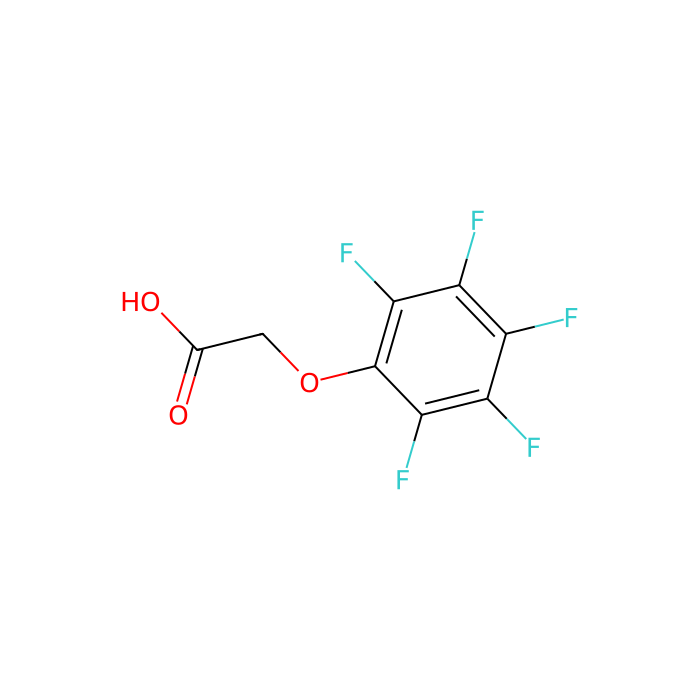
Pentafluorophenoxyacetic acid is an electron-deficient aryl ether bearing a terminal carboxylic acid, combining a perfluoroaryl ring (C6F5–O–) with an oxyacetic acid side chain (–CH2–CO2H).
Item-specific (from Product Data)
CAS: 14892-14-9
SKU: P160589
InChIKey: 340051 (as provided)
Storage: Room temperature; shipped under normal conditions
Research Use: For research use only
Literature/computed (for reference only; not item specifications)
Molecular formula (computed): C8H3F5O3
Molecular weight (computed): ~242.10 g/mol
Preferred IUPAC name (literature): 2-(pentafluorophenoxy)acetic acid
Electronic characteristics: The pentafluorophenyl ring is strongly electron-withdrawing, activating the ring toward nucleophilic aromatic substitution (SNAr), with positions para and ortho to the ether oxygen typically most susceptible.
2D layout in words: a benzene ring whose five hydrogens are replaced by fluorine atoms is connected via an ether oxygen to a methylene (–CH2–) that links to a terminal carboxylic acid (–CO2H). No stereocenters are present.
Synthetic Utility
Functional group handles
Carboxylic acid: convertible to amides, esters, acid chlorides, and anhydrides; amenable to coupling reagents (HATU, EDC, DIC) or activation (SOCl2, (COCl)2).
Perfluoroaryl ether: highly activated toward SNAr with hard or soft nucleophiles; provides orthogonal reactivity to the acid function.
Retrosynthetic value (literature/general)
Serves as a linchpin to append the C6F5–O– motif to diverse scaffolds via amide formation while retaining the capacity for later ring diversification by SNAr.
Useful as a 19F-NMR tag: downstream intermediates and products remain easily traceable, aiding purification and reaction monitoring.
Typical transformations and named methods
Steglich esterification (DCC/DMAP) to protect or derivatize the acid prior to base-intensive SNAr steps.
HATU- or EDC-mediated amidation to furnish amide-linked libraries.
SNAr on the aryl fluoride positions using alkoxides, thiolates, amines, or malonate enolates; Cs2CO3/K2CO3 in DMF/DMSO/NMP are common bases/solvents.
One-pot sequences: activate acid (e.g., as mixed anhydride), couple to amine alcohols, then diversify the ring in situ or in a telescoped fashion.
Practical tips
If competitive O- vs N-alkylation or undesired esterification is a concern during SNAr with alcohol/amine nucleophiles, temporarily protect the acid or employ phase-transfer/base selection to favor desired pathways.
Monitor progress by 19F NMR; distinct multiplicities/shifts report on substitution patterns.
Target Specificity
This product is a small-molecule building block and does not possess biological target specificity like antibodies, enzymes, or ligands.
Item-specific data required for target/antigen, clone, isotype, or species reactivity are Not applicable for this compound.
For applications involving conjugation to biomolecules, any “specificity” will derive from the biomolecule or appended pharmacophore, not from pentafluorophenoxyacetic acid itself.
We use cookies to ensure the website functions properly and, where permitted, to improve your experience. You can manage your preferences at any time in Settings. Learn more in our Cookie Policy.
Shall we send you a message when we have discounts available?
Remind me later
Thank you! Please check your email inbox to confirm.
Products are supplied to verified businesses, institutions, and qualified professionals for research and development use only. Not for use in humans, animals, diagnosis, or therapy.

 I2004001