GRADE & PURITYMoligand™?Moligand™ — Aladdin's line of ligands and bioactive small molecules. Use for receptor, pathway, and binding studies needing defined small-molecule tools.10 mM in DMSO
Moligand™, 10 mM in DMSO Moligand™ for sensitive chromatographic and analytical workflows requiring minimal baseline interference.
🌡
Storage & shipping
Store at -80°C Ships Dry ice packs + Cold packs Check lot-specific COA for exact specifications.
📋
Quality documents
SDS, COA, datasheet, and spec sheet available for download. Lot-specific COA accessible via lot number lookup.
📚
Literature proof
Cited in 0 peer-reviewed publications across chromatography, organic synthesis, and cross-coupling reactions.
Vue d’ensemble
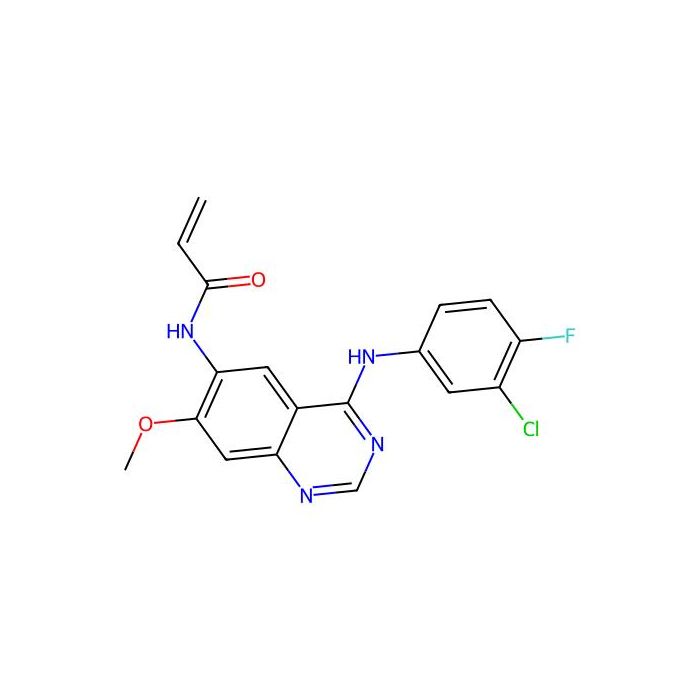
PF-6274484 is a potent EGFR inhibitor with K i s of 0.14 nM and 0.18 nM for EGFR-L858R/T790M and WT EGFR , respectively. PF-6274484 inhibits EGFR-L858R/T790M autophosphorylation in H1975 tumor cells and EGFR WT in A549 tumor cells with IC 50 s of 6.6 and 5.8 nM, respectively.
Specifications
Spécifications et pureté
Moligand™, 10 mM in DMSO
Conditions de stockage de stockage
Store at -80°C
Expédié en
Dry ice packs + Cold packs
Ce produit nécessite l'expédition en chaîne froide. Les services terrestres et autres services économiques ne sont pas disponibles.
Certificats (CoA, COO, BSE/TSE et tableau d'analyse)
C of A & Other Certificates(BSE/TSE, COO):
Analytical Chart:
Calculateurs de solution
Molarity Calculator
Determine the necessary mass, volume, or concentration for preparing a solution.
Dilution Calculator
Determine the dilution needed to prepare a stock solution.
Reconstitution Calculator
Avis
Avis des clients
Application Protocols
No tested applications, recommended dilutions, or positive control conditions are provided for this item in the product data.
Tested applications: Not specified for this item; refer to CoA/Spec Sheet.
Recommended assay concentrations/dilutions: Not specified for this item; refer to CoA/Spec Sheet.
Positive controls/standards: Not specified for this item; refer to CoA/Spec Sheet.
Users should develop and validate protocols appropriate to their assay platform and consult the SDS/CoA for any handling notes.
Biological Roles
Item-specific biological target, mechanism of action, and pathway engagement for PF-6274484 are not provided in this listing.
General context for small-molecule screening ligands (literature/practice):
Such compounds are investigated as potential modulators of enzymes, GPCRs, ion channels, transporters, or protein–protein interactions. Definitive target annotation requires experimental validation (biochemical/cellular assays, and often biophysical binding).
Orthogonal assays (thermal shift, SPR/MST, CETSA) help distinguish direct binding from downstream or off-target effects.
Counter-screening against common assay interference mechanisms (redox cycling, fluorescence quenching, colloidal aggregation) is recommended to confirm specificity of observed activity.
Early ADME checks—solubility, permeability (PAMPA/Caco-2), microsomal stability, and plasma protein binding—aid in interpreting cellular potency versus biochemical potency.
Caution:
Without item-specific data, no functional claims can be made about this compound’s biological role. Users should consult the CoA/spec sheet and any primary literature associated with CAS 1035638-91-5 or PubChem CID 74766099 for target information and use it strictly for research purposes only.
Buffer Applications
This product is a small-molecule test article, not a buffering agent; consequently, it is not used to set or maintain pH.
Practical handling in buffered systems (general guidance):
Prepare a concentrated stock in DMSO (or another compatible organic solvent) and dilute into assay buffer to a low final organic percentage (commonly 0.1–0.5% v/v), ensuring a matched vehicle control.
Pre-warm buffer to assay temperature and add compound last with thorough mixing to avoid local supersaturation and precipitation.
If the compound is ionizable (unknown for this item), solubility may vary with pH; a brief pH–solubility screen (e.g., pH 5.5, 7.4, 8.0) can be informative.
For buffer formulation details (HEPES, PBS, Tris), see standard lab references; these are not specific to this compound.
Green Alternatives
Because PF-6274484 is used primarily as a test article, “green alternatives” considerations focus on carrier solvents and assay media rather than replacing the compound itself.
Greener carrier options (general guidance):
Prefer aqueous buffer with minimal DMSO (≤0.1–0.5% v/v) when compatible with solubility and assay performance.
Ethanol or isopropanol (biobased grades where available) can substitute for DMF/NMP for moderately lipophilic compounds, but verify assay tolerance.
Consider PEG 300/400 + water cosolvent systems for preformulation screening when DMSO use must be minimized (check viscosity/assay impact).
Comparison (general; not item-specific):
DMSO: Standard for HTS; low vapor pressure; acceptable at low %; fossil-derived.
Ethanol (bio-ethanol): Renewable, readily biodegradable; volatility may affect dosing precision.
DMF/NMP: Powerful solvents but less preferred due to reproductive toxicity classifications; avoid where possible in bioassays.
Operational green practices:
Use miniaturized assay formats (384/1536-well) to reduce solvent consumption.
Centralize solvent recycling (where permitted) and segregate halogenated from non-halogenated waste.
Validate low-DMSO protocols early to reduce reoptimization later.
Note: These are general, literature-based recommendations for solvent selection in screening. Item-specific solubility and compatibility must be confirmed empirically.
Pharmaceutical Uses
No pharmacopeial status, excipient role, or formulation use is provided for this item. PF-6274484 is supplied strictly for research use only and is intended for discovery screening and chemical biology.
General discovery-related uses (non-clinical, literature/practice):
Reference/test article in in vitro and ex vivo assays to explore SAR, target engagement, and pathway modulation.
Potential inclusion in early preformulation screenings (solubility, salt/cocrystal exploration) to inform medicinal chemistry, when justified by biological data.
Restrictions:
Not for human or veterinary use. No clinical, diagnostic, or therapeutic claims are made or implied for this product.
For any regulated development work, obtain and retain the CoA and SDS and perform independent qualification according to institutional SOPs.
Physical Properties
Item-specific physico-chemical data are not disclosed in this listing.
Appearance: Not specified for this item; refer to CoA/Spec Sheet.
Molecular weight: Not specified for this item; refer to CoA/Spec Sheet.
Molecular formula: Not specified for this item; refer to CoA/Spec Sheet.
Melting point: Not specified for this item; refer to CoA/Spec Sheet.
Boiling point: Not specified for this item; refer to CoA/Spec Sheet.
Density: Not specified for this item; refer to CoA/Spec Sheet.
Refractive index (if liquid): Not specified for this item; refer to CoA/Spec Sheet.
Partition coefficient (logP/logD): Not specified for this item; refer to CoA/Spec Sheet.
pKa(s): Not specified for this item; refer to CoA/Spec Sheet.
Aqueous and organic solubility: Not specified for this item; refer to CoA/Spec Sheet.
General handling guidance (literature/practice, not item-specific):
Small-molecule screening compounds are commonly formulated as 10–50 mM DMSO stocks for storage and assay use; verify actual solubility experimentally.
If solubility is uncertain, perform a micro-scale solubility screen across DMSO, DMF, ethanol, and aqueous buffer with co-solvent (literature practice). Visual inspection plus UHPLC can confirm absence of precipitation.
Hygroscopicity, polymorphism, or solvates may affect apparent melting point or solubility; confirm by DSC/TGA and PXRD if your application is sensitive.
Always defer to the product’s CoA/specification and SDS for authoritative, item-specific physical property and handling information.
Quality and Grades
Grade/Purity: Moligand™
What Moligand™ signifies (general description of grade):
Moligand items are intended for discovery screening, target validation, and chemical biology workflows where compound identity and chromatographic purity are critical. Typical QC for such libraries includes HPLC/UPLC purity assessment and identity confirmation by MS and/or NMR; specific tests and acceptance criteria are batch-dependent and will be listed on the CoA (general grade description; not item-specific specifications).
Item-specific notes:
Stated grade: Moligand. No numerical purity, residual solvent, metal content, or water content is provided in this listing. Not specified for this item; refer to CoA/Spec Sheet.
Stabilizers/inhibitors: Not specified for this item; refer to CoA/Spec Sheet.
Implications for use:
The Moligand designation indicates suitability for HTS/SAR where consistent purity and identity are essential. For bioassays sensitive to fluorescent/UV background or impurities, request the latest CoA to verify purity method (UV, ELSD) and wavelength profile.
If the compound will be used as a reference standard or for quantitative bioanalysis, users should confirm lot-specific purity, water content, and counter-ions (if any), and consider secondary drying or desalting where appropriate based on CoA.
Documentation:
For regulatory or GLP-adjacent use in discovery, retain CoA, SDS, and any spectral data provided with the shipment to support data integrity and traceability.
Reaction and Applications
Primary use case: PF-6274484 is offered as a research screening ligand for discovery biology and medicinal chemistry support, rather than as a synthetic reagent or solvent.
Applicable research applications (general guidance for screening compounds):
Biochemical assays: Evaluate modulation of enzyme or receptor activity in vitro; establish IC50/EC50 via dose–response curves.
Cell-based assays: Assess pathway engagement, phenotypic outcomes, and cytotoxicity windows. Maintain consistent carrier solvent (e.g., 0.1% DMSO) across wells.
Target validation and tool compound benchmarking: Compare activity profiles against in-house or literature reference ligands under matched assay conditions.
ADME profiling: Solubility, permeability, microsomal stability, and plasma protein binding to contextualize biological readouts (literature/practice).
Not typically applicable:
This item is not commonly used as a reagent for named organic transformations (e.g., cross-coupling, reductions). For such chemistry, consult building blocks and reagents in the appropriate catalog sections.
Practical tips:
Prepare concentrated DMSO stocks (e.g., 10 mM) and aliquot to avoid freeze–thaw.
Confirm absence of aggregation (detergent controls, DLS, or counter-screens) to avoid false positives in biochemical assays (literature guidance).
Include orthogonal assay formats (biophysical binding such as DSF, SPR, or MST) where feasible to substantiate MOA.
Reaction Conditions
This product is not positioned as a reagent for preparative organic synthesis; therefore, named-reaction conditions are not applicable.
General conditions relevant to handling as a test article (not item-specific):
Stock solutions: Often prepared at 10–50 mM in anhydrous DMSO. Ensure complete dissolution by vortexing and brief sonication if needed. Filter if particulate remains (0.2 µm PTFE).
Stability checks: Assess stability in stock and assay media by LC–MS or UPLC at relevant time points (e.g., 0, 4, 24 h) at room temperature and at 37 °C. Protect from light if chromophores are suspected.
Adsorption/precipitation: Use low-binding plastics or silanized glass for low-concentration solutions; verify absence of precipitation after dilution into buffer.
If employing PF-6274484 as a synthetic substrate (not typical):
Consult the structural information to evaluate sensitivity to base/acid, redox conditions, or metal catalysts before attempting transformations. Without structure, no specific temperature, solvent, or catalyst guidance can be provided.
Always verify any working conditions experimentally and document outcomes in your ELN for reproducibility.
Safety and Handling
Safety data specific to this item are not provided in the listing and may vary with batch and form. Treat as a laboratory research chemical.
GHS and hazard data (item-specific):
Signal word: Not specified for this item; refer to SDS.
H-statements: Not specified for this item; refer to SDS.
GHS classification and pictograms: Not specified for this item; refer to SDS.
General laboratory precautions (good practice; not item-specific):
Use in a chemical fume hood. Avoid inhalation, ingestion, and skin/eye contact.
Wear appropriate PPE: lab coat, safety glasses, and gloves compatible with organic chemicals (e.g., nitrile). Change gloves frequently when working with DMSO solutions due to skin permeation potential of DMSO.
Avoid contact with strong oxidizers and strong acids/bases unless compatibility is known.
In case of skin/eye contact: Rinse with water for at least 15 minutes; remove contaminated clothing. Seek medical attention as needed.
Ingestion/inhalation: Move to fresh air, rinse mouth; obtain medical attention.
Spill response: Absorb with inert material (vermiculite, sand), collect for disposal as organic hazardous waste.
Storage and stability:
Follow item storage: Store at −80 °C (per Product Data). Keep container tightly closed, desiccated, and protected from light. Minimize freeze–thaw by aliquoting DMSO stocks.
Always consult the product Safety Data Sheet (SDS) for authoritative hazard classification and emergency measures.
Solvent Selection
PF-6274484 is supplied as a research screening compound. Without item-specific solubility data, selection of solvent should be guided by a small-scale solubility screen.
General solvent guidance for small-molecule libraries (literature/practice):
Primary stock solvent: DMSO is commonly used due to broad solvating power and compatibility with biochemical and cell-based assays (typically ≤0.1–1% v/v final in assay).
Secondary options: DMF and NMP provide strong solvation but may have higher cytotoxicity; ethanol or isopropanol can be used for less polar/neutral scaffolds with good assay compatibility at ≤0.5% v/v.
Aqueous systems: Use co-solvent (DMSO or ethanol) and/or pH adjustment if ionizable groups are present. Employ surfactants (e.g., 0.01–0.05% Tween 80) only if assay-tolerated to mitigate aggregation/precipitation.
Comparison (general; not item-specific):
DMSO: Broad solubility, assay-friendly at low %, hygroscopic; may carry test articles across skin.
DMF: Strong solvent; higher toxicity; less preferred in biological assays.
Ethanol: Volatile, good miscibility with water, limited for very lipophilic compounds.
Practical tips:
Perform a tiered solubility test at room temperature and 37 °C. Verify clarity over 24 h.
Filter (0.2 µm PTFE) if particulate is observed; avoid adsorption-prone filters for low-concentration working solutions.
Record exact solvent lot and composition in ELN for assay reproducibility.
Storage and Reconstitution
Storage (item-specific):
Store at −80 °C (per Product Data). Keep tightly sealed, desiccated, and protected from light. Minimize exposure to ambient humidity and temperature during handling.
Shipped on dry ice packs + cold packs to maintain low temperature during transit (per Product Data).
Reconstitution (general laboratory guidance; not item-specific specifications):
Allow vial to equilibrate to room temperature in a desiccator before opening to prevent moisture condensation.
Prepare a concentrated stock solution in anhydrous DMSO (commonly 10–50 mM, as solubility permits). Vortex and, if required, briefly sonicate to ensure complete dissolution.
Sterile-filter stock (0.2 µm PTFE) if solutions will be used in cell culture.
Aliquot stocks into low-bind tubes to avoid repeated freeze–thaw cycling. Store aliquots at −80 °C. Track freeze–thaw count in ELN.
For aqueous working solutions, dilute into pre-warmed assay buffer, maintaining a constant final DMSO percentage across controls and treatments. Inspect for precipitation; discard if turbidity appears.
Stability notes:
Item-specific shelf life and solution stability are Not specified for this item; refer to CoA/Spec Sheet. Verify stability by LC–MS/UPLC in your matrix of interest prior to critical experiments.
Research use only.
Structure and Identity
PF-6274484 is offered as an individual member of Aladdin’s Moligand small‑molecule library for discovery screening and chemical biology.
Molecular formula: Not specified for this item; refer to CoA/Spec Sheet.
Molecular weight: Not specified for this item; refer to CoA/Spec Sheet.
SMILES: Not specified for this item; refer to CoA/Spec Sheet.
InChIKey: Not specified for this item; refer to CoA/Spec Sheet.
Structural features (general notes):
Specific ring systems, heteroatoms, stereochemistry, and functional groups are not disclosed in this listing. For definitive structure, consult the certificate of analysis (CoA), specification sheet, or primary literature associated with the CAS/CID above.
For informatics workflows, use the CAS or PubChem CID to retrieve canonical SMILES/InChI for registration in ELNs, screening databases, or QSAR pipelines (literature/registry guidance).
2D structure (descriptive):
A text description of the 2D structure cannot be provided without the disclosed structural formula. Please refer to the PubChem record (CID 74766099) or the item’s CoA for the exact atom connectivity and stereochemical annotations.
Synthetic Utility
PF-6274484 is provided as a finished small-molecule screening compound and is not primarily intended as a synthetic reagent or building block.
When chemists choose to derivatize a screening hit (general medicinal chemistry practice; not item-specific):
Late-stage diversification may be pursued to probe SAR, using cross-coupling (e.g., Suzuki–Miyaura, Buchwald–Hartwig) or amide coupling if suitable vectors are present in the scaffold.
If heteroaromatic cores are involved (unknown for this item), Minisci-type C–H functionalization or directed metalation strategies can be used to access analog series.
Protecting-group strategies and orthogonal deprotections should be planned around sensitive heterocycles or basic centers to maintain integrity during diversification.
Note:
Because the exact functional groups of PF-6274484 are not disclosed here, no specific reaction compatibility or reactivity guidance can be given. Users interested in analog synthesis should consult the structural information via the CoA or public databases (CAS 1035638-91-5; CID 74766099) to design appropriate synthetic routes.
Target Specificity
Item-specific target, selectivity profile, and potency data are not provided for this product.
Target/antigen: Not specified for this item; refer to CoA/Spec Sheet.
Species reactivity: Not specified for this item; refer to CoA/Spec Sheet.
Mode of action/biochemical class: Not specified for this item; refer to CoA/Spec Sheet.
Notes:
For definitive target specificity, consult primary literature associated with CAS 1035638-91-5 or the PubChem entry (CID 74766099) and validate under your assay conditions using orthogonal methods. Use solely for research.
Need help choosing the grade?
Our grade selection guide covers purity, stabilizer status, and application suitability for all variants in our catalog.
We use cookies to ensure the website functions properly and, where permitted, to improve your experience. You can manage your preferences at any time in Settings. Learn more in our Cookie Policy.
Shall we send you a message when we have discounts available?
Remind me later
Thank you! Please check your email inbox to confirm.
Products are supplied to verified businesses, institutions, and qualified professionals for research and development use only. Not for use in humans, animals, diagnosis, or therapy.