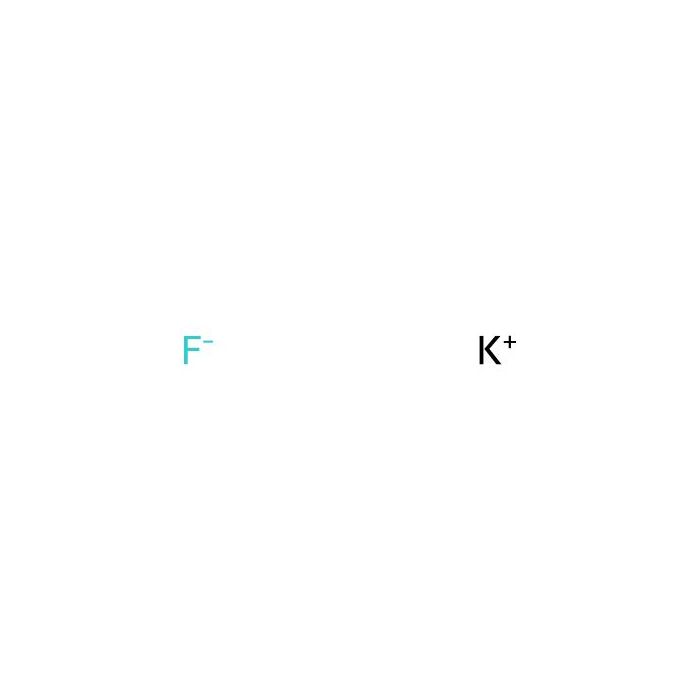
Potassium fluoride - UltraBio™, ≥99.5%(F) , CAS No.7789-23-3

CAS: 7789-23-3 Cat. No.: P755684 Formule: KF Poids moléculaire: 58.1 Beilstein Registry Number: 3902818 Numéro CE: 232-151-5
DISPONIBLE À COMMANDE
QUALITÉ & PURETÉ UltraBio™ ? UltraBio™ — Aladdin's line for molecular-biology applications. Use for nuclease-free, high-consistency reagents across molecular workflows. ≥99.5%(F)
Storage
Room temperature
Shipped In
FedEx DG Service
★
Taille
USA
Allemagne (EU)*
Prix
Qté
100g
P755684-100g
Sur commande · 8–12 semaines
156,90$US
500g
P755684-500g
Sur commande · 8–12 semaines
675,90$US
Enter a quantity for the sizes you want to add.
🧪
Pourquoi cette qualité

UltraBio™, ≥99.5%(F) UltraBio™ pour les flux de travail chromatographiques et analytiques sensibles nécessitant une interférence de ligne de base minimale.

🌡

Stockage & expédition

Room temperature Expédition FedEx DG Service. Consultez le COA spécifique au lot pour les spécifications exactes.

📋

Documents qualité

SDS, COA, fiche technique et fiche de spécifications disponibles au téléchargement. COA spécifique au lot accessible via la recherche par numéro de lot.

📚

Preuve documentaire

Cité dans 181 publications à comité de lecture couvrant la chromatographie, la synthèse organique et les réactions de couplage croisé.

Vue d’ensemble

Potassium fluoride may be used in thermodynamic analysis of DNA-ligand binding and studies on the structural stability of proteins and peptides.
A versatile fluoride ion source used in a study of ion-specific swelling and de-swelling of ampholytic polymer gels, in the room temperature oxidation of noble metals in HF, and in the measurement of electronic polarizabilities of ions in polymers of alkali halides.

Spécifications

Spécifications et pureté
UltraBio™, ≥99.5%(F)
Conditions de stockage de stockage
Room temperature
Expédié en
FedEx DG Service
Grade
UltraBio™
Pureté
≥99.5%(F)
Noms et identifiants
PH
7.0-8.5 (25 °C, 1 M in H 2 O)
Sourires canoniques
[F-].[K+]
IUPAC Name
potassium;fluoride
InChIKey
NROKBHXJSPEDAR-UHFFFAOYSA-M
INCHI
1S/FH.K/h1H;/q;+1/p-1
Isomères SMILES
[F-].[K+]
WGK Allemagne
1
Numéro ONU
1812
Groupe d'emballage
III
Poids moléculaire
58.1
Beilstein
3902818

Documentation

📋 Fiche de données de sécurité (FDS)

Document complet couvrant les dangers, la manipulation, le stockage et la conformité réglementaire.

<<<<<<< HEAD Télécharger la SDS → ======= Télécharger la SDS → >>>>>>> release248-p3

✅ Certificat d'analyse (COA)

Données qualité spécifiques au lot. Saisissez votre numéro de lot pour récupérer le COA exact.

Rechercher le COA →

📊 Fiche technique

Résumé de référence rapide des spécifications et applications du produit.

Voir la fiche technique →

🔬 Fiche de spécifications

Attributs de qualité complets et critères d'acceptation pour cette qualité.

Voir la fiche de spécifications →

Données avancées

Taxonomic Classification

Taxonomy Tree

KingdomInorganic compounds
SuperclassMixed metal/non-metal compounds
ClasseAlkali metal salts
SubclassAlkali metal fluorides
Intermediate Tree Nodes Not available
Direct ParentAlkali metal fluorides
Alternative Parents Inorganic salts  
Molecular FrameworkNot available
Substituents Alkali metal fluoride - Inorganic salt
DescriptionThis compound belongs to the class of inorganic compounds known as alkali metal fluorides. These are inorganic compounds in which the largest halogen atom is fluorine, and the heaviest metal atom is an alkali metal.
External Descriptors fluoride salt - potassium salt
Structure 3D
Modèle de structure chimique interactif


Certificats (CoA, COO, BSE/TSE et tableau d'analyse)
C of A & Other Certificates(BSE/TSE, COO):
Analytical Chart:
Propriétés chimiques et physiques
SolubilitéH 2 O: 1 M at 20 °C, clear, colorless
Point d'ébullition (°C)1505°C
Point de fusion (°C)858°C
Poids moléculaire58.096 g/mol
XLogP3
Hydrogen Bond Donor Count0
Hydrogen Bond Acceptor Count1
Rotatable Bond Count0
Exact Mass57.9621 Da
Monoisotopic Mass57.9621 Da
Topological Polar Surface Area0.000 Ų
Heavy Atom Count2
Formal Charge0
Complexity2.000
Isotope Atom Count0
Defined Atom Stereocenter Count0
Undefined Atom Stereocenter Count0
Defined Bond Stereocenter Count0
Undefined Bond Stereocenter Count0
The total count of all stereochemical bonds0
Covalently-Bonded Unit Count2
FAQ et articles
UltraBio™: Defining Excellence in Molecular Biology Applications
One Atom Can Change a Drug’s Fate: Atom-Level Knobs and a Functional-Group Toolbox for Medicinal Chemistry (Methyl / Halogen Bonding / 3D Building Blocks / Late-Stage Fluorination + Product-Selection Tables)
Late-Stage Fluorination Toolbox: “Minimally Invasive Upgrades” for Lead Candidates: Four “Fluorine Knobs” → Two major routes (electrophilic vs nucleophilic) → An ¹⁸F-PET tracer branch → Selection navigation & representative product list
OSF/ASF Dual-Channel Toolbox: Divergent Reactions of Four-Membered Ring Sulfonyl Fluorides, Condition “Knobs,” and Selection Navigation
Selection of Common Research Salts: A Task Map for Alkali Metal Salts & Alkaline Earth Metal Salts (with Product Tables 1–6)
Perovskite PV/PeLED Precursor Guide: Selecting Metal Halide Salts, Key Conditions, and Reproducible Performance (including Product Tables 1–4 and a Selection Navigation Guide)
Systematic Anticoagulant Selection Strategy
Choosing Boron Sources to Make Reactions Robust: How Boronic Acids, Boronate Esters, BF₃K Salts, and MIDA Improve Suzuki–Miyaura Start-Up and Scale-Up Reproducibility (with Product Tables 1–5)
How to Make the Suzuki–Miyaura Reaction Robust: Pinpoint the Bottleneck and Lock in a Reproducible Operating Window (with Selection Navigation and Product Tables 1–5)
Selection Logic for the Teoc Amino Protecting Group: From Fluoride-Triggered Deprotection to Orthogonal Protecting-Group Design
Experimental Judgment for TFPN in Carboxylic Acid Activation: Suitable Scenarios, Intermediate Distribution, and Nucleophile Compatibility
Experimental Selection Logic for Phase-Transfer Catalysts: Choosing Catalysts by Phase-State System, Source of Anionic Species, and Reaction Task
Design Logic of Fluorinated 3,3-Disubstituted Oxetane Building Blocks: Structural Construction and Modulation of Amine Basicity, Lipophilicity, and Metabolic Stability
Selectivity Mechanism of the Triple Aryne–Tetrazine Cascade Reaction: Reaction-Pathway Switching and Intermediate Transformations
Citations of This Product
Calculateurs de solution
Avis

Avis des clients

Souhaitez-vous que nous vous envoyions un message lorsque des réductions seront disponibles?

Me rappeler plus tard

Merci ! Veuillez vérifier votre boîte de réception e-mail pour confirmer.

Oups ! Les notifications sont désactivées.