GRADE & PURITYMoligand™?Moligand™ — Aladdin's line of ligands and bioactive small molecules. Use for receptor, pathway, and binding studies needing defined small-molecule tools.10 mM in DMSO
Certificats (CoA, COO, BSE/TSE et tableau d'analyse)
C of A & Other Certificates(BSE/TSE, COO):
Analytical Chart:
Calculateurs de solution
Molarity Calculator
Determine the necessary mass, volume, or concentration for preparing a solution.
Dilution Calculator
Determine the dilution needed to prepare a stock solution.
Reconstitution Calculator
Avis
Avis des clients
Application Protocols
The following are generalized, literature-informed protocols for small-molecule riboswitch ligands and are not validated, item-specific methods. Optimize for your system.
DMSO stock and working solution
Dissolve Ribocil-C in anhydrous DMSO to 10–50 mM. Store aliquots at –80°C.
For assays, dilute into buffer or media to desired final concentration with 0.1–1% DMSO. Include vehicle controls.
In vitro riboswitch binding (fluorescence or SPR)
Buffer: 10–50 mM HEPES or Tris pH 7.4–7.6, 50–150 mM KCl/NaCl, 1–5 mM MgCl2, 0.005–0.05% Tween-20 if needed.
RNA: refold purified riboswitch aptamer by heating to 70°C for 3 min and slow cooling; add Mg2+ during refolding (literature/generic).
Titrate ligand (e.g., 0.01–100 µM) and record response. Match DMSO across samples. Confirm specificity by FMN competition or mutant aptamer controls.
Culture: grow to mid-log phase, dilute into fresh media.
Treat with serial dilutions of Ribocil-C (e.g., 0.1–50 µM, vehicle-matched).
Incubate 4–16 h at 30–37°C; read reporter (e.g., fluorescence/luminescence) and normalize to OD600.
Stability checks
Assess stock integrity by LC–MS/HPLC at baseline and after storage; avoid >3–5 freeze–thaw cycles by aliquoting.
Biological Roles
Context from literature on the Ribocil chemotype (general, non-clinical):
Molecular target: FMN (flavin mononucleotide) riboswitch aptamer domain in bacteria. Binding of small molecules to the aptamer can mimic FMN, stabilizing a conformation that downregulates riboflavin biosynthetic genes.
Pathway: Riboflavin (vitamin B2) biosynthesis and flavin cofactor homeostasis. Modulation of this pathway affects cellular redox biochemistry dependent on FAD/FMN.
Mechanistic notes: Riboswitches are structured RNAs that bind metabolites to regulate gene expression via transcription attenuation, translation initiation control, or alternative splicing (organism-dependent). Synthetic ligands like Ribocil-class molecules can bias these regulatory outcomes.
Research utility: Chemical probes of RNA structure–function relationships, RNA–ligand recognition principles, evolutionary conservation of riboswitch architecture, and the cellular consequences of perturbing flavin metabolism.
Important: No medical or clinical claims are made for this product. All uses are for research and laboratory investigations into RNA regulatory biology and small-molecule–RNA interactions.
Buffer Applications
Ribocil-C is not a buffering reagent. However, buffer choice is critical for riboswitch binding and functional assays with this compound (general guidance):
RNA binding assays: Use Mg2+-containing buffers to stabilize riboswitch tertiary structure (e.g., 10–50 mM HEPES or Tris, pH 7.4–7.6; 50–150 mM KCl/NaCl; 1–5 mM MgCl2). Include RNase inhibitors as needed.
Fluorescence/biophysical readouts: For ITC, avoid high phosphate that can chelate Mg2+ or alter heats of dilution; for SPR, maintain low surfactant (e.g., 0.005–0.05% Tween-20) to reduce nonspecific interactions.
DMSO matching: Match DMSO concentration in sample and reference channels (e.g., 0.5–1.0% v/v) to ensure baseline stability in SPR or DSF.
Cell-based bacterial assays: Use standard media (e.g., M9 minimal or Mueller–Hinton) supplemented as required; maintain consistent vehicle content across conditions.
These parameters are general literature recommendations for RNA–ligand studies and are not item-specific specifications. Optimize for your target RNA construct and assay platform.
Green Alternatives
Green chemistry considerations primarily concern the choice of solvent system for preparing and using Ribocil-C, since the compound itself is a fixed structure.
Prefer greener solvents for workup and analytics: where compatible with solubility and assays, consider ethanol (bio-based) or water-rich buffers over DMF/DMF. However, many small molecules require DMSO for stock solutions; DMSO, while not renewable, has relatively low volatility and favorable worker exposure characteristics compared with many chlorinated solvents.
Comparison (general):
DMSO vs DMF: DMSO is less volatile and often more acceptable for biological assays; DMF is more problematic from an exposure standpoint.
Ethanol vs acetonitrile: ethanol is greener but can perturb biological assays more strongly at comparable percentages; acetonitrile is often required for LC analytics.
Trade-offs:
Biological compatibility and compound solubility generally dictate solvent choice. Prioritize minimal organic cosolvent percentages and use micro-scale formats to reduce waste. Employ LC methods with reduced solvent consumption (short columns, UHPLC) and consider aqueous-normal phase or supercritical CO2 for purification where feasible.
Pharmaceutical Uses
This product is supplied strictly for research use only. No therapeutic, diagnostic, or clinical uses are claimed or supported.
Relevant non-clinical, preformulation-style considerations for researchers using Ribocil-C as a tool compound:
Role: Reference/benchmark ligand for FMN riboswitch-targeted discovery biology, suitable for in vitro and cellular assay system development.
Vehicle/excipient context (research only): DMSO stocks diluted into aqueous media; where needed for in vivo-like modeling in non-clinical systems, solubilization aids such as PEG-400, Captisol, or mild surfactants may be explored within institutional approvals (literature/generic), but such formulations remain research-only.
Regulatory status: Not a pharmacopeial substance. No monograph.
Analytical support: Develop stability-indicating HPLC/LC–MS methods for tracking compound integrity during storage and dosing in research models.
All uses must remain in laboratory research settings; this product is not manufactured to GMP and is not intended for human or veterinary applications.
Physical Properties
Item-specific physicochemical constants are not provided in the product data.
Appearance: Not specified for this item; refer to CoA/Spec Sheet.
Molecular weight: Not specified for this item; refer to CoA/Spec Sheet.
Molecular formula: Not specified for this item; refer to CoA/Spec Sheet.
Melting point: Not specified for this item; refer to CoA/Spec Sheet.
Boiling point: Not applicable/Not typically reported for complex bioactive small molecules; refer to CoA/Spec Sheet.
Density: Not specified for this item; refer to CoA/Spec Sheet.
Solubility: Not specified for this item; refer to CoA/Spec Sheet. Practical note (general): small-molecule screening ligands are commonly prepared as DMSO stock solutions (e.g., 10–50 mM) and diluted into aqueous assay buffers containing 0.1–1% DMSO (literature/generic practice).
LogP/logD, pKa, refractive index, UV cutoff: Not specified for this item; consult literature or CoA if available.
General handling implications (literature/generic):
Compounds intended for riboswitch or enzyme-binding studies are often light-sensitive or moisture-sensitive depending on functional groups; protect from light and moisture until specifications are confirmed.
Use analytical techniques (HPLC/LC–MS) to verify concentration and integrity of stock solutions during long-term storage.
Quality and Grades
Grade/Purity: Moligand™ (as listed). While no numeric purity or stabilizer content is specified for this item, Moligand™ typically denotes screening-grade small molecules intended for discovery biology and medicinal chemistry workflows, emphasizing identity confirmation and suitability for high-throughput or focused assays.
What this means in practice (general guidance):
Identity/quality control: Such grades are commonly supported by LC–MS and/or NMR verification and a defined purity threshold appropriate for screening; exact methods and acceptance criteria should be confirmed on the CoA for this SKU.
Chromatographic suitability: If using in biochemical or biophysical assays (SPR, MST, DSF), confirm purity and absence of interfering UV-active impurities by LC–UV or LC–MS to ensure clean binding readouts.
Stabilizers/solvent of delivery: Not specified for this item; refer to CoA/Spec Sheet.
Lot-to-lot consistency: For quantitative SAR or mechanistic studies, record lot/CoA identifiers and verify purity and water content as needed.
Recommended user QC (best practices):
Confirm mass by LC–MS upon receipt, check purity by HPLC (>95% often targeted for detailed biophysical studies; literature/generic), and assess solution stability in DMSO at intended storage conditions.
Reaction and Applications
This product is supplied as a bioactive screening ligand rather than a general-purpose synthetic reagent.
Research applications (literature/general for Ribocil chemotype):
Chemical biology: probe of FMN (flavin mononucleotide) riboswitch function in bacteria to modulate riboflavin biosynthetic gene expression.
Target validation: tool compound for studying riboswitch-mediated transcriptional or translational regulation and the impacts on flavin metabolism.
Assay development: positive control for riboswitch binding assays (e.g., fluorescence, SPR, ITC) and for cellular reporter assays driven by FMN riboswitch elements.
Not typically used in named organic reactions (e.g., cross-couplings/Grignards). If derivatization is required for SAR or tagging, users generally follow medicinal chemistry routes described in the riboswitch ligand literature for related analogs.
Practical tips:
Prepare fresh DMSO stocks or verify integrity by LC–MS after long storage.
Control for assay interference: check for intrinsic fluorescence/absorbance in the detection window, and include detergent/albumin controls as appropriate to mitigate aggregation (literature/generic).
Use appropriate negative controls (vehicle and inactive analogs) and, where possible, FMN competition experiments to confirm riboswitch-relevant engagement.
Reaction Conditions
Not applicable as a traditional synthetic reagent. Ribocil-C is a bioactive ligand used in biochemical and cellular assays rather than in preparative organic reactions.
General conditions relevant to its research use (literature/generic):
Stock preparation: Dissolve in anhydrous DMSO at 10–50 mM; vortex and, if necessary, sonicate briefly to aid dissolution. Filter (0.22 µm) for sterile applications.
Assay dilution: Introduce into aqueous buffers to a final DMSO content typically 0.1–1.0% v/v. Equilibrate with RNA or cells at temperatures suited to the assay (e.g., 25–37°C for biochemical/cellular assays).
Binding studies: For FMN riboswitch constructs, Mg2+ (1–5 mM) is often required; incubation times of 10–60 min are common to reach binding equilibrium (platform-dependent). Always optimize for your specific RNA and detection method.
No expected chemical yields or catalytic conditions are relevant for this product. For any chemical modification work, consult primary synthetic literature for Ribocil congeners.
Safety and Handling
Hazard information is not provided in the product data and may vary with batch and form.
GHS classification: Not specified for this item; consult the SDS.
Signal word / H-statements / Pictograms: Not specified for this item; consult the SDS.
General laboratory safety (defer to SDS for authoritative guidance):
Personal protective equipment: wear lab coat, safety glasses, and suitable chemical-resistant gloves. Handle in a fume hood to avoid inhalation of dust/aerosols.
Avoid ingestion and contact with skin/eyes. Wash thoroughly after handling.
First aid (general): in case of skin or eye contact, rinse with water for at least 15 minutes; remove contaminated clothing. If inhaled, move to fresh air. Seek medical attention if symptoms occur. Refer to SDS for detailed measures.
Incompatibilities: unknown for this specific item; as a precaution, keep away from strong oxidizers/reductants and strong acids/bases until compatibility is known.
Environmental precautions: avoid release to the environment; collect and dispose of waste according to institutional and local regulations.
Special risks: For small-molecule research ligands, thermal decomposition and photodegradation are possible; minimize heat and light exposure. Do not autoclave solutions unless stability is established.
Research use only: not for human or animal diagnostic or therapeutic use.
Solvent Selection
Specific solubility data for Ribocil-C are not provided. For bioactive small molecules, DMSO is the default stock solvent due to broad solvating power and assay compatibility.
Primary stock solvent (general practice): DMSO, with typical stock concentrations 10–50 mM; filter-sterilize if required for sterile assays.
Aqueous dilution: Dilute into assay buffers to a final DMSO content commonly 0.1–1% v/v (check assay tolerance). Include vehicle controls.
Alternative solvents (if needed and compatible): DMF, ethanol, or aqueous buffers containing co-solvents/surfactants (e.g., 0.01–0.05% Tween-20) may aid solubilization; confirm assay compatibility first.
Polarity/miscibility (generic): DMSO is polar aprotic, fully miscible with water; ethanol is protic and broadly miscible; DMF is polar aprotic and water-miscible.
Selection tips:
For RNA riboswitch assays, minimize organic co-solvent to reduce RNA structural perturbation; pre-equilibrate compound and buffer before complex measurements.
For cell-based bacterial growth assays, keep DMSO ≤0.5–1.0% to avoid solvent effects on cells (literature/generic). Validate solubility at working concentrations by visual inspection and light scattering where possible.
Storage and Reconstitution
Storage conditions (as provided): Store at –80°C. Shipments are on dry ice packs + cold packs to maintain low temperature.
Best practices:
Upon receipt: Keep frozen at –80°C. Allow container to equilibrate to room temperature in a desiccator before opening to minimize moisture condensation.
Aliquoting: Prepare small, single-use aliquots (solid or concentrated DMSO stock) to avoid repeated freeze–thaw. Target ≤3–5 freeze–thaw cycles total.
Light and moisture: Protect from light and humidity. Reseal promptly under dry inert gas if feasible, or store with desiccant.
Reconstitution (general guidance for screening compounds):
Solvent: Use anhydrous DMSO to prepare concentrated stock (e.g., 10–50 mM). Confirm complete dissolution visually; gentle warming (≤37°C) and brief sonication can assist if compatible.
Sterile applications: Filter sterilize stock (0.22 µm PTFE) in a sterile hood.
Working solutions: Dilute into assay buffer or media immediately before use; maintain consistent vehicle concentration across all samples and controls.
Stability: Item-specific stability, water content, and impurity limits are not specified for this product; consult the CoA/Spec Sheet and verify by LC–MS/HPLC as needed for critical applications.
Research use only: Not for human or animal use.
Structure and Identity
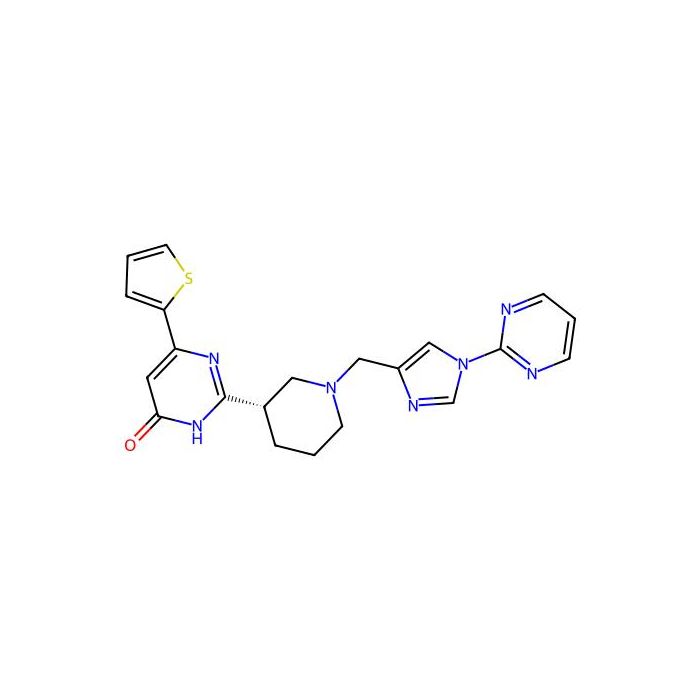
Ribocil-C is a cataloged small-molecule ligand supplied for screening and chemical biology research.
Product name: Ribocil-C (SKU: R1498874)
CAS: 1825355-56-3
PubChem CID: 136981150
Molecular formula: Not specified for this item; refer to CoA/Spec Sheet.
Molecular weight: Not specified for this item; refer to CoA/Spec Sheet.
InChIKey: Not specified for this item; refer to CoA/Spec Sheet.
SMILES: Not specified for this item; refer to CoA/Spec Sheet.
Structural description (general, literature):
Ribocil-class ligands are reported in the literature as synthetic small molecules discovered by phenotypic screening that bind the FMN (flavin mononucleotide) riboswitch in bacteria, modulating riboflavin biosynthesis. “Ribocil-C” denotes a specific congener within this chemotype (literature), typically featuring heteroaromatic and hydrogen-bonding motifs that mimic aspects of FMN recognition by the aptamer domain.
Stereochemistry and detailed ring/functional group features for this exact item are not specified in the provided product data and should be confirmed from the CoA/SDS or primary literature for the exact CAS/CID.
Synthetic Utility
Ribocil-C is provided as a finished small-molecule ligand and is not typically employed as a synthetic reagent or building block.
Potential roles in a synthetic/medchem context (general):
Positive control: Benchmark in SAR campaigns targeting the FMN riboswitch; helps calibrate assay windows and comparative potency.
Derivatization (if pursued by users): Literature on related Ribocil analogs indicates that substitution patterns on the core scaffold can modulate riboswitch binding; however, specific functional handles for this exact item are not provided in the product data. Any semisynthetic modifications should be guided by primary reports and confirmed by full analytical characterization.
Reference standard: May serve as a calibration standard for LC–MS quantitation in cellular uptake or stability studies once purity and extinction coefficients (if used) are established.
Because detailed functional groups are not specified here, no reactivity guidance or named-reaction recommendations are made for this item.
Target Specificity
Item-specific target validation data are not provided in the product data.
Literature context for the Ribocil chemotype (general):
Putative target: FMN (flavin mononucleotide) riboswitch aptamer domain in bacteria. Compounds in this class have been reported to bind the riboswitch and modulate expression of riboflavin biosynthetic genes.
Selectivity considerations: RNA-targeting small molecules may show sequence- and structure-dependent selectivity among riboswitch variants across species; off-target RNA or protein interactions are assay- and chemotype-dependent and should be empirically evaluated.
For this specific SKU (R1498874), no in-house potency, selectivity panel, or off-target data are supplied. Users should establish target engagement with appropriate controls (e.g., FMN competition, mutant riboswitch constructs, orthogonal binding assays) in their own systems.
Foire aux questions
What is Moligand??
Moligand? is one of Aladdin Scientific's premium product lines, formulated for high-purity applications across multiple workflows. Compared to standard grades in the same workflow, Moligand? products typically offer tighter specifications, more rigorous QC, and stronger lot-to-lot consistency.
How should this product be stored?
Store at ?80 °C. Ultra-low temperature storage is required to maintain the specified shelf life.
How is this product shipped?
This product ships frozen with dry ice and cold packs. Unpack on arrival and transfer it to the storage condition stated above; handle dry ice with insulated gloves in a ventilated area.
What are the CAS number, molecular formula and molecular weight?
The CAS Number is 1825355-56-3, the molecular formula is C21H21N7OS, and the molecular weight is 419.5 g/mol.
What documentation is provided?
Available product documentation, including Certificates of Analysis (COA), Safety Data Sheets (SDS), and specification sheets, is shown in the product document area. Document availability and access follow the current site policy.
Need help choosing the grade?
Our grade selection guide covers purity, stabilizer status, and application suitability for all variants in our catalog.
Nous utilisons des cookies pour garantir le bon fonctionnement du site et, lorsque cela est autorisé, pour améliorer votre expérience. Vous pouvez gérer vos préférences à tout moment dans les Paramètres. Pour en savoir plus, consultez notre Politique relative aux cookies.
Souhaitez-vous que nous vous envoyions un message lorsque des réductions seront disponibles?
Me rappeler plus tard
Merci ! Veuillez vérifier votre boîte de réception e-mail pour confirmer.
Products are supplied to verified businesses, institutions, and qualified professionals for research and development use only. Not for use in humans, animals, diagnosis, or therapy.